
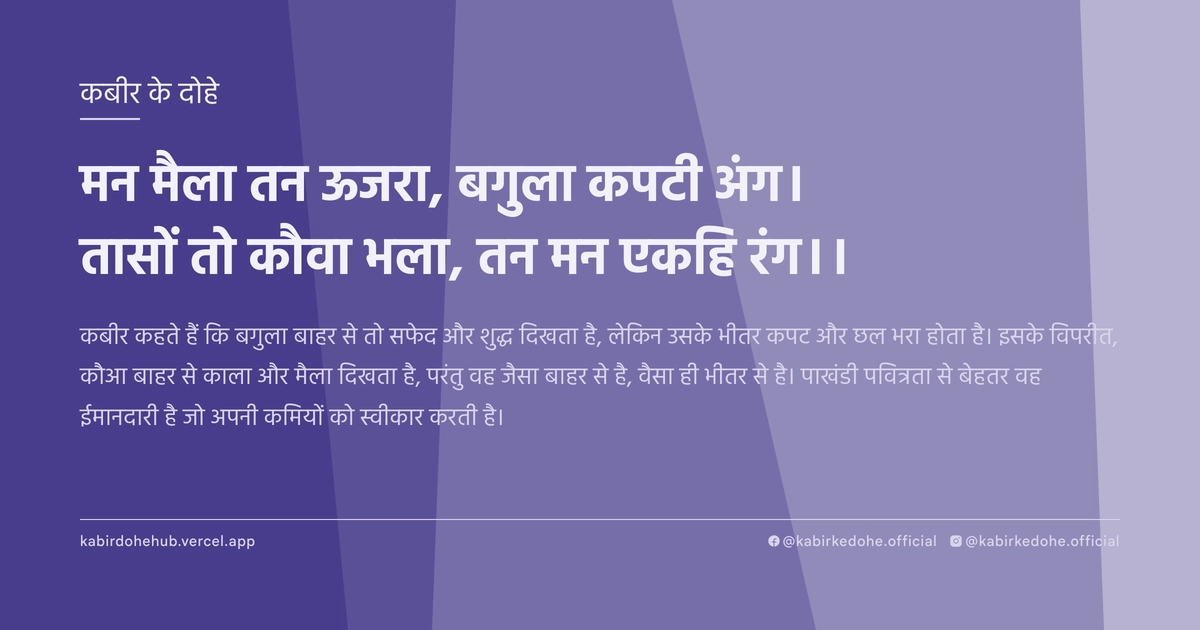
मन मैला तन ऊजरा, बगुला कपटी अंग।
तासों तो कौवा भला, तन मन एकहि रंग।।
Man maila tan ujra, bagula kapati ang. Taason to kauva bhala, tan man ekhi rang.
इस पृष्ठ पर इस कबीर दोहे का अर्थ (meaning), हिंदी व्याख्या और अंग्रेज़ी अनुवाद, दार्शनिक विश्लेषण और व्यावहारिक जीवन सीख दी गई है। यह दोहा निष्ठा (Integrity) विषय से जुड़ा है — Kabir doha meaning and explanation in Hindi and English.
अर्थ (Meaning):
कबीर कहते हैं कि बगुला बाहर से तो सफेद और शुद्ध दिखता है, लेकिन उसके भीतर कपट और छल भरा होता है। इसके विपरीत, कौआ बाहर से काला और मैला दिखता है, परंतु वह जैसा बाहर से है, वैसा ही भीतर से है। पाखंडी पवित्रता से बेहतर वह ईमानदारी है जो अपनी कमियों को स्वीकार करती है।
Kabir observes that the heron appears white and pure externally, yet its heart is filled with deceit and cunning. In contrast, the crow is dark and soiled in appearance, but it possesses a rare integrity—it is the same inside and out. Kabir asserts that honest imperfection is far superior to a fraudulent display of purity.
व्याख्या (Interpretation):
यह दोहा बाहरी दिखावे और आंतरिक वास्तविकता के बीच के गहरे विरोधाभास को दर्शाता है। बगुला यहाँ उन धर्मपरायण लोगों का प्रतीक है जो बाहरी कर्मकांडों, वस्त्रों और तिलक के माध्यम से अपनी पवित्रता का प्रदर्शन करते हैं, जबकि उनका मन वासना और अहंकार से ग्रस्त है। कौआ उस व्यक्ति का प्रतीक है जिसे समाज 'अपवित्र' या 'निम्न' मानता है, लेकिन जिसका अंतर्मन पारदर्शी है। यह निर्गुण भक्ति का सार है, जहाँ ईश्वर रूप या रंग में नहीं, बल्कि सत्य और सरलता में बसता है। माया यहाँ उस सफेद रंग की तरह है जो सत्य को ढंक लेती है। जब साधक अपने 'अहं' को मिटाकर अपनी वास्तविक स्थिति को स्वीकार करता है, तभी वह ब्रह्म के साथ अद्वैत संबंध स्थापित कर सकता है।
This couplet illuminates the profound paradox between external appearance and internal reality. The heron symbolizes the religious hypocrites who utilize rituals, attire, and symbols to project purity while their hearts remain enslaved by lust and ego. The crow represents the individual dismissed by society as 'impure' or 'lowly,' yet who possesses an authentic, transparent soul. This is the essence of Nirgun Bhakti, where the Divine resides not in form or color, but in truth and simplicity. Maya is depicted as the 'white plumage' that masks the underlying truth. Only when a seeker annihilates the ego and accepts their raw state can they realize the non-duality of Atman and Brahman, moving beyond the illusion of perceived holiness.
दार्शनिक विश्लेषण (Philosophical Analysis):
कबीर का यह विचार उनके युग के सामाजिक और धार्मिक पाखंड पर एक तीखा प्रहार है। मध्यकालीन भारत में, जाति और बाहरी प्रतीकों के आधार पर पवित्रता तय की जाती थी। कबीर ने इस व्यवस्था को चुनौती देते हुए कहा कि वास्तविक पवित्रता मन की शुद्धि में है, न कि शरीर के रंग या पहनावे में। यह दृष्टिकोण अद्वैत वेदांत के करीब है, जहाँ यह माना जाता है कि आत्मा का कोई रंग या जाति नहीं होती; वह शुद्ध चेतना है।
सूफीवाद के प्रभाव में, कबीर 'इश्क-ए-हकीकी' (ईश्वरीय प्रेम) की बात करते हैं, जो केवल तभी संभव है जब इंसान अपने मुखौटों को उतार फेंके। बगुले की तरह 'दिखना' एक मानसिक रोग है जिसे 'अहंकार' कहा जाता है। जब व्यक्ति खुद को दूसरों से श्रेष्ठ दिखाने की कोशिश करता है, तो वह सत्य से दूर हो जाता है।
यहाँ 'कपट' का अर्थ केवल झूठ बोलना नहीं है, बल्कि स्वयं से झूठ बोलना है। यह मनोवैज्ञानिक विखंडन है जहाँ व्यक्ति की सार्वजनिक छवि और निजी सत्य अलग-अलग होते हैं। कबीर इस विखंडन को मिटाकर 'एक रंग' (एकात्मता) की वकालत करते हैं।
कर्मकांडों का विरोध करते हुए कबीर स्पष्ट करते हैं कि मंदिर-मस्जिद जाना या माला जपना व्यर्थ है यदि हृदय में छल है। वे एक ऐसी आध्यात्मिकता का प्रस्ताव देते हैं जो लोकतांत्रिक है और जिसमें ईमानदारी सबसे बड़ा धर्म है।
अंततः, यह दोहा हमें सिखाता है कि आत्म-स्वीकृति ही मुक्ति का पहला कदम है। जो व्यक्ति अपनी 'काली' (कमियों वाली) छवि को स्वीकार कर लेता है, वह उस बंधन से मुक्त हो जाता है जिसे बनाए रखने के लिए बगुले को निरंतर अभिनय करना पड़ता है।
Kabir’s insight serves as a sharp critique of the social and religious hypocrisy prevalent during his era. In medieval India, purity was determined by caste and external symbols. Kabir challenged this hierarchy, asserting that true purity resides in the cleansing of the mind, not in the color of the body or the style of dress. This perspective aligns closely with Advaita Vedanta, which posits that the Atman possesses no color, caste, or form; it is pure, undifferentiated consciousness.
Influenced by Sufism, Kabir speaks of 'Ishq-e-Haqiqi' (Divine Love), which is only attainable when a human sheds all masks. The act of 'appearing' like the heron is a psychological ailment known as 'Ahankara' (ego). When an individual strives to project a superior image, they create a distance between themselves and the Ultimate Truth.
In this context, 'deceit' refers not merely to lying to others, but to the act of self-deception. This is a state of psychological fragmentation where the public persona and the private truth are incongruent. Kabir advocates for 'Ek Rang' (one color), or the integration of being, where internal and external realities merge into one.
By rejecting ritualism, Kabir clarifies that visiting temples or mosques and reciting beads is futile if the heart is riddled with guile. He proposes a democratic spirituality where honesty is the highest religion and the only valid currency of faith.
Ultimately, the couplet teaches that self-acceptance is the first step toward liberation. The person who accepts their 'dark' (imperfect) image is freed from the exhausting burden of performance that the heron must maintain to sustain its illusion of purity.
मूल संदेश (Core Message):
- बाहरी पवित्रता अक्सर आंतरिक रिक्तता का मुखौटा होती है।
- सत्य की पहली शर्त अपनी कमियों को स्वीकार करना है।
- दिखावे का धर्म वास्तव में आध्यात्मिक आत्महत्या है।
- सादगी और ईमानदारी ही वास्तविक ईश्वर-प्राप्ति का मार्ग है।
- जब व्यक्तित्व और आत्मा एक हो जाते हैं, तब द्वंद्व समाप्त होता है।
- External purity is often a mask for internal emptiness.
- The first condition of Truth is the acceptance of one's flaws.
- The religion of appearance is, in essence, spiritual suicide.
- Simplicity and honesty are the only authentic paths to the Divine.
- When personality and soul merge, all internal conflict ceases.
व्यावहारिक उदाहरण (Practical Example):
वाराणसी के एक पुराने घाट पर माधव नाम का एक वृद्ध नाविक रहता था। माधव का शरीर धूप से झुलसा हुआ था और उसके कपड़े फटे-पुराने थे। वह शहर के सबसे प्रतिष्ठित पंडितों की तरह सफेद वस्त्र नहीं पहनता था, लेकिन वह अपनी नाव चलाने वाले हर यात्री के प्रति ईमानदार था।
उसी घाट पर एक युवा विद्वान आता था, जो हमेशा रेशमी वस्त्र पहनता और शास्त्रार्थ में अपनी विद्वता का प्रदर्शन करता। वह सबको नैतिकता और धर्म का पाठ पढ़ाता, लेकिन गुप्त रूप से वह अपने शिष्यों से धन ठगता था और अपने मन में ईर्ष्या पालता था।
एक दिन, घाट पर एक भीषण विवाद हुआ। विद्वान ने अपनी ऊंची जाति और ज्ञान का हवाला देकर एक गरीब मजदूर को अपमानित किया, यह दावा करते हुए कि वह 'पवित्र' है और मजदूर 'अपवित्र'।
माधव यह सब देख रहा था। उसने शांति से कहा, 'महाराज, सफेद कपड़ा तो कोई भी पहन सकता है, लेकिन मन का रंग बदलना कठिन है। आप बगुले की तरह चमक रहे हैं, पर भीतर की कड़वाहट सबको दिख रही है।'
विद्वान को पहले तो गुस्सा आया, लेकिन जब उसने देखा कि घाट के सभी लोग माधव की सादगी और ईमानदारी का सम्मान करते हैं, जबकि उसके अपने शिष्यों ने उसकी चोरी का खुलासा कर दिया था, तो वह स्तब्ध रह गया।
उसे महसूस हुआ कि उसकी पूरी जिंदगी एक अभिनय थी। उसने अपनी विद्वता का उपयोग सत्य को खोजने के बजाय अपनी श्रेष्ठता सिद्ध करने के लिए किया था।
उस रात, विद्वान ने अपने रेशमी वस्त्र उतार दिए और घंटों तक गंगा किनारे बैठकर अपनी आंतरिक कुरूपता पर विचार किया।
उसने महसूस किया कि माधव की 'काली' और साधारण छवि वास्तव में उससे कहीं अधिक उज्ज्वल थी क्योंकि उसमें कोई दिखावा नहीं था।
अगले दिन से, उस विद्वान ने उपदेश देना बंद कर दिया और माधव के साथ नाव पर बैठकर साधारण लोगों की सेवा करना शुरू किया।
यह 'कबीर ट्विस्ट' था—जब बाहरी चमक का भ्रम टूटा, तब वास्तविक आत्म-साक्षात्कार शुरू हुआ और वह व्यक्ति 'एक रंग' में रंग गया।
On an ancient ghat in Varanasi lived an elderly boatman named Madhav. Madhav’s skin was scorched by the sun and his clothes were tattered and worn. He did not wear the pristine white robes of the city's prestigious priests, but he was unwaveringly honest with every passenger who boarded his boat.
On the same ghat, there frequented a young scholar who always wore shimmering silk and displayed his erudition through complex debates. He lectured everyone on morality and dharma, yet secretly he swindled money from his students and harbored deep-seated jealousy.
One day, a fierce dispute broke out on the ghat. The scholar, citing his high caste and vast knowledge, humiliated a poor laborer, claiming that he was 'pure' while the laborer was 'impure.'
Madhav witnessed this. He spoke calmly, 'Maharaj, anyone can wear white cloth, but changing the color of the mind is difficult. You shine like a heron, yet the bitterness within is visible to all.'
The scholar was initially enraged, but he soon realized that everyone on the ghat respected Madhav’s simplicity and honesty, while his own students had begun to expose his thefts.
He realized that his entire life had been a performance. He had used his scholarship not to seek Truth, but to establish a false sense of superiority.
That night, the scholar cast off his silk robes and sat by the Ganges for hours, contemplating his internal ugliness.
He understood that Madhav’s 'dark' and ordinary image was actually far more luminous because it lacked the burden of pretense.
From the next day, the scholar stopped preaching and began spending his time on the boat with Madhav, serving ordinary people without judgment.
This was the 'Kabir Twist'—when the illusion of external brilliance shattered, true self-realization began, and the man finally merged into 'one color.'
अभ्यास मार्गदर्शन (Practice Guidance):
- प्रतिदिन 15 मिनट मौन बैठें और विचार करें कि आप दुनिया को क्या दिखाते हैं और वास्तव में क्या हैं।
- एक 'ईमानदारी डायरी' लिखें जिसमें उन क्षणों को दर्ज करें जब आपने अपनी छवि बचाने के लिए झूठ बोला या दिखावा किया।
- व्यवहार परिवर्तन: किसी ऐसे व्यक्ति की मदद करें जिसे समाज 'निम्न' मानता है, बिना यह सोचे कि आप 'परोपकार' कर रहे हैं।
- डायग्नोस्टिक चेकलिस्ट: क्या मैं दूसरों की प्रशंसा पाने के लिए अपनी बातों को बढ़ा-चढ़ाकर कहता हूँ? क्या मेरी आंतरिक शांति मेरी बाहरी छवि पर निर्भर है? यदि हाँ, तो आप 'बगुला' बन रहे हैं।
- Sit in silence for 15 minutes daily and contemplate the gap between the image you project to the world and who you truly are.
- Maintain an 'Honesty Journal' to record moments where you lied or performed a role simply to protect your social image.
- Behavioral Shift: Serve someone whom society deems 'lowly' without the internal narrative that you are performing an act of 'charity.'
- Diagnostic Checklist: Do I exaggerate my achievements to gain admiration? Is my inner peace dependent on my external reputation? If yes, you are embodying the 'heron' archetype.
चिंतन प्रश्न (Reflection Questions):
- मेरे जीवन का वह कौन सा 'सफेद वस्त्र' है जिसे मैं अपनी कमियों को छिपाने के लिए पहनता हूँ?
- क्या मेरी धार्मिक या नैतिक पहचान वास्तव में मेरे मूल्यों से उपजी है, या यह केवल सामाजिक स्वीकृति का एक साधन है?
- यदि समाज मेरी सभी उपलब्धियों और पदवियों को छीन ले, तो क्या मैं अपनी नग्न सच्चाई के साथ सहज रह पाऊँगा?
- मैं किन लोगों को 'कौआ' (अपवित्र/निम्न) मानता हूँ, और क्या यह निर्णय मेरे अपने अहंकार का प्रतिबिंब है?
- डिजिटल युग में, मेरी सोशल मीडिया प्रोफाइल मेरी वास्तविकता से कितनी दूर है?
- What is the 'white robe' in my life that I wear to camouflage my imperfections?
- Is my religious or moral identity born from genuine values, or is it merely a tool for social validation?
- If society stripped away all my achievements and titles, would I be comfortable with my naked truth?
- Whom do I perceive as the 'crow' (impure/lowly), and is this judgment a reflection of my own ego?
- In the digital age, how far has my social media profile drifted from my actual reality?