
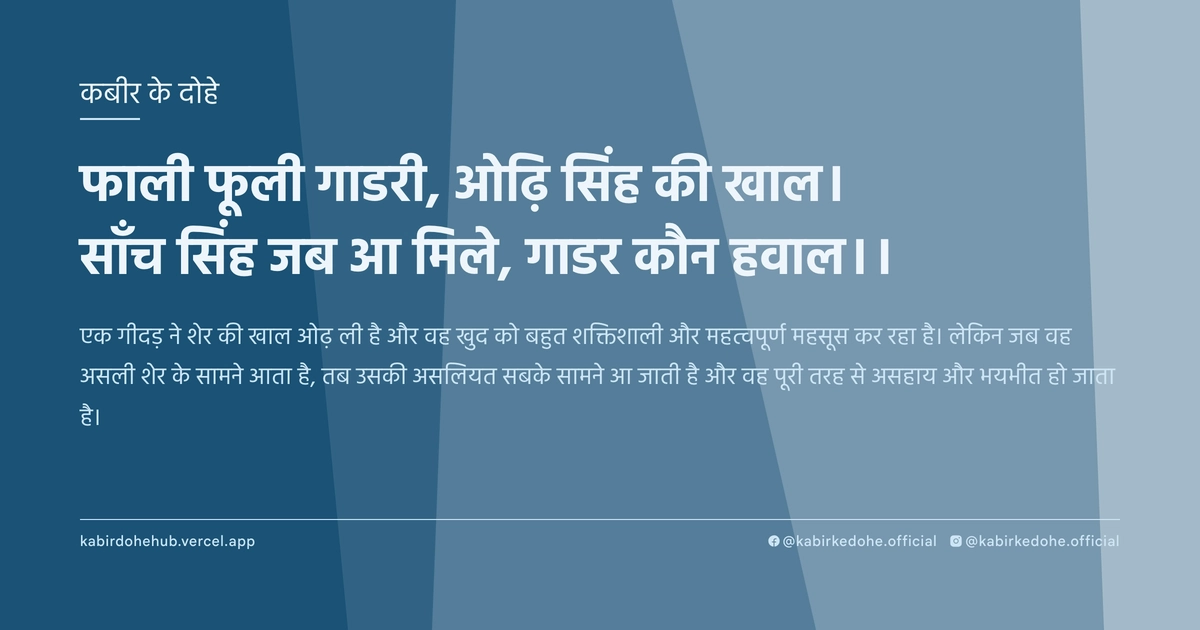
फाली फूली गाडरी, ओढ़ि सिंह की खाल।
साँच सिंह जब आ मिले, गाडर कौन हवाल।।
Phali phuli gadri, odhi singh ki khaal. Saanch singh jab aa mile, gadar kaun haval.
इस पृष्ठ पर इस कबीर दोहे का अर्थ (meaning), हिंदी व्याख्या और अंग्रेज़ी अनुवाद, दार्शनिक विश्लेषण और व्यावहारिक जीवन सीख दी गई है। यह दोहा अहंकार (The Ego) विषय से जुड़ा है — Kabir doha meaning and explanation in Hindi and English.
अर्थ (Meaning):
एक गीदड़ ने शेर की खाल ओढ़ ली है और वह खुद को बहुत शक्तिशाली और महत्वपूर्ण महसूस कर रहा है। लेकिन जब वह असली शेर के सामने आता है, तब उसकी असलियत सबके सामने आ जाती है और वह पूरी तरह से असहाय और भयभीत हो जाता है।
A jackal has draped itself in a lion's skin, masquerading as a powerful predator to deceive others. However, the moment it encounters a genuine lion, its facade collapses, leaving the jackal terrified and exposed in its own insignificance.
व्याख्या (Interpretation):
यहाँ 'गाडरी' (गीदड़) मानव अहंकार और पाखंड का प्रतीक है, जबकि 'सिंह की खाल' उन बाहरी आडंबरों, उपाधियों और धार्मिक दिखावों को दर्शाती है जिन्हें मनुष्य अपनी आंतरिक रिक्तता को छिपाने के लिए ओढ़ता है। यह दोहा निरगुण भक्ति के उस सिद्धांत पर आधारित है जहाँ बाहरी कर्मकांडों और सामाजिक प्रतिष्ठा को व्यर्थ माना गया है। जब 'साँच सिंह' यानी वास्तविक ज्ञान या परमात्मा का साक्षात्कार होता है, तो माया का यह पर्दा फट जाता है। यह आत्मा और ब्रह्म के बीच के द्वैत को मिटाने की प्रक्रिया है, जहाँ झूठी पहचान (अहंकार) का विनाश अनिवार्य है ताकि वास्तविक स्वरूप प्रकट हो सके।
The 'jackal' symbolizes the human ego and the propensity for hypocrisy, while the 'lion's skin' represents the external veneers, titles, and ritualistic displays humans adopt to mask their internal void. This verse aligns with Nirgun Bhakti, which dismisses outward ornamentation in favor of internal purity. The 'true lion' signifies the arrival of Absolute Truth or the Divine realization. When the soul encounters the formless Brahman, the illusion of Maya—the false identity—is stripped away. It highlights the central paradox: we spend our lives constructing a persona, only to find that liberation requires the total annihilation of that very persona.
दार्शनिक विश्लेषण (Philosophical Analysis):
कबीर का यह दोहा उस युग की सामाजिक और धार्मिक विसंगतियों पर प्रहार करता है जहाँ धर्म केवल बाहरी प्रतीकों (जैसे माला, तिलक, या विशेष वस्त्र) तक सीमित रह गया था। कबीर ने देखा कि लोग ज्ञान के बिना केवल 'पंडित' या 'पীর' होने का ढोंग कर रहे थे, जो कि शेर की खाल ओढ़े गीदड़ के समान था।
अद्वैत वेदांत के परिप्रेक्ष्य में, यह 'अविद्या' (अज्ञानता) की स्थिति है। मनुष्य खुद को शरीर, जाति या पद मानता है, जो कि एक मिथ्या पहचान है। जब तक यह झूठी पहचान बनी रहती है, तब तक वह सत्य से दूर रहता है।
सूफी मत के 'फ़ना' (अहंकार का विनाश) के सिद्धांत से भी यह मेल खाता है। जब तक 'मैं' (ईगो) मौजूद है, तब तक 'वह' (परमात्मा) प्रकट नहीं हो सकता। गीदड़ का भय वास्तव में उस अहंकार की चीख है जो अपनी मृत्यु का सामना कर रहा है।
कबीर यहाँ कर्मकांडीय धर्म के विरुद्ध एक मनोवैज्ञानिक युद्ध छेड़ते हैं। वे तर्क देते हैं कि बाहरी दिखावा केवल अज्ञानी को भ्रमित कर सकता है, लेकिन सत्य की कसौटी पर वह शून्य है। यह केवल धार्मिक पाखंड नहीं, बल्कि मानसिक रोग है जहाँ व्यक्ति अपनी वास्तविकता से भागता है।
अंततः, यह दोहा हमें यह सिखाता है कि आध्यात्मिक यात्रा 'बनने' की नहीं, बल्कि 'हटने' की प्रक्रिया है। हमें शेर बनने की कोशिश नहीं करनी है, बल्कि उस खाल को उतार फेंकना है जो हमें हमारी वास्तविक प्रकृति से अलग करती है।
Kabir’s verse strikes at the heart of the social and religious incongruities of his era, where spirituality had devolved into mere external symbols—beads, tilaks, or specific attire. He observed that many claimed the status of 'Pandit' or 'Peer' without possessing actual realization, likening them to jackals wearing lion skins.
From the lens of Advaita Vedanta, this is the state of 'Avidya' (ignorance). The human soul identifies with the body, caste, or social rank, which is a superimposed, false identity. As long as this illusory identity persists, the realization of the non-dual Brahman remains obscured.
This echoes the Sufi concept of 'Fana' (annihilation of the self). Until the 'I' (ego) is extinguished, the Divine cannot be manifested. The jackal's terror is not physical death, but the psychological collapse of the ego when confronted by the Absolute Truth.
Kabir wages a psychological war against ritualism. He argues that external displays can deceive the ignorant, but they are void when tested against the crucible of Truth. This is not merely a critique of religion, but a diagnosis of a mental ailment where the individual flees from their own authenticity.
Ultimately, the verse teaches that the spiritual journey is not about 'becoming' something greater, but about 'unbecoming' everything that is false. We are not called to become lions, but to shed the skin that separates us from our inherent, primordial nature.
मूल संदेश (Core Message):
- बाहरी आडंबर आंतरिक रिक्तता को कभी नहीं भर सकते।
- सत्य की उपस्थिति में हर झूठ का अंत निश्चित है।
- अहंकार एक उधार ली गई खाल है, जो अंततः बोझ बनती है।
- वास्तविक शक्ति विनम्रता में है, दिखावे में नहीं।
- स्वयं को जानने का अर्थ है अपनी झूठी पहचान को मिटाना।
- परमात्मा प्रतीकों में नहीं, बल्कि शुद्ध हृदय में बसता है।
- External ornaments can never fill an internal void.
- In the presence of Truth, every lie is destined to perish.
- The ego is a borrowed skin that eventually becomes a burden.
- True power resides in humility, not in pretension.
- Knowing the Self means erasing the false identity.
- The Divine dwells not in symbols, but in a purified heart.
व्यावहारिक उदाहरण (Practical Example):
वाराणसी के एक पुराने घाट पर रहने वाले एक वृद्ध विधवा, जिन्हें पूरा मोहल्ला 'परम भक्त' मानता था, की कहानी है। वे दिन भर सफेद वस्त्र पहनकर, माथे पर बड़ा तिलक लगाकर और जोर-जोर से मंत्रोच्चार करके अपनी धार्मिकता का प्रदर्शन करती थीं।
वे अक्सर अन्य महिलाओं को उनके 'अशुद्ध' व्यवहार के लिए टोकती थीं और खुद को आध्यात्मिक ऊंचाइयों पर बताती थीं। उनकी पहचान उनकी इस 'पवित्र' छवि से जुड़ी थी, जिससे उन्हें समाज में सम्मान और विशेष स्थान मिलता था।
एक दिन, उनके मोहल्ले में एक फकीर आया, जिसके पास न कोई वस्त्र थे और न कोई तिलक, लेकिन उसकी आँखों में एक अजीब सी शांति और गहराई थी। वह फकीर चुपचाप घाट की सीढ़ियों पर बैठ गया।
विधवा ने अपने अहंकार में उस फकीर को नीचा दिखाने की कोशिश की। उन्होंने उसे शास्त्र सुनाने शुरू किए और अपनी लंबी तपस्याओं का बखान किया, यह सोचकर कि वह फकीर उनकी विद्वत्ता के सामने झुक जाएगा।
फकीर ने केवल एक प्रश्न पूछा: 'माता, यदि आप इतनी पवित्र हैं, तो आपके भीतर का क्रोध और दूसरों के प्रति यह घृणा कहाँ से आ रही है? क्या आपका ईश्वर केवल आपके तिलक में रहता है या आपके व्यवहार में?'
यह प्रश्न उस फकीर के रूप में आए 'साँच सिंह' (सत्य) की तरह था। विधवा को अचानक महसूस हुआ कि उनकी सारी भक्ति केवल एक 'खाल' थी, एक सामाजिक मुखौटा था जिसे उन्होंने सम्मान पाने के लिए ओढ़ा था।
उनके भीतर का सारा पाखंड एक पल में ढह गया। उन्हें एहसास हुआ कि वे वास्तव में प्रेम और करुणा से शून्य थीं, और उनकी धार्मिकता केवल एक दिखावा थी।
उस क्षण, वे फूट-फूट कर रो पड़ीं। उन्होंने अपना अहंकार त्याग दिया और उस फकीर के चरणों में गिर गईं। उन्होंने बाहरी दिखावे को छोड़कर वास्तव में अपने भीतर की गंदगी को साफ करने का संकल्प लिया।
अब वे बिना किसी दिखावे के, सादगी से दूसरों की सेवा करने लगीं। मोहल्ले वालों के लिए वे अब 'परम भक्त' नहीं थीं, लेकिन वे स्वयं के लिए पहली बार स्वतंत्र और शांत थीं।
यह 'कबीर ट्विस्ट' था—जहाँ एक बाहरी पहचान का विनाश एक वास्तविक मानवीय हृदय के जन्म का कारण बना।
In the ancient alleys of Varanasi, there lived an elderly widow whom the entire neighborhood revered as a 'Param Bhakt' (Supreme Devotee). She spent her days draped in pristine white, with a prominent tilak on her forehead, chanting mantras loudly to signal her piety.
She frequently corrected other women for their 'impure' behavior, positioning herself on a spiritual pedestal. Her identity was entirely fused with this 'holy' image, which earned her social prestige and a position of authority.
One day, a wandering Sufi arrived at the ghats. He wore no religious symbols and carried no scriptures, yet his eyes possessed a profound, unsettling stillness. He sat quietly on the stone steps, observing the world.
Driven by her ego, the widow attempted to belittle the Sufi. She began reciting complex scriptures and boasting of her rigorous penances, expecting the stranger to bow before her perceived scholarship.
The Sufi asked a single, piercing question: 'Mother, if you are so pure, from where does this anger and hatred toward others arise? Does your God reside only in your tilak, or does He live in your conduct?'
This question acted as the 'True Lion' (Truth). The widow suddenly realized that her entire spiritual practice was merely a 'skin'—a social mask she had donned to secure respect and validation.
Her facade collapsed instantly. She recognized that she was void of actual love and compassion, and her religiosity was nothing more than a performance for the public eye.
In that moment, she broke down in tears. The ego that had sustained her for decades vanished, and she fell at the feet of the Sufi, stripped of all pretension.
She vowed to abandon the outward show and instead focus on cleansing the internal filth of judgment and pride. She stopped performing her piety for the neighborhood.
She began serving others in silence and simplicity. To the world, she was no longer the 'Supreme Devotee,' but for the first time, she was truly free and at peace.
This was the 'Kabir Twist'—where the destruction of a false identity became the catalyst for the birth of a genuine human heart.
अभ्यास मार्गदर्शन (Practice Guidance):
- दैनिक आत्म-निरीक्षण: प्रतिदिन 15 मिनट मौन बैठें और विचार करें कि आज आपने अपनी छवि को बनाए रखने के लिए कौन सा 'मुखौटा' पहना।
- ईगो-जर्नलिंग: एक डायरी लिखें जिसमें उन स्थितियों का वर्णन हो जहाँ आपने दूसरों को छोटा महसूस कराया ताकि आप स्वयं को बड़ा दिखा सकें।
- व्यवहारिक परिवर्तन: जानबूझकर ऐसी स्थितियों में जाएँ जहाँ आपकी सामाजिक पहचान (पद, डिग्री, प्रतिष्ठा) का कोई मूल्य न हो, और वहां अपनी विनम्रता का अभ्यास करें।
- डायग्नोस्टिक चेकलिस्ट: क्या मैं दूसरों की प्रशंसा पर निर्भर हूँ? क्या मैं अपनी गलतियों को स्वीकार करने में डरता हूँ? क्या मेरी शांति बाहरी प्रतीकों से जुड़ी है? यदि हाँ, तो आप 'शेर की खाल' ओढ़े हुए हैं।
- Daily Self-Audit: Spend 15 minutes in silence reflecting on which 'mask' you wore today to maintain a specific image in the eyes of others.
- Ego-Journaling: Maintain a log of moments where you belittled someone else to elevate your own perceived status or intellectual superiority.
- Behavioral Shift: Intentionally place yourself in environments where your social identity (rank, degree, prestige) holds no value, and practice raw humility.
- Diagnostic Checklist: Am I dependent on external validation? Do I fear admitting mistakes? Is my peace tied to symbols of status? If yes, you are wearing the 'lion's skin'.
चिंतन प्रश्न (Reflection Questions):
- वह कौन सी 'शेर की खाल' है जिसे मैं दुनिया के सामने ओढ़े हुए हूँ?
- यदि मेरी सभी उपाधियाँ और उपलब्धियाँ छीन ली जाएँ, तो मेरा वास्तविक अस्तित्व क्या बचेगा?
- क्या मेरी डिजिटल पहचान (सोशल मीडिया) मेरे वास्तविक जीवन के विरोधाभास को छिपाने का एक साधन है?
- मैं किन लोगों के सामने अपनी श्रेष्ठता सिद्ध करने के लिए संघर्ष करता हूँ और क्यों?
- क्या मैं सत्य को स्वीकार करने के लिए तैयार हूँ, भले ही वह मेरी वर्तमान छवि को नष्ट कर दे?
- मेरे जीवन में 'साँच सिंह' (सत्य) के रूप में कौन आता है, और मैं उससे डरता हूँ या प्रेम करता हूँ?
- What is the 'lion's skin' that I am currently wearing before the world?
- If all my titles and achievements were stripped away, what would remain of my actual existence?
- Is my digital persona a tool to mask the contradictions of my real life?
- Toward whom do I struggle to prove my superiority, and what is the root of that need?
- Am I truly ready to accept the Truth, even if it annihilates my current public image?
- Who appears as the 'True Lion' in my life, and do I meet them with fear or with love?