
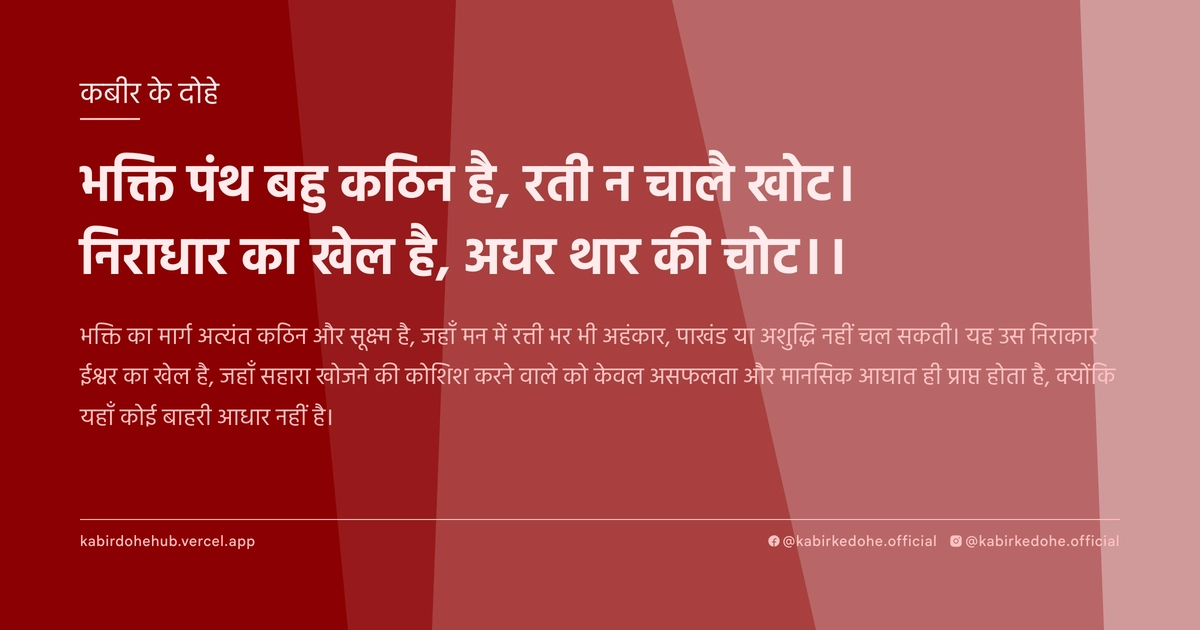
भक्ति पंथ बहु कठिन है, रती न चालै खोट।
निराधार का खेल है, अधर थार की चोट।।
Bhakti panth bahu kathin hai, rati na chaalai khot. Niradhar ka khel hai, adhar thar ki chot.
इस पृष्ठ पर इस कबीर दोहे का अर्थ (meaning), हिंदी व्याख्या और अंग्रेज़ी अनुवाद, दार्शनिक विश्लेषण और व्यावहारिक जीवन सीख दी गई है। यह दोहा भक्ति (Bhakti) विषय से जुड़ा है — Kabir doha meaning and explanation in Hindi and English.
अर्थ (Meaning):
भक्ति का मार्ग अत्यंत कठिन और सूक्ष्म है, जहाँ मन में रत्ती भर भी अहंकार, पाखंड या अशुद्धि नहीं चल सकती। यह उस निराकार ईश्वर का खेल है, जहाँ सहारा खोजने की कोशिश करने वाले को केवल असफलता और मानसिक आघात ही प्राप्त होता है, क्योंकि यहाँ कोई बाहरी आधार नहीं है।
The path of devotion is exceedingly arduous and precise; not even a grain of impurity or ego can persist here. It is the play of the Formless One, where those seeking a tangible external support find only the shock of instability, for there is no worldly foundation to lean upon.
व्याख्या (Interpretation):
इस दोहे का शाब्दिक अर्थ है कि ईश्वर की प्राप्ति का मार्ग कठिन है। गहरे स्तर पर, कबीर 'खोट' को अहंकार और द्वैत के रूप में परिभाषित करते हैं। निर्गुण भक्ति में, साधक को अपनी समस्त पहचान मिटानी पड़ती है। 'निराधार' शब्द ब्रह्म की उस अवस्था को दर्शाता है जो किसी भौतिक आधार से मुक्त है। जब मनुष्य बाहरी कर्मकांडों या सामाजिक प्रतिष्ठा को 'आधार' मानता है, तो उसे 'अधर थार की चोट' यानी अस्थिरता का अनुभव होता है। यह विरोधाभास है कि जिसे हम आधार समझते हैं, वही वास्तव में हमारी प्रगति में सबसे बड़ी बाधा है। अंततः, यह आत्मा का परमात्मा में विलीनीकरण है जहाँ 'मैं' का अस्तित्व समाप्त हो जाता है।
Literally, the verse warns of the difficulty of the devotional path. Metaphorically, 'khot' refers to the subtle impurities of ego and duality. In Nirgun Bhakti, the seeker must dissolve their entire identity. The term 'Niradhar' describes the Formless Absolute, which is devoid of any material support. When a human clings to external rituals or social status as a 'foundation,' they experience the 'shock of the unstable' (adhar thar ki chot). This presents a central paradox: the very supports we rely upon are the obstacles to liberation. Ultimately, it is the merging of Atman and Brahman, where the illusion of the separate 'I' is annihilated.
दार्शनिक विश्लेषण (Philosophical Analysis):
कबीर का यह कथन उनके युग के धार्मिक पाखंडों पर एक तीखा प्रहार है। उन्होंने देखा कि लोग तीर्थयात्रा, माला-जप और बाहरी दिखावे को मोक्ष का 'आधार' मान रहे थे। कबीर इसे 'खोट' कहते हैं क्योंकि यह आध्यात्मिक अहंकार को जन्म देता है। उनका दर्शन अद्वैत वेदांत और सूफी मत के 'फना' (अहंकार का विनाश) के करीब है, जहाँ भक्त और भगवान के बीच का पर्दा हट जाता है।
ऐतिहासिक रूप से, कबीर ने जाति और धर्म की सीमाओं को तोड़कर एक ऐसे मार्ग का प्रस्ताव दिया जो केवल आंतरिक शुद्धता पर आधारित था। उनके लिए भक्ति कोई सामाजिक गतिविधि नहीं, बल्कि एक मनोवैज्ञानिक रूपांतरण था। वे समझाते हैं कि जब तक साधक यह सोचता है कि वह 'कुछ कर रहा है', तब तक वह माया के जाल में है।
सूफीवाद के प्रभाव में, कबीर 'इश्क-ए-हकीकी' (ईश्वरीय प्रेम) की बात करते हैं, जो इतना तीव्र होता है कि वह साधक के पुराने व्यक्तित्व को जलाकर राख कर देता है। यहाँ 'निराधार' होना वास्तव में सर्वोच्च स्वतंत्रता है। जो व्यक्ति किसी बाहरी सहारे (जैसे गुरु की मूर्ति या शास्त्र) पर निर्भर रहता है, वह वास्तव में अपनी आंतरिक शक्ति को नकार रहा होता है।
यह विश्लेषण स्पष्ट करता है कि भक्ति का 'कठिन' होना बाहरी संघर्ष नहीं, बल्कि आंतरिक युद्ध है। यह युद्ध अपनी ही आदतों, पूर्वाग्रहों और पहचान के प्रति मोह के विरुद्ध है। जब तक 'मैं' जीवित है, तब तक 'वह' (परमात्मा) प्रकट नहीं हो सकता।
अंततः, कबीर यह संदेश देते हैं कि सत्य किसी नक्शे या निर्देश पुस्तिका से नहीं मिलता। यह एक छलांग है—अज्ञात में एक छलांग, जहाँ कोई सुरक्षा जाल नहीं है। यही वह बिंदु है जहाँ साधक अपनी सीमित पहचान को त्यागकर अनंत में विलीन हो जाता है।
Kabir's assertion is a sharp critique of the religious hypocrisy of his era. He observed people treating pilgrimages, bead-counting, and outward displays as the 'foundation' for salvation. Kabir labels this as 'khot' (impurity) because such practices often fuel spiritual ego. His philosophy aligns closely with Advaita Vedanta and the Sufi concept of 'Fana' (annihilation of the self), where the veil between the devotee and the Divine is lifted.
Historically, Kabir dismantled caste and religious boundaries, proposing a path based solely on internal purity. For him, Bhakti was not a social activity but a psychological transformation. He argues that as long as the seeker believes they are 'doing' something to achieve God, they remain trapped in Maya (illusion).
Influenced by Sufism, Kabir speaks of 'Ishq-e-Haqiqi' (Divine Love), a passion so intense it incinerates the seeker's old personality. Here, being 'Niradhar' (without support) is actually the pinnacle of freedom. One who relies on external crutches—be it idols or scriptures—is essentially denying their own inherent divine power.
This analysis clarifies that the 'difficulty' of the path is not an external struggle, but an internal war. It is a battle against one's own habits, biases, and attachment to identity. As long as the 'I' persists, the 'Thou' (the Absolute) cannot manifest.
Ultimately, Kabir suggests that Truth is not found via a map or a manual. It is a leap—a leap into the unknown where there is no safety net. This is the precise moment where the seeker sheds their limited identity to merge into the Infinite.
मूल संदेश (Core Message):
- बाहरी सहारे केवल भ्रम हैं, आंतरिक शून्यता ही सत्य है।
- अहंकार का एक कण भी पूर्णता के मार्ग में बाधा है।
- सच्ची भक्ति नियमों में नहीं, बल्कि पूर्ण समर्पण में है।
- जब 'मैं' मिटता है, तभी 'वह' प्रकट होता है।
- अस्थिरता का डर ही वास्तव में मुक्ति का द्वार है।
- External supports are illusions; internal emptiness is the only truth.
- A single grain of ego obstructs the path to wholeness.
- True devotion lies not in rules, but in absolute surrender.
- Only when the 'I' vanishes does the 'Thou' manifest.
- The fear of instability is actually the gateway to liberation.
व्यावहारिक उदाहरण (Practical Example):
वाराणसी के घाटों पर रहने वाली एक वृद्ध विधवा, जानकी, का जीवन केवल दान-पुण्य और कठोर नियमों के इर्द-गिर्द घूमता था। वह मानती थी कि उसकी शुद्धता उसके नियमों के पालन में है। वह दूसरों को उनकी 'अशुद्धता' के लिए चुपके से कोसती थी, जबकि खुद को श्रेष्ठ मानती थी।
एक दिन उसकी मुलाकात एक फकीर से हुई जिसने उसे चुनौती दी कि वह अपनी 'पवित्रता' का बोझ उतार फेंके। जानकी ने तर्क दिया कि बिना नियमों के वह गिर जाएगी। फकीर ने मुस्कुराकर कहा, 'तुम गिरोगी नहीं, क्योंकि तुम अभी तक केवल अपने अहंकार के सहारे खड़ी हो।'
जानकी को यह बात चुभी। उसने महसूस किया कि उसकी पूरी भक्ति वास्तव में एक सुरक्षा कवच थी ताकि वह अपनी आंतरिक रिक्तता और डर का सामना न कर सके। वह 'आधार' जिसे वह धर्म समझ रही थी, वह वास्तव में उसका अहंकार था।
उस रात, जानकी ने पहली बार अपनी बंद आँखों से प्रार्थना नहीं की, बल्कि अपने भीतर के उस अंधेरे को देखा जिसे वह सालों से छिपा रही थी। उसने महसूस किया कि वह जिसे 'पवित्र' मानती थी, वह केवल एक सामाजिक मुखौटा था।
अगले कुछ महीनों में, जानकी ने अपनी कठोरता छोड़ दी। उसने उन लोगों की मदद करना शुरू किया जिन्हें वह पहले 'अपवित्र' मानती थी। उसने पाया कि जब उसने अपनी श्रेष्ठता का 'आधार' छोड़ दिया, तो वह वास्तव में हल्का महसूस करने लगी।
एक दिन, एक बीमार भिखारी ने उसका हाथ पकड़ा। पहले वह घबरा जाती, लेकिन अब उसने केवल करुणा महसूस की। उसने महसूस किया कि जब कोई बाहरी आधार नहीं रहता, तब केवल प्रेम ही शेष बचता है।
उसने पाया कि उसकी पुरानी भक्ति एक बोझ थी, जबकि यह नई स्थिति एक मुक्ति थी। वह अब नियमों की गुलाम नहीं, बल्कि प्रेम की दासी थी।
जानकी का रूपांतरण यह था कि उसने 'सही होने' की जिद छोड़ दी। यही वह 'निराधार' होना था जिसकी बात कबीर ने की थी—जहाँ कोई सहारा नहीं है, केवल समर्पण है।
अंत में, जानकी ने पाया कि जिस 'चोट' से वह डरती थी (अपनी पहचान खोने का डर), वही चोट वास्तव में उसके अहंकार के टूटने की आवाज थी, जिसने उसे वास्तव में ईश्वर से जोड़ा।
Janaki, an elderly widow living on the ghats of Varanasi, led a life revolving strictly around ritual purity and rigid rules. She believed her holiness lay in her adherence to these norms, often silently judging others for their 'impurity' while viewing herself as superior.
One day, she encountered a wandering fakir who challenged her to cast off the burden of her 'purity.' Janaki argued that without these rules, she would collapse. The fakir smiled and replied, 'You will not fall, for you are currently standing only by the support of your ego.'
These words stung Janaki. She realized that her entire devotion was actually a protective shield, preventing her from facing her internal emptiness and fear. The 'foundation' she mistook for religion was, in truth, her pride.
That night, for the first time, Janaki did not pray with closed eyes in a rote manner; instead, she looked into the darkness within her that she had suppressed for years. She realized her perceived 'purity' was merely a social mask.
Over the following months, Janaki abandoned her rigidity. She began helping those she had previously deemed 'unclean.' She discovered that once she let go of the 'foundation' of her superiority, she felt an unprecedented lightness.
One day, a sick beggar grasped her hand. Previously, she would have recoiled in horror, but now she felt only compassion. She realized that when all external supports are gone, only love remains.
She found that her old devotion was a burden, while this new state was a liberation. She was no longer a slave to rules, but a servant of love.
Janaki's transformation lay in relinquishing the insistence on 'being right.' This was the state of being 'Niradhar' that Kabir spoke of—where there is no support, only surrender.
Ultimately, Janaki discovered that the 'shock' she feared (the loss of identity) was actually the sound of her ego shattering, which finally connected her to the Divine.
अभ्यास मार्गदर्शन (Practice Guidance):
- दैनिक मौन अभ्यास: प्रतिदिन 20 मिनट पूर्ण मौन में बैठें। किसी भी विचार या मंत्र का सहारा न लें; केवल अपनी शून्यता को महसूस करें।
- अहंकार की पहचान (Journaling): प्रतिदिन लिखें कि आज आपने कहाँ अपनी श्रेष्ठता सिद्ध करने की कोशिश की या कहाँ आपको लगा कि आप दूसरों से अधिक 'धार्मिक' या 'नैतिक' हैं।
- निराधार प्रयोग: किसी ऐसे कार्य को करें जिसमें आपको कोई प्रशंसा या सामाजिक मान्यता न मिले, और जानबूझकर अपनी पहचान गुप्त रखें।
- निदान चेकलिस्ट: क्या मैं अपनी आध्यात्मिक उपलब्धियों पर गर्व करता हूँ? क्या मैं दूसरों के विश्वासों को गलत मानता हूँ? क्या मैं ईश्वर को पाने के लिए किसी बाहरी माध्यम पर अत्यधिक निर्भर हूँ? (यदि हाँ, तो आप अभी भी 'खोट' के साथ चल रहे हैं)।
- Daily Silence Practice: Sit in absolute silence for 20 minutes daily. Do not rely on any mantra or thought; simply experience your own emptiness.
- Ego Mapping (Journaling): Record daily instances where you attempted to prove your superiority or felt more 'religious' or 'moral' than others.
- The 'Supportless' Experiment: Perform an act of service where you receive no praise or social recognition, intentionally keeping your identity hidden.
- Diagnostic Checklist: Do I take pride in my spiritual achievements? Do I judge others' beliefs as inferior? Am I overly dependent on external mediums to reach God? (If yes, you are still carrying the 'khot' or impurity).
चिंतन प्रश्न (Reflection Questions):
- मेरा वह कौन सा 'आधार' है जिसे मैं धर्म या नैतिकता कहता हूँ, लेकिन वह वास्तव में मेरा अहंकार है?
- यदि मेरी सारी सामाजिक और धार्मिक पहचान छीन ली जाए, तो मेरे भीतर क्या बचेगा?
- मैं अपनी आध्यात्मिक यात्रा में किन 'सुरक्षा जालों' का उपयोग कर रहा हूँ ताकि मुझे वास्तव में समर्पित न होना पड़े?
- क्या मेरी करुणा वास्तव में निस्वार्थ है, या यह मेरी अपनी छवि को 'उदार' बनाने का एक तरीका है?
- मैं उस शून्य से क्यों डरता हूँ जहाँ कोई सहारा नहीं है?
- What is that 'foundation' I call religion or morality, which is actually just my ego?
- If all my social and religious identities were stripped away, what would remain within me?
- What 'safety nets' am I using in my spiritual journey to avoid true surrender?
- Is my compassion truly selfless, or is it a tool to build an image of myself as 'generous'?
- Why do I fear the void where there is no support to lean upon?