
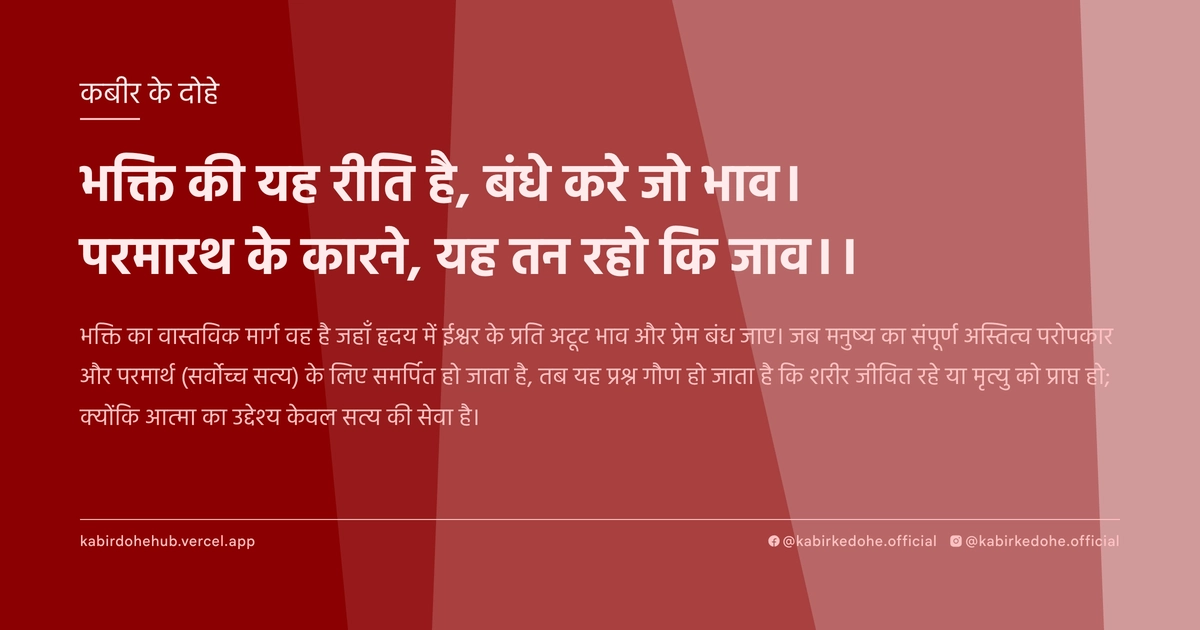
भक्ति की यह रीति है, बंधे करे जो भाव।
परमारथ के कारने, यह तन रहो कि जाव।।
Bhakti ki yeh reeti hai, bandhe kare jo bhaav. Parmarath ke kaarane, yeh tan raho ki jaav.
इस पृष्ठ पर इस कबीर दोहे का अर्थ (meaning), हिंदी व्याख्या और अंग्रेज़ी अनुवाद, दार्शनिक विश्लेषण और व्यावहारिक जीवन सीख दी गई है। यह दोहा भक्ति (Bhakti) विषय से जुड़ा है — Kabir doha meaning and explanation in Hindi and English.
अर्थ (Meaning):
भक्ति का वास्तविक मार्ग वह है जहाँ हृदय में ईश्वर के प्रति अटूट भाव और प्रेम बंध जाए। जब मनुष्य का संपूर्ण अस्तित्व परोपकार और परमार्थ (सर्वोच्च सत्य) के लिए समर्पित हो जाता है, तब यह प्रश्न गौण हो जाता है कि शरीर जीवित रहे या मृत्यु को प्राप्त हो; क्योंकि आत्मा का उद्देश्य केवल सत्य की सेवा है।
The true essence of devotion lies in the cultivation of an unwavering emotional bond with the Divine. When a seeker dedicates their entire existence to 'Paramarth'—the highest spiritual good and selfless service—the physical survival of the body becomes irrelevant. The only goal is the realization of Truth, regardless of whether the physical form persists or perishes.
व्याख्या (Interpretation):
यह दोहा भक्ति के बाह्य कर्मकांडों के बजाय आंतरिक 'भाव' की प्रधानता पर जोर देता है। यहाँ 'बंधे' शब्द का अर्थ है एक ऐसा प्रेम जो बंधन नहीं, बल्कि मुक्ति का मार्ग है। यह निर्गुण भक्ति का वह शिखर है जहाँ साधक अपनी व्यक्तिगत पहचान (अहंकार) को मिटाकर ब्रह्मांडीय चेतना में विलीन हो जाता है। माया का पर्दा तब गिरता है जब 'मैं' का स्थान 'परमार्थ' ले लेता है। यह अद्वैत वेदांत के उस सिद्धांत को दर्शाता है जहाँ आत्मा और परमात्मा का भेद समाप्त हो जाता है। शरीर केवल एक माध्यम है, साध्य नहीं। जब उद्देश्य सर्वोच्च सत्य की प्राप्ति हो, तो देह की नश्वरता एक बाधा नहीं बल्कि एक उत्सव बन जाती है।
This couplet emphasizes the primacy of internal 'Bhaav' (emotional devotion) over external rituals. The word 'bandhe' suggests a bond that is not a shackle, but a bridge to liberation. It represents the pinnacle of Nirgun Bhakti, where the seeker dissolves the individual ego into the cosmic consciousness. The veil of Maya falls when 'I' is replaced by 'Paramarth' (the Supreme Good). This aligns with Advaita Vedanta, where the duality between the Atman and Brahman vanishes. The body is viewed merely as a vehicle, not the destination. When the purpose is the realization of the Absolute Truth, the mortality of the physical form ceases to be an obstacle and becomes a liberation.
दार्शनिक विश्लेषण (Philosophical Analysis):
कबीर का यह दृष्टिकोण तत्कालीन समाज में व्याप्त पाखंड और केवल मंदिर-मस्जिद जाने वाली भक्ति पर एक कड़ा प्रहार है। वे भक्ति को एक व्यक्तिगत और आंतरिक अनुभव के रूप में परिभाषित करते हैं, न कि सामाजिक प्रदर्शन के रूप में। यहाँ 'परमारथ' शब्द केवल दान-पुण्य नहीं, बल्कि उस परम सत्य की खोज है जो जाति, धर्म और वर्ग से ऊपर है।
दार्शनिक स्तर पर, यह सूफी मत के 'फना' (अहंकार का विनाश) और वेदांत के 'अद्वैत' का संगम है। कबीर तर्क देते हैं कि जब तक मनुष्य अपने शरीर और उसकी सुरक्षा से चिपका रहता है, वह सत्य को नहीं पा सकता। वास्तविक भक्ति वह है जो साधक को उसके सीमित स्वार्थों से मुक्त कर उसे सार्वभौमिक प्रेम में बदल दे।
यह विश्लेषण हमें बताता है कि कबीर के लिए शरीर एक वस्त्र की तरह है। यदि वस्त्र सत्य की राह में बाधा बने, तो उसे त्यागने में कोई संकोच नहीं होना चाहिए। यह शारीरिक मृत्यु की बात नहीं, बल्कि 'अहंकार की मृत्यु' की बात है।
ऐतिहासिक रूप से, कबीर ने उन लोगों को चुनौती दी जो शास्त्रों के ज्ञान का दावा करते थे लेकिन जिनके हृदय में करुणा नहीं थी। उन्होंने सिखाया कि ज्ञान तब तक व्यर्थ है जब तक वह व्यवहार में 'परमार्थ' न बन जाए।
अंततः, यह दोहा मनोवैज्ञानिक रूपांतरण की बात करता है। जब भय (मृत्यु का भय) समाप्त हो जाता है और प्रेम (ईश्वर के प्रति भाव) प्रबल होता है, तब मनुष्य वास्तव में स्वतंत्र होता है। यही वह बिंदु है जहाँ भक्त और भगवान एक हो जाते हैं।
Kabir’s perspective is a sharp critique of the hypocrisy and ritualistic devotion prevalent in his era, where spirituality was often reduced to visiting temples or mosques. He defines Bhakti not as a social performance, but as a deeply personal and internal experience. Here, 'Paramarth' does not merely signify charity, but the pursuit of the Supreme Truth that transcends caste, religion, and social hierarchy.
Philosophically, this is a confluence of the Sufi concept of 'Fana' (annihilation of the ego) and the Advaita Vedantic realization of non-duality. Kabir argues that as long as a human clings to the body and its preservation, the Truth remains elusive. True devotion is that which liberates the seeker from limited self-interest and transforms them into a vessel of universal love.
This analysis reveals that for Kabir, the body is like a garment. If the garment hinders the path to Truth, there should be no hesitation in discarding it. This is not a call for physical suicide, but for the 'death of the ego'—the dissolution of the false identity.
Historically, Kabir challenged those who claimed scriptural authority but lacked compassion. He taught that knowledge is futile unless it manifests as 'Paramarth' in one's daily conduct and interactions with others.
Ultimately, the couplet speaks to a psychological transformation. When the fear of death is replaced by the intensity of divine love, the human being becomes truly free. This is the precise moment where the devotee and the Divine merge into one.
मूल संदेश (Core Message):
- बाह्य कर्मकांड केवल भ्रम हैं; वास्तविक भक्ति हृदय के भाव में है।
- अहंकार का विसर्जन ही परमात्मा से मिलन का एकमात्र मार्ग है।
- शरीर एक अस्थायी साधन है, जबकि आत्मा का लक्ष्य शाश्वत सत्य है।
- निस्वार्थ सेवा ही सबसे बड़ी आध्यात्मिक साधना है।
- जब 'मैं' मिटता है, तब 'वह' (परमात्मा) प्रकट होता है।
- External rituals are mere illusions; true devotion resides in the heart's intent.
- The dissolution of the ego is the only path to union with the Divine.
- The body is a temporary tool; the soul's destination is Eternal Truth.
- Selfless service is the highest form of spiritual discipline.
- When the 'I' vanishes, the 'Divine' manifests.
व्यावहारिक उदाहरण (Practical Example):
वाराणसी के एक पुराने घाट पर रहने वाली एक वृद्ध विधवा, जानकी, का जीवन अत्यंत कठिन था। वह दूसरों के घरों में छोटे-मोटे काम करके अपना गुजारा करती थी। समाज उसे 'अशुभ' मानता था और लोग उससे दूरी बनाकर रखते थे। जानकी के पास न तो कोई धन था और न ही कोई अपना, लेकिन उसके भीतर एक गहरा, मौन प्रेम था जिसे वह अपनी प्रार्थनाओं में व्यक्त करती थी।
एक समय की बात है, घाट के पास एक भीषण आग लगी। लोग अपनी जान बचाकर भाग रहे थे। उसी अफरा-तफरी में जानकी ने देखा कि एक छोटा बच्चा मलबे के नीचे दबा हुआ है और उसकी चीखें सुनाई दे रही हैं। चारों ओर आग की लपटें थीं और कोई भी उस बच्चे की ओर बढ़ने का साहस नहीं कर रहा था क्योंकि वह जोखिम बहुत बड़ा था।
जानकी, जिसकी उम्र और कमजोरी किसी भी सामान्य व्यक्ति को रोक देती, बिना एक पल सोचे आग की लपटों की ओर बढ़ी। उसके मन में न तो अपनी जान जाने का डर था और न ही इस बात की चिंता कि दुनिया उसे क्या कहेगी। उसके लिए उस समय केवल वह बच्चा 'परमार्थ' था—एक जीव की रक्षा, जो उसके लिए ईश्वर की सेवा के समान थी।
वह मलबे के बीच घुसी, अपनी फटी हुई साड़ी से बच्चे को ढका और उसे सुरक्षित बाहर निकाल लाई। इस प्रक्रिया में उसके हाथ और पैर बुरी तरह झुलस गए। जब वह बाहर आई, तो लोग हैरान थे कि एक 'अशुभ' मानी जाने वाली महिला ने अपनी जान जोखिम में डालकर एक अजनबी बच्चे को बचाया।
जब लोगों ने उससे पूछा कि उसने ऐसा क्यों किया, तो उसने केवल मुस्कुराकर कहा, 'जब हृदय में प्रेम बंध जाता है, तो शरीर का रहना या न रहना मायने नहीं रखता।' उसके इस सरल उत्तर ने वहां मौजूद कई 'धार्मिक' लोगों के अहंकार को तोड़ दिया।
उस दिन जानकी के लिए शरीर की पीड़ा गौण हो गई थी क्योंकि उसने उस परम आनंद को महसूस किया जो केवल निस्वार्थ सेवा से आता है। वह अब केवल एक विधवा नहीं थी, बल्कि एक जीवित उदाहरण थी कि भक्ति वास्तव में क्या होती है।
उसकी इस क्रिया ने पूरे मोहल्ले की सोच बदल दी। जिन लोगों ने उसे दुत्कारा था, वे अब उसके चरणों में झुकने लगे। लेकिन जानकी को इस प्रसिद्धि में कोई रुचि नहीं थी।
वह वापस अपनी उसी छोटी सी कुटिया में चली गई, जहाँ वह अब भी मौन रहकर उसी निराकार ईश्वर की सेवा में लीन रहती थी। उसका जीवन अब 'परमार्थ' का पर्याय बन चुका था।
In the ancient ghats of Varanasi lived an elderly widow named Janaki. Her life was fraught with hardship; she survived by doing odd jobs in other people's homes. Society labeled her 'inauspicious,' and people maintained a cold distance from her. Janaki possessed neither wealth nor kin, yet she harbored a deep, silent love that she expressed through her quiet prayers.
One day, a devastating fire broke out near the ghats. People were fleeing in terror to save their own lives. Amidst the chaos, Janaki noticed a small child trapped under the debris, whose screams were barely audible over the roar of the flames. The fire was raging, and no one dared to approach the child because the risk was too immense.
Janaki, whose age and frailty would have deterred any ordinary person, stepped toward the flames without a moment's hesitation. There was no fear of death in her heart, nor any concern for how the world perceived her. For her, at that moment, the child was 'Paramarth'—the highest good—and saving a living being was equivalent to serving the Divine.
She plunged into the debris, shielded the child with her torn saree, and managed to pull him to safety. In the process, her hands and legs were severely burned. When she emerged, the crowd was stunned that a woman deemed 'inauspicious' had risked her life for a stranger.
When asked why she did it, she simply smiled and said, 'When the heart is bound by love, whether the body remains or perishes ceases to matter.' This simple response shattered the egos of many 'religious' people standing there.
For Janaki, the physical pain became insignificant because she had experienced the supreme bliss that comes only from selfless service. She was no longer just a widow; she had become a living embodiment of true Bhakti.
Her action transformed the mindset of the entire neighborhood. Those who had once shunned her now bowed at her feet. However, Janaki had no interest in this newfound fame.
She returned to her small hut, continuing to live in silence, immersed in the service of the Formless Divine. Her life had become a synonym for 'Paramarth.'
अभ्यास मार्गदर्शन (Practice Guidance):
- दैनिक चिंतन: प्रतिदिन 15 मिनट मौन बैठें और विचार करें कि आपके जीवन का कौन सा हिस्सा केवल 'स्व' के लिए है और कौन सा 'परमार्थ' के लिए।
- सेवा अभ्यास: सप्ताह में एक बार ऐसा कार्य करें जिसका कोई व्यक्तिगत लाभ न हो और जिसे आप गुप्त रखें।
- आत्म-पूछताछ जर्नल: लिखें कि किस डर (शारीरिक, सामाजिक या मानसिक) के कारण आप किसी की मदद करने या सत्य को अपनाने से रुकते हैं।
- निदान चेकलिस्ट: यदि आप किसी की मदद करते समय बदले में प्रशंसा या आभार की अपेक्षा करते हैं, तो समझें कि आपका 'भाव' अभी भी अहंकार से बंधा है, परमार्थ से नहीं।
- Daily Contemplation: Sit in silence for 15 minutes daily and reflect on which parts of your life are lived for the 'self' and which are dedicated to 'Paramarth' (the higher good).
- Service Practice: Once a week, perform an act of kindness that offers no personal gain and keep it strictly anonymous.
- Self-Inquiry Journal: Document the specific fears (physical, social, or mental) that prevent you from helping others or embracing the absolute truth.
- Diagnostic Checklist: If you find yourself expecting praise or gratitude after helping someone, recognize that your 'Bhaav' is still bound to the ego, not to selfless devotion.
चिंतन प्रश्न (Reflection Questions):
- क्या मेरी धार्मिक पहचान वास्तव में मुझे विनम्र बना रही है, या यह मेरे अहंकार को पोषण दे रही है?
- यदि आज मेरा भौतिक अस्तित्व समाप्त हो जाए, तो क्या मेरे पीछे कोई ऐसा कार्य बचेगा जिसे मैं 'परमार्थ' कह सकूँ?
- मैं किन सामाजिक मुखौटों के पीछे अपनी वास्तविक आध्यात्मिक तड़प को छिपा रहा हूँ?
- क्या मैं सत्य की खोज कर रहा हूँ, या केवल सत्य के बारे में बात करने का सुख ले रहा हूँ?
- मेरे जीवन में 'प्रेम' और 'मोह' के बीच की सूक्ष्म रेखा कहाँ है?
- Does my religious identity truly make me humble, or is it merely feeding my ego?
- If my physical existence ended today, would there be any action left behind that I could truly call 'Paramarth'?
- Behind which social masks am I hiding my genuine spiritual longing?
- Am I actually seeking the Truth, or am I merely enjoying the act of talking about the Truth?
- Where exactly is the thin line between 'divine love' and 'worldly attachment' in my life?