
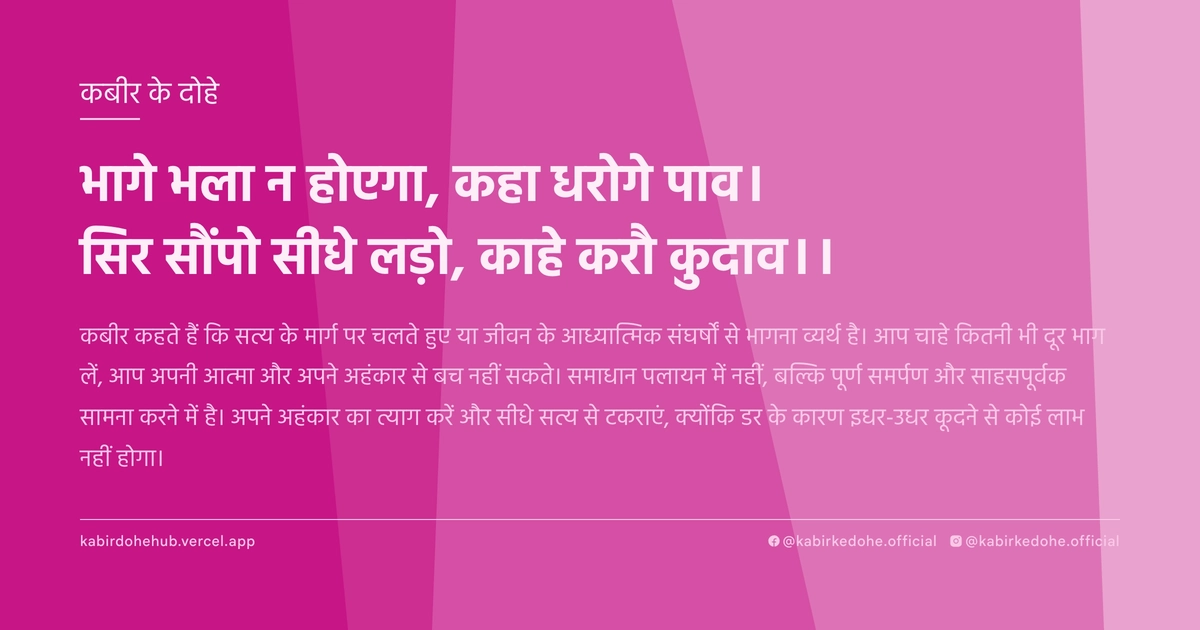
भागे भला न होएगा, कहा धरोगे पाव।
सिर सौंपो सीधे लड़ो, काहे करौ कुदाव।।
Bhaage bhala na hoyega, kaha dharoge paav. Sir saunpo seedhe laro, kaahe karau kudaav.
इस पृष्ठ पर इस कबीर दोहे का अर्थ (meaning), हिंदी व्याख्या और अंग्रेज़ी अनुवाद, दार्शनिक विश्लेषण और व्यावहारिक जीवन सीख दी गई है। यह दोहा प्रपत्ति (Surrender) विषय से जुड़ा है — Kabir doha meaning and explanation in Hindi and English.
अर्थ (Meaning):
कबीर कहते हैं कि सत्य के मार्ग पर चलते हुए या जीवन के आध्यात्मिक संघर्षों से भागना व्यर्थ है। आप चाहे कितनी भी दूर भाग लें, आप अपनी आत्मा और अपने अहंकार से बच नहीं सकते। समाधान पलायन में नहीं, बल्कि पूर्ण समर्पण और साहसपूर्वक सामना करने में है। अपने अहंकार का त्याग करें और सीधे सत्य से टकराएं, क्योंकि डर के कारण इधर-उधर कूदने से कोई लाभ नहीं होगा।
Kabir asserts that fleeing from the spiritual struggle or the truth of existence is futile. No matter how far one runs, there is no escape from the self or the ego. The solution lies not in avoidance or evasion, but in total surrender and courageous confrontation. Relinquish the ego, offer your head (your identity), and face the truth directly, for jumping around in fear achieves nothing.
व्याख्या (Interpretation):
इस दोहे का शाब्दिक अर्थ है कि भागने से कुछ हासिल नहीं होगा, क्योंकि आपके पैर आपको कहाँ ले जाएंगे? कबीर यहाँ 'सिर सौंपने' का आह्वान करते हैं, जो कि अहंकार के पूर्ण विसर्जन का प्रतीक है। यह निर्गुण भक्ति का सार है, जहाँ साधक को यह समझना होता है कि माया का भ्रम केवल तभी टूटता है जब हम उससे लड़ने के बजाय उसमें विलीन हो जाएं। 'सीधे लड़ो' का अर्थ बाहरी युद्ध नहीं, बल्कि आंतरिक द्वंद्व है। यह अद्वैत वेदांत के उस सिद्धांत को दर्शाता है जहाँ जीव और ब्रह्म के बीच का पर्दा केवल 'मैं' (अहंकार) है। जब तक हम इस अहंकार को बचाने की कोशिश करते हैं, हम डरते रहेंगे। जैसे ही हम इसे समर्पित कर देते हैं, भय समाप्त हो जाता है और मोक्ष का मार्ग खुलता है।
Literally, the verse asks where one intends to go by fleeing, as there is no sanctuary from the self. Kabir calls for 'offering the head,' a potent metaphor for the total annihilation of the ego. This aligns with Nirgun Bhakti, where the seeker realizes that the illusion of Maya is shattered only when one stops resisting and starts dissolving. 'Fight directly' does not imply an external battle, but an internal confrontation with one's own shadows. It mirrors the Advaita Vedanta principle that the only veil between the Atman and Brahman is the 'I-consciousness' (Ahamkara). As long as we attempt to protect this fragile identity, we remain in a state of fear. Once the identity is surrendered, fear vanishes, and the non-dual reality emerges.
दार्शनिक विश्लेषण (Philosophical Analysis):
कबीर का यह दोहा उस कालखंड की उपज है जब समाज कर्मकांडों और बाहरी आडंबरों में उलझा हुआ था। कबीर ने स्पष्ट किया कि मोक्ष किसी तीर्थयात्रा या बाहरी अनुष्ठान से नहीं, बल्कि आंतरिक साहस से मिलता है। यहाँ 'भागने' का अर्थ केवल शारीरिक पलायन नहीं, बल्कि मानसिक व्याकुलता और सत्य से मुंह मोड़ना है।
दार्शनिक स्तर पर, यह सूफी मत के 'फना' (अहंकार का विनाश) और वेदांत के 'अहं ब्रह्मास्मि' के बीच का सेतु है। जब कबीर कहते हैं 'सिर सौंपो', तो वे उस बिंदु की बात कर रहे हैं जहाँ व्यक्ति अपनी व्यक्तिगत इच्छाओं का त्याग कर सार्वभौमिक चेतना में मिल जाता है। यह मनोवैज्ञानिक रूपांतरण की प्रक्रिया है जहाँ भय, जो कि पृथकता (separation) का परिणाम है, एकता (unity) में बदल जाता है।
अक्सर लोग इस दोहे को केवल वीरता के रूप में देखते हैं, लेकिन यह वास्तव में 'अहिंसक आत्म-विनाश' है। यह उस अहंकार की हत्या है जो हमें यह विश्वास दिलाता है कि हम शरीर हैं। कबीर ritualism का विरोध करते हुए यह समझाते हैं कि ईश्वर मंदिर या मस्जिद में नहीं, बल्कि उस साहस में है जो हमें अपने स्वयं के अंधेरे का सामना करने की शक्ति देता है।
यह शिक्षण हमें सिखाता है कि आध्यात्मिक प्रगति का मार्ग 'परिहार' (avoidance) नहीं बल्कि 'स्वीकार' (acceptance) है। जब हम अपनी कमियों, अपने पापों और अपनी नश्वरता को स्वीकार कर लेते हैं, तब हम वास्तव में स्वतंत्र होते हैं।
अंततः, यह दोहा मनुष्य को उसकी कायरता से जगाकर उसे उसकी वास्तविक शक्ति—जो कि उसकी आत्मा की अविनाशी प्रकृति है—से परिचित कराता है। यह एक आह्वान है कि हम जीवन के नाटक से भागने के बजाय, उसके केंद्र में खड़े होकर उसे साक्षी भाव से देखें।
This couplet emerges from an era dominated by rigid ritualism and external piety. Kabir clarifies that liberation is not attained through pilgrimages or ceremonies, but through internal courage. 'Fleeing' here refers not just to physical escape, but to mental agitation and the denial of existential truth.
Philosophically, this is a bridge between the Sufi concept of 'Fana' (annihilation of the self) and the Vedantic realization of 'Aham Brahmasmi.' When Kabir urges to 'offer the head,' he refers to the precise moment where the individual relinquishes personal desire to merge into the universal consciousness. This is a process of psychological transmutation where fear—a byproduct of perceived separation—is converted into the peace of unity.
Literalists often mistake this for a call to physical bravery; however, it is actually a call for 'non-violent self-destruction.' It is the killing of the ego that convinces us we are merely the body. By rejecting ritualism, Kabir demonstrates that the Divine is not in a temple or mosque, but in the courage to face one's own inner darkness.
This teaching emphasizes that spiritual progress is achieved through 'acceptance' rather than 'avoidance.' When we embrace our flaws, our sins, and our mortality, we truly become free from the cycle of longing and fear.
Ultimately, the verse awakens the human from a state of spiritual cowardice, introducing them to their inherent power—the indestructible nature of the Atman. It is a summons to stop running from the drama of life and instead stand at its center as a witness.
मूल संदेश (Core Message):
- पलायन केवल भ्रम को बढ़ाता है, समाधान को नहीं।
- अहंकार का समर्पण ही वास्तविक साहस की पहली सीढ़ी है।
- सत्य से भागना स्वयं से भागने के समान है।
- जब 'मैं' मिटता है, तब भय का अस्तित्व समाप्त हो जाता है।
- आंतरिक युद्ध में जीत केवल पूर्ण समर्पण से संभव है।
- शांति बाहरी परिस्थितियों में नहीं, आंतरिक स्वीकृति में है।
- Avoidance only amplifies the illusion, not the solution.
- The surrender of ego is the first step toward true courage.
- Fleeing from truth is equivalent to fleeing from oneself.
- When the 'I' dissolves, the existence of fear ceases.
- Victory in the internal war is possible only through total surrender.
- Peace lies not in external conditions, but in internal acceptance.
व्यावहारिक उदाहरण (Practical Example):
वाराणसी के एक पुराने घाट पर माधव नाम का एक वृद्ध बुनकर रहता था। माधव अपनी पूरी जिंदगी केवल इस डर में बिता चुका था कि उसकी सामाजिक प्रतिष्ठा कम न हो जाए। वह अपनी गलतियों को छिपाने के लिए झूठ बोलता और जब भी कोई उसे उसकी कमियों का अहसास कराता, वह क्रोधित होकर वहां से चला जाता या विषय बदल देता। वह आध्यात्मिक शांति की तलाश में था, लेकिन वह अपनी ईगो (अहंकार) से भाग रहा था।
एक दिन उसने एक फकीर को देखा जो बीच सड़क पर बैठा था और लोग उसे गालियां दे रहे थे, लेकिन वह शांत था। माधव ने पूछा, 'आप डरते क्यों नहीं? लोग आपका अपमान कर रहे हैं।' फकीर ने मुस्कुराकर कहा, 'मैं किससे डरूं? जिस 'मैं' का अपमान हो रहा है, वह तो मैंने बहुत पहले ही सौंप दिया था। अब यहाँ केवल वह है जो देख रहा है।'
यह बात माधव के दिल में चुभ गई। उसे अहसास हुआ कि वह सालों से अपनी प्रतिष्ठा रूपी एक काल्पनिक दीवार के पीछे भाग रहा था। उसने महसूस किया कि उसकी सारी बेचैनी इसी बात से थी कि वह अपनी असलियत को स्वीकार नहीं कर पा रहा था।
अगले दिन, माधव ने अपनी उस गलती को स्वीकार किया जिसके लिए वह सालों से दूसरों को दोष दे रहा था। उसने अपने परिवार और पड़ोसियों के सामने अपनी कमजोरी स्वीकार की। उसे लगा कि अब उसकी प्रतिष्ठा खत्म हो जाएगी, वह डर गया था।
लेकिन एक चमत्कार हुआ। जैसे ही उसने 'सिर सौंपा' (अपनी ईगो को त्याग दिया), लोगों का उसके प्रति सम्मान और बढ़ गया। वह बोझ जो वह सालों से ढो रहा था, अचानक गायब हो गया।
उसने पाया कि जब वह अपनी कमियों से भागना बंद कर देता है, तो वह वास्तव में शक्तिशाली हो जाता है। अब वह किसी की आलोचना से नहीं डरता था क्योंकि उसके पास अब खोने के लिए कोई 'झूठा अहंकार' नहीं था।
माधव ने अपनी बुनाई में भी एक नया ठहराव पाया। अब वह केवल पैसे के लिए नहीं, बल्कि उस अनंत शांति के लिए बुनता था जिसे उसने अपने भीतर खोजा था।
उसने समझ लिया कि भागना केवल थकान देता है, जबकि सामना करना मुक्ति देता है। वह अब वाराणसी की गलियों में एक ऐसा व्यक्ति था जो अपनी खामियों के साथ पूरी तरह सहज था।
उसका जीवन अब एक निरंतर प्रार्थना बन गया था, जहाँ उसने अपनी पहचान को उस विराट सत्य में विलीन कर दिया था।
यह माधव का 'कबीर ट्विस्ट' था—अहंकार का समर्पण ही उसकी सबसे बड़ी जीत बन गया।
On an ancient ghat in Varanasi lived an elderly weaver named Madhav. Madhav had spent his entire life in fear that his social prestige might diminish. To hide his flaws, he lied constantly, and whenever someone pointed out his shortcomings, he would either react with anger or flee the conversation. He sought spiritual peace, yet he was perpetually running away from his own ego.
One day, he encountered a dervish sitting in the middle of the street. People were hurling insults at the dervish, yet he remained profoundly serene. Madhav asked, 'Why are you not afraid? People are insulting you.' The dervish smiled and replied, 'Who should I fear? The "I" that is being insulted was surrendered long ago. Now, there is only the Witness.'
These words pierced Madhav's heart. He realized he had spent years hiding behind a fictional wall of prestige. He understood that all his restlessness stemmed from his inability to accept his true, flawed self.
The following day, Madhav confessed a mistake for which he had blamed others for years. He admitted his weakness before his family and neighbors. He feared that his reputation would be destroyed in that moment.
But a miracle occurred. The moment he 'offered his head' (relinquished his ego), the respect people had for him actually increased. The heavy burden he had carried for decades vanished instantly.
He discovered that when he stopped fleeing from his imperfections, he became truly powerful. He no longer feared criticism because he no longer had a 'false ego' to protect.
Madhav found a new stillness in his weaving. He no longer wove merely for money, but for the infinite peace he had discovered within.
He learned that fleeing only brings exhaustion, while confrontation brings liberation. He became a man in the streets of Varanasi who was completely at ease with his flaws.
His life became a continuous prayer, where he merged his identity into the vast, universal truth.
This was Madhav's 'Kabir Twist'—the surrender of the ego became his greatest victory.
अभ्यास मार्गदर्शन (Practice Guidance):
- प्रतिदिन 20 मिनट मौन ध्यान करें। जब भी मन में किसी स्थिति से भागने की इच्छा हो, तो रुकें और पूछें, 'मैं किस चीज से डर रहा हूँ?'
- एक 'छाया पत्रिका' (Shadow Journal) लिखें। उन गुणों या गलतियों को लिखें जिन्हें आप दुनिया से छिपाते हैं। उन्हें स्वीकार करें और लिखें, 'यह भी मैं हूँ, और मैं इसे स्वीकार करता हूँ।'
- व्यवहार परिवर्तन: दिन में कम से कम एक बार अपनी गलती को बिना किसी बहाने के स्वीकार करें, भले ही वह छोटी हो।
- निदान चेकलिस्ट: यदि आप दूसरों की आलोचना पर रक्षात्मक (defensive) हो रहे हैं या अपनी छवि को लेकर चिंतित हैं, तो समझें कि आप अभी भी 'भाग' रहे हैं। यदि आप शांत रहकर सत्य को देख पा रहे हैं, तो आप 'सामना' कर रहे हैं।
- Practice 20 minutes of silent meditation daily. Whenever the urge to flee a situation arises, pause and ask, 'What exactly am I afraid of?'
- Maintain a 'Shadow Journal.' List the traits or mistakes you hide from the world. Acknowledge them by writing, 'This too is a part of me, and I accept it.'
- Behavioral Change: At least once a day, admit a mistake without offering any excuses, no matter how trivial it may be.
- Diagnostic Checklist: If you find yourself becoming defensive during criticism or anxious about your image, you are still 'fleeing.' If you can observe the truth with equanimity, you are 'confronting.'
चिंतन प्रश्न (Reflection Questions):
- वह कौन सी छवि है जिसे मैं दुनिया के सामने बनाए रखने के लिए सबसे अधिक संघर्ष कर रहा हूँ?
- यदि मेरी सारी सामाजिक प्रतिष्ठा आज छीन ली जाए, तो मेरे भीतर क्या बचेगा?
- मैं अपनी किन कमियों को 'परिस्थितियों का दोष' बताकर उनसे भाग रहा हूँ?
- क्या मेरा आध्यात्मिक अभ्यास वास्तव में सत्य की खोज है, या यह दुनिया के तनाव से भागने का एक तरीका है?
- मेरे जीवन का वह कौन सा 'सिर' (अहंकार) है जिसे मुझे आज समर्पित करने की आवश्यकता है?
- क्या मैं अपनी डिजिटल पहचान (Social Media Ego) को ही अपनी वास्तविक पहचान मान बैठा हूँ?
- What is the specific image of myself that I struggle most to maintain before the world?
- If all my social prestige were stripped away today, what would remain within me?
- Which of my flaws am I currently avoiding by blaming external circumstances?
- Is my spiritual practice a genuine search for truth, or merely a sophisticated way to flee from life's stresses?
- Which 'head' (ego-identity) in my life needs to be surrendered today?
- Have I mistaken my digital identity (social media ego) for my actual self?