
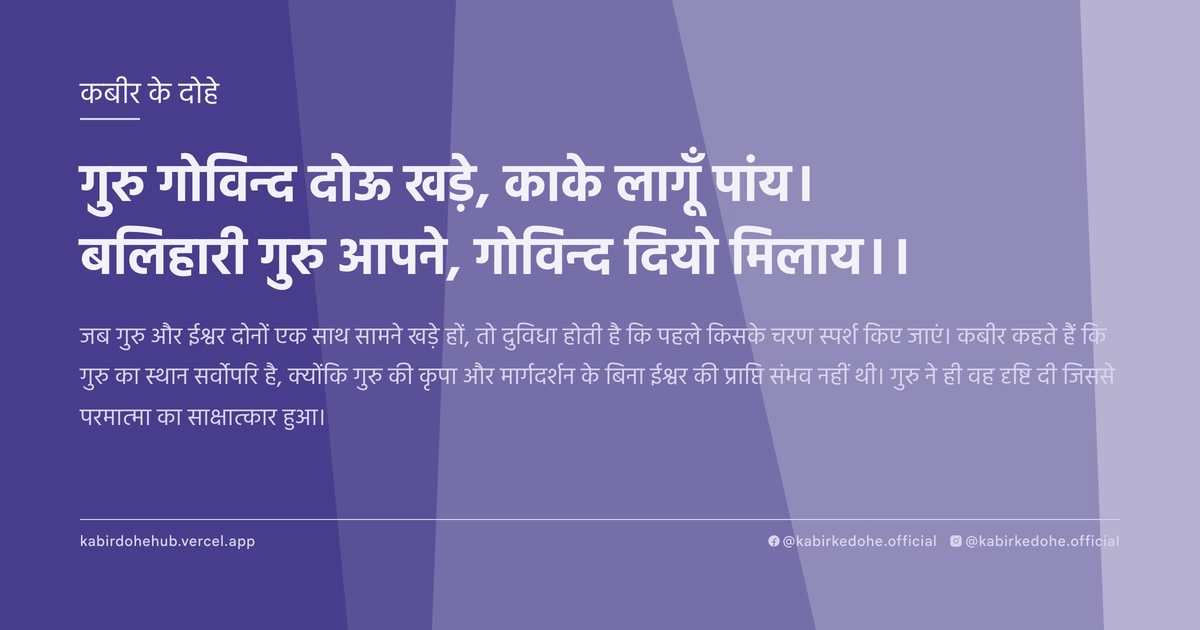
गुरु गोविन्द दोऊ खड़े, काके लागूँ पांय।
बलिहारी गुरु आपने, गोविन्द दियो मिलाय।।
Guru Govind dou khade, kaake laagun paany. Balihari guru aapne, Govind diyo milay.
इस पृष्ठ पर इस कबीर दोहे का अर्थ (meaning), हिंदी व्याख्या और अंग्रेज़ी अनुवाद, दार्शनिक विश्लेषण और व्यावहारिक जीवन सीख दी गई है। यह दोहा गुरु महत्व (The Guru's Importance) विषय से जुड़ा है — Kabir doha meaning and explanation in Hindi and English.
अर्थ (Meaning):
जब गुरु और ईश्वर दोनों एक साथ सामने खड़े हों, तो दुविधा होती है कि पहले किसके चरण स्पर्श किए जाएं। कबीर कहते हैं कि गुरु का स्थान सर्वोपरि है, क्योंकि गुरु की कृपा और मार्गदर्शन के बिना ईश्वर की प्राप्ति संभव नहीं थी। गुरु ने ही वह दृष्टि दी जिससे परमात्मा का साक्षात्कार हुआ।
When both the spiritual teacher (Guru) and the Divine (Govind) stand before the seeker, a dilemma arises: whose feet should be touched first? Kabir declares that the Guru is paramount, for it was the Guru's grace and guidance that paved the way to the Divine. Without the teacher, the realization of God would have remained unattainable.
व्याख्या (Interpretation):
शाब्दिक रूप से यह दोहा गुरु की महानता का वर्णन करता है, परंतु आध्यात्मिक स्तर पर यह 'साधन' और 'साध्य' के संबंध को दर्शाता है। यहाँ 'गोविन्द' केवल एक बाहरी देवता नहीं, बल्कि वह निर्गुण ब्रह्म है जो हमारे भीतर व्याप्त है। गुरु वह माध्यम है जो माया के पर्दे को हटाकर आत्मा का परिचय परमात्मा से कराता है। यह अद्वैत वेदांत के उस सिद्धांत को पुष्ट करता है जहाँ ज्ञान की प्राप्ति के लिए एक अनुभवी मार्गदर्शक अनिवार्य है। गुरु यहाँ केवल एक व्यक्ति नहीं, बल्कि वह 'चेतना' है जो अज्ञानता के अंधकार को मिटाती है। इस विरोधाभास में ही सत्य छिपा है कि ईश्वर सर्वोपरि है, फिर भी उसे पाने का मार्ग गुरु से होकर जाता है। अंततः, गुरु और गोविंद एक ही सत्य के दो रूप बन जाते हैं।
Literally, this couplet praises the teacher, but spiritually, it explores the relationship between the 'means' (Sadhana) and the 'end' (Sadhya). 'Govind' here is not merely an external deity but the Nirgun Brahman residing within. The Guru is the catalyst who lifts the veil of Maya, introducing the Atman to the Brahman. This aligns with Advaita Vedanta, where a realized guide is essential to transcend the illusion of duality. The Guru represents the 'Awakened Consciousness' that dissolves the darkness of ignorance. The central paradox lies in the fact that while the Divine is the ultimate destination, the Guru is the indispensable map. Ultimately, the distinction between the teacher and the taught, the seeker and the sought, vanishes into a singular, non-dual reality.
दार्शनिक विश्लेषण (Philosophical Analysis):
कबीर का यह दोहा उस युग की उपज है जहाँ कर्मकांड और बाहरी आडंबरों का बोलबाला था। कबीर ने मंदिर-मस्जिद के बजाय 'अनुभव' और 'ज्ञान' को प्राथमिकता दी। यहाँ गुरु का महत्व इसलिए है क्योंकि वह व्यक्ति को रस्मों से निकालकर आत्म-साक्षात्कार की ओर ले जाता है। यह दृष्टिकोण सूफी मत के 'पीर' और वेदांत के 'गुरु' के समन्वय जैसा है, जहाँ आंतरिक रूपांतरण बाहरी पूजा से अधिक महत्वपूर्ण है।
दार्शनिक रूप से, यह अहंकार के विसर्जन की प्रक्रिया है। जब शिष्य गुरु के चरणों में झुकता है, तो वह वास्तव में अपने 'अहं' को समर्पित करता है। बिना इस समर्पण के, ज्ञान का बीज अंकुरित नहीं हो सकता। कबीर यह स्पष्ट करते हैं कि ईश्वर तक पहुँचने का मार्ग शास्त्रों के रटने से नहीं, बल्कि एक जीवित चेतना के सानिध्य से संभव है।
यह दोहा जाति और वर्ग के भेदभाव को पूरी तरह नकारता है। गुरु कोई भी हो सकता है—एक जुलाहा, एक मोची या एक साधारण मनुष्य—यदि उसके पास सत्य का अनुभव है। यह सामाजिक क्रांति का एक सूक्ष्म रूप है, जहाँ योग्यता और अनुभव को जन्म या पद से ऊपर रखा गया है।
अद्वैत वेदांत के संदर्भ में, यह 'अज्ञान' (Avidya) और 'विद्या' के बीच का संघर्ष है। गोविंद वह सत्य है जो हमेशा मौजूद था, लेकिन गुरु वह प्रकाश है जिसने उस सत्य को दृश्यमान बनाया। अतः, गुरु की कृतज्ञता वास्तव में उस सत्य के प्रति कृतज्ञता है जिसने हमें मुक्त किया।
अंततः, यह शिक्षण हमें सिखाता है कि आध्यात्मिक यात्रा एकांत की नहीं, बल्कि एक परंपरा की निरंतरता है। यह 'गुरु-शिष्य' परंपरा का उत्सव है, जो मनुष्य को उसकी सीमित पहचान से निकालकर उसे ब्रह्मांडीय चेतना (Universal Consciousness) से जोड़ता है।
This couplet emerges from an era dominated by rigid ritualism and external piety. Kabir prioritized 'Anubhava' (direct experience) over institutionalized religion. The Guru's supremacy here is rooted in the ability to shift the seeker's focus from outward rituals to inward realization, mirroring the Sufi concept of the 'Pir' and the Vedantic 'Guru'.
Philosophically, this is a process of ego-annihilation. When the disciple bows to the Guru, they are not bowing to a person, but surrendering their 'Ahamkara' (ego). Without this surrender, the seed of spiritual knowledge cannot germinate. Kabir asserts that the path to the Divine is not found in the rote memorization of scriptures, but through the presence of a living, realized consciousness.
This teaching fundamentally rejects caste and class hierarchies. The Guru can be anyone—a weaver, a cobbler, or a commoner—provided they possess the experience of Truth. This is a subtle social revolution, elevating spiritual merit and lived experience over hereditary status or formal titles.
In the context of Advaita Vedanta, this represents the transition from 'Avidya' (ignorance) to 'Vidya' (knowledge). Govind is the eternal truth that always existed; the Guru is the light that makes that truth visible. Therefore, gratitude toward the Guru is an expression of gratitude toward the Truth itself.
Ultimately, this teaching suggests that the spiritual journey is not a solitary venture but a continuation of a lineage of wisdom. It celebrates the Guru-Shishya tradition, which expands the human identity from the limited 'I' to the expansive Universal Consciousness.
मूल संदेश (Core Message):
- अहंकार का विसर्जन ही ज्ञान का प्रवेश द्वार है।
- बाहरी खोज को आंतरिक अनुभव में बदलें।
- गुरु वह सेतु है जो सीमित को अनंत से जोड़ता है।
- सत्य किसी मंदिर में नहीं, बल्कि जागृत चेतना में है।
- कृतज्ञता ही वह चाबी है जो आध्यात्मिक द्वार खोलती है।
- The dissolution of ego is the gateway to true knowledge.
- Transform external searching into internal experience.
- The Guru is the bridge connecting the finite to the infinite.
- Truth resides not in temples, but in awakened consciousness.
- Gratitude is the key that unlocks the spiritual doors.
व्यावहारिक उदाहरण (Practical Example):
वाराणसी के घाटों पर रहने वाले एक वृद्ध विधवा, जानकी, का जीवन अभावों और अकेलेपन से भरा था। वह प्रतिदिन घंटों मंदिर में पूजा करतीं, लेकिन उनके मन में एक गहरी टीस और ईश्वर के प्रति शिकायतें थीं। उन्हें लगता था कि उनकी भक्ति का कोई फल नहीं मिल रहा है।
एक दिन उनकी मुलाकात एक साधारण से दिखने वाले साधु से हुई, जो किसी आश्रम के नहीं थे और न ही कोई उपदेश देते थे। उन्होंने जानकी को देखा और बस इतना कहा, 'माँ, तुम पत्थर को पुकार रही हो, जबकि वह पत्थर तुम्हारे भीतर धड़क रहा है।'
जानकी को पहले यह बात अजीब लगी। उन्होंने तर्क दिया कि वे शास्त्रों के अनुसार पूजा कर रही हैं। साधु ने मुस्कुराते हुए उन्हें अपनी आँखें बंद करने और केवल अपनी आती-जाती सांसों को देखने के लिए कहा। उन्होंने कहा, 'पूजा वह नहीं जो दुनिया देखे, पूजा वह है जो तुम स्वयं को देखो।'
कई हफ्तों तक, जानकी ने उस साधु के मार्गदर्शन में मौन का अभ्यास किया। उन्होंने महसूस किया कि जिस शांति की तलाश में वे मंदिर की सीढ़ियाँ चढ़ती थीं, वह शांति उनके भीतर के मौन में छिपी थी।
एक दिन, जब वे मंदिर जा रही थीं, उन्होंने देखा कि एक छोटा बच्चा भूख से रो रहा है। पहले की जानकी शायद उसे अनदेखा कर मंदिर की आरती में लीन हो जातीं, लेकिन अब उनके भीतर एक नई करुणा जागी थी।
उन्होंने अपनी पोटली से अपना आखिरी भोजन उस बच्चे को दे दिया। उस क्षण, उन्हें महसूस हुआ कि उस बच्चे की मुस्कान में वही 'गोविन्द' था जिसे वे मूर्तियों में खोज रही थीं।
जानकी को समझ आया कि साधु ने उन्हें केवल एक तकनीक नहीं सिखाई, बल्कि उनकी दृष्टि बदल दी। उन्होंने उन्हें उस सत्य से मिलाया जो उनके भीतर ही था, लेकिन अहंकार और रीति-रिवाजों के बोझ तले दबा हुआ था।
अब जानकी के लिए मंदिर केवल एक स्थान नहीं, बल्कि हर जीवित प्राणी एक मंदिर बन गया। उन्होंने महसूस किया कि साधु (गुरु) ने उन्हें उस ईश्वर (गोविन्द) से मिला दिया जो प्रेम और सेवा में बसता है।
उनकी शिकायतें समाप्त हो गईं और उनका जीवन एक शांत नदी की तरह बहने लगा। उन्होंने जाना कि गुरु का हाथ पकड़कर ही वे उस अनंत सागर तक पहुँच सकीं।
यह 'कबीर ट्विस्ट' था—बाहरी पूजा का आंतरिक प्रेम में रूपांतरण। जानकी ने जाना कि गुरु की कृपा ने ही उन्हें स्वयं के वास्तविक स्वरूप से परिचित कराया।
Janaki, an elderly widow living on the ghats of Varanasi, led a life of scarcity and loneliness. She spent hours daily in temple worship, yet her heart was heavy with grievances and complaints toward God, feeling her devotion yielded no fruit.
One day, she encountered a simple-looking monk who belonged to no ashram and preached no formal sermons. He looked at Janaki and simply said, 'Mother, you are calling out to a stone, while that very stone is beating within you.'
Janaki found this strange and argued that she was following the scriptures. The monk smiled and asked her to close her eyes and simply observe her breath. He told her, 'Worship is not what the world sees; worship is seeing yourself.'
For several weeks, under the monk's guidance, Janaki practiced silence. She realized that the peace she sought by climbing temple stairs was hidden within her own stillness.
One day, while walking to the temple, she saw a small child crying from hunger. The old Janaki might have ignored him to immerse herself in the temple's Aarti, but a new compassion had awakened within her.
She gave her last bit of food from her bundle to the child. In that moment, she felt that the smile of the child held the same 'Govind' she had been searching for in idols.
Janaki realized the monk had not just taught her a technique, but had shifted her entire perception. He had introduced her to the truth that was always within her, buried under the weight of ego and ritual.
Now, for Janaki, the temple was no longer just a building; every living being became a temple. She understood that the Guru had connected her to the God who resides in love and service.
Her grievances vanished, and her life began to flow like a calm river. She recognized that only by holding the Guru's hand could she reach that infinite ocean.
This was the 'Kabir Twist'—the transformation of external ritual into internal love. Janaki understood that the Guru's grace had introduced her to her own true nature.
अभ्यास मार्गदर्शन (Practice Guidance):
- प्रतिदिन 15 मिनट 'साक्षी भाव' का अभ्यास करें: अपने विचारों को बिना किसी निर्णय के देखें, जैसे आप किसी और को देख रहे हों।
- आत्म-पूछताछ जर्नल: लिखें कि आपके जीवन में 'गुरु' की भूमिका किसने निभाई (कोई व्यक्ति, कोई परिस्थिति या कोई पुस्तक) और उसने आपकी दृष्टि कैसे बदली।
- व्यवहारिक परिवर्तन: किसी ऐसे व्यक्ति की मदद करें जिससे आप असहमत हैं, यह मानते हुए कि उनमें भी वही 'दिव्य तत्व' है जो आपमें है।
- डायग्नोस्टिक चेकलिस्ट: क्या मैं अभी भी बाहरी प्रतीकों और रस्मों में उलझा हूँ? क्या मैं सत्य को खोजने के बजाय उसे 'मांग' रहा हूँ? क्या मैं अपने मार्गदर्शक के प्रति कृतज्ञ हूँ या केवल अपनी उपलब्धियों का श्रेय ले रहा हूँ?
- Practice 'Witness Consciousness' for 15 minutes daily: Observe your thoughts without judgment, as if you are watching someone else.
- Self-Inquiry Journaling: Write about who has played the role of 'Guru' in your life (a person, a circumstance, or a book) and how they shifted your perception.
- Behavioral Shift: Help someone you fundamentally disagree with, acknowledging that the same 'Divine Element' resides in them as it does in you.
- Diagnostic Checklist: Am I still entangled in external symbols and rituals? Am I 'demanding' truth rather than seeking it? Am I grateful to my guide, or am I taking sole credit for my spiritual growth?
चिंतन प्रश्न (Reflection Questions):
- क्या मेरा 'गुरु' वास्तव में मुझे चुनौती देता है, या वह केवल मेरी धारणाओं की पुष्टि करता है?
- यदि मेरे जीवन से सभी धार्मिक प्रतीक हटा दिए जाएं, तो क्या मेरा ईश्वर से संबंध बना रहेगा?
- मैं अपनी डिजिटल पहचान (Social Media Ego) को कितना महत्व देता हूँ और यह मेरे वास्तविक आत्म-साक्षात्कार में कैसे बाधा है?
- क्या मैं ज्ञान का उपयोग दूसरों को नीचा दिखाने के लिए कर रहा हूँ या स्वयं को विनम्र बनाने के लिए?
- मेरे जीवन का वह कौन सा 'अंधेरा' है जिसे मैं स्वीकार करने से डरता हूँ, और क्या मैं उसे देखने का साहस रखता हूँ?
- Does my 'Guru' truly challenge me, or do they merely validate my existing biases?
- If all religious symbols were removed from my life, would my connection to the Divine remain?
- How much value do I place on my digital identity (Social Media Ego), and how does this obstruct my true self-realization?
- Am I using spiritual knowledge to look down upon others or to cultivate humility within myself?
- What is that 'darkness' in my life I am afraid to acknowledge, and do I have the courage to face it?