
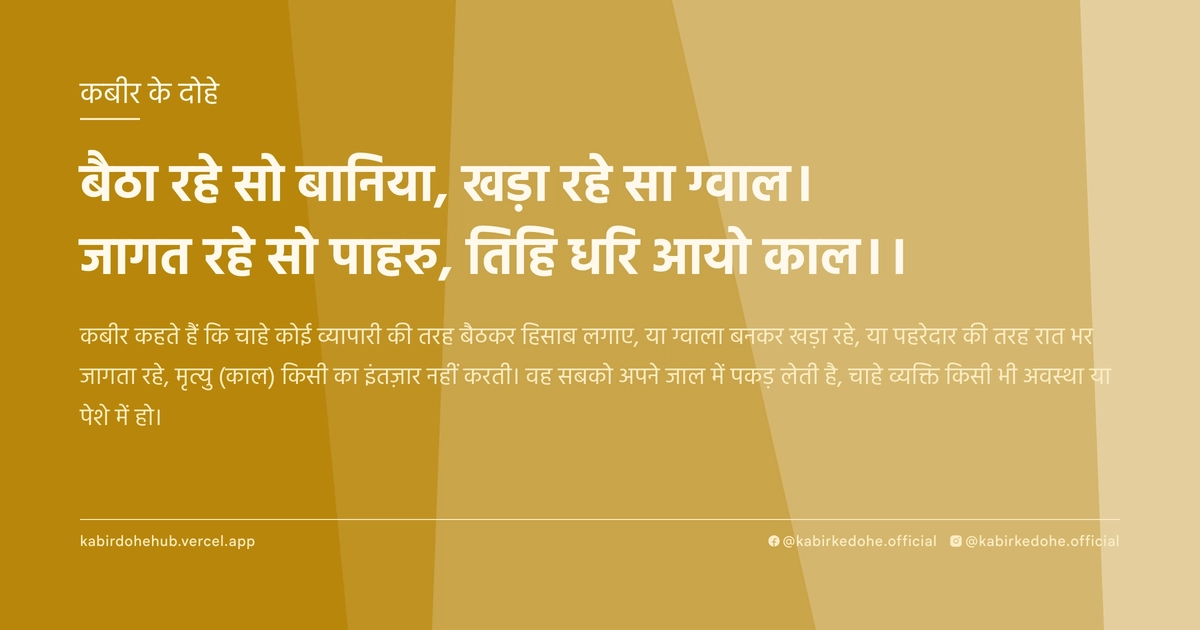
बैठा रहे सो बानिया, खड़ा रहे सा ग्वाल।
जागत रहे सो पाहरु, तिहि धरि आयो काल।।
Baitha rahe so baniya, khada rahe sa gwal. Jagat rahe so pahru, tih dhari aayo kaal.
इस पृष्ठ पर इस कबीर दोहे का अर्थ (meaning), हिंदी व्याख्या और अंग्रेज़ी अनुवाद, दार्शनिक विश्लेषण और व्यावहारिक जीवन सीख दी गई है। यह दोहा मृतुक्यता (Mortality) विषय से जुड़ा है — Kabir doha meaning and explanation in Hindi and English.
अर्थ (Meaning):
कबीर कहते हैं कि चाहे कोई व्यापारी की तरह बैठकर हिसाब लगाए, या ग्वाला बनकर खड़ा रहे, या पहरेदार की तरह रात भर जागता रहे, मृत्यु (काल) किसी का इंतज़ार नहीं करती। वह सबको अपने जाल में पकड़ लेती है, चाहे व्यक्ति किसी भी अवस्था या पेशे में हो।
Kabir asserts that whether one remains seated like a merchant calculating profits, stands like a cowherd tending his flock, or stays awake like a sentinel guarding the gates, Death (Kaal) eventually claims everyone. No state of alertness or social position can offer sanctuary from the inevitable end.
व्याख्या (Interpretation):
यहाँ 'बानिया', 'ग्वाल' और 'पाहुरु' केवल व्यवसायों के प्रतीक नहीं हैं, बल्कि मानवीय चेतना की विभिन्न अवस्थाओं—स्थिरता, सक्रियता और सतर्कता—को दर्शाते हैं। बानिया भौतिक संचय का प्रतीक है, ग्वाला सांसारिक कर्तव्यों का, और पहरेदार मानसिक जागरूकता का। कबीर इस विरोधाभास को उजागर करते हैं कि भौतिक या मानसिक सतर्कता मृत्यु से नहीं बचा सकती। यह 'माया' के उस भ्रम को तोड़ता है जहाँ मनुष्य सोचता है कि वह अपनी योजनाओँ या सावधानी से समय को जीत सकता है। वास्तव में, यह दोहा आत्मा (Atman) की नश्वरता और ब्रह्म (Brahman) की शाश्वतता के बीच के अंतर को स्पष्ट करता है, जहाँ केवल आत्म-साक्षात्कार ही वास्तविक मुक्ति है, न कि बाहरी सतर्कता।
In this verse, the 'merchant', 'cowherd', and 'sentinel' are not merely professions but symbols of human consciousness: stability, activity, and vigilance. The merchant represents material accumulation, the cowherd worldly duties, and the sentinel mental alertness. Kabir highlights the paradox that neither material planning nor mental vigilance can evade Death. This shatters the illusion of 'Maya', where humans believe they can outsmart time through caution or strategy. It emphasizes the distinction between the transient nature of the physical form and the eternal nature of the Atman, suggesting that only spiritual realization, rather than external alertness, provides true liberation from the cycle of birth and death.
दार्शनिक विश्लेषण (Philosophical Analysis):
कबीर का यह दोहा उनके युग के सामाजिक और धार्मिक पाखंडों पर एक गहरा प्रहार है। उस समय लोग कर्मकांडों और बाहरी दिखावों के माध्यम से मोक्ष पाने की कोशिश करते थे। कबीर यहाँ 'निरगुण भक्ति' के सिद्धांत को लाते हुए बताते हैं कि मृत्यु एक सार्वभौमिक सत्य है जो जाति, धर्म या पेशे का भेद नहीं करती। यह विचार अद्वैत वेदांत के करीब है, जहाँ यह माना जाता है कि शरीर केवल एक वस्त्र है और वास्तविक तत्व शुद्ध चेतना है।
सूफी मत के 'फना' (अहंकार का विनाश) के सिद्धांत से जुड़ते हुए, कबीर यह समझाते हैं कि जब तक मनुष्य अपनी पहचान को 'व्यापारी' या 'पहरेदार' जैसे सांसारिक लेबलों से जोड़ता है, वह काल के भय में रहता है। अहंकार (Ego) ही वह पर्दा है जो हमें यह विश्वास दिलाता है कि हम समय को नियंत्रित कर सकते हैं।
ritualism (कर्मकांड) का विरोध करते हुए कबीर कहते हैं कि मंदिर की सीढ़ियाँ चढ़ना या माला जपना तब तक व्यर्थ है जब तक आंतरिक रूपांतरण न हो। मृत्यु का भय केवल उन्हें होता है जिन्होंने जीवन भर केवल 'संग्रह' (accumulation) किया है, न कि 'समर्पण' (surrender)।
मनोवैज्ञानिक स्तर पर, यह दोहा हमें 'मृत्यु जागरूकता' (Memento Mori) की ओर ले जाता है। जब हम यह स्वीकार कर लेते हैं कि कोई भी बाहरी सुरक्षा कवच काम नहीं करेगा, तब हम वर्तमान क्षण में जीने और आंतरिक शांति की खोज करने के लिए प्रेरित होते हैं।
अंततः, कबीर यह संदेश देते हैं कि वास्तविक 'जागृति' वह नहीं है जो पहरेदार की है (शारीरिक जागरण), बल्कि वह है जो आत्मा की है (आध्यात्मिक जागरण)। जब व्यक्ति स्वयं को ब्रह्म के साथ एक महसूस करता है, तब काल का भय समाप्त हो जाता है क्योंकि वह जान जाता है कि जो जन्म लेता है वही मरता है, लेकिन जो 'सत्य' है वह अविनाशी है।
Kabir's couplet is a profound critique of the social and religious hypocrisies of his era. During his time, people sought salvation through rigid rituals and outward displays of piety. By invoking the principles of 'Nirgun Bhakti' (devotion to the formless), Kabir asserts that death is a universal truth that transcends caste, creed, or profession.
Connecting to the Sufi concept of 'Fana' (annihilation of the ego), Kabir explains that as long as a person identifies themselves with worldly labels—be it a merchant or a sentinel—they remain trapped in the fear of time. The ego is the veil that creates the illusion of control over destiny.
In his rejection of ritualism, Kabir suggests that climbing temple stairs or chanting beads is futile without internal transformation. The fear of death resides only in those who have spent their lives in 'accumulation' rather than 'surrender'.
Psychologically, this verse introduces the concept of 'Memento Mori'. By accepting that no external shield is effective, the individual is driven toward mindfulness and the pursuit of inner peace in the present moment.
Ultimately, Kabir distinguishes between physical wakefulness (the sentinel's watch) and spiritual awakening. When one realizes the non-duality of Atman and Brahman, the fear of death vanishes, for they understand that while the body is transient, the essence of Truth is immortal.
मूल संदेश (Core Message):
- बाहरी सतर्कता आध्यात्मिक सुरक्षा नहीं दे सकती।
- मृत्यु का भय केवल अहंकार की उपज है।
- संग्रह का त्याग ही वास्तविक शांति का मार्ग है।
- जागृति का अर्थ शारीरिक जागरण नहीं, आत्म-बोध है।
- समय के साथ लड़ने के बजाय उसमें विलीन होना सीखें।
- अंतिम सत्य केवल वह है जो समय से परे है।
- External vigilance cannot provide spiritual security.
- The fear of death is merely a product of the ego.
- Renouncing accumulation is the path to true peace.
- Awakening is not physical alertness, but self-realization.
- Learn to merge with time rather than fighting it.
- The ultimate truth is that which exists beyond time.
व्यावहारिक उदाहरण (Practical Example):
वाराणसी के एक पुराने घाट पर माधव नाम का एक वृद्ध बुनकर रहता था। माधव अपने काम में इतना मग्न था कि उसने जीवन भर केवल बेहतरीन रेशमी साड़ियाँ बुनने और धन संचय करने को ही अपना लक्ष्य माना। वह खुद को बहुत सतर्क मानता था; उसने अपने धन को सुरक्षित रखने के लिए कई तिजोरियाँ बनाई थीं और अपने स्वास्थ्य के लिए हर संभव सावधानी बरती थी। वह अक्सर अपने पड़ोसियों को चेतावनी देता था कि बिना योजना के जीवन व्यर्थ है।
एक दिन, शहर में एक अज्ञात महामारी फैली। माधव ने अपने घर के दरवाजे बंद कर लिए, खिड़कियाँ मज़बूत कर लीं और खुद को पूरी तरह अलग कर लिया। वह एक 'पहरेदार' की तरह जाग रहा था, यह सुनिश्चित करते हुए कि कोई भी बाहरी तत्व उसके सुरक्षित घेरे में न घुसे। उसे विश्वास था कि उसकी सावधानी और उसकी संचित संपत्ति उसे हर संकट से बचा लेगी।
लेकिन एक सुबह, माधव को अचानक सीने में तेज़ दर्द हुआ। वह बिस्तर से उठ भी नहीं पाया। उसने देखा कि उसकी तिजोरियाँ उसके सामने थीं, लेकिन वे उसे सांस लेने में मदद नहीं कर सकती थीं। उसकी सारी 'सतर्कता' और 'योजनाएँ' उस समय बेकार हो गईं जब काल ने उसके दरवाजे पर दस्तक दी।
उस अंतिम क्षण में, माधव को कबीर का वह दोहा याद आया जो उसने बचपन में सुना था। उसे एहसास हुआ कि वह जीवन भर केवल 'बाहरी पहरेदारी' करता रहा, लेकिन अपनी आत्मा के भीतर की शून्यता को कभी नहीं भरा। उसने धन तो जोड़ा, लेकिन प्रेम और करुणा को भुला दिया।
उसने महसूस किया कि वह एक बानिया की तरह हिसाब लगाता रहा, लेकिन जीवन के वास्तविक मूल्य का हिसाब कभी नहीं किया। उसकी सारी सावधानी केवल शरीर को बचाने के लिए थी, आत्मा को मुक्त करने के लिए नहीं।
जैसे ही उसकी सांसें उखड़ने लगीं, उसने अपनी आँखें बंद कीं और पहली बार अपनी सारी संपत्ति और पहचान को त्याग कर स्वयं को उस अनंत शून्य को समर्पित कर दिया।
उसका चेहरा, जो अब तक तनाव और चिंता से भरा था, अचानक शांत हो गया। उसने पाया कि मृत्यु का भय केवल उस 'अहंकार' में था जो खुद को सुरक्षित समझना चाहता था।
जब वह अहंकार मिटा, तो उसे एक असीम शांति का अनुभव हुआ। माधव ने अंततः जान लिया कि काल से बचने का एकमात्र तरीका उसके साथ लड़ना या उससे छिपना नहीं, बल्कि उसमें विलीन हो जाना है।
On an ancient ghat in Varanasi lived an elderly weaver named Madhav. Madhav was so absorbed in his craft that he spent his entire life focusing on weaving the finest silk sarees and accumulating wealth. He considered himself extremely cautious, building multiple vaults for his money and taking every possible precaution for his health. He often warned his neighbors that a life without a plan was wasted.
One day, an unknown epidemic swept through the city. Madhav locked his doors, reinforced his windows, and completely isolated himself. He remained awake like a 'sentinel', ensuring that no external element could penetrate his secure perimeter. He believed his caution and accumulated riches would protect him from any crisis.
However, one morning, Madhav felt a sudden, sharp pain in his chest. He could not even rise from his bed. He saw his vaults standing before him, but they could not help him breathe. All his 'vigilance' and 'plans' became useless the moment Death knocked on his door.
In those final moments, Madhav recalled a couplet by Kabir he had heard in childhood. He realized he had spent his life practicing 'external guarding' but had never filled the void within his soul. He had accumulated wealth but forgotten love and compassion.
He understood that he had been calculating like a merchant, but had never accounted for the true value of life. All his caution was merely to preserve the body, not to liberate the soul.
As his breath faded, he closed his eyes and for the first time surrendered his wealth and identity to the infinite void.
His face, previously etched with tension and anxiety, suddenly became serene. He discovered that the fear of death existed only in the 'ego' that sought security.
Once that ego dissolved, he experienced an immense peace. Madhav finally learned that the only way to escape Death is not to fight or hide from it, but to merge with it.
अभ्यास मार्गदर्शन (Practice Guidance):
- प्रतिदिन 15 मिनट मौन ध्यान करें, जहाँ आप अपनी सांसों के आने और जाने को देखें और यह महसूस करें कि यह शरीर क्षणभंगुर है।
- एक 'मृत्यु-चिंतन' जर्नल लिखें: हर सप्ताह एक ऐसी चीज़ लिखें जिसे आप पकड़े हुए हैं (जैसे कोई पुरानी नाराजगी या भौतिक इच्छा) और उसे मानसिक रूप से त्याग दें।
- व्यवहार परिवर्तन: दिन में कम से कम एक बार किसी ऐसे व्यक्ति की निस्वार्थ मदद करें जिससे आपको कोई लाभ न हो, ताकि 'संग्रह' की प्रवृत्ति कम हो और 'समर्पण' बढ़े।
- डायग्नोस्टिक चेकलिस्ट: क्या आप भविष्य की चिंता में वर्तमान को खो रहे हैं? क्या आप अपनी पहचान अपने पद या संपत्ति से जोड़ते हैं? यदि हाँ, तो आप अभी भी 'बानिया' या 'पहरेदार' की मानसिक अवस्था में हैं।
- Practice 15 minutes of silent meditation daily, observing the breath and realizing the transience of the physical body.
- Maintain a 'Mortality Journal': Each week, identify one attachment (a grudge or a material desire) and consciously practice letting it go.
- Behavioral Shift: Perform one selfless act of service daily without expecting any return, shifting the mindset from 'accumulation' to 'surrender'.
- Diagnostic Checklist: Are you losing the present to future anxieties? Do you derive your identity from your status or possessions? If so, you are still operating in the consciousness of the 'merchant' or 'sentinel'.
चिंतन प्रश्न (Reflection Questions):
- यदि आज आपका अंतिम दिन हो, तो आपकी कौन सी 'तैयारियाँ' वास्तव में मायने रखेंगी और कौन सी व्यर्थ साबित होंगी?
- आप अपनी पहचान किन बाहरी लेबलों (पद, प्रतिष्ठा, संपत्ति) से जोड़ते हैं, और यदि वे छीन लिए जाएँ, तो आपके भीतर क्या बचेगा?
- क्या आपकी 'सतर्कता' वास्तव में जागरूकता है, या यह केवल खोने का डर है?
- आप अपने जीवन में किस 'तिजोरी' को भरने की कोशिश कर रहे हैं, और क्या वह तिजोरी कभी भर पाएगी?
- क्या आप मृत्यु से डरते हैं, या उस अधूरेपन से जो आपने जीवन में महसूस किया है?
- आपका 'डिजिटल अहंकार' (सोशल मीडिया इमेज) आपको वास्तविक सत्य से कितना दूर ले जा रहा है?
- If today were your last day, which of your 'preparations' would actually matter and which would prove futile?
- What external labels (status, reputation, wealth) do you attach to your identity, and what remains if they are stripped away?
- Is your 'vigilance' truly awareness, or is it simply the fear of loss?
- Which 'vault' are you trying to fill in your life, and can that vault ever be truly full?
- Do you fear death, or the incompleteness you have felt throughout your life?
- How far is your 'digital ego' (social media image) distancing you from the actual truth?