
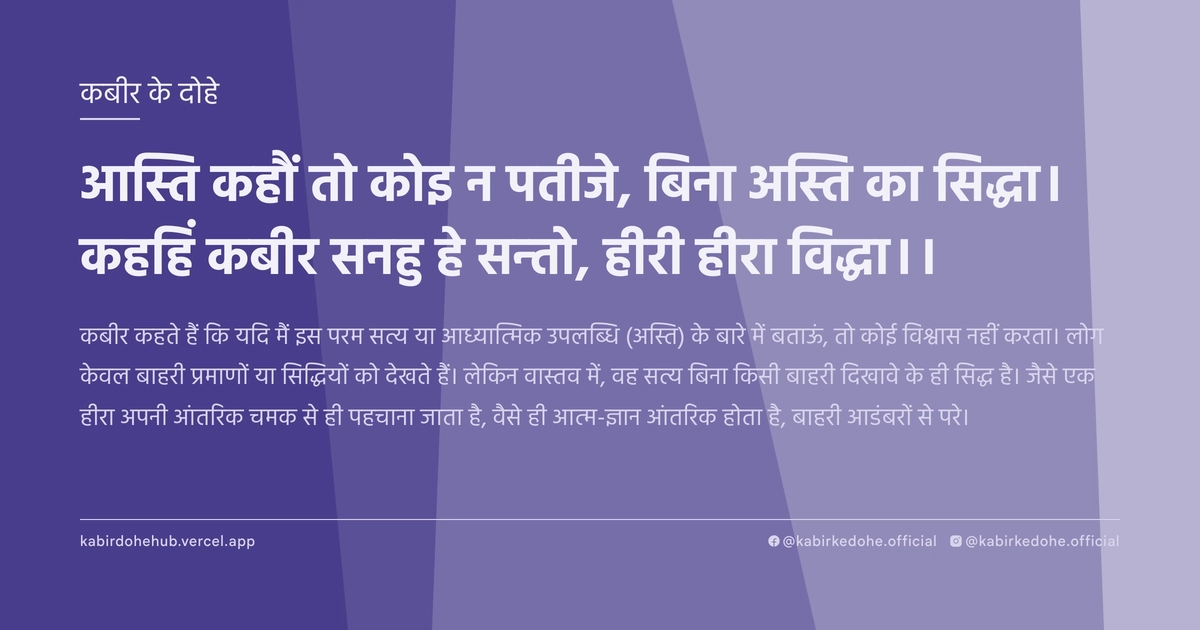
आस्ति कहौं तो कोइ न पतीजे, बिना अस्ति का सिद्धा।
कहहिं कबीर सनहु हे सन्तो, हीरी हीरा विद्धा।।
Asti kahon to koi na patije, bina asti ka siddha. Kahahin Kabir sanahu he santo, heeri heera viddha.
इस पृष्ठ पर इस कबीर दोहे का अर्थ (meaning), हिंदी व्याख्या और अंग्रेज़ी अनुवाद, दार्शनिक विश्लेषण और व्यावहारिक जीवन सीख दी गई है। यह दोहा सत्य (Truth) विषय से जुड़ा है — Kabir doha meaning and explanation in Hindi and English.
अर्थ (Meaning):
कबीर कहते हैं कि यदि मैं इस परम सत्य या आध्यात्मिक उपलब्धि (अस्ति) के बारे में बताऊं, तो कोई विश्वास नहीं करता। लोग केवल बाहरी प्रमाणों या सिद्धियों को देखते हैं। लेकिन वास्तव में, वह सत्य बिना किसी बाहरी दिखावे के ही सिद्ध है। जैसे एक हीरा अपनी आंतरिक चमक से ही पहचाना जाता है, वैसे ही आत्म-ज्ञान आंतरिक होता है, बाहरी आडंबरों से परे।
Kabir asserts that when he speaks of the ultimate existence or spiritual realization (Aasti), people remain skeptical because they seek external proofs or miraculous signs. However, true realization is self-evident and requires no outward validation. He compares this to a diamond; its value and authenticity are inherent in its internal brilliance, not in the labels or claims made about it.
व्याख्या (Interpretation):
इस दोहे का शाब्दिक अर्थ है कि सत्य की बात कहने पर लोग संदेह करते हैं। रूपक के स्तर पर, 'अस्ति' यहाँ शुद्ध चेतना या ब्रह्म का प्रतीक है। कबीर निरगुण भक्ति के माध्यम से यह समझा रहे हैं कि ईश्वर या सत्य किसी बाहरी कर्मकांड, तीर्थ या शास्त्र में नहीं, बल्कि अनुभव में है। माया मनुष्य को बाहरी चमक-धमक में उलझाए रखती है, जिससे वह आंतरिक हीरे (आत्मा) को नहीं देख पाता। यह अद्वैत वेदांत के उस सिद्धांत को दर्शाता है जहाँ ज्ञाता, ज्ञान और ज्ञेय एक हो जाते हैं। यहाँ विरोधाभास यह है कि जिसे दुनिया 'अदृश्य' या 'अस्तित्वहीन' मानती है, वही एकमात्र वास्तविक सत्य है।
Literally, the verse addresses the skepticism faced by the enlightened. Metaphorically, 'Aasti' represents Pure Consciousness or Brahman. Through the lens of Nirgun Bhakti, Kabir explains that Truth resides in direct experience, not in external rituals or scriptures. Maya (illusion) blinds humanity, making them seek validation in the material world while ignoring the 'diamond' of the Soul within. This aligns with Advaita Vedanta, where the duality between the seeker and the sought dissolves. The central paradox is that the most profound reality is often dismissed as non-existent because it lacks a physical, tangible form.
दार्शनिक विश्लेषण (Philosophical Analysis):
कबीर का यह दोहा उस सामाजिक और धार्मिक परिवेश की प्रतिक्रिया है जहाँ धर्म केवल बाहरी प्रतीकों, जैसे कि तिलक, माला और जातिगत श्रेष्ठता तक सीमित था। उन्होंने पुरजोर तरीके से इस बात का विरोध किया कि आध्यात्मिक उपलब्धि को बाहरी 'सिद्धियों' या चमत्कारिक शक्तियों से मापा जाए। उनके लिए, वास्तविक सिद्धि अहंकार का पूर्ण विलोपन है।
दार्शनिक रूप से, यह सूफी मत के 'फना' (अहंकार का विनाश) और अद्वैत वेदांत के 'अहं ब्रह्मास्मि' का संगम है। कबीर तर्क देते हैं कि सत्य को प्रमाणित करने के लिए किसी प्रमाण की आवश्यकता नहीं होती, क्योंकि सत्य स्वयं अपना प्रमाण है। जो व्यक्ति बाहरी प्रमाण खोजता है, वह वास्तव में माया के जाल में फँसा हुआ है, क्योंकि वह द्वैत (दो होने का भाव) में विश्वास करता है।
यहाँ 'हीरा' शब्द का प्रयोग अत्यंत महत्वपूर्ण है। हीरा अपनी कठोरता और शुद्धता के लिए जाना जाता है। इसी तरह, आत्म-ज्ञान वह कठोर सत्य है जो दुनिया के झूठ और भ्रम की परतों को काट देता है। कबीर यह स्पष्ट करते हैं कि आध्यात्मिक मार्ग पर चलने वाले को दुनिया की स्वीकृति की आवश्यकता नहीं है, क्योंकि सत्य की अपनी एक आंतरिक गूँज होती है।
मनोवैज्ञानिक स्तर पर, यह दोहा व्यक्ति को बाहरी मान्यता (External Validation) की भूख से मुक्त करने का आह्वान है। जब तक मनुष्य दूसरों की नजरों में 'सिद्ध' दिखने की कोशिश करता है, वह अपनी वास्तविक प्रकृति से दूर होता रहता है। वास्तविक रूपांतरण तब होता है जब व्यक्ति बाहरी शोर को शांत कर आंतरिक मौन में उस 'हीरे' को खोज लेता है।
अंततः, कबीर यह संदेश देते हैं कि धर्म कोई ऐसी वस्तु नहीं है जिसे खरीदा या प्रदर्शित किया जा सके। यह एक आंतरिक रूपांतरण है। जो लोग केवल शास्त्रों को पढ़कर या अनुष्ठान करके सत्य पाना चाहते हैं, वे केवल शब्दों के जाल में उलझे हैं। वास्तविक ज्ञान वह है जो अनुभव किया जाए, न कि वह जिसे केवल बोला जाए।
This Doha is a direct reaction to the socio-religious climate of Kabir's era, where spirituality was reduced to external symbols like tilaks, beads, and caste hierarchies. He vehemently rejected the notion that spiritual attainment should be measured by 'Siddhis' or miraculous powers. For Kabir, the only true achievement is the total annihilation of the ego.
Philosophically, this is a convergence of the Sufi concept of 'Fana' (annihilation of self) and the Advaita Vedanta realization of 'Aham Brahmasmi' (I am Brahman). Kabir argues that Truth requires no external proof because Truth is its own evidence. Those seeking external validation are trapped in Maya, as they operate from a place of duality—separating the observer from the observed.
The metaphor of the 'diamond' is pivotal. A diamond is defined by its hardness and purity. Similarly, self-realization is the uncompromising truth that cuts through the layers of worldly deception and illusion. Kabir emphasizes that the spiritual seeker does not need the world's approval, for Truth possesses its own internal resonance.
Psychologically, the verse calls for liberation from the hunger for external validation. As long as a person strives to appear 'enlightened' in the eyes of others, they remain alienated from their true nature. Genuine transformation occurs only when one silences the external noise to discover the 'diamond' within the stillness of the heart.
Ultimately, Kabir suggests that religion is not a commodity to be acquired or displayed. It is an internal alchemy. Those who seek truth solely through scriptures or rituals are merely entangled in a web of words. Real knowledge is that which is experienced, not that which is merely recited.
मूल संदेश (Core Message):
- बाहरी प्रमाण की खोज वास्तव में आंतरिक शून्यता का संकेत है।
- सत्य को शब्दों में नहीं, बल्कि अनुभव की गहराई में खोजें।
- अहंकार वह पर्दा है जो हमें आंतरिक हीरे को देखने से रोकता है।
- मौन सबसे शक्तिशाली प्रमाण है कि आप सत्य के करीब हैं।
- वास्तविक सिद्धि वह है जहाँ 'मैं' का भाव पूरी तरह समाप्त हो जाए।
- आध्यात्मिकता प्रदर्शन नहीं, बल्कि एक आंतरिक रूपांतरण की यात्रा है।
- The search for external proof is often a symptom of internal emptiness.
- Seek Truth not in the noise of words, but in the depth of experience.
- The ego is the veil that prevents us from seeing the internal diamond.
- Silence is the most powerful evidence of proximity to the Truth.
- True attainment is where the sense of 'I' is completely dissolved.
- Spirituality is not a performance, but a journey of internal transformation.
व्यावहारिक उदाहरण (Practical Example):
वाराणसी के एक पुराने घाट पर रामदीन नाम का एक वृद्ध नाविक रहता था। वह जीवन भर लोगों को नदी पार कराता रहा, लेकिन उसकी सादगी ऐसी थी कि लोग उसे अनपढ़ और अज्ञानी समझते थे।
रामदीन कभी मंदिर नहीं गया, न ही उसने कभी कोई कठिन व्रत रखा। वह बस अपनी नाव चलाते समय एक गहरे मौन में रहता था, जिसे वह अपना 'भीतरी संगीत' कहता था।
शहर के बड़े पंडित और विद्वान अक्सर उसके पास आते और उसे धर्म के बारे में उपदेश देते, यह दावा करते हुए कि बिना शास्त्रों के ज्ञान के मोक्ष संभव नहीं है।
रामदीन बस मुस्कुराता और कहता, 'साहब, मैं तो बस इस नदी की तरह बह रहा हूँ।' लोग उसका मजाक उड़ाते और उसे 'मूर्ख' कहते क्योंकि उसके पास दिखाने के लिए कोई आध्यात्मिक डिग्री या चमत्कार नहीं थे।
एक दिन, एक अहंकारी युवा विद्वान ने उसे चुनौती दी कि वह अपनी 'सिद्धि' का कोई प्रमाण दे। रामदीन ने शांति से कहा, 'हीरे की परख आग में होती है, शब्दों में नहीं।'
उस विद्वान ने देखा कि रामदीन के चेहरे पर एक ऐसी असीम शांति और करुणा थी, जो उस विद्वान ने अपनी सारी किताबों और कठोर तपस्या के बाद भी प्राप्त नहीं की थी।
विद्वान ने महसूस किया कि वह केवल 'अस्ति' (अस्तित्व) के बारे में पढ़ रहा था, जबकि रामदीन उस अस्तित्व को जी रहा था। रामदीन का मौन ही उसका सबसे बड़ा प्रमाण था।
उस क्षण विद्वान का अहंकार टूट गया। उसने समझा कि असली ज्ञान वह नहीं जो दूसरों को प्रभावित करे, बल्कि वह है जो व्यक्ति को भीतर से शांत और सरल बना दे।
रामदीन ने बिना किसी उपदेश के, केवल अपने अस्तित्व से उस विद्वान को यह सिखा दिया कि सत्य बाहरी प्रदर्शन का विषय नहीं है।
विद्वान ने अपनी किताबें किनारे रखीं और रामदीन के साथ नाव पर बैठकर मौन का अभ्यास करने लगा, यह जानकर कि हीरा अंदर ही चमकता है।
On an ancient ghat in Varanasi lived an elderly boatman named Ramdin. He spent his life ferrying people across the river, but his simplicity was such that people dismissed him as illiterate and ignorant.
Ramdin never frequented the grand temples, nor did he observe rigorous fasts. He simply remained in a deep silence while rowing his boat, which he called his 'inner music.'
High priests and scholars of the city often visited him to preach about religion, claiming that liberation was impossible without the knowledge of the scriptures.
Ramdin would only smile and say, 'Sir, I am merely flowing like this river.' People mocked him and called him a 'fool' because he had no spiritual degrees or miracles to showcase.
One day, an arrogant young scholar challenged him to provide some proof of his 'Siddhi' or spiritual attainment. Ramdin calmly replied, 'A diamond is tested by fire, not by words.'
The scholar noticed an infinite peace and compassion on Ramdin's face—a serenity that the scholar had failed to achieve despite all his books and rigorous austerities.
The scholar realized that while he had been reading about 'Aasti' (Existence), Ramdin was actually living it. Ramdin's silence was his greatest evidence.
In that moment, the scholar's ego shattered. He understood that true knowledge is not that which impresses others, but that which makes a person internally peaceful and simple.
Without a single sermon, Ramdin taught the scholar through his mere existence that Truth is not a matter of external display.
The scholar set aside his books and sat with Ramdin on the boat to practice silence, realizing that the diamond shines from within.
अभ्यास मार्गदर्शन (Practice Guidance):
- प्रतिदिन 20 मिनट 'साक्षी भाव' का अभ्यास करें, जहाँ आप अपने विचारों को बिना किसी निर्णय के केवल देखें, जैसे आप किसी और को देख रहे हों।
- एक डायरी लिखें जिसमें आप उन क्षणों को दर्ज करें जब आपने बाहरी प्रशंसा की इच्छा की। विश्लेषण करें कि वह इच्छा आपके आंतरिक सत्य को कैसे ढक रही है।
- व्यवहार परिवर्तन: अगले एक सप्ताह तक किसी भी आध्यात्मिक या नैतिक उपलब्धि का दावा न करें। अपनी अच्छाई को गुप्त रखें और देखें कि यह आपके अहंकार को कैसे कम करता है।
- निदान चेकलिस्ट: क्या मैं दूसरों को प्रभावित करने के लिए धर्म का उपयोग कर रहा हूँ? क्या मेरी शांति बाहरी परिस्थितियों पर निर्भर है? क्या मैं प्रमाणों के बिना सत्य को स्वीकार करने में सक्षम हूँ?
- Practice 'Witness Consciousness' (Sakshi Bhav) for 20 minutes daily, observing your thoughts without judgment, as if you are watching a stranger.
- Maintain a journal to record moments when you craved external validation. Analyze how that desire obscures your internal truth.
- Behavioral Shift: For one week, refrain from claiming any spiritual or moral superiority. Keep your acts of kindness secret and observe how this diminishes the ego.
- Diagnostic Checklist: Am I using spirituality to impress others? Is my peace dependent on external circumstances? Am I capable of accepting Truth without needing tangible proof?
चिंतन प्रश्न (Reflection Questions):
- यदि मेरी सारी सामाजिक पहचान और उपलब्धियाँ छीन ली जाएँ, तो क्या मेरे भीतर कुछ ऐसा बचेगा जिसे मैं 'सत्य' कह सकूँ?
- मैं अपनी आध्यात्मिक छवि को बनाए रखने के लिए दुनिया के सामने कितना मुखौटा पहनता हूँ?
- क्या मेरी ईश्वर की खोज वास्तव में सत्य को पाने के लिए है, या केवल अपनी श्रेष्ठता सिद्ध करने के लिए?
- मेरे जीवन का वह कौन सा हिस्सा है जहाँ मैं अभी भी बाहरी प्रमाणों का गुलाम हूँ?
- क्या मैं उस सत्य को स्वीकार कर सकता हूँ जो मेरी मान्यताओं और तर्क के बिल्कुल विपरीत है?
- मेरे भीतर का 'हीरा' क्या है, और मैंने उसे किन सांसारिक परतों के नीचे दबा रखा है?
- If all my social identities and achievements were stripped away, would there be something left within me that I could call 'Truth'?
- How much of a mask do I wear before the world to maintain my image of being a 'good' or 'spiritual' person?
- Is my search for the Divine truly to find Truth, or merely to prove my own superiority over others?
- Which part of my life is still enslaved by the need for external validation and proof?
- Can I accept a Truth that is diametrically opposed to my current beliefs and logic?
- What is the 'diamond' within me, and under which worldly layers have I buried it?