
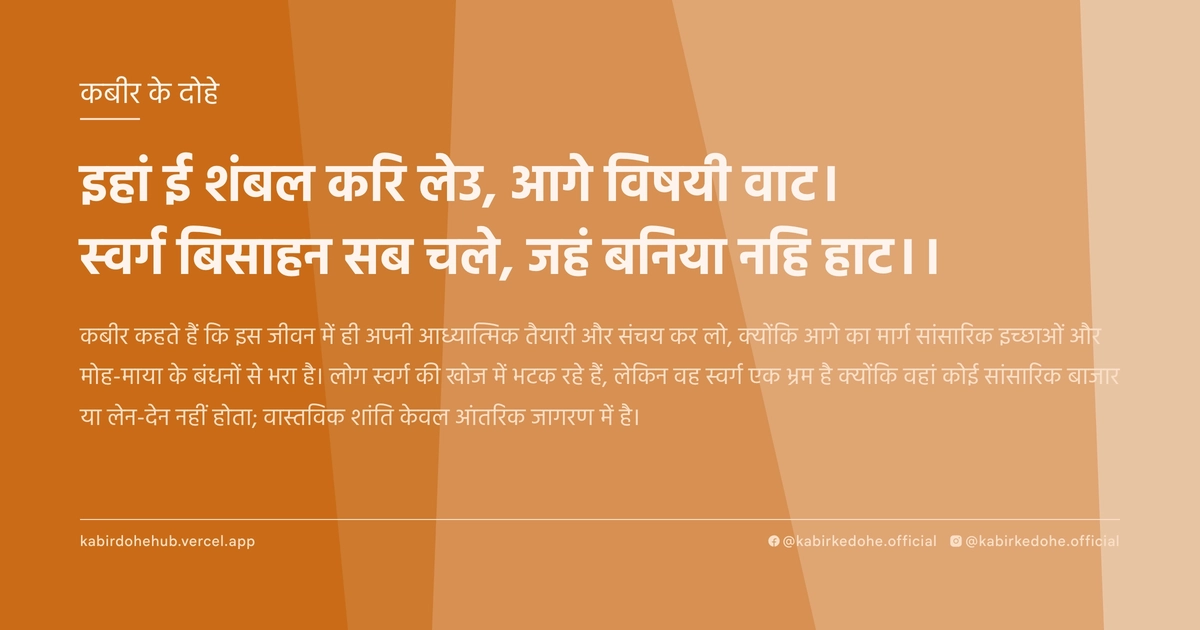
इहां ई शंबल करि लेउ, आगे विषयी वाट।
स्वर्ग बिसाहन सब चले, जहं बनिया नहि हाट।।
Ihan ee shambal kari leu, aage vishayi vaat. Swarg bisahan sab chale, jahan baniya nahi haat.
इस पृष्ठ पर इस कबीर दोहे का अर्थ (meaning), हिंदी व्याख्या और अंग्रेज़ी अनुवाद, दार्शनिक विश्लेषण और व्यावहारिक जीवन सीख दी गई है। यह दोहा वैराग्य (Detachment) विषय से जुड़ा है — Kabir doha meaning and explanation in Hindi and English.
अर्थ (Meaning):
कबीर कहते हैं कि इस जीवन में ही अपनी आध्यात्मिक तैयारी और संचय कर लो, क्योंकि आगे का मार्ग सांसारिक इच्छाओं और मोह-माया के बंधनों से भरा है। लोग स्वर्ग की खोज में भटक रहे हैं, लेकिन वह स्वर्ग एक भ्रम है क्योंकि वहां कोई सांसारिक बाजार या लेन-देन नहीं होता; वास्तविक शांति केवल आंतरिक जागरण में है।
Kabir advises making one's spiritual preparations and gathering inner wealth in this very life, for the path ahead is fraught with sensory attachments and worldly desires. While crowds chase the illusion of a celestial paradise, he warns that such a place is devoid of the worldly commerce and ego-driven exchanges that define human existence; true liberation is found within.
व्याख्या (Interpretation):
यहाँ 'शंबल' का अर्थ केवल भौतिक संचय नहीं, बल्कि आध्यात्मिक पात्रता और विवेक का संचय है। कबीर संकेत देते हैं कि मनुष्य जीवन भर बाहरी दुनिया में 'बाजार' खोजता है, जबकि वास्तविक सत्य अंतर्मुखी होने में है। यह दोहा निर्गुण भक्ति के उस सिद्धांत को दर्शाता है जहाँ ईश्वर किसी बाहरी स्वर्ग में नहीं, बल्कि आत्मा के भीतर स्थित है। माया का पर्दा हमें यह विश्वास दिलाता है कि सुख किसी अन्य लोक में है, जबकि अद्वैत वेदांत के अनुसार, आत्मा और ब्रह्म एक ही हैं। जब तक अहंकार (बनिया) का लेन-देन चलता रहता है, तब तक मोक्ष संभव नहीं है। यह विरोधाभास है कि हम जिसे पाने के लिए भागते हैं, वह वास्तव में हमारे भीतर की शून्यता और शांति में निहित है।
Here, 'Shambal' does not refer to material accumulation but to the gathering of spiritual merit and discernment. Kabir suggests that humans spend their lives searching for a 'marketplace' of rewards, whereas the ultimate truth lies in introspection. This verse embodies the Nirgun Bhakti principle that the Divine is not in a distant heaven but within the soul. The veil of Maya convinces us that happiness exists in another realm, while Advaita Vedanta posits the non-duality of Atman and Brahman. As long as the 'merchant' of ego continues the transaction of desires, liberation remains elusive. The central paradox is that the paradise we seek externally is actually the stillness and void found within our own being.
दार्शनिक विश्लेषण (Philosophical Analysis):
कबीर का यह दोहा तत्कालीन सामाजिक और धार्मिक पाखंड पर एक तीखा प्रहार है। उन्होंने उस समय के प्रचलित स्वर्ग-नरक के सिद्धांतों को चुनौती दी, जो लोगों को कर्मकांडों और बाहरी अनुष्ठानों में उलझाए रखते थे। कबीर का दर्शन सूफीवाद के 'फना' (अहंकार का विनाश) और वेदांत के 'माया' के सिद्धांत का संगम है। वे तर्क देते हैं कि जो व्यक्ति इस जीवन में अपनी इंद्रियों पर विजय नहीं पाता, वह मृत्यु के बाद किसी काल्पनिक सुख की आशा नहीं कर सकता।
उनका विरोध केवल धर्म से नहीं, बल्कि उस 'व्यापारिक मानसिकता' से था जिसने धर्म को भी एक सौदेबाजी बना दिया था—जैसे दान देकर स्वर्ग खरीदना। यह 'बनिया' या व्यापारी का रूपक वास्तव में मानव अहंकार का प्रतीक है जो हर चीज़ का मूल्य लगाता है। कबीर के अनुसार, आध्यात्मिक मार्ग कोई सौदा नहीं है, बल्कि पूर्ण समर्पण और आत्म-साक्षात्कार की प्रक्रिया है।
ऐतिहासिक रूप से, कबीर ने जाति और वर्ग के भेदों को नकारते हुए एक ऐसी सार्वभौमिक चेतना की बात की जो किसी मंदिर या मस्जिद की मोहताज नहीं थी। उनका दृष्टिकोण मनोवैज्ञानिक रूपांतरण पर केंद्रित था, जहाँ साधक अपनी पहचान को सामाजिक पदवियों से हटाकर शुद्ध चेतना में विलीन करता है।
यह शिक्षण हमें बताता है कि 'स्वर्ग' कोई भौगोलिक स्थान नहीं, बल्कि मन की एक अवस्था है। जब व्यक्ति वासनाओं (विषयी वाट) के जाल को काट देता है, तब वह उस अवस्था में पहुँचता है जहाँ कोई लेन-देन नहीं, केवल अस्तित्व का आनंद है।
अंततः, कबीर यह स्पष्ट करते हैं कि मोक्ष किसी बाहरी शक्ति द्वारा दिया गया पुरस्कार नहीं है, बल्कि यह स्वयं के भीतर की अशुद्धियों को साफ करने का परिणाम है। जो इस जीवन में जागृत नहीं हुआ, वह अनंत काल तक भ्रम के चक्र में घूमता रहेगा।
This couplet is a sharp critique of the social and religious hypocrisies of Kabir's era. He challenged the prevailing notions of heaven and hell, which kept people entangled in superficial rituals and external ceremonies. Kabir's philosophy is a confluence of the Sufi concept of 'Fana' (annihilation of the ego) and the Vedantic principle of 'Maya' (illusion).
He argues that one who fails to conquer their senses in this lifetime cannot hope for a hypothetical bliss after death. His opposition was not merely toward religion, but toward the 'mercantile mindset' that had turned faith into a transaction—such as purchasing a place in heaven through donations.
The metaphor of the 'Baniya' or merchant represents the human ego that seeks to quantify and trade spiritual merit. According to Kabir, the spiritual path is not a bargain but a process of total surrender and self-realization.
Historically, Kabir rejected caste and class distinctions, advocating for a universal consciousness independent of temples or mosques. His approach focused on psychological transformation, where the seeker shifts their identity from social labels to pure consciousness.
This teaching reveals that 'Heaven' is not a geographical location but a state of mind. When an individual severs the ties of sensory desires (Vishayi Vaat), they enter a state where there is no transaction, only the joy of existence.
Ultimately, Kabir clarifies that liberation is not a reward bestowed by an external deity, but the result of purifying one's own inner being. Those who do not awaken in this life remain trapped in the cycle of illusion indefinitely.
मूल संदेश (Core Message):
- बाहरी स्वर्ग एक भ्रम है; वास्तविक शांति भीतर है।
- धर्म कोई व्यापार नहीं, बल्कि पूर्ण समर्पण है।
- अहंकार का लेन-देन ही मोक्ष का सबसे बड़ा अवरोध है।
- वर्तमान क्षण में आध्यात्मिक तैयारी ही एकमात्र सत्य है।
- निस्वार्थ कर्म ही आत्मा का वास्तविक संचय है।
- इंद्रियों की वासनाओं को पार करना ही वास्तविक यात्रा है।
- External paradise is an illusion; true peace resides within.
- Spirituality is not a transaction, but total surrender.
- The commerce of ego is the greatest barrier to liberation.
- Spiritual preparation in the present is the only truth.
- Selfless action is the only true accumulation of the soul.
- Transcending sensory desires is the only authentic journey.
व्यावहारिक उदाहरण (Practical Example):
वाराणसी के एक पुराने घाट पर रहने वाले माधव नाम के एक वृद्ध बुनकर थे। माधव का पूरा जीवन रेशमी साड़ियों की बुनाई में बीता, लेकिन उनका मन हमेशा इस चिंता में रहता था कि मृत्यु के बाद उनका क्या होगा। वे हर साल बड़ी मात्रा में दान करते और कठिन व्रत रखते, यह सोचकर कि वे अपने लिए स्वर्ग में एक बड़ा महल 'खरीद' रहे हैं।
एक दिन उन्होंने एक फकीर को देखा जो केवल एक फटे हुए कपड़े में था, लेकिन उसके चेहरे पर ऐसी शांति थी जो माधव ने अपने सबसे अमीर ग्राहकों के चेहरे पर भी नहीं देखी थी। माधव ने उनसे पूछा, 'मैं स्वर्ग पाने के लिए इतना संचय कर रहा हूँ, क्या मैं सही रास्ते पर हूँ?'
फकीर ने मुस्कुराते हुए कहा, 'माधव, तुम उस बाजार में सामान जमा कर रहे हो जहाँ कोई दुकानदार नहीं बैठता। तुम बाहर महल बना रहे हो, जबकि तुम्हारा अपना घर—तुम्हारी आत्मा—धूल से भरा है।'
यह बात माधव के दिल में चुभ गई। उन्होंने महसूस किया कि उनका पूरा धार्मिक जीवन एक 'सौदा' था। वे भगवान को दान दे रहे थे ताकि बदले में उन्हें सुख मिले। यह एक व्यापार था, भक्ति नहीं।
अगले कुछ महीनों में, माधव ने बाहरी दिखावे वाले दान बंद कर दिए। उन्होंने अपनी बुनाई को ही प्रार्थना बना लिया। अब वे रेशम के धागों को केवल पैसे के लिए नहीं, बल्कि उस परमात्मा की अभिव्यक्ति के रूप में बुनने लगे।
उन्होंने अपने अहंकार को त्यागना शुरू किया। जब भी उनके मन में यह विचार आता कि 'मैं एक महान दानी हूँ', वे तुरंत उस विचार को पकड़कर नष्ट कर देते। उन्होंने सीखा कि वास्तविक 'शंबल' (संचय) दया, क्षमा और आंतरिक मौन है।
एक दिन एक गरीब अनाथ बच्चा उनके पास आया। माधव ने बिना किसी उम्मीद या पुण्य की इच्छा के, अपनी सबसे कीमती शॉल उसे दे दी। उस क्षण उन्हें जो आनंद मिला, वह किसी भी काल्पनिक स्वर्ग के वादे से कहीं अधिक वास्तविक था।
माधव अब मृत्यु से नहीं डरते थे। उन्होंने समझ लिया था कि जिस स्वर्ग की वे तलाश कर रहे थे, वह उनके भीतर की निस्वार्थता और प्रेम में ही था। उन्होंने अपना 'बाजार' बंद कर दिया और 'सत्य' को अपना लिया।
उनके जीवन का रूपांतरण यह था कि वे अब भविष्य के पुरस्कारों के लिए नहीं, बल्कि वर्तमान क्षण की पवित्रता के लिए जीते थे। उनकी शांति अब बाहरी परिस्थितियों पर निर्भर नहीं थी।
In the ancient ghats of Varanasi lived an elderly weaver named Madhav. Madhav spent his entire life weaving exquisite silk sarees, yet his mind was perpetually clouded by anxiety about what would happen after death. He donated lavishly and observed rigorous fasts, believing he was 'purchasing' a grand mansion in heaven.
One day, he encountered a wandering dervish clad in a single tattered cloth, yet possessing a serenity Madhav had never seen even in his wealthiest clients. Madhav asked, 'I am accumulating so much for heaven; am I on the right path?'
The dervish smiled and replied, 'Madhav, you are storing goods in a market where no merchant sits. You are building palaces outside, while your own home—your soul—is covered in dust.'
These words pierced Madhav's heart. He realized that his entire religious life had been a 'transaction.' He was giving to God expecting a return in the form of pleasure. It was business, not devotion.
Over the next few months, Madhav ceased his performative charities. He turned his weaving into a prayer. He no longer wove silk threads for money alone, but as an expression of the Divine.
He began to dismantle his ego. Whenever the thought 'I am a great donor' arose, he consciously intercepted and dissolved it. He learned that true 'Shambal' (accumulation) consists of compassion, forgiveness, and inner silence.
One day, an orphaned child approached him. Without any desire for merit or reward, Madhav gave the child his most precious shawl. The joy he felt in that moment was far more real than any promise of a celestial paradise.
Madhav no longer feared death. He understood that the heaven he sought existed within his own selflessness and love. He closed his 'marketplace' and embraced the Truth.
The transformation in his life was that he no longer lived for future rewards, but for the purity of the present moment. His peace was no longer dependent on external circumstances.
अभ्यास मार्गदर्शन (Practice Guidance):
- दैनिक आत्म-निरीक्षण: प्रतिदिन 20 मिनट मौन बैठें और देखें कि आपके कौन से कार्य 'पुरस्कार' की इच्छा से प्रेरित हैं और कौन से निस्वार्थ हैं।
- अहंकार का विसर्जन: दिन में कम से कम एक ऐसा कार्य करें जिससे किसी को मदद मिले, लेकिन यह सुनिश्चित करें कि किसी को पता न चले और न ही आप स्वयं को 'दाता' महसूस करें।
- जर्नलिंग प्रॉम्प्ट: 'यदि मुझे मृत्यु के बाद कोई पुरस्कार नहीं मिलना है, तो क्या मैं अभी भी वही धार्मिक या नैतिक कार्य करूँगा जो मैं आज कर रहा हूँ?'
- निदान चेकलिस्ट: क्या आप दूसरों की प्रशंसा के लिए दान करते हैं? क्या आप ईश्वर से सौदेबाजी करते हैं? क्या आप वर्तमान की शांति के बजाय भविष्य के सुख की कल्पना में अधिक समय बिताते हैं? यदि हाँ, तो आप अभी भी 'बाजार' में हैं।
- Daily Self-Observation: Sit in silence for 20 minutes daily and observe which of your actions are driven by a desire for 'reward' and which are genuinely selfless.
- Dissolution of Ego: Perform at least one act of service daily, ensuring it remains anonymous and that you do not perceive yourself as the 'giver'.
- Journaling Prompt: 'If there were no rewards after death, would I still perform the same religious or moral acts that I do today?'
- Diagnostic Checklist: Do you donate for public praise? Do you bargain with God? Do you spend more time imagining future bliss than experiencing present peace? If yes, you are still in the 'marketplace'.
चिंतन प्रश्न (Reflection Questions):
- मेरे जीवन के कौन से 'पुण्य' वास्तव में एक निवेश हैं जिनसे मैं भविष्य में लाभ की उम्मीद करता हूँ?
- क्या मेरी धार्मिक पहचान मेरे वास्तविक स्वरूप को छिपाने का एक मुखौटा है?
- यदि समाज में मेरी छवि पूरी तरह मिट जाए, तो मेरे भीतर क्या बचेगा?
- मैं अपनी आध्यात्मिक प्रगति को किस पैमाने पर मापता हूँ—शांति से या दूसरों की स्वीकृति से?
- क्या मैं ईश्वर से प्रेम करता हूँ, या उस सुख से जो ईश्वर के नाम पर मुझे मिलने का वादा किया गया है?
- मेरे भीतर का 'बनिया' (व्यापारी) किन रिश्तों में लेन-देन की उम्मीद करता है?
- Which of my 'virtuous' acts are actually investments from which I expect a future return?
- Is my religious identity a mask that hides my true nature?
- If my social image were completely erased, what would remain within me?
- By what metric do I measure my spiritual progress—inner peace or external validation?
- Do I love the Divine, or do I love the pleasure promised in the name of the Divine?
- In which of my relationships does the 'merchant' within me still expect a transaction?