
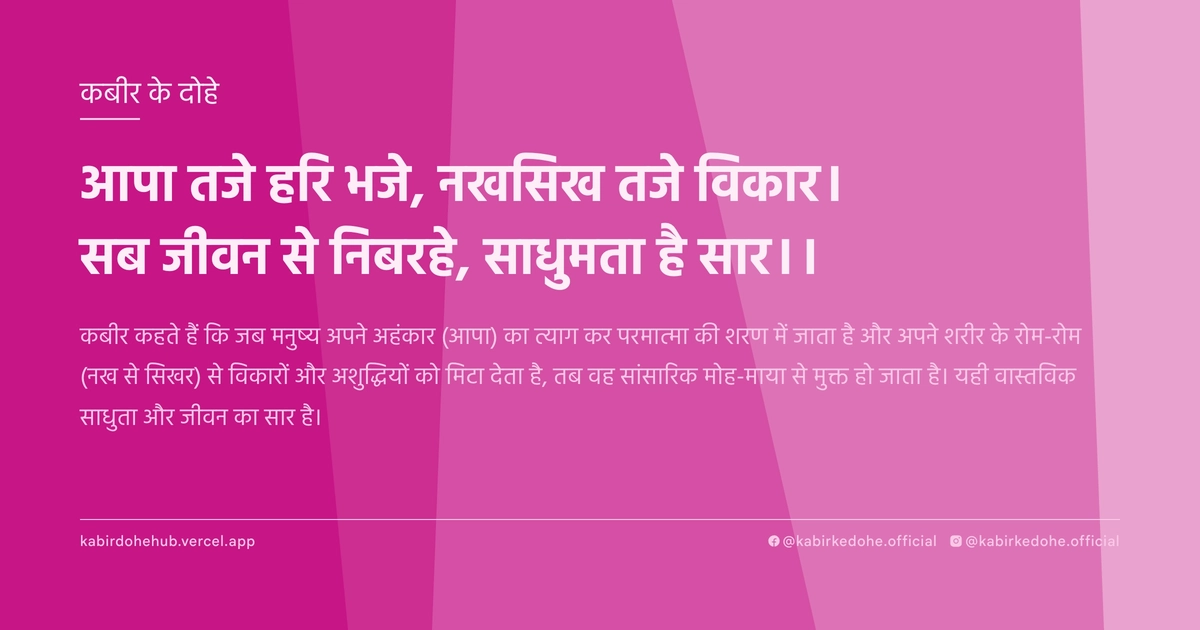
आपा तजे हरि भजे, नखसिख तजे विकार।
सब जीवन से निबरहे, साधुमता है सार।।
Aapa taje Hari bhaje, nakhasikh taje vikaar. Sab jeevan se nibarahe, sadhumata hai saar.
इस पृष्ठ पर इस कबीर दोहे का अर्थ (meaning), हिंदी व्याख्या और अंग्रेज़ी अनुवाद, दार्शनिक विश्लेषण और व्यावहारिक जीवन सीख दी गई है। यह दोहा वैराग्य (Detachment) विषय से जुड़ा है — Kabir doha meaning and explanation in Hindi and English.
अर्थ (Meaning):
कबीर कहते हैं कि जब मनुष्य अपने अहंकार (आपा) का त्याग कर परमात्मा की शरण में जाता है और अपने शरीर के रोम-रोम (नख से सिखर) से विकारों और अशुद्धियों को मिटा देता है, तब वह सांसारिक मोह-माया से मुक्त हो जाता है। यही वास्तविक साधुता और जीवन का सार है।
Kabir teaches that when a human relinquishes the ego (Aapa) and turns toward the Divine, purging every atom of their being—from the nails to the crown of the head—of all impurities and vices, they transcend the entanglements of worldly existence. This state of detachment and purity is the true essence of sainthood.
व्याख्या (Interpretation):
इस दोहे का शाब्दिक अर्थ अहंकार के विसर्जन और आंतरिक शुद्धि से है। 'आपा' केवल घमंड नहीं, बल्कि वह झूठी पहचान है जिसे हम 'मैं' कहते हैं। जब यह 'मैं' मिटता है, तब 'हरि' (निराकार ब्रह्म) का उदय होता है। 'नखसिख' का उल्लेख यह दर्शाता है कि आध्यात्मिक परिवर्तन आंशिक नहीं, बल्कि संपूर्ण होना चाहिए। यह निर्गुण भक्ति का मार्ग है जहाँ साधक माया के आवरण को हटाकर आत्मा और परमात्मा की एकता (अद्वैत) को अनुभव करता है। यहाँ विरोधाभास यह है कि स्वयं को पूरी तरह मिटाकर ही मनुष्य वास्तव में स्वयं को प्राप्त करता है।
The literal meaning centers on the dissolution of ego and internal purification. 'Aapa' is not merely pride, but the false identity we call 'I'. When this 'I' vanishes, 'Hari' (the Formless Absolute) emerges. The reference to 'Nakhasikh' (nails to hair) signifies that spiritual transformation must be holistic, not partial. This aligns with Nirgun Bhakti, where the seeker strips away the veil of Maya to realize the non-duality of Atman and Brahman. The central paradox is that only by completely erasing the self does one truly find the Self.
दार्शनिक विश्लेषण (Philosophical Analysis):
कबीर का यह दर्शन मध्यकालीन भारत की रूढ़िवादिता और बाहरी कर्मकांडों के विरुद्ध एक सशक्त प्रहार है। वे तर्क देते हैं कि मंदिर, मस्जिद या तीर्थयात्रा तब तक व्यर्थ हैं जब तक 'आपा' जीवित है। यह दृष्टिकोण अद्वैत वेदांत के 'अहं ब्रह्मास्मि' और सूफीवाद के 'फना' (अहंकार का विनाश) के सिद्धांत से मेल खाता है, जहाँ साधक अपनी व्यक्तिगत पहचान को ईश्वर की अनंतता में विलीन कर देता है।
ऐतिहासिक रूप से, कबीर ने जाति और वर्ग के भेदभाव को नकारते हुए यह बताया कि साधुता किसी विशेष कुल या वस्त्र से नहीं, बल्कि आंतरिक शुद्धि से आती है। उनके लिए 'विकार' वे मानसिक विकार हैं—काम, क्रोध, लोभ, मोह—जो आत्मा को परमात्मा से अलग करते हैं।
मनोवैज्ञानिक स्तर पर, यह दोहा 'कॉग्निटिव डिसोनेंस' को समाप्त करने की बात करता है। जब हम अपनी सामाजिक छवि (Persona) को सत्य मान लेते हैं, तो हम दुख के चक्र में फंस जाते हैं। अहंकार का त्याग वास्तव में मानसिक बंधनों से मुक्ति है।
कबीर की 'निबरहे' (निरोधा) की अवधारणा संन्यास का बाहरी प्रदर्शन नहीं, बल्कि आंतरिक वैराग्य है। यह संसार को छोड़ने के बारे में नहीं, बल्कि संसार के प्रति अपनी आसक्ति को छोड़ने के बारे में है।
अंततः, यह दर्शन सिखाता है कि मोक्ष कोई बाहरी गंतव्य नहीं, बल्कि एक आंतरिक अवस्था है। जब व्यक्ति अपनी सीमाओं को पार कर समग्रता में विलीन होता है, तब वह 'साधु' बन जाता है, चाहे वह समाज की नज़र में कुछ भी हो।
Kabir's philosophy serves as a potent critique of the ritualism and orthodoxy prevalent in medieval India. He argues that temples, mosques, or pilgrimages are futile as long as the 'Aapa' (ego) persists. This perspective converges with the Advaita Vedanta concept of 'Aham Brahmasmi' and the Sufi doctrine of 'Fana' (annihilation of the self), where the seeker merges their individual identity into the infinite Divine.
Historically, by rejecting caste and class distinctions, Kabir asserts that sainthood is not derived from lineage or attire, but from internal purity. For him, 'Vikaar' represents the psychological impurities—lust, anger, greed, and attachment—that create a veil between the soul and the Absolute.
On a psychological level, this verse addresses the resolution of the conflict between the social persona and the true self. When we mistake our social mask for our identity, we remain trapped in suffering. The relinquishing of ego is, in essence, liberation from these mental constructs.
Kabir's concept of 'Nibarhe' (detachment) is not about external renunciation or fleeing to the forests, but about internal dispassion. It is not about leaving the world, but about leaving the attachment to the world.
Ultimately, this philosophy teaches that liberation is not an external destination but an internal state of being. When an individual transcends their limitations and merges into the wholeness of existence, they become a 'Sadhu', regardless of their societal status.
मूल संदेश (Core Message):
- अहंकार वह पर्दा है जो ईश्वर और आत्मा के बीच खड़ा है।
- पूर्ण शुद्धि केवल बाहरी स्नान से नहीं, बल्कि आंतरिक विकारों के त्याग से आती है।
- सच्ची साधुता पदवी में नहीं, बल्कि शून्य होने की क्षमता में है।
- जब 'मैं' मिटता है, तब अनंत का अनुभव शुरू होता है।
- सांसारिक मोह से मुक्ति का अर्थ पलायन नहीं, बल्कि अनासक्ति है।
- The ego is the veil standing between the Divine and the soul.
- True purity comes not from ritual bathing, but from shedding internal vices.
- Genuine sainthood lies not in titles, but in the capacity to become nothing.
- When the 'I' vanishes, the experience of the Infinite begins.
- Liberation from worldly attachment is not escape, but non-attachment.
व्यावहारिक उदाहरण (Practical Example):
एक समय की बात है, बनारस के घाटों पर रहने वाला एक वृद्ध विधवा, जिसे लोग केवल उसकी गरीबी और विवशता से जानते थे, वह अपना समय केवल दूसरों की सेवा और भजनों में बिताती थी।
शहर के एक प्रतिष्ठित पंडित जी, जो शास्त्रों के ज्ञाता थे, अक्सर उसे देखते और सोचते कि यह अनपढ़ स्त्री कैसे इतनी शांत रह सकती है जबकि उसके पास कुछ नहीं है।
पंडित जी का अहंकार उनके ज्ञान और उनकी उच्च जाति की पहचान से जुड़ा था; वे मानते थे कि मोक्ष केवल कठिन तपस्या और विधि-विधान से मिलता है।
एक दिन, पंडित जी ने उस विधवा से पूछा, 'तुम बिना किसी शास्त्र के, बिना किसी गुरु के, इतनी शांति कहाँ से लाती हो?'
विधवा ने मुस्कुराकर उत्तर दिया, 'महाराज, मैंने बस अपनी 'मैं' को गंगा में बहा दिया। अब यहाँ न मैं हूँ, न मेरा दुख, बस वह है जो सबमें है।'
पंडित जी को लगा कि यह एक साधारण बात है, लेकिन उस रात उन्हें नींद नहीं आई। उन्होंने महसूस किया कि उनके पास ज्ञान तो बहुत था, लेकिन उस ज्ञान का बोझ ही उनका अहंकार बन गया था।
उन्होंने देखा कि वे अपनी विद्वत्ता की रक्षा करने में इतने व्यस्त थे कि उन्होंने कभी वास्तव में प्रेम या करुणा का अनुभव ही नहीं किया था।
अगली सुबह, पंडित जी ने अपना कीमती रेशमी वस्त्र त्याग दिया और उस विधवा के साथ बैठकर चुपचाप ध्यान लगाने लगे।
उन्होंने महसूस किया कि जब तक वे 'पंडित' बने रहेंगे, वे सत्य को नहीं देख पाएंगे; उन्हें पहले उस 'पंडित' को मिटाना होगा।
धीरे-धीरे, उनके भीतर का क्रोध और श्रेष्ठता का भाव समाप्त हो गया, और उन्होंने पहली बार उस शांति का अनुभव किया जिसे वे किताबों में खोज रहे थे।
Once, on the ghats of Varanasi, lived an elderly widow known only for her poverty and helplessness, spending her days in selfless service and hymns.
A prestigious priest of the city, a scholar of the scriptures, often observed her and wondered how this unlettered woman could remain so serene despite having nothing.
The priest's ego was tied to his knowledge and high-caste identity; he believed liberation was only attainable through rigorous penance and ritualistic precision.
One day, the priest asked her, 'Without scriptures, without a formal guru, where do you find such profound peace?'
The widow smiled and replied, 'Sir, I simply cast my 'I' into the Ganges. Now there is no 'me', no 'my sorrow'—only That which resides in everyone.'
The priest initially dismissed this as a simpleton's answer, but that night, sleep evaded him. He realized that while he possessed vast knowledge, the burden of that knowledge had become his ego.
He saw that he was so preoccupied with defending his status as a scholar that he had never truly experienced unconditional love or compassion.
The next morning, the priest cast aside his expensive silk robes and sat beside the widow in silent meditation.
He understood that as long as he remained the 'Priest', he would never see the Truth; he first had to annihilate the 'Priest' within.
Gradually, his anger and sense of superiority dissolved, and for the first time, he experienced the peace he had spent a lifetime searching for in books.
अभ्यास मार्गदर्शन (Practice Guidance):
- दैनिक आत्म-निरीक्षण: प्रतिदिन 15 मिनट मौन बैठें और विचार करें कि दिन भर में कितनी बार 'मैं' या 'मेरा' शब्द आपके निर्णयों को प्रभावित कर रहा था।
- अहंकार विसर्जन अभ्यास: किसी ऐसे व्यक्ति की मदद करें जिससे आप घृणा करते हैं या जो आपसे सामाजिक स्तर पर नीचे है, बिना उसे यह एहसास दिलाए कि आप उपकार कर रहे हैं।
- जर्नलिंग प्रॉम्प्ट: लिखें कि आपकी कौन सी पहचान (पद, प्रतिष्ठा, धर्म) आपको सबसे अधिक बांधती है और यदि वह कल छिन जाए, तो आप कौन होंगे?
- डायग्नोस्टिक चेकलिस्ट: क्या आप किसी की आलोचना सुनकर विचलित होते हैं? क्या आप अपनी उपलब्धियों का श्रेय दूसरों को देने में हिचकिचाते हैं? यदि हाँ, तो 'आपा' अभी जीवित है।
- Daily Self-Observation: Sit in silence for 15 minutes daily and observe how many times the words 'I' or 'Mine' influenced your decisions throughout the day.
- Ego-Dissolution Practice: Perform an act of service for someone you dislike or someone socially marginalized, without letting them feel that you are doing them a favor.
- Journaling Prompt: Write down which identity (status, prestige, religion) binds you the most. If that identity were stripped away tomorrow, who would you be?
- Diagnostic Checklist: Do you feel disturbed by criticism? Do you hesitate to give credit to others for your achievements? If yes, the 'Aapa' is still active.
चिंतन प्रश्न (Reflection Questions):
- आपकी वह कौन सी 'छवि' है जिसे आप दुनिया के सामने बनाए रखने के लिए सबसे अधिक संघर्ष करते हैं?
- क्या आपकी आध्यात्मिक साधना वास्तव में अहंकार को मिटा रही है, या यह एक 'आध्यात्मिक अहंकार' (Spiritual Ego) को जन्म दे रही है?
- यदि आपका नाम, पेशा और सामाजिक दर्जा हटा दिया जाए, तो आपके भीतर क्या शेष बचेगा?
- आप किन विकारों को अपनी 'मजबूरी' बताकर सही ठहराते हैं?
- क्या आप वास्तव में दूसरों की भलाई चाहते हैं, या आप केवल अपनी 'भलाई करने वाले' की छवि से प्रेम करते हैं?
- Which 'image' of yourself do you struggle most to maintain in the eyes of the world?
- Is your spiritual practice truly dissolving the ego, or is it creating a 'Spiritual Ego'?
- If your name, profession, and social status were removed, what would remain within you?
- Which vices do you justify by labeling them as your 'nature' or 'necessity'?
- Do you truly desire the well-being of others, or are you merely in love with your image as a 'benefactor'?