
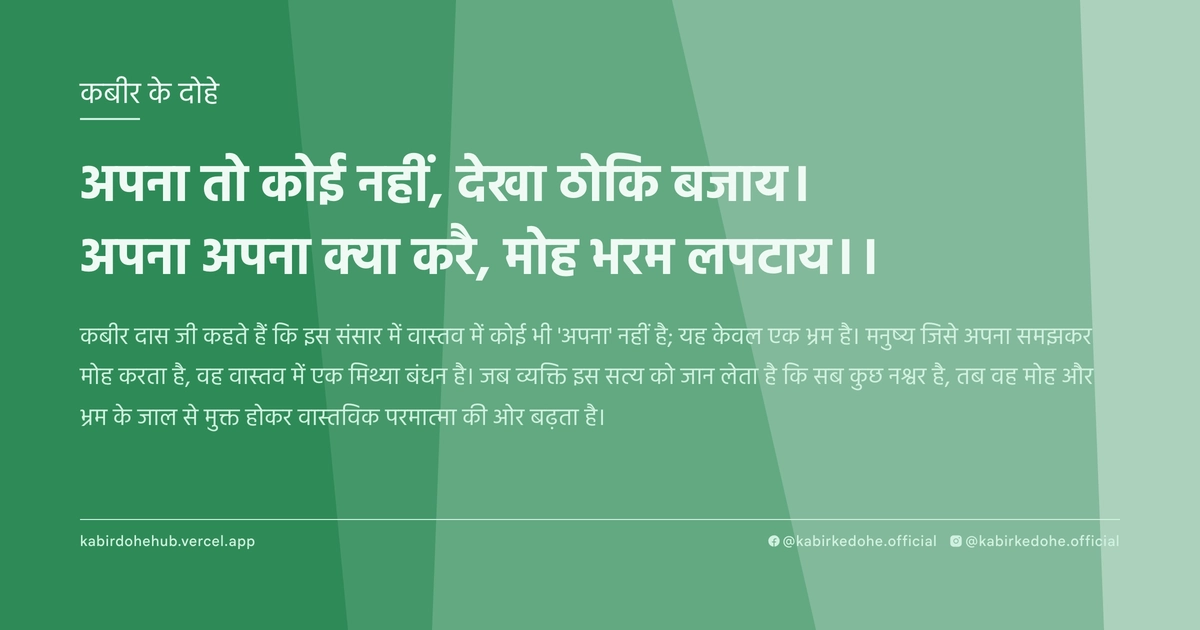
अपना तो कोई नहीं, देखा ठोकि बजाय।
अपना अपना क्या करै, मोह भरम लपटाय।।
Apna to koi nahi, dekha thoki bajay. Apna apna kya karai, moh bharam lapatay.
इस पृष्ठ पर इस कबीर दोहे का अर्थ (meaning), हिंदी व्याख्या और अंग्रेज़ी अनुवाद, दार्शनिक विश्लेषण और व्यावहारिक जीवन सीख दी गई है। यह दोहा मोह (Attachment) विषय से जुड़ा है — Kabir doha meaning and explanation in Hindi and English.
अर्थ (Meaning):
कबीर दास जी कहते हैं कि इस संसार में वास्तव में कोई भी 'अपना' नहीं है; यह केवल एक भ्रम है। मनुष्य जिसे अपना समझकर मोह करता है, वह वास्तव में एक मिथ्या बंधन है। जब व्यक्ति इस सत्य को जान लेता है कि सब कुछ नश्वर है, तब वह मोह और भ्रम के जाल से मुक्त होकर वास्तविक परमात्मा की ओर बढ़ता है।
Kabir asserts that in this transient world, there is no one who truly belongs to us; the notion of 'mine' is a mere illusion. Humans cling to attachments, believing others to be their own, but this is a veil of delusion. Once one realizes the impermanence of all worldly bonds, they break free from the shackles of attachment to find the eternal truth.
व्याख्या (Interpretation):
इसका शाब्दिक अर्थ है कि संसार में कोई भी स्थायी संबंध नहीं है। आध्यात्मिक स्तर पर, कबीर 'अपना' शब्द के माध्यम से अहंकार (Ego) पर प्रहार कर रहे हैं। जब हम किसी को 'अपना' कहते हैं, तो हम वास्तव में उस व्यक्ति पर अपना अधिकार जमाना चाहते हैं, जो कि माया का एक सूक्ष्म रूप है। यह दोहा निर्गुण भक्ति के उस सिद्धांत को दर्शाता है जहाँ आत्मा का संबंध केवल निराकार ब्रह्म से है। अद्वैत वेदांत के अनुसार, जब तक 'मैं' और 'मेरा' का भाव है, तब तक द्वैत बना रहता है। इस भ्रम (मोह) को हटाते ही यह स्पष्ट हो जाता है कि संपूर्ण ब्रह्मांड एक ही चेतना का विस्तार है। अतः, 'अपना' होने का दावा करना वास्तव में स्वयं को सत्य से दूर करना है।
Literally, the verse claims that no permanent bonds exist in the world. Spiritually, Kabir attacks the construct of the 'Ego' through the word 'mine'. When we label someone as 'ours', we are exercising a subtle form of possession, which is a manifestation of Maya (illusion). This aligns with Nirgun Bhakti, where the soul's only true relationship is with the formless Divine. According to Advaita Vedanta, as long as the sense of 'I' and 'mine' persists, duality remains. Once this veil of attachment (Moh) is lifted, it becomes evident that the entire universe is an extension of a single consciousness. Thus, claiming ownership over any being is an act of distancing oneself from the ultimate Truth.
दार्शनिक विश्लेषण (Philosophical Analysis):
कबीर का यह दोहा 15वीं शताब्दी के सामाजिक और धार्मिक परिवेश की प्रतिक्रिया है, जहाँ लोग जाति, कुल और संकीर्ण पारिवारिक पहचानों में बँधे थे। कबीर ने ritualism और बाहरी पहचानों को नकारते हुए आंतरिक सत्य की खोज पर बल दिया। यहाँ 'अपना' का त्याग करना केवल अकेलेपन का आह्वान नहीं है, बल्कि यह 'अहं' के विसर्जन की प्रक्रिया है।
सूफीवाद के 'फना' (अस्तित्व का मिट जाना) के सिद्धांत की तरह, कबीर यहाँ यह समझा रहे हैं कि जब तक व्यक्ति अपनी छोटी पहचान (Identity) को नहीं मिटाता, वह विराट सत्य का अनुभव नहीं कर सकता। यह विचार अद्वैत वेदांत के 'ब्रह्म सत्यं जगन्मिथ्या' से मेल खाता है, जहाँ संसार की सभी वस्तुएं और संबंध क्षणभंगुर और मिथ्या माने गए हैं।
मनोवैज्ञानिक स्तर पर, यह दोहा 'attachment' और 'love' के बीच के अंतर को स्पष्ट करता है। मोह (Attachment) बंधन पैदा करता है और दुख का कारण बनता है क्योंकि यह खोने के डर पर आधारित होता है। इसके विपरीत, आध्यात्मिक प्रेम (Devotion) मुक्तिदायक होता है क्योंकि इसमें कोई स्वामित्व नहीं होता।
कबीर का दृष्टिकोण क्रांतिकारी था क्योंकि उन्होंने धर्म को मंदिर-मस्जिद से निकालकर मनुष्य के अपने हृदय और उसकी चेतना के संघर्ष में स्थापित किया। उन्होंने यह स्पष्ट किया कि मोक्ष किसी बाहरी अनुष्ठान से नहीं, बल्कि इस मानसिक भ्रम के टूटने से मिलता है कि हम इस संसार में अलग-अलग इकाइयाँ हैं।
अंततः, यह विश्लेषण हमें सिखाता है कि 'अपना' होने का भ्रम ही वह पर्दा है जो हमें परमात्मा से अलग करता है। जब यह पर्दा गिरता है, तो व्यक्ति पाता है कि वह किसी एक का नहीं, बल्कि सबका है, और वास्तव में वह स्वयं वह अनंत चेतना है जिसे वह बाहर खोज रहा था।
This couplet is a reaction to the 15th-century socio-religious climate where individuals were fragmented by caste, lineage, and narrow familial identities. Kabir rejects ritualism and external labels, emphasizing the quest for internal truth. The renunciation of 'mine' is not a call for loneliness, but a process of dissolving the Ego.
Similar to the Sufi concept of 'Fana' (annihilation of the self), Kabir explains that unless one erases their limited identity, they cannot experience the Vast Truth. This resonates with the Advaita Vedanta principle of 'Brahman is the only truth, the world is an illusion,' where all worldly bonds are seen as ephemeral and illusory.
Psychologically, the verse distinguishes between 'attachment' and 'love'. Moh (Attachment) creates bondage and leads to suffering because it is rooted in the fear of loss. In contrast, spiritual love is liberating because it possesses no ownership.
Kabir's approach was revolutionary as he shifted religion from temples and mosques to the human heart and the struggle of consciousness. He clarified that liberation is not achieved through external rituals but through the shattering of the mental illusion that we are separate entities in this world.
Ultimately, this analysis teaches us that the illusion of 'mine' is the very veil that separates us from the Divine. When this veil falls, the seeker realizes they belong to no one and yet to everyone, discovering that they are the very infinite consciousness they were searching for externally.
मूल संदेश (Core Message):
- अहंकार का 'मेरा' शब्द ही आत्मा की सबसे बड़ी बेड़ी है।
- मोह वह धुंध है जो हमें सत्य के प्रकाश से दूर रखती है।
- सच्ची स्वतंत्रता तब है जब आप किसी का स्वामित्व नहीं चाहते।
- संबंधों को बंधन नहीं, बल्कि परमात्मा के प्रतिबिंब के रूप में देखें।
- जब 'मैं' मिटता है, तब केवल अनंत और अविनाशी सत्य बचता है।
- The word 'mine' uttered by the ego is the soul's heaviest shackle.
- Attachment is the mist that obscures the light of ultimate Truth.
- True freedom is found when you cease to desire ownership over others.
- View relationships not as bonds, but as reflections of the Divine.
- When the 'I' vanishes, only the infinite and indestructible Truth remains.
व्यावहारिक उदाहरण (Practical Example):
एक समय की बात है, वाराणसी के घाटों पर रहने वाले एक वृद्ध बुनकर थे जिनका नाम माधव था। माधव ने अपना पूरा जीवन अपने परिवार को संजोने में लगा दिया। उन्होंने अपनी पत्नी और बच्चों को दुनिया की हर खुशी देने की कोशिश की, और उन्हें ही अपनी पूरी दुनिया 'अपना' मान लिया।
एक समय आया जब माधव के जीवन में भारी उथल-पुथल मची। उनके बेटे विदेश चले गए और पत्नी का देहांत हो गया। माधव गहरे अवसाद में चले गए। उन्हें लगा कि उनका सब कुछ छिन गया है, क्योंकि उन्होंने अपनी पहचान केवल 'अपने' लोगों से जोड़ी थी।
एक दिन वे एक संत के पास गए और रोते हुए कहा, "मेरे पास अब अपना कोई नहीं बचा, मैं पूरी तरह अकेला हूँ।"
संत ने मुस्कुराते हुए उन्हें एक खाली कप दिया और कहा, "इस कप को पकड़ो और बताओ यह तुम्हारा है या नहीं?"
माधव ने कहा, "हाँ, यह मेरा है।"
संत ने कहा, "यदि मैं इसे अभी तोड़ दूँ, तो क्या तुम्हारा अस्तित्व मिट जाएगा?"
माधव चुप रहे। संत ने तब कबीर का यह दोहा सुनाया और समझाया कि जिसे तुम 'अपना' कह रहे थे, वे केवल किराए के घर की तरह थे। तुम उनमें अपनी खुशी खोज रहे थे, जबकि खुशी तुम्हारे भीतर की आत्मा में थी।
माधव को समझ आया कि उनका दुख इस बात का नहीं था कि लोग चले गए, बल्कि इस बात का था कि उन्होंने अपनी खुशी को दूसरों की मौजूदगी का गुलाम बना लिया था।
इस 'कबीर ट्विस्ट' ने माधव के जीवन को बदल दिया। उन्होंने अब दूसरों से उम्मीद करना छोड़ दिया और अपनी शांति को अपने भीतर खोजना शुरू किया।
उन्होंने अपना घर अन्य अनाथ बच्चों के लिए खोल दिया। अब वे उन्हें 'अपना' मानकर बांधते नहीं थे, बल्कि उन्हें निस्वार्थ प्रेम करते थे।
उनकी आँखों में अब शोक नहीं, बल्कि एक गहरी करुणा थी। उन्होंने जान लिया था कि जब कोई 'अपना' नहीं होता, तभी वास्तव में पूरी दुनिया अपनी हो जाती है।
माधव अब एक अकेले वृद्ध नहीं थे, बल्कि एक मुक्त आत्मा थे जो हर आने-जाने वाले में उसी एक परमात्मा को देखते थे।
Once, in the ghats of Varanasi, lived an elderly weaver named Madhav. Madhav spent his entire life nurturing his family, striving to provide every comfort to his wife and children, regarding them as his entire world—his 'own'.
Eventually, turmoil struck Madhav's life. His sons moved abroad for work, and his wife passed away. Madhav sank into a deep depression, feeling that everything had been snatched away because he had anchored his identity solely to his 'own' people.
One day, he approached a wandering saint and wept, "I have no one of my own left; I am utterly alone."
The saint smiled, handed him an empty cup, and asked, "Hold this cup and tell me, is it yours?"
Madhav replied, "Yes, it is mine."
The saint asked, "If I break this cup right now, will your existence cease to be?"
Madhav remained silent. The saint then recited Kabir's doha and explained that the people he called 'his own' were like rented houses. He was searching for happiness in them, whereas true joy resides within the soul.
Madhav realized that his grief did not stem from the departure of people, but from the fact that he had made his happiness a slave to the presence of others.
This 'Kabir Twist' transformed Madhav's life. He stopped expecting from others and began seeking peace within himself.
He opened his home to orphaned children. He no longer viewed them as 'his' to possess, but loved them with selfless devotion.
There was no longer sorrow in his eyes, only a profound compassion. He understood that when no one is 'yours', the entire world becomes your own.
Madhav was no longer a lonely old man, but a liberated soul who saw the same Divine spark in every passing stranger.
अभ्यास मार्गदर्शन (Practice Guidance):
- प्रतिदिन 20 मिनट मौन ध्यान करें, जहाँ आप अपने भीतर उठने वाले 'मेरा' और 'मेरा यह' के विचारों को केवल एक साक्षी (Witness) की तरह देखें, बिना उनसे जुड़े।
- एक डायरी लिखें जिसमें आप उन सभी चीजों या लोगों की सूची बनाएं जिन्हें आप 'अपना' मानते हैं, और फिर ईमानदारी से विश्लेषण करें कि यदि वे कल न रहें, तो आपकी आंतरिक शांति पर क्या प्रभाव पड़ेगा।
- व्यवहार परिवर्तन: दिन में कम से कम एक बार किसी ऐसे व्यक्ति की मदद करें जिससे आपका कोई संबंध न हो, ताकि आप 'अपने-पराये' के भेदभाव से ऊपर उठ सकें।
- डायग्नोस्टिक चेकलिस्ट: क्या आप किसी के व्यवहार से जल्दी आहत होते हैं? क्या आप अपनों पर नियंत्रण करना चाहते हैं? यदि हाँ, तो आप अभी भी 'मोह भ्रम' में हैं। यदि आप विछोह में भी शांत हैं, तो आप इस ज्ञान को जी रहे हैं।
- Practice 20 minutes of silent meditation daily, observing the thoughts of 'mine' and 'this is mine' as a detached witness, without clinging to them.
- Maintain a journal listing everything and everyone you consider 'your own', then honestly analyze how your internal peace would be affected if they were gone tomorrow.
- Behavioral Change: At least once a day, help someone with whom you have no personal connection, to transcend the binary of 'mine' and 'others'.
- Diagnostic Checklist: Do you get easily hurt by others' behavior? Do you feel a need to control your loved ones? If yes, you are still under the 'veil of Moh'. If you remain peaceful even in separation, you are living this wisdom.
चिंतन प्रश्न (Reflection Questions):
- यदि आज आपकी सारी सामाजिक पहचान (पद, परिवार, संपत्ति) छीन ली जाए, तो आपके भीतर क्या बचेगा?
- क्या आपका प्रेम वास्तव में दूसरे के लिए है, या वह केवल आपकी अपनी भावनात्मक जरूरतों को पूरा करने का एक साधन है?
- आप डिजिटल दुनिया में अपनी जो छवि (Image) बना रहे हैं, वह 'अपना' होने का कितना बड़ा भ्रम है?
- क्या आप उन लोगों को वास्तव में प्यार करते हैं जिन्हें आप 'अपना' कहते हैं, या आप केवल उस भावना को प्यार करते हैं जो वे आपको देते हैं?
- आपके जीवन का वह कौन सा गुप्त डर है जो आपको 'मोह' के धागों से बांधे रखता है?
- If all your social identities (status, family, wealth) were stripped away today, what would remain within you?
- Is your love truly for the other, or is it merely a tool to satisfy your own emotional needs?
- How much of the image you curate in the digital world is a manifestation of the illusion of 'mine'?
- Do you actually love the people you call 'yours', or do you only love the feeling they provide you?
- What is the hidden fear in your life that keeps you bound to the threads of attachment?