
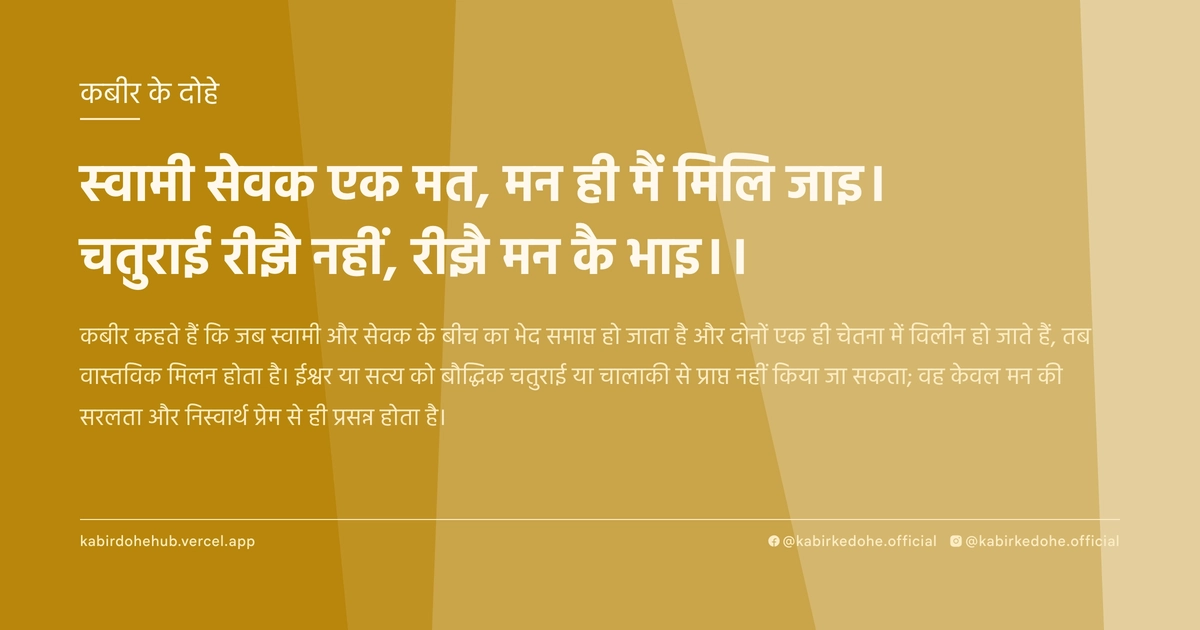
स्वामी सेवक एक मत, मन ही मैं मिलि जाइ।
चतुराई रीझै नहीं, रीझै मन कै भाइ।।
Swami sevak ek mat, man hi main mili jaai. Chaturai reejhai nahi, reejhai man kai bhai.
इस पृष्ठ पर इस कबीर दोहे का अर्थ (meaning), हिंदी व्याख्या और अंग्रेज़ी अनुवाद, दार्शनिक विश्लेषण और व्यावहारिक जीवन सीख दी गई है। यह दोहा विनम्रता (Humility) विषय से जुड़ा है — Kabir doha meaning and explanation in Hindi and English.
अर्थ (Meaning):
कबीर कहते हैं कि जब स्वामी और सेवक के बीच का भेद समाप्त हो जाता है और दोनों एक ही चेतना में विलीन हो जाते हैं, तब वास्तविक मिलन होता है। ईश्वर या सत्य को बौद्धिक चतुराई या चालाकी से प्राप्त नहीं किया जा सकता; वह केवल मन की सरलता और निस्वार्थ प्रेम से ही प्रसन्न होता है।
Kabir asserts that true union occurs when the distinction between the master and the servant dissolves into a single consciousness. The Divine or the Ultimate Truth cannot be captivated by intellectual cleverness or strategic maneuvering; it is won only through the purity of heart and the simplicity of sincere love.
व्याख्या (Interpretation):
इस दोहे का शाब्दिक अर्थ है कि मालिक और नौकर का भेद मिटाकर मन में एक हो जाना चाहिए। आध्यात्मिक स्तर पर, 'स्वामी' परमात्मा है और 'सेवक' जीवात्मा। जब तक 'मैं' और 'तू' का द्वैत बना रहता है, तब तक माया का पर्दा रहता है। निर्गुण भक्ति के अनुसार, ईश्वर किसी बाहरी कर्मकांड या मानसिक चालाकी से नहीं मिलता। यह अद्वैत वेदांत के उस सिद्धांत को दर्शाता है जहाँ आत्मा और ब्रह्म एक ही हैं। चतुराई यहाँ अहंकार का प्रतीक है, जो स्वयं को श्रेष्ठ मानकर सत्य को नियंत्रित करना चाहता है। वास्तविक मिलन तब होता है जब अहंकार पूरी तरह शून्य हो जाता है और केवल प्रेम शेष रहता है।
Literally, the verse suggests the erasure of the boundary between master and servant within the mind. Spiritually, the 'Master' represents the Divine and the 'Servant' the individual soul. As long as the duality of 'I' and 'Thou' persists, the veil of Maya remains intact. According to Nirgun Bhakti, the Formless cannot be reached through external rituals or mental gymnastics. This aligns with Advaita Vedanta, where Atman and Brahman are non-dual. 'Cleverness' here symbolizes the ego's attempt to manipulate or intellectually grasp the Truth. True union occurs only when the ego is annihilated, leaving behind only the essence of pure, selfless love.
दार्शनिक विश्लेषण (Philosophical Analysis):
कबीर का यह दोहा उस युग की सामाजिक और धार्मिक जड़ता पर प्रहार करता है जहाँ धर्म को नियमों, श्रेणियों और पदानुक्रम (Hierarchy) के रूप में देखा जाता था। स्वामी और सेवक का संबंध केवल सामाजिक नहीं, बल्कि आध्यात्मिक दासता का प्रतीक है। कबीर इस पदानुक्रम को नकारते हुए कहते हैं कि सत्य किसी पद या प्रतिष्ठा का मोहताज नहीं है।
यहाँ 'चतुराई' का अर्थ है वह बौद्धिक अहंकार जो तर्क के माध्यम से ईश्वर को खोजने का प्रयास करता है। सूफी मत में इसे 'नफ्स' (अहंकार) का विनाश कहा गया है। जब तक साधक यह सोचता है कि वह अपनी बुद्धि से मोक्ष प्राप्त कर लेगा, वह वास्तव में सत्य से दूर होता जा रहा है।
अद्वैत वेदांत के परिप्रेक्ष्य में, यह दोहा 'अहं ब्रह्मास्मि' की ओर संकेत करता है। जब सेवक यह जान लेता है कि उसका स्वामी उससे अलग नहीं है, बल्कि वही चेतना है, तब द्वैत समाप्त हो जाता है। यह मानसिक रूपांतरण की प्रक्रिया है जहाँ 'कर्ता' का भाव मिट जाता है।
कबीर कर्मकांडीय धर्म के विरुद्ध हैं। वे बताते हैं कि मंदिर, मस्जिद या शास्त्र पढ़ने की चतुराई ईश्वर को प्रसन्न नहीं करती। ईश्वर 'भाव' का भूखा है, 'विधि' का नहीं। यह एक क्रांतिकारी विचार था जिसने जाति और वर्ग के भेदों को आध्यात्मिक एकता में विलीन कर दिया।
अंततः, यह विश्लेषण हमें सिखाता है कि आध्यात्मिक प्रगति का मार्ग 'जोड़ने' में नहीं, बल्कि 'मिटाने' में है—अपने अहंकार को मिटाने में। जब तक हम खुद को 'सेवक' मानकर अलग रखते हैं, हम दूरी पैदा करते हैं। जब हम 'एक मत' हो जाते हैं, तो दूरी समाप्त हो जाती है और केवल अनंत सत्य शेष रहता है।
This couplet strikes at the social and religious rigidity of Kabir's era, where spirituality was often viewed through the lens of rules, categories, and hierarchies. The relationship between master and servant is not merely social but symbolizes the spiritual bondage of the soul. Kabir rejects this hierarchy, asserting that Truth is indifferent to rank or prestige.
'Cleverness' refers to the intellectual arrogance that attempts to reach the Divine through logic and strategic piety. In Sufism, this is akin to the struggle against the 'Nafs' (the lower self/ego). As long as the seeker believes they can 'engineer' their way to liberation through intellect, they remain distanced from the Truth.
From the perspective of Advaita Vedanta, this verse points toward 'Aham Brahmasmi' (I am Brahman). When the servant realizes that the Master is not a separate entity but the same universal consciousness, duality vanishes. This is a process of psychological transmutation where the sense of being the 'doer' is erased.
Kabir stands firmly against ritualistic religion. He argues that the cleverness of reciting scriptures or performing elaborate rites does not please the Divine. The Divine craves 'Bhava' (pure emotion/devotion), not 'Vidhi' (method/procedure). This was a revolutionary stance that dissolved caste and class distinctions into spiritual unity.
Ultimately, this analysis teaches us that spiritual progress is not about 'adding' knowledge, but about 'subtracting' the ego. As long as we identify as a separate 'servant,' we maintain a gap. When we become 'one mind,' the gap closes, and only the infinite Truth remains.
मूल संदेश (Core Message):
- अहंकार का विसर्जन ही वास्तविक मिलन की पहली शर्त है।
- बौद्धिक चालाकी सत्य के मार्ग में सबसे बड़ी बाधा है।
- सेवा जब प्रेम बन जाती है, तो सेवक और स्वामी का भेद मिट जाता है।
- सरलता ही वह एकमात्र द्वार है जिससे परमात्मा प्रवेश करता है।
- आत्मा की एकता ही संसार के समस्त द्वंद्वों का अंतिम समाधान है।
- The dissolution of ego is the primary condition for true union.
- Intellectual cleverness is the greatest obstacle on the path to Truth.
- When service transforms into love, the divide between master and servant vanishes.
- Simplicity is the only gateway through which the Divine enters.
- The unity of the soul is the ultimate resolution to all worldly dualities.
व्यावहारिक उदाहरण (Practical Example):
राजस्थान के एक छोटे से गाँव में रामू नाम का एक वृद्ध किसान था, जो अपने जमींदार के यहाँ दशकों से काम कर रहा था। रामू स्वभाव से बहुत सीधा था, लेकिन उसके मन में हमेशा यह टीस रहती थी कि वह एक 'सेवक' है और जमींदार 'स्वामी'। वह हमेशा अपनी गरीबी और अपनी स्थिति को लेकर शिकायत करता था।
उसी गाँव में एक फकीर आया जिसने रामू को कबीर का यह दोहा सुनाया। फकीर ने कहा, "रामू, तू खुद को सेवक मानकर दुखी है, और जमींदार को स्वामी मानकर उससे डरता है। जिस दिन तू देखेगा कि तुम दोनों के भीतर एक ही प्राण है, उस दिन तेरा दुख मिट जाएगा।"
रामू ने पहले तो इसे मजाक समझा। लेकिन उसने प्रयोग करना शुरू किया। उसने जमींदार को एक 'मालिक' की तरह नहीं, बल्कि एक ऐसे इंसान की तरह देखना शुरू किया जो उसी तरह की भूख, प्यास और डर से जूझ रहा है जैसे वह खुद।
एक दिन जमींदार बहुत बीमार पड़ा और उसका पूरा परिवार संकट में था। गाँव के अन्य लोग केवल औपचारिकता निभा रहे थे, लेकिन रामू ने बिना किसी स्वार्थ के, अपनी पूरी रात जमींदार की सेवा में लगा दी। उसने यह नहीं सोचा कि वह अपनी 'नौकरी' बचा रहा है या अपनी 'वफादारी' दिखा रहा है।
उस रात, रामू के मन से 'सेवक' और 'स्वामी' का भेद पूरी तरह मिट गया। उसने महसूस किया कि वह सेवा जमींदार की नहीं, बल्कि उस ईश्वर की कर रहा है जो दोनों में समान रूप से विद्यमान है।
जब जमींदार ठीक हुआ, तो उसने रामू की आँखों में एक ऐसी चमक देखी जो उसने पहले कभी नहीं देखी थी। वह चमक डर की नहीं, बल्कि एक गहरी समानता और प्रेम की थी। जमींदार का हृदय भी पिघल गया।
जमींदार ने रामू को गले लगाया और कहा, "आज तक मैं तुम्हें अपना नौकर समझता था, लेकिन आज मुझे महसूस हो रहा है कि तुम मेरे सबसे बड़े मित्र और मार्गदर्शक हो।"
रामू की 'चतुराई' (कि कैसे ज्यादा वेतन माँगा जाए या कैसे चापलूसी की जाए) खत्म हो गई थी। उसकी सरलता ने उस दीवार को गिरा दिया जिसे सालों की सामाजिक व्यवस्था ने खड़ा किया था।
रामू अब केवल एक किसान नहीं था; वह एक मुक्त आत्मा था जिसने अपने जीवन में अद्वैत का अनुभव किया था। उसने सीखा कि जब हम दूसरे में खुद को देखते हैं, तो सेवा बोझ नहीं, बल्कि उत्सव बन जाती है।
इस प्रकार, एक साधारण किसान ने कबीर के शब्दों को जीकर यह सिद्ध कर दिया कि प्रेम और समानता ही वह एकमात्र कुंजी है जो मनुष्य को मनुष्य से और मनुष्य को परमात्मा से जोड़ती है।
In a small village in Rajasthan lived an elderly farmer named Ramu, who had worked for the local landlord for decades. Ramu was simple by nature, but he always carried a lingering ache in his heart because he viewed himself as a 'servant' and the landlord as the 'master.' He constantly lamented his poverty and his low social standing.
A wandering fakir arrived in the village and recited this specific Doha to Ramu. The fakir said, "Ramu, you are miserable because you identify as a servant, and you fear the landlord because you see him as the master. The day you realize that the same life-force flows through both of you, your suffering will vanish."
At first, Ramu took this as a joke. However, he began to experiment with this perspective. He stopped seeing the landlord as a 'boss' and started seeing him as a human being who struggled with the same hunger, thirst, and fear that he did.
One day, the landlord fell gravely ill, and his entire family was thrown into turmoil. While other villagers performed mere formalities, Ramu spent his entire night tending to the landlord without any ulterior motive. He didn't think about saving his job or proving his loyalty.
During that night, the distinction between 'servant' and 'master' completely dissolved in Ramu's mind. He felt that he wasn't serving the landlord, but rather the Divine presence that resided equally in both of them.
When the landlord recovered, he saw a spark in Ramu's eyes that he had never noticed before. It wasn't the spark of fear or subservience, but one of deep equality and unconditional love.
The landlord embraced Ramu and said, "Until today, I considered you my servant, but now I feel that you are my greatest friend and guide."
Ramu's 'cleverness'—the mental calculations of how to ask for a raise or how to flatter the master—had vanished. His simplicity tore down the wall that years of social conditioning had built.
Ramu was no longer just a farmer; he was a liberated soul who had experienced non-duality in his own life. He learned that when we see ourselves in others, service is no longer a burden but a celebration.
Thus, a simple farmer, by living Kabir's words, proved that love and equality are the only keys that connect human to human and human to the Divine.
अभ्यास मार्गदर्शन (Practice Guidance):
- प्रतिदिन 15 मिनट मौन ध्यान करें, जहाँ आप अपनी पहचान (नाम, पद, रिश्ता) को त्यागकर केवल एक 'साक्षी' के रूप में स्वयं को देखें।
- एक डायरी लिखें जिसमें आप उन क्षणों को दर्ज करें जब आपने किसी के प्रति श्रेष्ठता या हीनता का भाव महसूस किया, और फिर विश्लेषण करें कि वह 'चतुराई' कहाँ थी।
- दिन में कम से कम एक बार किसी ऐसे व्यक्ति की निस्वार्थ सेवा करें जिससे आपका कोई संबंध न हो, यह महसूस करते हुए कि आप स्वयं की ही सेवा कर रहे हैं।
- निदान चेकलिस्ट: क्या मैं दूसरों को उनकी सामाजिक स्थिति से आंकता हूँ? क्या मैं ईश्वर या सत्य को पाने के लिए 'शॉर्टकट' या मानसिक तर्क खोज रहा हूँ? यदि हाँ, तो मैं अभी भी 'चतुराई' के जाल में हूँ।
- Practice 15 minutes of silent meditation daily, stripping away your identity (name, rank, relationship) and observing yourself solely as a 'witness'.
- Maintain a journal to record moments when you felt superior or inferior to someone, then analyze where the 'cleverness' of the ego was operating.
- Perform one act of selfless service daily for a stranger, consciously feeling that you are serving the Divine within them and yourself.
- Diagnostic Checklist: Do I judge others by their social status? Am I seeking 'shortcuts' or using intellectual logic to attain spiritual truth? If yes, I am still trapped in the web of 'cleverness'.
चिंतन प्रश्न (Reflection Questions):
- मेरे जीवन में वह कौन सा 'स्वामी' है जिसे मैं वास्तव में मुक्त करना चाहता हूँ, और वह कौन सा 'सेवक' है जिसे मैं दबा रहा हूँ?
- क्या मेरी आध्यात्मिकता केवल एक बौद्धिक व्यायाम है, या यह मेरे व्यवहार में करुणा के रूप में प्रकट हो रही है?
- जब मैं दूसरों की मदद करता हूँ, तो क्या मेरे भीतर एक सूक्ष्म अहंकार होता है कि 'मैं' मदद कर रहा हूँ?
- यदि मेरी सारी सामाजिक पहचान (डिग्री, पद, संपत्ति) छीन ली जाए, तो मेरे भीतर क्या शेष बचेगा?
- मैं सत्य को 'पाने' की कोशिश कर रहा हूँ या उस 'अहंकार' को मिटाने की जो मुझे सत्य से अलग करता है?
- Who is the 'Master' in my life that I secretly wish to liberate, and who is the 'Servant' I am suppressing within myself?
- Is my spirituality merely an intellectual exercise, or is it manifesting as genuine compassion in my behavior?
- When I help others, is there a subtle ego whispering that 'I' am the one providing the help?
- If all my social identities (degrees, titles, assets) were stripped away, what would remain of me?
- Am I trying to 'attain' the Truth, or am I trying to erase the 'ego' that separates me from it?