
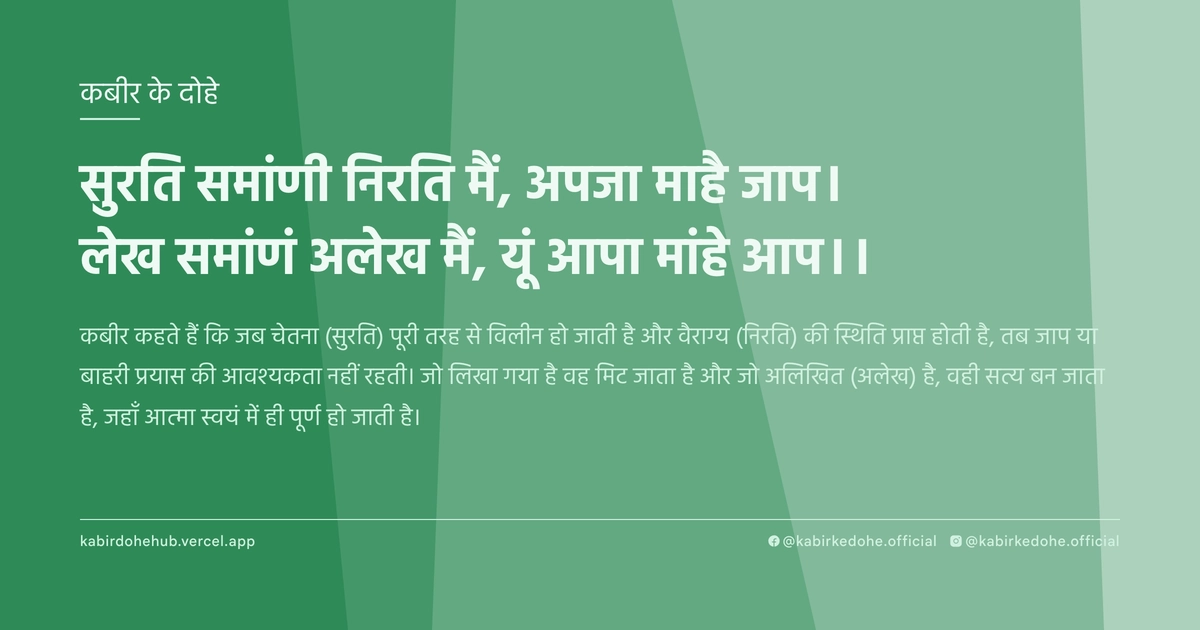
सुरति समांणी निरति मैं, अपजा माहै जाप।
लेख समांणं अलेख मैं, यूं आपा मांहे आप।।
Surati samani nirati main, apaja maahai jaap. Lekh samanan alekh main, yun aapa maahe aap.
इस पृष्ठ पर इस कबीर दोहे का अर्थ (meaning), हिंदी व्याख्या और अंग्रेज़ी अनुवाद, दार्शनिक विश्लेषण और व्यावहारिक जीवन सीख दी गई है। यह दोहा निर्गुण ब्रह्म (Nirguna Brahman) विषय से जुड़ा है — Kabir doha meaning and explanation in Hindi and English.
अर्थ (Meaning):
कबीर कहते हैं कि जब चेतना (सुरति) पूरी तरह से विलीन हो जाती है और वैराग्य (निरति) की स्थिति प्राप्त होती है, तब जाप या बाहरी प्रयास की आवश्यकता नहीं रहती। जो लिखा गया है वह मिट जाता है और जो अलिखित (अलेख) है, वही सत्य बन जाता है, जहाँ आत्मा स्वयं में ही पूर्ण हो जाती है।
Kabir asserts that when consciousness (Surati) is fully absorbed and a state of complete detachment (Nirati) is achieved, the need for repetitive chanting or external effort vanishes. The written or conditioned identity dissolves into the Unwritten (Alekh), where the Self becomes entirely absorbed within its own primordial essence.
व्याख्या (Interpretation):
यह दोहा चेतना के उच्चतम स्तर की व्याख्या करता है। 'सुरति' का अर्थ है वह सजगता जो बाहरी दुनिया में भटकती है; जब यह 'समांणी' (विलीन) होती है, तो द्वैत समाप्त हो जाता है। 'निरति' वह अवस्था है जहाँ इच्छाओं का पूर्ण अभाव होता है। कबीर यहाँ 'लेख' (लिखा हुआ/नियति/अहंकार) और 'अलेख' (अविनाशी/परमात्मा) के बीच के अंतर को मिटा रहे हैं। यह निर्गुण भक्ति का सार है, जहाँ साधक को पता चलता है कि जिसे वह बाहर खोज रहा था, वह उसके भीतर ही था। यह अद्वैत वेदांत की उस स्थिति को दर्शाता है जहाँ ज्ञाता, ज्ञान और ज्ञेय एक हो जाते हैं। अंततः, 'आपा मांहे आप' का अर्थ है कि आत्मा अब किसी बाहरी सहारे की मोहताज नहीं, बल्कि स्वयं में ही पूर्ण और आनंदित है।
This couplet elucidates the highest strata of consciousness. 'Surati' refers to the mindful attention that usually wanders in the external world; when it becomes 'samani' (absorbed), duality ceases. 'Nirati' is the state of total cessation of desire. Kabir contrasts 'Lekh' (the written/destiny/conditioned ego) with 'Alekh' (the Unwritten/Indescribable Absolute). This is the essence of Nirgun Bhakti, where the seeker realizes that the Divine sought externally was always internal. It mirrors the Advaita Vedanta state where the knower, the known, and the knowledge merge into one. Ultimately, 'Aapa maahe aap' signifies that the Soul is no longer dependent on external anchors but is complete and blissful within its own being.
दार्शनिक विश्लेषण (Philosophical Analysis):
कबीर का यह दर्शन 15वीं शताब्दी के सामाजिक और धार्मिक परिवेश में एक क्रांतिकारी हस्तक्षेप था। उस समय धर्म केवल कर्मकांडों, माला जपने और तीर्थयात्राओं (लेख) तक सीमित था। कबीर ने इन बाहरी प्रतीकों को 'लेख' कहा—अर्थात वह जो केवल कागजों या परंपराओं में लिखा है। उन्होंने 'अलेख' की बात की, जो शब्दों और सीमाओं से परे है। यह सूफी मत के 'फना' (अहंकार का विनाश) और अद्वैत वेदांत के 'ब्रह्म' के विचार का संगम है।
यहाँ 'जाप' का विरोध नहीं है, बल्कि उसकी सीमा बताई गई है। कबीर का तर्क है कि जब तक आप 'मैं' और 'ईश्वर' को अलग मानते हैं, तब तक जाप एक साधन है। लेकिन जब चेतना विलीन हो जाती है, तो साधन की आवश्यकता नहीं रहती, केवल साध्य बचता है। यह मनोवैज्ञानिक रूपांतरण की वह प्रक्रिया है जहाँ व्यक्ति अपनी सामाजिक पहचान (जाति, धर्म, पद) को पूरी तरह त्याग कर शुद्ध चेतना में स्थित हो जाता है।
यह दोहा ritualism (कर्मकांड) पर कड़ा प्रहार करता है। कबीर कहते हैं कि यदि आपका मन अभी भी वासनाओं और अहंकार में फंसा है, तो हजार बार जाप करना भी व्यर्थ है। वास्तविक भक्ति वह है जो आंतरिक मौन में घटित होती है। यह 'शून्य' की अवस्था है, जहाँ पहुँचकर मनुष्य यह अनुभव करता है कि वह कभी अलग था ही नहीं।
सांस्कृतिक रूप से, कबीर ने इस ज्ञान को आम जनमानस तक पहुँचाया, यह बताते हुए कि मोक्ष किसी विशेष वर्ग या पंडितों की बपौती नहीं है। यह केवल 'सुरति' के सही दिशा में प्रवाह का परिणाम है। उन्होंने सिखाया कि सत्य को शब्दों में नहीं बांधा जा सकता, क्योंकि शब्द ही 'लेख' हैं, जबकि सत्य 'अलेख' है।
अंततः, यह विश्लेषण हमें उस बिंदु पर ले जाता है जहाँ व्यक्ति अपनी व्यक्तिगत पहचान (Individual Ego) को सार्वभौमिक चेतना (Universal Consciousness) में विलीन कर देता है। यह केवल एक आध्यात्मिक उपलब्धि नहीं, बल्कि एक मानसिक मुक्ति है, जो मनुष्य को भय और मोह के बंधनों से मुक्त करती है।
Kabir's philosophy represents a revolutionary intervention in the 15th-century socio-religious landscape. At that time, religion was confined to rituals, repetitive chanting, and pilgrimages (Lekh). Kabir termed these external symbols as 'Lekh'—that which is merely written in books or traditions. He advocated for the 'Alekh'—the Indescribable, which exists beyond words and boundaries. This is a confluence of the Sufi concept of 'Fana' (annihilation of the ego) and the Advaita Vedanta notion of 'Brahman'.
There is no opposition to 'Jaap' (chanting) here, but rather a definition of its limits. Kabir argues that as long as one perceives a separation between 'I' and 'God', chanting remains a tool. However, when consciousness is fully absorbed, the tool is discarded, and only the destination remains. This is a process of psychological transformation where the individual sheds social identities—caste, religion, status—to reside in pure consciousness.
This couplet strikes a severe blow against ritualism. Kabir suggests that if the mind is still entangled in desires and ego, a thousand repetitions of a mantra are futile. True devotion occurs in internal silence. This is the state of 'Shunya' (Void), where the human realizes they were never separate from the Whole.
Culturally, Kabir democratized this wisdom, asserting that liberation is not the monopoly of a specific class or the priesthood. It is simply the result of directing 'Surati' (attention) inward. He taught that Truth cannot be bound by words, for words are 'Lekh', while Truth is 'Alekh'.
Ultimately, this analysis leads us to the point where the individual ego is dissolved into the universal consciousness. This is not merely a spiritual achievement but a mental liberation, freeing the human from the shackles of fear and attachment.
मूल संदेश (Core Message):
- बाहरी कर्मकांड केवल सीढ़ियाँ हैं, मंजिल नहीं।
- सच्ची भक्ति शब्दों के अंत और मौन के आरंभ में है।
- अहंकार का विसर्जन ही वास्तविक ज्ञान की प्राप्ति है।
- जब 'मैं' मिटता है, तब केवल 'वह' शेष रहता है।
- परमात्मा कोई बाहरी लक्ष्य नहीं, बल्कि आंतरिक स्थिति है।
- द्वैत से अद्वैत की यात्रा ही जीवन का चरम उद्देश्य है।
- External rituals are merely ladders, not the destination.
- True devotion lies in the end of words and the birth of silence.
- The dissolution of ego is the only path to real knowledge.
- When the 'I' vanishes, only the 'Absolute' remains.
- The Divine is not an external goal, but an internal state.
- The journey from duality to non-duality is life's ultimate purpose.
व्यावहारिक उदाहरण (Practical Example):
वाराणसी के एक पुराने घाट पर रहने वाले एक वृद्ध बुनकर थे, जिनका नाम माधव था। माधव जीवन भर कपड़े बुनते रहे और साथ ही साथ धर्म के बाहरी आडंबरों में विश्वास करते थे। वे घंटों माला जपते और यह मानते थे कि उनके द्वारा किया गया 'लेख' (पुण्य का हिसाब) उन्हें मोक्ष दिलाएगा।
एक दिन माधव की मुलाकात एक फकीर से हुई। फकीर ने देखा कि माधव जप तो कर रहे हैं, लेकिन उनके चेहरे पर तनाव और मन में दूसरों के प्रति ईर्ष्या है। फकीर ने उनसे पूछा, "तुम क्या गिन रहे हो? मोतियों की संख्या या अपने अहंकार की लंबाई?"
माधव को यह बात चुभी, लेकिन उन्होंने इसे अनदेखा किया। कुछ दिनों बाद, माधव के परिवार में एक बड़ा विवाद हुआ। उनकी वर्षों की तपस्या और जप के बावजूद, वे क्रोध और घृणा से भर गए। उन्हें एहसास हुआ कि उनका 'जाप' केवल एक मानसिक ढाल था, जिसने उन्हें वास्तव में बदलने के बजाय उनके अहंकार को और पुष्ट किया था।
उन्हें कबीर का यह दोहा याद आया कि जब तक 'सुरति' विलीन नहीं होती, जाप केवल एक बाहरी क्रिया है। माधव ने तय किया कि वे अब माला नहीं फेरेंगे, बल्कि अपने भीतर के उस शोर को सुनेंगे जिसे वे अब तक दबा रहे थे।
उन्होंने मौन का अभ्यास शुरू किया। जब भी क्रोध आता, वे जप करने के बजाय यह देखते कि वह क्रोध कहाँ से आ रहा है। उन्होंने पाया कि उनका क्रोध उनकी 'पहचान' (मैं एक बड़ा भक्त हूँ, मैं ईमानदार हूँ) से जुड़ा था।
धीरे-धीरे, माधव की 'सुरति' बाहरी दुनिया से हटकर आंतरिक शून्य की ओर मुड़ने लगी। उन्होंने महसूस किया कि जिस ईश्वर को वे माला के मनकों में खोज रहे थे, वह वास्तव में उनके भीतर की शांति में मौजूद है।
एक दिन, बुनते समय उन्हें एक गहरा अनुभव हुआ। उन्हें लगा कि धागे, करघा, और वे स्वयं—सब एक ही ऊर्जा का हिस्सा हैं। वहाँ न कोई बुनकर था, न कोई कपड़ा, बस एक निरंतर प्रवाह था।
यह उनका 'अलेख' क्षण था। अब उन्हें मोक्ष के लिए किसी हिसाब-किताब (लेख) की जरूरत नहीं थी। वे स्वयं में पूर्ण हो गए थे।
माधव का व्यवहार बदल गया। अब वे केवल शांत नहीं थे, बल्कि उनके भीतर एक ऐसी करुणा थी जो बिना किसी शर्त के दूसरों की मदद करती थी।
उनका जीवन अब एक जीवित प्रार्थना बन गया था, जहाँ शब्दों की आवश्यकता नहीं थी, क्योंकि वे स्वयं उस मौन संगीत का हिस्सा बन चुके थे।
In the ancient ghats of Varanasi lived an elderly weaver named Madhav. Throughout his life, Madhav wove fabrics and believed deeply in the external trappings of religion. He spent hours chanting with beads, believing that his 'Lekh' (the record of his merits) would secure his salvation.
One day, Madhav encountered a wandering dervish. The dervish noticed that while Madhav chanted, his face was etched with tension and his heart harbored jealousy toward others. The dervish asked, "What are you counting? The number of beads, or the length of your ego?"
Madhav felt stung by this, but he ignored it. Some days later, a severe conflict erupted within Madhav's family. Despite years of chanting, he found himself consumed by rage and hatred. He realized that his 'Jaap' had been a mere mental shield, reinforcing his ego rather than transforming him.
He recalled Kabir's teaching that until 'Surati' is absorbed, chanting is merely an external act. Madhav decided he would stop the beads and instead listen to the internal noise he had been suppressing.
He began the practice of silence. Whenever anger arose, instead of chanting a mantra to suppress it, he observed where the anger originated. He discovered that his rage was tied to his 'identity'—the image of being a 'great devotee' or 'honest man'.
Gradually, Madhav's 'Surati' shifted from the external world toward the internal void. He realized that the God he sought in the beads was actually present in the stillness within him.
One day, while weaving, he had a profound experience. He felt that the threads, the loom, and himself were all part of a single energy. There was no weaver, no cloth—only a continuous flow.
This was his 'Alekh' moment. He no longer needed a ledger of merits (Lekh) for salvation. He had become complete within himself.
Madhav's behavior transformed. He was not just calm; he possessed a compassion that helped others without any condition.
His life became a living prayer, where words were no longer necessary, for he had become a part of that silent music.
अभ्यास मार्गदर्शन (Practice Guidance):
- दैनिक मौन अभ्यास: प्रतिदिन 20 मिनट के लिए पूर्ण मौन रहें। शब्दों, विचारों और यहाँ तक कि मानसिक जाप को भी छोड़ने का प्रयास करें। केवल अपनी श्वास के साक्षी बनें।
- स्व-पूछताछ जर्नल: प्रतिदिन एक ऐसी घटना लिखें जहाँ आपके 'अहंकार' (लेख) ने आपकी प्रतिक्रिया को नियंत्रित किया। पूछें: "यदि मेरी यह पहचान नहीं होती, तो मैं कैसे प्रतिक्रिया करता?"
- साक्षी भाव का विकास: दिन भर में कई बार रुकें और स्वयं से पूछें, "क्या मैं अभी बाहरी दुनिया में हूँ (सुरति) या अपने केंद्र में?"
- निदान चेकलिस्ट: यदि आप अभी भी दूसरों के निर्णय से विचलित होते हैं या अपनी धार्मिक उपलब्धियों पर गर्व करते हैं, तो आप अभी भी 'लेख' (अहंकार) में हैं। यदि आप बिना किसी कारण के आंतरिक शांति का अनुभव करते हैं, तो आप 'अलेख' की ओर बढ़ रहे हैं।
- Daily Silence Practice: Spend 20 minutes in absolute silence. Attempt to let go of words, thoughts, and even mental chanting. Simply be the witness to your breath.
- Self-Inquiry Journal: Daily record one instance where your 'ego' (Lekh) controlled your reaction. Ask: "If this identity didn't exist, how would I have responded?"
- Developing Witness Consciousness: Several times a day, pause and ask yourself, "Am I currently in the external world (Surati) or in my own center?"
- Diagnostic Checklist: If you are still disturbed by others' judgments or proud of your spiritual achievements, you are still in 'Lekh' (ego). If you experience internal peace without any external cause, you are moving toward 'Alekh'.
चिंतन प्रश्न (Reflection Questions):
- मेरी वह कौन सी 'लिखी हुई' पहचान (लेख) है जिसे मैं सबसे अधिक सहेज कर रखता हूँ?
- क्या मेरा आध्यात्मिक अभ्यास मुझे विनम्र बना रहा है या मुझे दूसरों से श्रेष्ठ महसूस करा रहा है?
- यदि मुझसे मेरी सभी उपलब्धियाँ और सामाजिक पद छीन लिए जाएँ, तो मेरे भीतर क्या बचेगा?
- मैं अपनी डिजिटल पहचान (सोशल मीडिया) को कितना सच मानता हूँ और वह मेरे वास्तविक स्वरूप से कितना अलग है?
- क्या मैं वास्तव में मौन होने का साहस रखता हूँ, या मैं मौन के डर से शब्दों का सहारा लेता हूँ?
- मेरे जीवन का वह कौन सा हिस्सा है जहाँ मैं अभी भी 'मैं' और 'तुम' के द्वैत में फंसा हुआ हूँ?
- What is the 'written' identity (Lekh) that I cling to most desperately?
- Is my spiritual practice making me humble, or is it making me feel superior to others?
- If all my achievements and social statuses were stripped away, what would remain within me?
- How much of my digital identity do I perceive as true, and how far does it deviate from my real essence?
- Do I truly have the courage to be silent, or do I use words as a shield against the fear of silence?
- In which area of my life am I still trapped in the duality of 'I' and 'Thou'?