
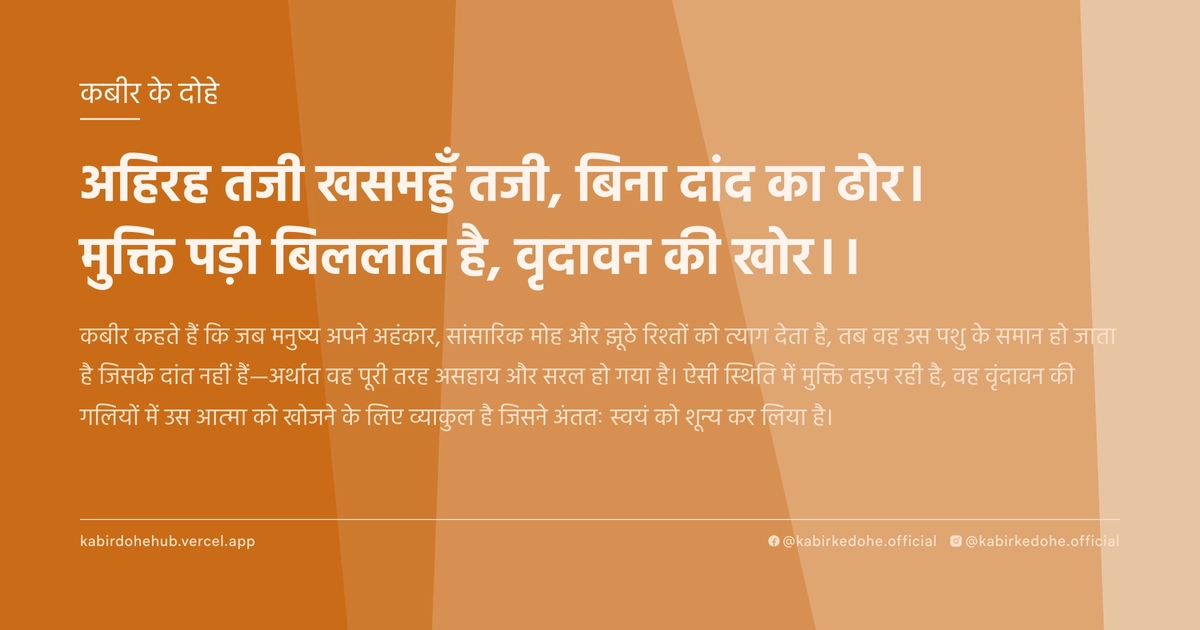
अहिरह तजी खसमहुँ तजी, बिना दांद का ढोर।
मुक्ति पड़ी बिललात है, वृ़दावन की खोर।।
Ahirah taji khasamhun taji, bina daand ka dhor. Mukti padi billaat hai, vridaavan ki khor.
इस पृष्ठ पर इस कबीर दोहे का अर्थ (meaning), हिंदी व्याख्या और अंग्रेज़ी अनुवाद, दार्शनिक विश्लेषण और व्यावहारिक जीवन सीख दी गई है। यह दोहा मृतुक्यता (Mortality) विषय से जुड़ा है — Kabir doha meaning and explanation in Hindi and English.
अर्थ (Meaning):
कबीर कहते हैं कि जब मनुष्य अपने अहंकार, सांसारिक मोह और झूठे रिश्तों को त्याग देता है, तब वह उस पशु के समान हो जाता है जिसके दांत नहीं हैं—अर्थात वह पूरी तरह असहाय और सरल हो गया है। ऐसी स्थिति में मुक्ति तड़प रही है, वह वृंदावन की गलियों में उस आत्मा को खोजने के लिए व्याकुल है जिसने अंततः स्वयं को शून्य कर लिया है।
Kabir suggests that when a seeker abandons their ego, worldly attachments, and false identities, they become like a toothless animal—utterly humble and stripped of the power to bite or resist. In this state of complete surrender and vulnerability, liberation itself yearns for the seeker, wandering the sacred groves of Vrindavan, searching for the soul that has finally become empty.
व्याख्या (Interpretation):
यह दोहा आत्म-विलय की प्रक्रिया का वर्णन करता है। 'बिना दांद का ढोर' एक शक्तिशाली रूपक है जो अहंकार के विनाश को दर्शाता है; दांत शक्ति और आक्रामकता के प्रतीक हैं, और उनका अभाव पूर्ण समर्पण को दर्शाता है। कबीर यहाँ निरगुण भक्ति के उस चरम बिंदु की बात कर रहे हैं जहाँ 'मैं' पूरी तरह समाप्त हो जाता है। जब साधक अपनी सामाजिक पहचान (खसम/स्वामी) और मानसिक पकड़ (अहिरह/अहंकार) को छोड़ता है, तो वह द्वैत से मुक्त हो जाता है। यह अद्वैत वेदांत के उस सत्य को उजागर करता है जहाँ आत्मा और ब्रह्म के बीच की बाधा केवल अहंकार है। मुक्ति कोई बाहरी पुरस्कार नहीं है, बल्कि एक आंतरिक स्थिति है जो तब प्रकट होती है जब हम अपनी झूठी पहचान की परतों को उतार फेंकते हैं। यह विरोधाभास है कि जब हम सबसे अधिक असहाय और शून्य होते हैं, तभी हम वास्तव में पूर्ण और मुक्त होते हैं।
This couplet describes the process of spiritual dissolution. The 'toothless animal' is a potent metaphor for the annihilation of the ego; teeth symbolize power, aggression, and the ability to grasp, and their absence signifies total surrender. Kabir speaks of the pinnacle of Nirgun Bhakti, where the 'I' is completely erased. When the seeker relinquishes social identities and mental attachments, they transcend duality. This aligns with Advaita Vedanta, suggesting that the only barrier between the Atman and Brahman is the ego. Liberation is not an external reward but an internal state that manifests when the layers of false identity are stripped away. It is the central paradox of the human condition: only when we are most vulnerable and empty do we become truly whole and free.
दार्शनिक विश्लेषण (Philosophical Analysis):
कबीर का यह दृष्टिकोण उनके समय के कर्मकांडीय धर्म के विरुद्ध एक तीव्र प्रहार था। उन्होंने देखा कि लोग तीर्थों, मूर्तियों और बाहरी दिखावे में मुक्ति खोज रहे थे, जबकि वास्तविक मुक्ति आंतरिक शून्यता में निहित थी। यह दोहा सूफी मत के 'फना' (अहंकार का विनाश) के सिद्धांत से गहराई से जुड़ा है, जहाँ प्रेमी अपने अस्तित्व को ईश्वर में विलीन कर देता है। कबीर यहाँ यह समझा रहे हैं कि जब तक मनुष्य अपनी जाति, पद या संबंधों के अहंकार को पकड़े रहता है, वह मुक्ति के लिए अयोग्य रहता है।
दार्शनिक स्तर पर, यह 'माया' के जाल को काटने की बात करता है। माया केवल बाहरी दुनिया नहीं है, बल्कि वह आंतरिक पहचान है जिसे हम सत्य मान बैठते हैं। जब कबीर 'बिना दांद' की बात करते हैं, तो वे उस मानसिक हिंसा और प्रतिरोध को समाप्त करने का आह्वान करते हैं जो हम सत्य के विरुद्ध करते हैं। यह एक मनोवैज्ञानिक रूपांतरण है जहाँ व्यक्ति अपनी रक्षात्मक प्रवृत्तियों को त्याग कर पूर्णतः पारदर्शी हो जाता है।
अद्वैत वेदांत के संदर्भ में, यह 'नेति-नेति' (यह नहीं, वह नहीं) की प्रक्रिया है। जब हम यह जान लेते हैं कि हम न तो शरीर हैं, न मन, न सामाजिक पद, तब जो बचता है वही शुद्ध चेतना है। कबीर का 'वृंदावन' यहाँ किसी भौगोलिक स्थान का संकेत नहीं है, बल्कि वह हृदय की पवित्र अवस्था है जहाँ परमात्मा का वास है।
इस शिक्षण में एक गहरा मनोवैज्ञानिक सत्य है: हम अक्सर अपनी कमजोरियों को छिपाने की कोशिश करते हैं, लेकिन आध्यात्मिक मार्ग पर हमारी सबसे बड़ी कमजोरी (अहंकार का अभाव) ही हमारी सबसे बड़ी शक्ति बन जाती है। यह उस स्थिति का वर्णन है जहाँ साधक अब कुछ पाने की इच्छा नहीं रखता, और यही 'इच्छा का अंत' उसे मुक्ति के योग्य बनाता है।
अंततः, कबीर यह संदेश देते हैं कि मुक्ति कोई ऐसी चीज़ नहीं है जिसे प्राप्त किया जाए, बल्कि यह वह है जो तब शेष रह जाती है जब सब कुछ अनावश्यक हटा दिया जाता है। यह एक नकारात्मक मार्ग (Via Negativa) है—सत्य को खोजने के लिए पहले असत्य का त्याग करना अनिवार्य है।
Kabir's perspective is a sharp critique of the ritualistic religion of his era. He observed people seeking liberation through pilgrimages and idols, while true liberation lay in internal emptiness. This couplet is deeply connected to the Sufi concept of 'Fana' (annihilation of the self), where the lover dissolves their existence into the Divine. Kabir explains that as long as one clings to the ego of caste, status, or relationships, they remain ineligible for liberation.
Philosophically, this addresses the cutting of 'Maya's' web. Maya is not just the external world, but the internal identity we mistake for truth. When Kabir mentions the 'toothless' state, he calls for the cessation of the mental violence and resistance we exert against the Truth. This is a psychological transformation where the individual sheds all defensive mechanisms to become completely transparent.
In the context of Advaita Vedanta, this is the process of 'Neti-Neti' (not this, not that). When we realize we are neither the body, nor the mind, nor the social role, what remains is pure consciousness. Kabir's 'Vrindavan' here does not signify a geographical location, but the sacred state of the heart where the Divine resides.
There is a profound psychological truth here: we often strive to hide our vulnerabilities, but on the spiritual path, our greatest vulnerability—the absence of ego—becomes our greatest strength. It describes a state where the seeker no longer desires to gain anything, and this 'end of desire' makes them worthy of liberation.
Ultimately, Kabir conveys that liberation is not something to be acquired, but what remains when everything unnecessary is removed. It is a 'Via Negativa'—to find the Truth, the systematic removal of the untruth is mandatory.
मूल संदेश (Core Message):
- अहंकार की पकड़ ही वास्तव में हमारी सबसे बड़ी बेड़ी है।
- पूर्ण समर्पण ही वह द्वार है जिससे मुक्ति प्रवेश करती है।
- जब 'मैं' समाप्त होता है, तब 'सत्य' का उदय होता है।
- शून्यता कोई अभाव नहीं, बल्कि पूर्णता की सर्वोच्च अवस्था है।
- बाहरी खोज व्यर्थ है; हृदय का वृंदावन भीतर ही है।
- शक्ति का त्याग ही वास्तविक आध्यात्मिक शक्ति है।
- The grip of the ego is actually our greatest shackle.
- Total surrender is the only portal through which liberation enters.
- When the 'I' ends, the 'Truth' arises.
- Emptiness is not a lack, but the highest state of fullness.
- External searching is futile; the Vrindavan of the heart is within.
- The relinquishing of power is the only true spiritual power.
व्यावहारिक उदाहरण (Practical Example):
वाराणसी के घाटों पर रहने वाले एक वृद्ध विधवा, जानकी, का जीवन अत्यंत कठिन था। वह दूसरों के घरों में बर्तन मांजती और बचे-कुचे अन्न पर जीवित रहती थी। समाज ने उसे 'अशुभ' मानकर हाशिए पर धकेल दिया था। जानकी के मन में शुरू में बहुत क्रोध था; वह अपनी किस्मत और समाज के अन्याय से लड़ती रही, जैसे कोई दांतों से काटने की कोशिश करता है।
एक दिन, उसने कबीर के शब्दों को सुना कि असली मुक्ति तब मिलती है जब हम अपनी सारी पकड़ छोड़ देते हैं। जानकी ने महसूस किया कि उसका क्रोध, उसकी शिकायतें और उसकी 'पीड़ित' होने की पहचान भी एक प्रकार का अहंकार था जो उसे शांति से दूर रख रहा था। उसने तय किया कि वह अब अपनी परिस्थितियों से लड़ेगी नहीं, बल्कि उन्हें स्वीकार करेगी।
उसने अपनी पहचान के प्रति सारी जिद छोड़ दी। उसने यह सोचना बंद कर दिया कि वह एक 'दुखी विधवा' है। उसने बस अपना काम करना शुरू किया, बिना किसी उम्मीद के, बिना किसी शिकायत के। वह अब उस 'बिना दांद के ढोर' की तरह हो गई थी—सरल, शांत और पूरी तरह समर्पित।
धीरे-धीरे, उसके चेहरे पर एक ऐसी शांति आने लगी जो बड़े-बड़े पंडितों के पास नहीं थी। लोग जो पहले उससे डरते थे या उसे अनदेखा करते थे, अब उसकी उपस्थिति में सुकून महसूस करने लगे। वह अब किसी से कुछ नहीं मांगती थी, और न ही किसी से लड़ती थी।
एक शाम, एक युवा साधु उसके पास आया और पूछा, "माँ, आप इतनी शांति में कैसे रहती हैं जबकि आपके पास कुछ नहीं है?" जानकी ने बस मुस्कुराकर कहा, "बेटा, जब तक मेरे पास 'मेरा' कहने के लिए कुछ था, मैं तड़पती थी। अब जब मेरे पास कुछ नहीं बचा, तो मैंने पाया कि सब कुछ मेरा है।"
यह जानकी का 'कबीर ट्विस्ट' था। उसने अपनी लाचारी को अपनी शक्ति बना लिया। उसने अपनी सामाजिक पहचान के टूटने को शोक नहीं, बल्कि उत्सव माना।
उसकी इस आंतरिक शून्यता ने उसे एक ऐसी स्थिति में पहुँचा दिया जहाँ वह अब बाहरी दुनिया के उतार-चढ़ाव से अप्रभावित थी। वह अब केवल एक शरीर नहीं थी, बल्कि एक जीवित अनुभव बन गई थी।
उसकी मुक्ति किसी मंदिर या तीर्थ में नहीं, बल्कि उसके अपने हृदय के वृंदावन में घटित हुई, क्योंकि उसने स्वयं को पूरी तरह शून्य कर लिया था।
Janaki, an elderly widow living on the ghats of Varanasi, led an arduous life. She scrubbed pots in others' homes and survived on leftover grains. Society had pushed her to the margins, labeling her as 'inauspicious.' Initially, Janaki was consumed by rage; she fought against her fate and society's injustice, clinging to her pain like an animal biting back with all its strength.
One day, she heard Kabir's words: true liberation comes when we let go of all our grip. Janaki realized that her anger, her complaints, and even her identity as a 'victim' were forms of ego that kept her from peace. She decided she would no longer fight her circumstances but embrace them.
She relinquished all stubbornness regarding her identity. She stopped thinking of herself as a 'miserable widow.' She simply performed her duties without expectation or complaint. She became like the 'toothless animal'—simple, quiet, and completely surrendered.
Gradually, a serenity dawned on her face that even the most learned scholars lacked. People who once feared or ignored her began to feel a profound peace in her presence. She no longer asked for anything, nor did she fight anyone.
One evening, a young monk approached her and asked, "Mother, how do you remain in such peace when you have nothing?" Janaki simply smiled and replied, "Son, as long as I had something to call 'mine,' I suffered. Now that I have nothing left, I have found that everything is mine."
This was Janaki's 'Kabir Twist.' She transformed her helplessness into her strength. She viewed the shattering of her social identity not as a tragedy, but as a celebration.
This internal emptiness brought her to a state where she was unaffected by the fluctuations of the external world. She was no longer just a body, but a living experience of truth.
Her liberation did not occur in a temple or a pilgrimage, but in the Vrindavan of her own heart, because she had finally made herself void.
अभ्यास मार्गदर्शन (Practice Guidance):
- दैनिक आत्म-निरीक्षण: दिन के अंत में 15 मिनट बैठें और उन क्षणों को पहचानें जब आपने अपनी 'पहचान' या 'अधिकार' को बचाने के लिए मानसिक संघर्ष किया।
- शून्यता का अभ्यास: ध्यान के दौरान यह कल्पना करें कि आपकी सामाजिक भूमिकाएँ (पुत्र, पिता, कर्मचारी, नागरिक) कपड़े की तरह उतर रही हैं, और अंत में केवल एक शुद्ध, नामहीन चेतना शेष है।
- मौन व्रत: सप्ताह में एक बार कुछ घंटों के लिए पूर्ण मौन रहें, न केवल शब्दों से, बल्कि विचारों में भी किसी की आलोचना या प्रशंसा करने से बचें।
- डायग्नोस्टिक चेकलिस्ट: क्या मैं अभी भी अपनी गलतियों के लिए दूसरों को दोष दे रहा हूँ? क्या मैं अपनी उपलब्धियों पर गर्व महसूस करता हूँ? क्या मैं अपनी 'बेचारगी' को अपनी पहचान बना चुका हूँ? यदि हाँ, तो अहंकार अभी भी जीवित है।
- Daily Self-Inquiry: Spend 15 minutes at the end of the day identifying moments where you struggled mentally to protect your 'identity' or 'rights.'
- Practice of Emptiness: During meditation, visualize your social roles (son, father, employee, citizen) peeling away like old clothes, leaving only a pure, nameless consciousness.
- Vow of Silence: Once a week, observe complete silence for a few hours—not just in words, but refrain from judging or praising anyone in your thoughts.
- Diagnostic Checklist: Am I still blaming others for my mistakes? Do I feel pride in my achievements? Have I made my 'victimhood' my identity? If yes, the ego is still active.
चिंतन प्रश्न (Reflection Questions):
- यदि आज आपसे आपकी सारी उपाधियाँ, संपत्ति और रिश्ते छीन लिए जाएँ, तो आपके पास 'स्वयं' के रूप में क्या बचेगा?
- क्या आप अपनी कमजोरियों को छिपाने के लिए एक मुखौटा पहनते हैं, और क्या वह मुखौटा ही आपका असली अहंकार बन गया है?
- आप अपनी डिजिटल पहचान (सोशल मीडिया) को कितना सच मानते हैं, और वह आपकी वास्तविक शांति को कैसे बाधित करता है?
- क्या आप वास्तव में मुक्त होना चाहते हैं, या आप केवल अपनी वर्तमान इच्छाओं की पूर्ति चाहते हैं?
- वह कौन सा 'दांत' (अहंकार/शक्ति) है जिसे आप छोड़ने से सबसे ज्यादा डरते हैं?
- क्या आप अपनी पीड़ा को एक पहचान की तरह इस्तेमाल कर रहे हैं ताकि दुनिया आपको सहानुभूति दे?
- If all your titles, possessions, and relationships were stripped away today, what would remain of 'you' as a self?
- Do you wear a mask to hide your vulnerabilities, and has that mask become your primary ego?
- How much of your digital identity (social media) do you believe is real, and how does it disrupt your actual peace?
- Do you truly desire liberation, or do you merely desire the fulfillment of your current cravings?
- What is the specific 'tooth' (ego/power) that you are most afraid to let go of?
- Are you using your suffering as an identity to garner sympathy from the world?