
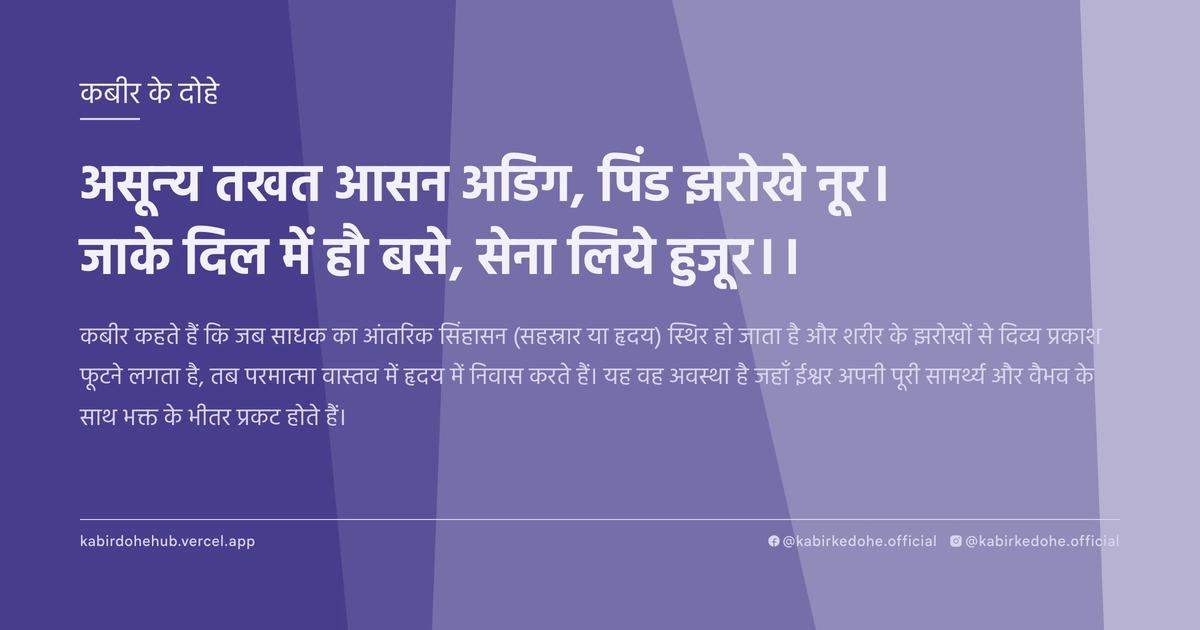
असून्य तखत आसन अडिग, पिंड झरोखे नूर।
जाके दिल में हौ बसे, सेना लिये हुजूर।।
Asunya takhat aasan adig, pind jharokhe noor. Jaake dil me hau base, sena liye huzoor.
इस पृष्ठ पर इस कबीर दोहे का अर्थ (meaning), हिंदी व्याख्या और अंग्रेज़ी अनुवाद, दार्शनिक विश्लेषण और व्यावहारिक जीवन सीख दी गई है। यह दोहा अंतर ज्योति (The Inner Light) विषय से जुड़ा है — Kabir doha meaning and explanation in Hindi and English.
अर्थ (Meaning):
कबीर कहते हैं कि जब साधक का आंतरिक सिंहासन (सहस्रार या हृदय) स्थिर हो जाता है और शरीर के झरोखों से दिव्य प्रकाश फूटने लगता है, तब परमात्मा वास्तव में हृदय में निवास करते हैं। यह वह अवस्था है जहाँ ईश्वर अपनी पूरी सामर्थ्य और वैभव के साथ भक्त के भीतर प्रकट होते हैं।
Kabir declares that when the inner throne of the seeker becomes unwavering and divine light radiates through the windows of the physical body, the Supreme Being truly resides within the heart. This is the state where the Divine manifests within the devotee with all Their sovereign power and celestial glory.
व्याख्या (Interpretation):
इसका शाब्दिक अर्थ है कि एक स्थिर आसन पर बैठकर जब शरीर से नूर निकलता है, तब प्रभु का वास होता है। रूपकात्मक रूप से, 'तखत' और 'आसन' मन की उस स्थिरता को दर्शाते हैं जो गहन ध्यान से प्राप्त होती है। 'पिंड' शरीर है और 'झरोखे' हमारी इंद्रियाँ और चेतना के द्वार हैं। जब अहंकार मिटता है, तो आत्मा (Atman) और परमात्मा (Brahman) का द्वैत समाप्त हो जाता है, जो अद्वैत वेदांत का सार है। यह निर्गुण भक्ति की वह पराकाष्ठा है जहाँ ईश्वर किसी बाहरी मंदिर में नहीं, बल्कि शरीर रूपी मंदिर के भीतर 'हुजूर' यानी सम्राट के रूप में विराजमान होते हैं। यह विरोधाभास है कि सबसे शक्तिशाली सत्ता सबसे शांत और स्थिर हृदय में वास करती है।
Literally, it describes a steady posture where divine light emanates from the body, signaling the Divine's presence. Metaphorically, the 'throne' and 'seat' represent the mental stability achieved through profound meditation. 'Pind' refers to the physical body, and 'jharokhe' are the sensory gateways of consciousness. When the ego dissolves, the duality between Atman and Brahman vanishes, echoing the essence of Advaita Vedanta. This is the pinnacle of Nirgun Bhakti, where the Formless Divine resides not in external temples, but as a sovereign 'Huzoor' within the temple of the body. The central paradox lies in the fact that the most powerful cosmic force dwells within the most silent and still heart.
दार्शनिक विश्लेषण (Philosophical Analysis):
कबीर का यह दोहा उनके युग के उस सामाजिक और धार्मिक संघर्ष का प्रतिबिंब है जहाँ धर्म केवल बाहरी कर्मकांडों और तीर्थयात्राओं तक सीमित था। कबीर ने पुरजोर तरीके से इस विचार का खंडन किया कि ईश्वर केवल काबा या काशी में मिलते हैं। उन्होंने 'पिंड' (शरीर) को ही ब्रह्मांड का सूक्ष्म रूप माना, जो सूफी मत के 'इंसान-ए-कामिल' की अवधारणा से मेल खाता है।
दार्शनिक स्तर पर, यह अद्वैत वेदांत के उस सिद्धांत का समर्थन करता है जहाँ जीव और ब्रह्म एक ही हैं। 'अडिग आसन' का अर्थ है मानसिक चंचलता का पूर्ण विनाश। जब तक मन विचारों के तूफान में है, वह 'तखत' नहीं बन सकता। यह मनोवैज्ञानिक रूपांतरण की प्रक्रिया है जहाँ साधक अपनी बाहरी पहचान को त्यागकर आंतरिक शून्यता में प्रवेश करता है।
सूफीवाद के 'नूर' (दिव्य प्रकाश) का उल्लेख यहाँ महत्वपूर्ण है। कबीर यहाँ यह समझा रहे हैं कि आध्यात्मिक ज्ञान कोई किताबी विद्या नहीं है, बल्कि एक अनुभवजन्य प्रकाश है जो शरीर के रोम-रोम से छलकता है। यह प्रकाश अज्ञानता के अंधकार को मिटाकर सत्य का साक्षात्कार कराता है।
जाति और वर्ण के भेदभाव को नकारते हुए, कबीर यह संदेश देते हैं कि यह 'दिव्य तखत' किसी विशेष जाति या धर्म के लिए आरक्षित नहीं है। जो भी अपने अहंकार को मिटाकर स्थिरता प्राप्त करता है, वह इस साम्राज्य का स्वामी बन जाता है। यह लोकतंत्र का आध्यात्मिक स्वरूप है।
अंततः, 'सेना लिये हुजूर' का अर्थ भौतिक सेना नहीं, बल्कि ब्रह्मांडीय शक्तियों का संरेखण है। जब मनुष्य अपनी मूल प्रकृति (Self) से जुड़ता है, तो वह पूरी सृष्टि की शक्ति को अपने भीतर महसूस करता है। यह अहंकार का विसर्जन और सार्वभौमिक चेतना का उदय है।
This couplet reflects the socio-religious conflict of Kabir's era, where religion was confined to external rituals and pilgrimages. Kabir vehemently rejected the notion that the Divine is found only in the Kaaba or Kashi, asserting instead that the 'Pind' (body) is a microcosm of the universe, aligning with the Sufi concept of 'Insan-e-Kamil' (the Perfect Human).
Philosophically, this supports the Advaita Vedanta principle that the individual soul and the Universal Brahman are one. The 'unwavering seat' signifies the total annihilation of mental volatility. As long as the mind is a storm of thoughts, it cannot become a 'throne.' This is a process of psychological transmutation where the seeker sheds the external identity to enter inner emptiness.
The mention of 'Noor' (divine light) is pivotal, drawing from Sufi mysticism. Kabir explains that spiritual realization is not a scholarly pursuit but an experiential radiance that emanates from every pore of the being. This light dissolves the darkness of ignorance to reveal the Absolute Truth.
By dismissing caste and creed, Kabir suggests that this 'divine throne' is not reserved for any specific elite. Anyone who eradicates their ego and achieves stillness becomes the sovereign of this inner empire. It is, in essence, a spiritual democracy.
Finally, 'Huzoor with an army' does not refer to a physical militia, but to the alignment of cosmic forces. When a human connects with their primordial nature, they feel the entire power of the universe within. This is the dissolution of the small 'i' and the awakening of the Universal Consciousness.
मूल संदेश (Core Message):
- बाहरी खोज को समाप्त कर आंतरिक गहराई में उतरें।
- स्थिरता ही वह द्वार है जिससे दिव्य प्रकाश प्रकट होता है।
- अहंकार का विसर्जन ही परमात्मा के आगमन की शर्त है।
- शरीर केवल एक माध्यम है, असली निवास चेतना है।
- जब 'मैं' मिटता है, तब 'वह' (परमात्मा) प्रकट होता है।
- Cease the external search and dive into internal depths.
- Stillness is the gateway through which divine light manifests.
- The dissolution of ego is the prerequisite for the Divine's arrival.
- The body is merely a vessel; the true residence is consciousness.
- When the 'I' vanishes, the 'He' (Divine) appears.
व्यावहारिक उदाहरण (Practical Example):
वाराणसी के एक पुराने घाट पर रहने वाली एक वृद्ध विधवा, जानकी, का जीवन केवल दूसरों के लिए सेवा और अंतहीन विलाप में बीता था। वह मानती थी कि मोक्ष केवल गंगा में डुबकी लगाने और कठोर उपवास से मिलेगा।
वह हर दिन घंटों मंदिर की सीढ़ियों पर बैठकर रोती और अपनी गलतियों की क्षमा मांगती, लेकिन उसका मन हमेशा दूसरों की आलोचना और अपने दुखों के बोझ से दबा रहता था।
एक दिन उसकी मुलाकात एक फकीर से हुई जिसने उससे कहा, 'माँ, तुम बाहर की सीढ़ियाँ तो चढ़ रही हो, लेकिन भीतर के तखत पर कभी बैठी ही नहीं।'
जानकी ने पूछा कि वह भीतर का तखत क्या है। फकीर ने उसे अपनी आँखें बंद करने और केवल अपनी आती-जाती सांसों को देखने के लिए कहा, बिना किसी निर्णय के।
शुरुआत में जानकी का मन विचलित रहा; उसे अपने मृत पति की याद आई, समाज के ताने याद आए, और शरीर का दर्द महसूस हुआ।
लेकिन धीरे-धीरे, उसने महसूस किया कि वह जो 'मैं' है, वह केवल यादों का एक पुलिंदा है। उसने उस 'मैं' को छोड़ना शुरू किया और केवल मौन में ठहर गई।
कई महीनों के इस अभ्यास के बाद, एक सुबह जब वह ध्यान में थी, उसे महसूस हुआ कि उसके भीतर एक असीम शांति है, जैसे कोई सम्राट उसके हृदय में आकर बैठ गया हो।
उसका चेहरा, जो कभी दुख से मुरझाया रहता था, अब एक अलौकिक चमक (नूर) से भर गया था। अब वह मंदिर नहीं जाती थी, क्योंकि वह जान गई थी कि मंदिर उसके भीतर है।
उसने दूसरों की सेवा करना जारी रखा, लेकिन अब वह विलाप नहीं करती थी। उसकी उपस्थिति मात्र से लोग शांत महसूस करने लगे।
यह 'कबीर ट्विस्ट' था—बाहरी अनुष्ठानों का त्याग और आंतरिक स्थिरता की प्राप्ति, जिसने एक दुखी विधवा को एक जीवित संत में बदल दिया।
Janaki, an elderly widow living on an ancient ghat in Varanasi, had spent her life in service to others and endless lamentation. She believed liberation could only be achieved through dips in the Ganges and rigorous fasting.
Every day, she spent hours weeping on temple steps, begging for forgiveness, yet her mind remained burdened by the judgment of others and her own sorrows.
One day, she met a wandering dervish who told her, 'Mother, you climb the external stairs, but you have never sat upon the inner throne.'
Janaki asked what this inner throne was. The dervish instructed her to close her eyes and simply observe her breath, without judgment or desire.
Initially, Janaki's mind was turbulent; she recalled her deceased husband, the taunts of society, and the aches of her aging body.
Gradually, however, she realized that the 'I' she clung to was merely a bundle of memories. She began to let go of that 'I' and rested in pure silence.
After months of this practice, one morning during meditation, she felt an infinite peace, as if a sovereign Emperor had taken residence within her heart.
Her face, once withered by grief, now radiated a celestial glow (Noor). She stopped visiting the temple, for she realized the temple was within her.
She continued serving others, but the lamentation had ceased. Her mere presence began to bring peace to those around her.
This was the 'Kabir Twist'—the abandonment of external rituals in favor of internal stillness, transforming a grieving widow into a living saint.
अभ्यास मार्गदर्शन (Practice Guidance):
- दैनिक ध्यान: प्रतिदिन 20 मिनट 'साक्षी भाव' का अभ्यास करें, जहाँ आप अपने विचारों को बिना किसी प्रतिक्रिया के केवल देखते हैं, जैसे आप किसी बाहरी दृश्य को देख रहे हों।
- आत्म-पूछताछ जर्नल: प्रतिदिन लिखें—'आज मेरा अहंकार किन बातों पर आहत हुआ?' और 'क्या मैं अपनी शांति बाहरी परिस्थितियों पर निर्भर कर रहा हूँ?'
- व्यवहारिक परिवर्तन: जब भी क्रोध या तनाव महसूस हो, तुरंत अपनी रीढ़ सीधी करें और कल्पना करें कि आप एक स्थिर 'तखत' पर बैठे हैं, जहाँ कोई भी बाहरी शोर आपको विचलित नहीं कर सकता।
- नैदानिक चेकलिस्ट: यदि आप अभी भी दूसरों की स्वीकृति खोज रहे हैं, तो आप 'तखत' से दूर हैं। यदि आप मौन में भी पूर्णता महसूस करते हैं, तो आप नूर के करीब हैं।
- Daily Meditation: Practice 'Witness Consciousness' for 20 minutes daily, observing your thoughts without reaction, as if watching a distant landscape.
- Self-Inquiry Journal: Daily record—'In what moments did my ego feel wounded today?' and 'Am I anchoring my peace in external circumstances?'
- Behavioral Shift: Whenever anger or stress arises, immediately straighten your spine and visualize yourself seated on an unwavering 'throne' where no external noise can disturb you.
- Diagnostic Checklist: If you are still seeking external validation, you are far from the 'throne.' If you feel complete even in absolute silence, you are nearing the Noor.
चिंतन प्रश्न (Reflection Questions):
- क्या मेरी शांति मेरी उपलब्धियों पर टिकी है या मेरी आंतरिक स्थिरता पर?
- मैं अपनी सार्वजनिक छवि (Digital/Social Ego) को बनाए रखने के लिए अपनी कितनी आंतरिक ऊर्जा नष्ट कर रहा हूँ?
- यदि मेरे जीवन से सभी बाहरी पहचान (नाम, पद, रिश्ता) छीन ली जाएं, तो क्या मेरे भीतर कुछ शेष बचेगा?
- क्या मैं ईश्वर को किसी विशेष स्थान पर खोज रहा हूँ, या मैं स्वयं उस स्थान बनने का साहस रखता हूँ?
- मेरे भीतर का 'नूर' किन डर और पूर्वाग्रहों की परतों के नीचे दबा हुआ है?
- Is my peace anchored in my achievements or in my internal stability?
- How much internal energy am I wasting to maintain my public image (Digital/Social Ego)?
- If all external identities (name, rank, relationship) were stripped away, would anything remain within me?
- Am I searching for the Divine in a specific place, or do I have the courage to become that place?
- Under which layers of fear and prejudice is my inner 'Noor' currently buried?