
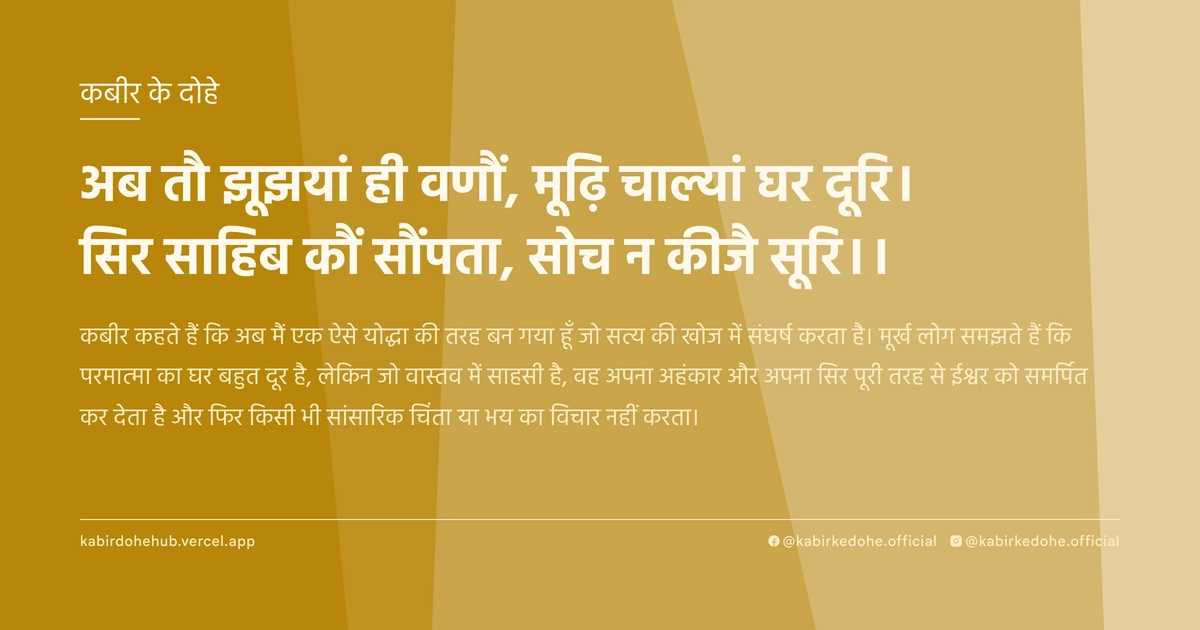
अब तौ झूझयां ही वणौं, मूढ़ि चाल्यां घर दूरि।
सिर साहिब कौं सौंपता, सोच न कीजै सूरि।।
Ab tau jhujhayan hi vanau, mudh chalya ghar doori. Sir sahib kaun saupata, soch na keeje suri.
इस पृष्ठ पर इस कबीर दोहे का अर्थ (meaning), हिंदी व्याख्या और अंग्रेज़ी अनुवाद, दार्शनिक विश्लेषण और व्यावहारिक जीवन सीख दी गई है। यह दोहा प्रपत्ति (Surrender) विषय से जुड़ा है — Kabir doha meaning and explanation in Hindi and English.
अर्थ (Meaning):
कबीर कहते हैं कि अब मैं एक ऐसे योद्धा की तरह बन गया हूँ जो सत्य की खोज में संघर्ष करता है। मूर्ख लोग समझते हैं कि परमात्मा का घर बहुत दूर है, लेकिन जो वास्तव में साहसी है, वह अपना अहंकार और अपना सिर पूरी तरह से ईश्वर को समर्पित कर देता है और फिर किसी भी सांसारिक चिंता या भय का विचार नहीं करता।
Kabir declares that he has become a spiritual warrior, one who struggles relentlessly against the illusions of the world. While the ignorant believe the divine abode is a distant destination to be reached, the true brave heart surrenders their very existence—their head—to the Master, casting aside all hesitation and worldly anxiety in the act of total devotion.
व्याख्या (Interpretation):
इस दोहे का शाब्दिक अर्थ है कि अब मैं केवल संघर्ष करने वाला योद्धा हूँ क्योंकि अज्ञानी लोग घर (परमात्मा) को दूर मानते हैं। यहाँ "घर" का अर्थ भौतिक स्थान नहीं, बल्कि आत्मा की अपनी मूल अवस्था है। यह निर्गुण भक्ति का सार है जहाँ साधक माया के पर्दे को फाड़कर सत्य को देखता है। "सिर सौंपना" अहंकार के पूर्ण विनाश का प्रतीक है, जो अद्वैत वेदांत के 'अहं ब्रह्मास्मि' की प्राप्ति के लिए आवश्यक है। जब तक 'मैं' (अहंकार) जीवित है, तब तक दूरी का भ्रम बना रहता है। जैसे ही समर्पण होता है, दूरी समाप्त हो जाती है और साधक स्वयं को ब्रह्म में लीन पाता है। यह विरोधाभास है कि जिसे हम सबसे दूर खोजते हैं, वह हमारे भीतर ही है, बस उसे पाने के लिए अहंकार की आहुति देनी पड़ती है।
Literally, Kabir describes himself as a combatant because the foolish perceive the 'Home' (the Divine) as a distant place. In this mystical context, 'Home' is not a geographical location but the primordial state of the soul. This aligns with Nirgun Bhakti, where the seeker tears through the veil of Maya to witness the Formless Truth. The act of 'surrendering the head' is a potent metaphor for the total annihilation of the ego, a prerequisite for realizing the non-duality of Atman and Brahman. The central paradox is that the perceived distance between the seeker and the Divine is created solely by the ego; once the 'I' is sacrificed, the distance vanishes. The struggle mentioned is not against an external enemy, but against the internal inertia and delusions that prevent the soul from recognizing its own divinity.
दार्शनिक विश्लेषण (Philosophical Analysis):
कबीर का यह दोहा उस युग की प्रतिक्रिया है जब धर्म केवल कर्मकांडों और बाहरी आडंबरों तक सीमित था। उन्होंने स्पष्ट किया कि मोक्ष किसी तीर्थ यात्रा या कठिन शारीरिक तपस्या से नहीं, बल्कि आंतरिक समर्पण से मिलता है। यह दृष्टिकोण सूफी मत के 'फना' (अहंकार का विनाश) के बहुत करीब है, जहाँ प्रेमी अपने अस्तित्व को मिटाकर केवल प्रिय (ईश्वर) में जीवित रहता है।
अद्वैत वेदांत के परिप्रेक्ष्य में, यह दोहा अज्ञान (Avidya) के विनाश की बात करता है। जब कबीर कहते हैं कि "मूढ़ चाल्यां घर दूरि", तो वे उस मानसिक भ्रम की ओर इशारा कर रहे हैं जो हमें यह विश्वास दिलाता है कि ईश्वर कहीं बाहर या ऊपर स्थित है। यह द्वैत (Duality) ही दुख का मूल कारण है।
कबीर की 'योद्धा' वाली छवि यह दर्शाती है कि आध्यात्मिक मार्ग कोई शांत सैर नहीं है, बल्कि एक भीषण युद्ध है—अपने ही विकारों, वासनाओं और सामाजिक कंडीशनिंग के विरुद्ध। यह युद्ध बाहरी दुनिया से नहीं, बल्कि अपने भीतर के 'अहं' से है।
यहाँ ritualism का पूर्ण खंडन है। मंदिर, मस्जिद या किसी विशेष विधि के बजाय, 'सिर सौंपना' यानी पूर्ण शरणागति (Surrender) को ही एकमात्र मार्ग बताया गया है। यह मार्ग किसी जाति या धर्म के लिए नहीं, बल्कि हर उस व्यक्ति के लिए है जो सत्य के लिए अपना सब कुछ दांव पर लगाने को तैयार है।
मनोवैज्ञानिक स्तर पर, यह 'अहंकार की मृत्यु' (Ego Death) की प्रक्रिया है। जब व्यक्ति अपनी पहचान को अपनी उपलब्धियों, पद या शरीर से जोड़ना बंद कर देता है, तब वह उस सार्वभौमिक चेतना के साथ एकाकार हो जाता है जिसे कबीर 'साहिब' कहते हैं। यह रूपांतरण ही वास्तविक मुक्ति है।
This couplet emerges from an era dominated by rigid ritualism and caste hierarchies. Kabir dismantles the notion that liberation is achieved through external pilgrimages or mechanical piety, asserting instead that the only true path is internal surrender. This philosophy mirrors the Sufi concept of 'Fana'—the annihilation of the self in the Divine, where the lover ceases to exist as a separate entity and remains only as a reflection of the Beloved.
From the lens of Advaita Vedanta, Kabir addresses the removal of 'Avidya' (ignorance). By stating that the foolish perceive the 'Home' as distant, he critiques the illusion of duality. The belief that God is an external entity to be reached is the primary obstacle to enlightenment; in reality, the seeker and the sought are one and the same.
Kabir's self-identification as a 'warrior' (jhujhayan) underscores that the spiritual path is not a passive stroll but a rigorous battle. This is a war against internal inertia, ingrained biases, and the seductive pull of Maya. It is a psychological struggle to dismantle the constructed identity of the 'ego' to reveal the timeless Atman.
There is a fierce rejection of ritualism here. By emphasizing the 'surrender of the head,' Kabir suggests that no amount of chanting or fasting can replace the courage of total surrender. This is a democratic spirituality, accessible to the weaver, the laborer, and the king alike, provided they possess the bravery to let go of their perceived importance.
Ultimately, this is a call for a radical shift in consciousness. The 'surrender' is not an act of defeat but an act of supreme victory—the victory over the small self to embrace the Universal Self. It corrects the literalist misconception that spirituality is about adding more knowledge; rather, it is about subtracting the ego until only Truth remains.
मूल संदेश (Core Message):
- अहंकार ही वह एकमात्र पर्दा है जो हमें सत्य से अलग करता है।
- आध्यात्मिक यात्रा बाहरी खोज नहीं, बल्कि आंतरिक विसर्जन है।
- पूर्ण समर्पण ही वह कुंजी है जो दूरी के भ्रम को मिटाती है।
- सच्चा साहस स्वयं को मिटाने में है, न कि स्वयं को स्थापित करने में।
- जब 'मैं' मिटता है, तभी 'वह' (परमात्मा) प्रकट होता है।
- The ego is the only veil that separates the seeker from the Truth.
- The spiritual journey is not an external quest, but an internal dissolution.
- Total surrender is the key that erases the illusion of distance.
- True courage lies in erasing the self, not in establishing the ego.
- Only when the 'I' vanishes does the 'Divine' manifest.
व्यावहारिक उदाहरण (Practical Example):
वाराणसी के एक पुराने घाट पर माधव नाम का एक वृद्ध बुनकर रहता था। वह जीवन भर रेशमी कपड़े बुनता रहा और अपनी कला में इतना निपुण हो गया कि पूरे शहर में उसकी चर्चा थी। उसकी कला ने उसे एक सूक्ष्म अहंकार दिया—उसे लगने लगा कि वह दूसरों से श्रेष्ठ है क्योंकि उसकी उंगलियां ईश्वर की तरह सृजन करती हैं। वह घंटों मंदिर जाता, दान करता और शास्त्रों की चर्चा करता, फिर भी उसके मन में एक बेचैनी थी, जैसे वह कुछ बहुत महत्वपूर्ण खोज रहा हो जो उससे बहुत दूर है।
एक दिन उसने कबीर के इस दोहे को सुना। पहले तो उसे लगा कि यह केवल कवियों की कल्पना है। लेकिन धीरे-धीरे उसे समझ आया कि उसका 'घर' (शांति) दूर नहीं है, बल्कि उसके अपने अहंकार की दीवार के पीछे छिपा है। उसने महसूस किया कि उसकी श्रेष्ठता का बोध ही वह पर्दा है जिसने उसे उसके वास्तविक स्वरूप से अलग कर रखा है।
माधव ने एक कठिन निर्णय लिया। उसने अपनी सबसे महंगी साड़ियों को उन लोगों में बांटना शुरू किया जिन्हें समाज ने ठुकरा दिया था। उसने अपनी कला का श्रेय लेना बंद कर दिया। जब लोग उसकी प्रशंसा करते, तो वह मन ही मन उस प्रशंसा को 'साहिब' के चरणों में समर्पित कर देता।
एक शाम, जब वह घाट की सीढ़ियों पर बैठा था, उसने देखा कि एक छोटा बच्चा मिट्टी के घर बना रहा है और फिर उन्हें हँसते हुए तोड़ रहा है। उस क्षण माधव को बोध हुआ कि जिसे वह जीवन भर सहेज रहा था, वह केवल मिट्टी का एक घर था।
उसने अपनी आँखें बंद कीं और मानसिक रूप से अपना सारा गौरव, अपनी पहचान और अपना 'मैं' उस अनंत शून्य में विसर्जित कर दिया। उसने अपना 'सिर' (अहंकार) सौंप दिया।
अचानक, वह बेचैनी गायब हो गई। उसे महसूस हुआ कि वह अब अलग नहीं है; वह उस नदी का हिस्सा है, उस हवा का हिस्सा है और उस हर इंसान का हिस्सा है जो उसके सामने खड़ा था।
अब वह केवल कपड़े नहीं बुनता था, बल्कि वह हर धागे में प्रेम और समर्पण बुनने लगा। उसकी कला अब प्रदर्शन के लिए नहीं, बल्कि प्रार्थना बन गई थी।
उसने जान लिया कि घर कहीं जाना नहीं था, बल्कि घर तो वह स्थिति है जहाँ 'मैं' समाप्त हो जाता है।
माधव अब एक योद्धा था, जिसने अपने भीतर के सबसे बड़े शत्रु—अहंकार—को हरा दिया था।
उसकी शांति अब बाहरी परिस्थितियों पर निर्भर नहीं थी, क्योंकि उसने स्वयं को उस अविनाशी साहिब में विलीन कर दिया था।
On an ancient ghat in Varanasi lived an elderly weaver named Madhav. Throughout his life, he wove exquisite silk fabrics, becoming so skilled that his fame spread across the city. However, this mastery birthed a subtle ego; he began to believe he was superior because his fingers could create beauty like a god. He visited temples, gave alms, and discussed scriptures, yet a persistent restlessness haunted him, a feeling that the 'Home' of peace was somewhere far away.
One day, he encountered this specific Doha of Kabir. Initially, he dismissed it as poetic hyperbole. But slowly, the words began to sink in: his 'Home' was not a distant destination, but was hidden behind the thick wall of his own pride. He realized that his sense of superiority was the very veil separating him from his true nature.
Madhav made a radical decision. He began distributing his most expensive sarees to those marginalized by society. He stopped claiming credit for his art. Whenever people praised him, he mentally offered that praise at the feet of the 'Sahib' (the Divine).
One evening, while sitting on the stone steps of the ghat, he watched a small child building houses of sand and then laughing as he knocked them down. In that moment, Madhav had a revelation: everything he had spent his life meticulously building was merely a house of sand.
He closed his eyes and mentally surrendered all his glory, his identity, and his 'I-ness' into the infinite void. He 'surrendered his head'—the seat of his ego.
Suddenly, the restlessness vanished. He felt that he was no longer a separate entity; he was the river, the wind, and every human being standing before him.
He no longer wove fabric for acclaim; his weaving became a form of prayer, infusing every thread with love and surrender.
He understood that 'Home' was not a place to travel to, but a state of being where the 'I' ceases to exist.
Madhav had become a warrior, having defeated his greatest internal enemy: the ego.
His peace was no longer dependent on external circumstances, for he had merged himself into the indestructible Sahib.
अभ्यास मार्गदर्शन (Practice Guidance):
- प्रतिदिन 20 मिनट मौन ध्यान करें, जहाँ आप अपने विचारों को एक साक्षी (Witness) की तरह देखें और उन्हें 'मैं' से जोड़ना बंद करें।
- एक 'अहंकार डायरी' लिखें: दिन भर में जब भी आपको महसूस हो कि आप किसी से श्रेष्ठ हैं या किसी पर प्रभुत्व जमा रहे हैं, उसे लिखें और फिर उसे मानसिक रूप से समर्पित करें।
- सेवा का अभ्यास: किसी ऐसे व्यक्ति की निस्वार्थ मदद करें जिससे आपका कोई संबंध न हो और इस बात का पूरा ध्यान रखें कि इस कार्य का श्रेय किसी को न मिले।
- निदान चेकलिस्ट: क्या मैं अभी भी अपनी उपलब्धियों के माध्यम से अपनी पहचान बना रहा हूँ? क्या मैं दूसरों में अपनी कमियाँ देख रहा हूँ? क्या मुझे अभी भी लगता है कि ईश्वर मुझसे दूर है? यदि हाँ, तो समर्पण की प्रक्रिया अभी अधूरी है।
- Practice 20 minutes of silent meditation daily, observing your thoughts as a witness and consciously detaching them from the identity of 'I'.
- Maintain an 'Ego Journal': Record moments throughout the day when you felt superior to others or sought dominance, then mentally surrender those feelings to the Divine.
- Practice selfless service (Seva): Help someone with whom you have no connection, ensuring that the act remains anonymous and no credit is claimed.
- Diagnostic Checklist: Am I still defining my identity through my achievements? Am I projecting my shadows onto others? Do I still feel that the Divine is distant? If yes, the process of surrender is incomplete.
चिंतन प्रश्न (Reflection Questions):
- मेरे जीवन का वह कौन सा 'सिर' (अहंकार) है जिसे मैं कभी समर्पित नहीं करना चाहता?
- मैं अपनी सार्वजनिक छवि को बनाए रखने के लिए अपने वास्तविक स्वरूप को कितना दबाता हूँ?
- क्या मेरी भक्ति वास्तव में समर्पण है, या यह केवल एक और तरीका है खुद को 'आध्यात्मिक' महसूस कराने का?
- यदि मेरी सारी उपलब्धियाँ और पद आज छीन लिए जाएँ, तो मेरे पास क्या बचेगा?
- मैं किन सूक्ष्म पूर्वाग्रहों के कारण दूसरों को खुद से कमतर या बेहतर मानता हूँ?
- क्या मैं सत्य की खोज कर रहा हूँ, या केवल अपनी इच्छाओं की पुष्टि?
- What is that specific 'head' (ego/identity) in my life that I refuse to surrender?
- How much of my authentic self do I suppress to maintain my public persona?
- Is my devotion truly a surrender, or is it just another way to feel 'spiritually superior'?
- If all my achievements and titles were stripped away today, what would actually remain of me?
- What subtle biases lead me to perceive others as inferior or superior to myself?
- Am I truly seeking the Truth, or am I merely seeking confirmation of my own desires?