
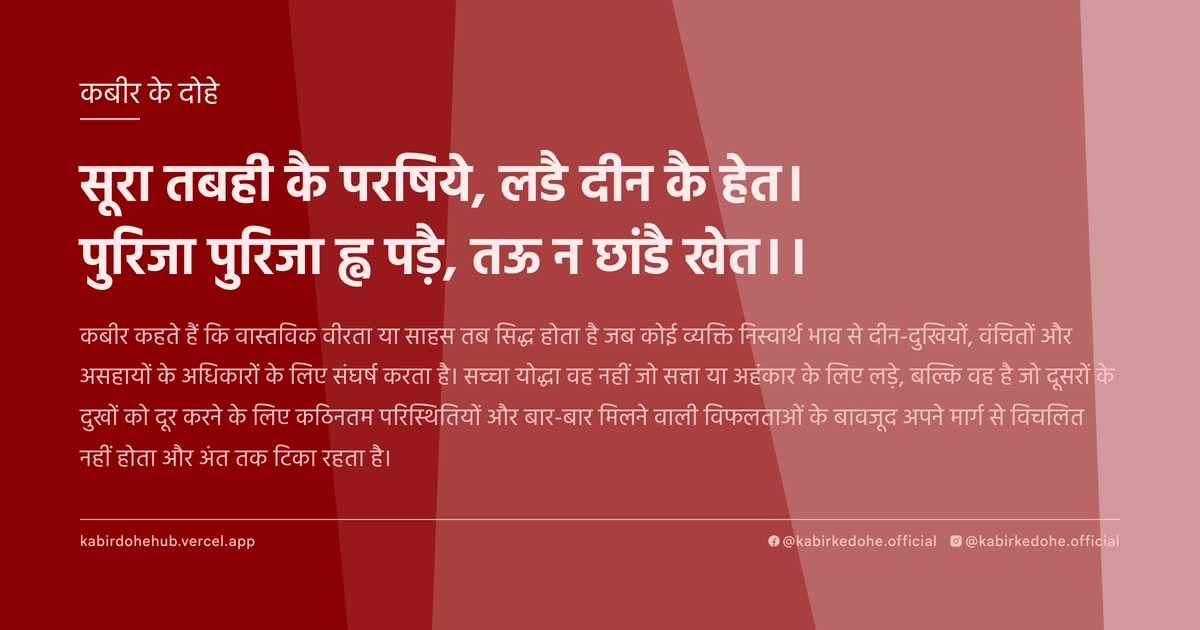
सूरा तबही कै परषिये, लडै दीन कै हेत।
पुरिजा पुरिजा ह्व पड़ै, तऊ न छांडै खेत।।
Sura tabhi kai parashiye, ladai deen kai het. Purija purija hwa padai, tau na chhandai khet.
इस पृष्ठ पर इस कबीर दोहे का अर्थ (meaning), हिंदी व्याख्या और अंग्रेज़ी अनुवाद, दार्शनिक विश्लेषण और व्यावहारिक जीवन सीख दी गई है। यह दोहा करुणा (Compassion) विषय से जुड़ा है — Kabir doha meaning and explanation in Hindi and English.
अर्थ (Meaning):
कबीर कहते हैं कि वास्तविक वीरता या साहस तब सिद्ध होता है जब कोई व्यक्ति निस्वार्थ भाव से दीन-दुखियों, वंचितों और असहायों के अधिकारों के लिए संघर्ष करता है। सच्चा योद्धा वह नहीं जो सत्ता या अहंकार के लिए लड़े, बल्कि वह है जो दूसरों के दुखों को दूर करने के लिए कठिनतम परिस्थितियों और बार-बार मिलने वाली विफलताओं के बावजूद अपने मार्ग से विचलित नहीं होता और अंत तक टिका रहता है।
Kabir asserts that true bravery or heroism is validated only when one fights selflessly for the sake of the poor, the downtrodden, and the marginalized. A real warrior is not one who battles for power or ego, but one who persists in the face of repeated hardships and failures, refusing to abandon the field of struggle until the cause of the suffering is alleviated.
व्याख्या (Interpretation):
शाब्दिक अर्थ में यह दोहा एक ऐसे योद्धा की बात करता है जो गरीबों के लिए लड़ता है। आध्यात्मिक स्तर पर, 'दीन' यहाँ केवल भौतिक गरीबी नहीं, बल्कि उस आत्मा का प्रतीक है जो माया और अज्ञान के कारण बंधन में है। 'खेत' वह संसार या चेतना का क्षेत्र है जहाँ कर्म किए जाते हैं। निर्गुण भक्ति के संदर्भ में, यह अहंकार के विनाश की प्रक्रिया है; जब साधक अपने 'स्व' को मिटाकर दूसरों के दुखों को अपनाता है, तब वह वास्तव में 'सूरा' (वीर) बनता है। यह अद्वैत वेदांत के उस सिद्धांत को पुष्ट करता है जहाँ दूसरों की सेवा ही स्वयं की सेवा है क्योंकि आत्मा एक ही है। यहाँ विरोधाभास यह है कि जीत बाहरी युद्ध में नहीं, बल्कि आंतरिक करुणा के विस्तार में है।
Literally, the couplet speaks of a warrior fighting for the poor. Spiritually, 'the poor' symbolizes the soul bound by Maya and ignorance. The 'field' represents the realm of consciousness or the world where karma is enacted. In the context of Nirgun Bhakti, this is the process of ego-annihilation; when the seeker dissolves their 'I' to embrace the suffering of others, they become a true 'Sura' (hero). This reinforces the Advaita Vedanta principle that service to others is service to the Self, as all souls are one. The central paradox lies in the fact that victory is not found in external conquest, but in the expansion of internal compassion.
दार्शनिक विश्लेषण (Philosophical Analysis):
कबीर का यह दोहा उनके समय के सामाजिक ढांचे पर एक गहरा प्रहार है, जहाँ वीरता को अक्सर राजसी युद्धों या धार्मिक कट्टरता से जोड़ा जाता था। कबीर ने वीरता की परिभाषा को पूरी तरह बदल दिया, इसे 'करुणा' और 'न्याय' से जोड़कर। उन्होंने जाति और वर्ण व्यवस्था के उस अहंकार को चुनौती दी जो कुछ लोगों को जन्म से ही 'श्रेष्ठ' और कुछ को 'दीन' मानता था।
दार्शनिक रूप से, यह सूफीवाद के 'इश्क-ए-हकीकी' (ईश्वरीय प्रेम) के करीब है, जहाँ प्रेम केवल ईश्वर के लिए नहीं, बल्कि उसकी रचना (मानवता) के लिए व्यक्त होता है। जब कबीर कहते हैं कि वह 'खेत नहीं छोड़ता', तो वे उस अटूट संकल्प की बात कर रहे हैं जो एक साधक को निर्वाण या मोक्ष की ओर ले जाता है। यह केवल सामाजिक सक्रियता नहीं है, बल्कि एक आध्यात्मिक अनुशासन है।
अद्वैत वेदांत के नजरिए से, जब हम किसी 'दीन' की सहायता करते हैं, तो हम वास्तव में उस भ्रम को तोड़ रहे होते हैं कि हम अलग-अलग हैं। यह 'अहं' का विसर्जन है। यदि कोई व्यक्ति केवल अपनी मुक्ति के लिए ध्यान करता है, तो वह अधूरा है; पूर्णता तब आती है जब व्यक्तिगत मुक्ति सामूहिक मुक्ति के साथ जुड़ जाती है।
कबीर यहाँ कर्मयोग का संदेश दे रहे हैं। वे बताते हैं कि वास्तविक आध्यात्मिकता गुफाओं में छिपने में नहीं, बल्कि जीवन के संघर्षों के बीच रहकर करुणा का अभ्यास करने में है। यह कर्म और भक्ति का एक दुर्लभ समन्वय है, जहाँ सेवा ही सबसे बड़ी पूजा बन जाती है।
अंततः, यह दोहा हमें सिखाता है कि आध्यात्मिक प्रगति का पैमाना यह नहीं है कि हमने कितनी पुस्तकें पढ़ीं, बल्कि यह है कि हमने कितने टूटे हुए दिलों को सहारा दिया। वीरता का अर्थ अब तलवार चलाना नहीं, बल्कि अहंकार को काटकर प्रेम को स्थापित करना है।
This couplet is a profound critique of the social structures of Kabir's era, where bravery was often equated with royal conquests or religious zealotry. Kabir completely redefined heroism, anchoring it in 'compassion' and 'justice.' He challenged the arrogance of the caste system that deemed some superior by birth and others 'poor' or 'lowly.'
Philosophically, this aligns with the Sufi concept of 'Ishq-e-Haqiqi' (Divine Love), where love is expressed not just toward God, but toward His creation (humanity). When Kabir mentions not 'leaving the field,' he refers to the unwavering resolve required for a seeker to reach liberation. This is not merely social activism, but a rigorous spiritual discipline.
From the perspective of Advaita Vedanta, helping the downtrodden is an act of shattering the illusion of separation. It is the dissolution of the 'I'. A seeker who meditates solely for personal salvation remains incomplete; wholeness is achieved when individual liberation merges with collective liberation.
Kabir advocates for Karma Yoga here. He suggests that true spirituality is not found in retreating to caves, but in practicing compassion amidst the struggles of life. This is a rare synthesis of action and devotion, where service becomes the highest form of worship.
Ultimately, the couplet teaches that the metric of spiritual progress is not the number of scriptures read, but the number of broken hearts healed. Bravery is no longer about wielding a sword, but about severing the ego to establish love.
मूल संदेश (Core Message):
- अहंकार का त्याग ही वास्तविक वीरता की पहली सीढ़ी है।
- सेवा केवल दान नहीं, बल्कि आत्मा का विस्तार है।
- सच्ची जीत बाहरी संघर्ष में नहीं, आंतरिक करुणा में है।
- विफलताओं के बावजूद टिके रहना ही आध्यात्मिक दृढ़ता है।
- मानवता की सेवा ही ईश्वर की सबसे बड़ी पूजा है।
- स्वयं की मुक्ति सामूहिक मुक्ति के बिना अधूरी है।
- Renouncing the ego is the first step toward true bravery.
- Service is not mere charity, but the expansion of the soul.
- True victory lies in internal compassion, not external conflict.
- Persistence despite repeated failure is spiritual fortitude.
- Serving humanity is the highest form of worship to the Divine.
- Individual liberation is incomplete without collective liberation.
व्यावहारिक उदाहरण (Practical Example):
वाराणसी के एक पुराने मोहल्ले में माधव नाम का एक बुनकर रहता था। वह अपनी कला में निपुण था, लेकिन उसका मन हमेशा इस बात से व्यथित रहता था कि उसके समुदाय के कई लोग कर्ज के बोझ तले दबे थे और साहूकारों के जुल्म सह रहे थे।
माधव ने तय किया कि वह अपनी कमाई का एक बड़ा हिस्सा उन लोगों की मदद के लिए देगा जो अपनी जमीन खो चुके थे। शुरुआत में, उसके अपने परिवार ने उसे पागल कहा। उन्होंने तर्क दिया कि वह अपनी सुरक्षा देखे, दूसरों की नहीं।
साहूकारों ने माधव को डराने की कोशिश की। उन्होंने उसकी दुकान का सामान खराब कर दिया और उसे समाज से बहिष्कृत करने की धमकी दी। माधव के लिए यह एक कठिन समय था, वह मानसिक और आर्थिक रूप से टूट रहा था।
एक दिन, एक अत्यंत गरीब विधवा के पास उसके घर की आखिरी छोटी सी जमीन बची थी, जिसे साहूकार जबरन हड़पना चाहता था। माधव ने उस विधवा के लिए कानूनी लड़ाई लड़ी और गाँव के अन्य लोगों को एकजुट किया।
कई बार वह हारता रहा। उसे झूठे आरोपों में फंसाया गया और जेल भी जाना पड़ा। लोग कहने लगे, "देखो, माधव अपनी बर्बादी को निमंत्रण दे रहा है, वह व्यर्थ ही इस खेत में लड़ा हुआ है।"
लेकिन माधव को कबीर की वाणी याद थी। उसने महसूस किया कि उसकी अपनी शांति तब तक नहीं आएगी जब तक वह दूसरों के अन्याय को चुपचाप देखता रहेगा। उसने अपनी हार को भी एक साधना बना लिया।
धीरे-धीरे, उसकी निस्वार्थता ने अन्य बुनकरों के दिलों को छुआ। जो लोग डर के मारे चुप थे, वे माधव के साहस को देखकर खड़े होने लगे। एक सामूहिक चेतना जागी।
अंततः, साहूकार का प्रभाव कम हुआ और गाँव के गरीबों को उनका हक मिला। माधव ने कोई धन नहीं कमाया, बल्कि उसने एक ऐसा समाज बनाया जहाँ करुणा का शासन था।
उसकी वीरता तलवार चलाने में नहीं, बल्कि बार-बार गिरने के बाद भी दूसरों के लिए खड़े होने में थी। उसने साबित किया कि सच्चा योद्धा वह है जो दूसरों के आंसुओं को पोंछने के लिए अपना जीवन दांव पर लगा दे।
माधव का जीवन अब एक जीवित उदाहरण था कि जब व्यक्ति 'मैं' से ऊपर उठकर 'हम' के लिए लड़ता है, तो वह ईश्वर के सबसे करीब होता है।
In an old neighborhood of Varanasi lived a weaver named Madhav. He was skilled in his craft, but his heart was always heavy seeing members of his community crushed under the weight of debt and the cruelty of moneylenders.
Madhav decided to dedicate a significant portion of his earnings to help those who had lost their lands. Initially, his own family called him foolish, arguing that he should secure his own future rather than worry about others.
The moneylenders tried to intimidate him. They sabotaged his looms and threatened to socially boycott him. Madhav faced a grueling period; he was breaking down mentally and financially.
One day, an elderly widow was left with a tiny piece of land, the last remnant of her home, which the moneylender sought to seize by force. Madhav fought a legal and social battle for her and began mobilizing other villagers.
He failed many times. He was framed with false accusations and even spent time in prison. People mocked him, saying, "Look at Madhav, inviting his own ruin; he is fighting a useless battle in this field."
But Madhav remembered the words of Kabir. He realized that his own inner peace would remain elusive as long as he remained a silent spectator to injustice. He turned his failures into a spiritual practice.
Gradually, his selflessness touched the hearts of other weavers. Those who had been silent out of fear began to stand up, inspired by Madhav's courage. A collective consciousness awakened.
Eventually, the moneylender's grip weakened, and the poor regained their rights. Madhav earned no wealth, but he built a community governed by compassion.
His bravery was not in wielding a weapon, but in standing up for others despite falling repeatedly. He proved that a true warrior is one who risks their life to wipe the tears of another.
Madhav's life became a living testament that when a person rises above 'I' to fight for 'We,' they are closest to the Divine.
अभ्यास मार्गदर्शन (Practice Guidance):
- प्रतिदिन 15 मिनट मौन रहकर विचार करें कि आपके जीवन में कौन से ऐसे लोग हैं जिन्हें आपकी सहायता की आवश्यकता है, लेकिन आप अपने अहंकार या डर के कारण उनसे दूर हैं।
- एक 'करुणा डायरी' लिखें: प्रतिदिन एक ऐसा कार्य दर्ज करें जहाँ आपने अपने व्यक्तिगत लाभ को त्यागकर किसी दूसरे की मदद की हो।
- व्यवहार परिवर्तन: जब भी आप किसी असहाय व्यक्ति को देखें, तो उसे 'दीन' समझने के बजाय उसे अपने ही स्वरूप का एक विस्तार मानें और बिना किसी उम्मीद के उसकी मदद करें।
- निदान चेकलिस्ट: क्या मैं केवल अपनी सफलता से खुश होता हूँ? क्या मैं दूसरों के दुख को देखकर विचलित होता हूँ? क्या मैं कठिन परिस्थितियों में भी सही मार्ग पर टिका रहता हूँ? यदि उत्तर 'नहीं' है, तो समझें कि अहंकार अभी प्रभावी है।
- Spend 15 minutes in silence daily contemplating who in your life needs help, but whom you avoid due to your own ego or fear.
- Maintain a 'Compassion Journal': Record one act every day where you sacrificed personal gain to assist another.
- Behavioral Shift: Whenever you encounter a marginalized person, instead of seeing them as 'poor,' view them as an extension of your own Self and help without expectation.
- Diagnostic Checklist: Do I only find joy in my own success? Am I disturbed by the suffering of others? Do I persist in the right path despite hardships? If the answer is 'no,' recognize that the ego is still dominant.
चिंतन प्रश्न (Reflection Questions):
- क्या मेरी 'परोपकार' की भावना वास्तव में निस्वार्थ है, या मैं समाज में अपनी छवि सुधारने के लिए ऐसा करता हूँ?
- जब मैं दूसरों की मदद करता हूँ, तो क्या मैं खुद को उनसे 'श्रेष्ठ' महसूस करता हूँ?
- मेरे जीवन का वह कौन सा 'खेत' (क्षेत्र) है जिसे मैंने डर या आलस्य के कारण छोड़ दिया है?
- क्या मैं अपनी डिजिटल पहचान (सोशल मीडिया) पर करुणा दिखाता हूँ, जबकि वास्तविक जीवन में मैं उदासीन हूँ?
- मेरे भीतर का वह कौन सा डर है जो मुझे अन्याय के खिलाफ खड़े होने से रोकता है?
- यदि मेरी सारी उपलब्धियाँ छीन ली जाएँ, तो क्या मेरी करुणा ही मेरी एकमात्र पहचान बचेगी?
- Is my sense of 'philanthropy' truly selfless, or do I do it to polish my social image?
- When I help others, do I subconsciously feel 'superior' to them?
- Which 'field' in my life have I abandoned due to fear or lethargy?
- Do I perform compassion on my digital identity (social media) while remaining indifferent in real life?
- What is the specific fear within me that prevents me from standing against injustice?
- If all my achievements were stripped away, would my compassion be the only identity left?