
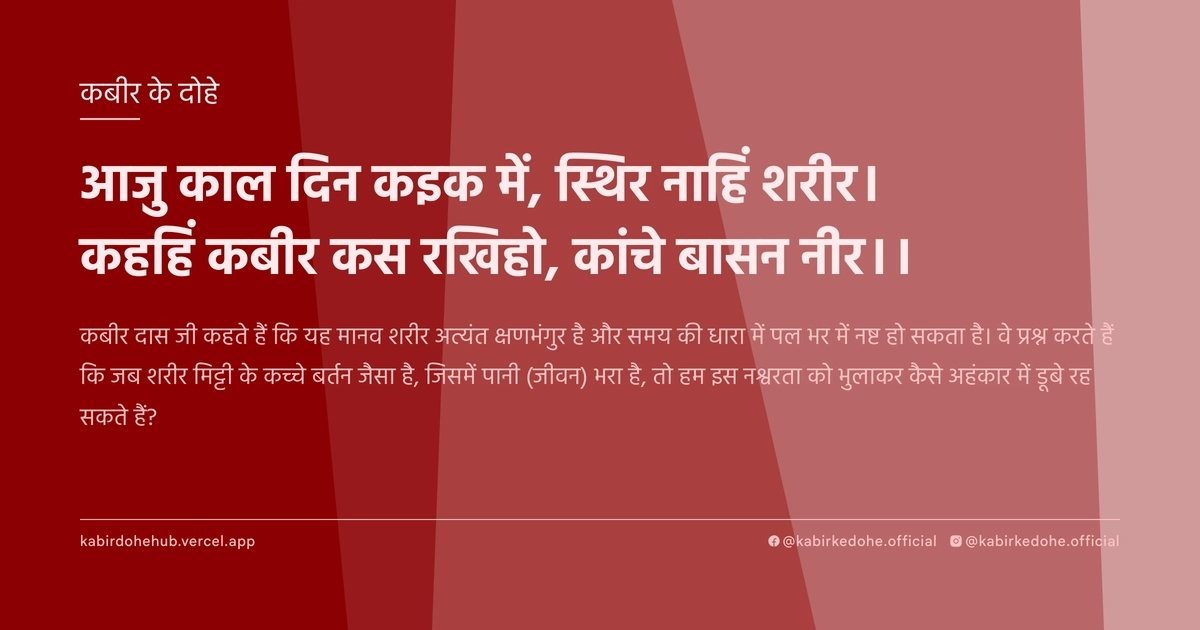
आजु काल दिन कइक में, स्थिर नाहिं शरीर।
कहहिं कबीर कस रखिहो, कांचे बासन नीर।।
Aaju kaal din kaik me, sthir nahin shareer. Kahahin Kabir kas rakhiho, kaanche baasan neer.
इस पृष्ठ पर इस कबीर दोहे का अर्थ (meaning), हिंदी व्याख्या और अंग्रेज़ी अनुवाद, दार्शनिक विश्लेषण और व्यावहारिक जीवन सीख दी गई है। यह दोहा अनित्य (Impermanence) विषय से जुड़ा है — Kabir doha meaning and explanation in Hindi and English.
अर्थ (Meaning):
कबीर दास जी कहते हैं कि यह मानव शरीर अत्यंत क्षणभंगुर है और समय की धारा में पल भर में नष्ट हो सकता है। वे प्रश्न करते हैं कि जब शरीर मिट्टी के कच्चे बर्तन जैसा है, जिसमें पानी (जीवन) भरा है, तो हम इस नश्वरता को भुलाकर कैसे अहंकार में डूबे रह सकते हैं?
Kabir asserts that the human body is ephemeral, vanishing in the blink of an eye within the relentless flow of time. He poses a poignant question: if the body is like an unbaked clay pot holding water, how can we remain oblivious to its fragility and cling to the illusions of permanence?
व्याख्या (Interpretation):
इस दोहे का शाब्दिक अर्थ शरीर की नश्वरता को रेखांकित करना है। रूपक के स्तर पर, 'कांचे बासन' (कच्चा बर्तन) मानव देह का प्रतीक है और 'नीर' (जल) उसमें निहित चेतना या प्राण का। कबीर यहाँ निर्गुण भक्ति के उस सिद्धांत को प्रस्तुत करते हैं जहाँ शरीर को केवल एक माध्यम माना गया है, गंतव्य नहीं। यह माया के उस जाल की ओर इशारा करता है जहाँ मनुष्य स्वयं को शरीर समझ बैठता है, जबकि वह वास्तव में अविनाशी आत्मा है। यह विरोधाभास है कि हम उस बर्तन को सजाने में जीवन बिता देते हैं जो कभी भी टूट सकता है। अंततः, यह बोध हमें बाहरी दिखावे से हटाकर आंतरिक सत्य की खोज की ओर ले जाता है।
Literally, the couplet underscores the transience of the physical form. Metaphorically, the 'unbaked clay pot' represents the human body, and the 'water' symbolizes the consciousness or life-force within. Kabir invokes the principle of Nirgun Bhakti, where the body is viewed merely as a vessel, not the destination. He highlights the deception of Maya, where humans mistakenly identify with the perishable shell rather than the eternal Atman. The central paradox lies in our obsession with decorating a vessel that is destined to shatter. Ultimately, this realization shifts the seeker's focus from external ornamentation to the pursuit of the formless, timeless Truth.
दार्शनिक विश्लेषण (Philosophical Analysis):
कबीर का यह दृष्टिकोण उनके समय के कर्मकांडीय आडंबरों और जातिगत श्रेष्ठता के विरुद्ध एक सशक्त प्रहार था। जब लोग ऊंच-नीच और बाहरी पहचान में उलझे थे, कबीर ने 'मृत्यु' को सबसे बड़े समतावादी (Equalizer) के रूप में प्रस्तुत किया। यह दर्शन अद्वैत वेदांत के करीब है, जहाँ शरीर को 'मिथ्या' और आत्मा को 'सत्य' माना गया है।
सूफी मत के 'फना' (अहंकार का विनाश) के सिद्धांत की तरह, यहाँ भी शरीर की नश्वरता का बोध अहंकार को नष्ट करने का साधन है। यदि मनुष्य यह जान ले कि उसका अस्तित्व एक कच्चे घड़े जैसा है, तो वह दूसरों पर प्रभुत्व जमाने की व्यर्थ कोशिश छोड़ देगा।
कबीर यहाँ केवल भय नहीं पैदा कर रहे, बल्कि 'वैराग्य' की स्थिति उत्पन्न कर रहे हैं। वैराग्य का अर्थ संसार का त्याग नहीं, बल्कि संसार की असारता का ज्ञान है। यह मनोवैज्ञानिक रूपांतरण है जहाँ भय, जागरूकता में बदल जाता है।
ऐतिहासिक संदर्भ में, कबीर ने धर्म के नाम पर होने वाले संघर्षों को इस सत्य से चुनौती दी कि अंत में सब मिट्टी में मिल जाना है। यह बोध व्यक्ति को संकीर्ण पहचानों से मुक्त कर सार्वभौमिक प्रेम की ओर ले जाता है।
अक्सर लोग इसे निराशावादी मानते हैं, लेकिन वास्तव में यह परम आशावाद है। जब हम यह स्वीकार करते हैं कि शरीर अस्थायी है, तभी हम उस 'अविनाशी' तत्व की खोज शुरू करते हैं जो समय और मृत्यु से परे है।
Kabir’s perspective serves as a powerful critique of the ritualistic pomposity and caste hierarchies of his era. While society was obsessed with social stratification, Kabir presented death as the ultimate equalizer. This philosophy aligns closely with Advaita Vedanta, which posits the body as 'Mithya' (illusory) and the Atman as 'Satya' (Truth).
Similar to the Sufi concept of 'Fana' (the annihilation of the ego), the realization of physical fragility is used here as a tool to dissolve the ego. If a human recognizes their existence as a fragile clay pot, the futile desire to dominate others vanishes.
Kabir is not inciting fear, but rather cultivating 'Vairagya' (dispassion). Vairagya is not the abandonment of the world, but the realization of its inherent transience. This is a psychological transformation where the fear of death evolves into a state of heightened spiritual awareness.
In a historical context, Kabir challenged religious conflicts by reminding humanity that all paths lead to the same dust. This realization liberates the individual from narrow identities and steers them toward universal love.
Common literalist interpretations often mistake this for pessimism. However, it is the highest form of optimism; by accepting the temporary nature of the shell, one is finally motivated to seek the 'Indestructible' element that transcends time and decay.
मूल संदेश (Core Message):
- शरीर नश्वर है, केवल चेतना शाश्वत है।
- अहंकार एक भ्रम है जो मिट्टी के बर्तन जैसा टूट जाता है।
- बाहरी सजावट से अधिक आंतरिक शुद्धि आवश्यक है।
- मृत्यु का स्मरण जीवन को अधिक सार्थक बनाता है।
- सत्य वह है जो समय की कसौटी पर स्थिर रहे।
- The body is transient; only consciousness is eternal.
- Ego is a delusion that shatters like a clay pot.
- Inner purification outweighs external ornamentation.
- Mindfulness of death renders life more meaningful.
- Truth is that which remains stable across time.
व्यावहारिक उदाहरण (Practical Example):
एक समय की बात है, वाराणसी के घाटों पर रामदीन नाम का एक वृद्ध कुम्हार रहता था। वह शहर के सबसे बेहतरीन और महंगे बर्तन बनाने के लिए प्रसिद्ध था। उसका अहंकार इतना बढ़ गया था कि वह अपने बर्तनों की मजबूती और सुंदरता पर गर्व करता था और अन्य कुम्हारों को तुच्छ समझता था।
रामदीन ने एक बार राजा के लिए एक विशाल और अलंकृत जलपात्र बनाया। उसने महीनों तक उस पर नक्काशी की और उसे सोने की परत से सजाया। वह विश्वास करने लगा था कि उसकी कला उसे अमर बना देगी और यह पात्र युगों-युगों तक उसकी महानता की गवाही देगा।
एक दिन, एक साधारण सा दिखने वाला फकीर उसके पास आया और उसने रामदीन के उस भव्य पात्र को देखा। फकीर ने मुस्कुराते हुए पूछा, 'रामदीन, यह पात्र बहुत सुंदर है, लेकिन क्या तुमने इसे आग में ठीक से पकाया है?'
रामदीन ने गर्व से कहा, 'मैंने इसे अपनी पूरी कुशलता से बनाया है, यह कभी नहीं टूटेगा।' तभी अचानक, एक छोटा सा कंपन हुआ और वह विशाल पात्र एक मामूली सी दरार के कारण बीच से फट गया। सारा पानी जमीन पर बह गया और सोने की परतें मिट्टी में मिल गईं।
रामदीन स्तब्ध रह गया। वह घंटों उस टूटे हुए मलबे को देखता रहा। उसे महसूस हुआ कि जिस पात्र पर उसने अपना पूरा अहंकार टिकाया था, वह अंततः मिट्टी ही था।
उस क्षण उसे कबीर के शब्दों की याद आई कि शरीर भी इसी कच्चे बर्तन की तरह है। उसने महसूस किया कि उसने अपना पूरा जीवन बाहरी सुंदरता और प्रशंसा बटोरने में बिता दिया, जबकि उसके भीतर की आत्मा प्यासी और उपेक्षित थी।
रामदीन का अहंकार पूरी तरह टूट गया। उसने अपनी कला का उपयोग अब धन कमाने के लिए नहीं, बल्कि गरीबों को मुफ्त में बर्तन देने के लिए करना शुरू किया।
उसने अपनी पहचान 'महान कलाकार' से बदलकर 'ईश्वर का सेवक' कर ली। उसके जीवन में अब एक ऐसी शांति थी जो उसे सोने के बर्तनों से कभी नहीं मिली थी।
वह अब समझ गया था कि असली सुंदरता बर्तन की बाहरी चमक में नहीं, बल्कि उस प्रेम और सेवा में है जो वह दूसरों के प्रति दिखाता है।
रामदीन की यह कहानी हमें सिखाती है कि जब हम अपनी नश्वरता को स्वीकार कर लेते हैं, तभी हम वास्तव में जीना शुरू करते हैं।
Once, on the ghats of Varanasi, lived an elderly potter named Ramdeen. He was renowned for crafting the finest and most expensive pottery in the city. His ego grew so immense that he took immense pride in the strength and beauty of his creations, viewing other potters with disdain.
Ramdeen once crafted a massive, ornate water vessel for the King. He spent months carving intricate patterns and gilding it with gold. He began to believe that his art would make him immortal and that this vessel would testify to his greatness for ages.
One day, a simple-looking fakir approached him and gazed at the magnificent vessel. The fakir smiled and asked, 'Ramdeen, this vessel is beautiful, but have you truly fired it in the kiln to withstand the test of time?'
Ramdeen replied with pride, 'I have crafted this with all my skill; it shall never break.' At that very moment, a slight tremor occurred, and the massive vessel split open due to a tiny, unseen flaw. All the water spilled onto the ground, and the gold leaf mingled with the mud.
Ramdeen stood frozen. He stared at the wreckage for hours. He realized that the object upon which he had anchored his entire ego was, in the end, merely clay.
In that moment, the essence of Kabir’s words resonated within him: the body is just like this unbaked pot. He realized he had spent his entire life gathering external beauty and praise, while the soul within remained thirsty and neglected.
Ramdeen's ego shattered completely. He stopped using his art for wealth and began providing pottery to the poor for free.
He shifted his identity from a 'Great Artist' to a 'Servant of the Divine.' A profound peace descended upon him, a peace that the golden vessels had never provided.
He now understood that true beauty lies not in the external luster of the pot, but in the love and service one offers to others.
Ramdeen's story teaches us that only when we accept our transience do we truly begin to live meaningfully.
अभ्यास मार्गदर्शन (Practice Guidance):
- प्रतिदिन 15 मिनट 'शवासन' में लेटकर यह चिंतन करें कि शरीर की प्रत्येक कोशिका बदल रही है और अंततः यह मिट्टी में मिल जाएगी।
- एक डायरी लिखें जिसमें आप उन तीन चीजों की सूची बनाएं जिन पर आप सबसे अधिक गर्व करते हैं, और फिर विश्लेषण करें कि मृत्यु के समय उनका क्या मूल्य होगा।
- व्यवहार परिवर्तन: जब भी क्रोध या अहंकार महसूस हो, तो मन में कहें 'मैं एक कच्चा घड़ा हूँ', ताकि स्थिति की गंभीरता और अपना लघुत्व याद रहे।
- निदान चेकलिस्ट: क्या मैं अपनी भौतिक उपलब्धियों को अपनी स्थायी पहचान मान रहा हूँ? क्या मैं दूसरों को उनकी सामाजिक स्थिति के आधार पर आंक रहा हूँ? यदि हाँ, तो आप 'माया' के प्रभाव में हैं।
- Spend 15 minutes daily in 'Shavasana' (corpse pose), contemplating how every cell in the body is changing and will eventually return to dust.
- Maintain a journal listing three things you are most proud of, then analyze their perceived value from the perspective of the moment of death.
- Behavioral Shift: Whenever anger or ego arises, mentally whisper 'I am but an unbaked pot' to recall your fragility and the insignificance of the conflict.
- Diagnostic Checklist: Am I mistaking my material achievements for my permanent identity? Am I judging others based on social status? If yes, you are operating under the illusion of Maya.
चिंतन प्रश्न (Reflection Questions):
- यदि आज आपका 'बर्तन' टूट जाए, तो पीछे क्या बचेगा जिसे आप गर्व से कह सकें कि 'यह मैं हूँ'?
- आपकी डिजिटल पहचान (सोशल मीडिया) आपके वास्तविक अस्तित्व के बारे में क्या झूठ बोल रही है?
- आप किन भौतिक वस्तुओं को अपनी सुरक्षा कवच मानते हैं, जबकि वे स्वयं नश्वर हैं?
- क्या आपका प्रेम केवल शरीर की सुंदरता से जुड़ा है, या आप उस 'नीर' (आत्मा) को देख पा रहे हैं?
- आपकी कौन सी ऐसी आदत है जो इस भ्रम को पुष्ट करती है कि आप अमर हैं?
- If your 'vessel' were to shatter today, what would remain that you could proudly claim as 'I'?
- What lies is your digital identity (social media) telling about your actual existence?
- Which material possessions do you treat as security blankets, despite their own transience?
- Is your love tied only to the beauty of the form, or can you perceive the 'water' (soul) within?
- Which of your habits reinforces the delusion that you are immortal?