
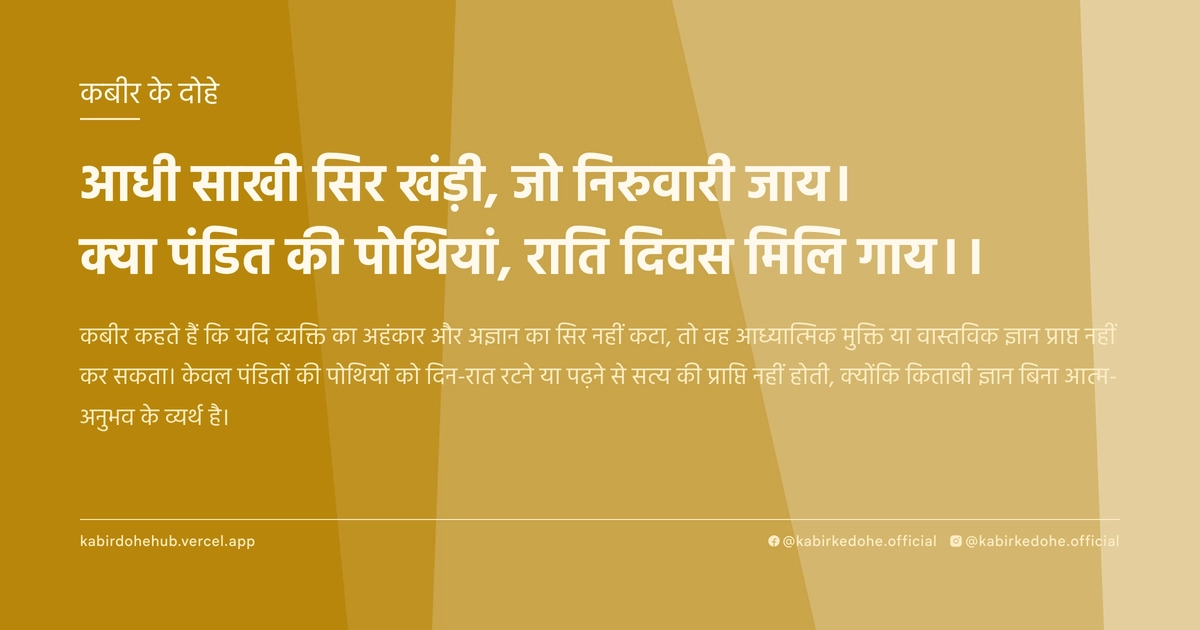
आधी साखी सिर खंड़ी, जो निरुवारी जाय।
क्या पंडित की पोथियां, राति दिवस मिलि गाय।।
Aadhi saakhi sir khandi, jo niruvari jaaye. Kya pandit ki pothiyan, raati divas mili gaaye.
इस पृष्ठ पर इस कबीर दोहे का अर्थ (meaning), हिंदी व्याख्या और अंग्रेज़ी अनुवाद, दार्शनिक विश्लेषण और व्यावहारिक जीवन सीख दी गई है। यह दोहा कर्मकांड विरोध (Critique of Ritualism) विषय से जुड़ा है — Kabir doha meaning and explanation in Hindi and English.
अर्थ (Meaning):
कबीर कहते हैं कि यदि व्यक्ति का अहंकार और अज्ञान का सिर नहीं कटा, तो वह आध्यात्मिक मुक्ति या वास्तविक ज्ञान प्राप्त नहीं कर सकता। केवल पंडितों की पोथियों को दिन-रात रटने या पढ़ने से सत्य की प्राप्ति नहीं होती, क्योंकि किताबी ज्ञान बिना आत्म-अनुभव के व्यर्थ है।
Kabir asserts that unless the 'head' of ego and ignorance is severed, one cannot attain spiritual liberation or true realization. Merely reciting or studying the scriptures of scholars day and night is futile, as bookish knowledge remains empty without the direct experience of the Divine within.
व्याख्या (Interpretation):
यहाँ 'सिर खंड़ी' का अर्थ शारीरिक मृत्यु नहीं, बल्कि अहंकार (Ego) का विसर्जन है। यह दोहा निरगुण भक्ति के उस मार्ग को दर्शाता है जहाँ बाहरी कर्मकांडों और शास्त्रों के बोझ के बजाय आंतरिक शुद्धि को प्राथमिकता दी गई है। माया व्यक्ति को यह विश्वास दिलाती है कि ज्ञान शब्दों में है, जबकि वास्तव में ज्ञान वह है जो द्वैत को समाप्त कर दे। जब तक 'मैं' का भाव जीवित है, तब तक पोथियाँ केवल बौद्धिक व्यायाम हैं, आध्यात्मिक जागृति नहीं। यह आत्मा और ब्रह्म की अद्वैत स्थिति की ओर संकेत करता है, जहाँ ज्ञाता और ज्ञेय का भेद मिट जाता है।
The phrase 'severing the head' does not imply physical death, but the annihilation of the ego. This couplet illuminates the path of Nirgun Bhakti, prioritizing internal purification over the burden of external rituals and scriptures. Maya deceives the seeker into believing that truth resides in words, whereas true knowledge is that which dissolves duality. As long as the sense of 'I' persists, scriptures are merely intellectual exercises rather than spiritual awakenings. It points toward the Advaita state of non-duality, where the distinction between the knower and the known vanishes completely.
दार्शनिक विश्लेषण (Philosophical Analysis):
कबीर का यह प्रहार उस समय की सामाजिक और धार्मिक जड़ता पर था, जहाँ ब्राह्मणवादी वर्चस्व ने ज्ञान को केवल संस्कृत ग्रंथों और उच्च जातियों तक सीमित कर दिया था। वे तर्क देते हैं कि ईश्वर किसी विशेष भाषा या पुस्तक का बंधक नहीं है। यह दृष्टिकोण सूफी मत के 'फना' (अहंकार का विनाश) और अद्वैत वेदांत के 'अहं ब्रह्मास्मि' के करीब है, जहाँ व्यक्तिगत पहचान का विलीनीकरण सार्वभौमिक चेतना में होता है।
ritualism (कर्मकांड) की अस्वीकृति यहाँ स्पष्ट है। कबीर मानते हैं कि शास्त्र केवल उंगली हैं जो चंद्रमा की ओर इशारा करती हैं, लेकिन लोग उंगली को ही चंद्रमा मान बैठते हैं। उनके लिए 'साखी' (साक्ष्य) वह है जो स्वयं के अनुभव से प्रमाणित हो, न कि वह जो किसी दूसरे ने लिखा हो। यह मनोवैज्ञानिक रूपांतरण की मांग करता है जहाँ व्यक्ति अपनी बौद्धिक श्रेष्ठता के गर्व को त्याग कर शून्य हो जाए।
ऐतिहासिक रूप से, कबीर ने एक ऐसे समाज का निर्माण करना चाहा जहाँ सत्य का मापदंड 'पवित्र ग्रंथ' नहीं बल्कि 'पवित्र आचरण' हो। वे चेतावनी देते हैं कि जब ज्ञान अहंकार का पोषण करने लगे, तो वह ज्ञान वास्तव में अज्ञान का सबसे गहरा रूप बन जाता है। यह विरोधाभास है कि जो जितना अधिक पढ़ता है, वह उतना ही अधिक खुद को दूसरों से श्रेष्ठ समझने लगता है, जो कि मुक्ति के मार्ग में सबसे बड़ी बाधा है।
सूफीवाद के प्रभाव में, कबीर 'इश्क' और 'अनुभव' को 'इल्म' (किताबी ज्ञान) से ऊपर रखते हैं। उनके अनुसार, हृदय का ज्ञान वह कुंजी है जो उस द्वार को खोलती है जिसे हजारों पोथियाँ बंद रखती हैं। यह एक क्रांतिकारी आह्वान था कि मनुष्य अपनी अंतरात्मा की आवाज सुने, न कि पुरोहितों के निर्देशों का पालन करे।
अंततः, यह दोहा हमें सिखाता है कि आध्यात्मिक यात्रा 'जोड़ने' की नहीं बल्कि 'छोड़ने' की प्रक्रिया है। हमें ज्ञान अर्जित नहीं करना है, बल्कि उस अज्ञान को हटाना है जो हमें हमारे वास्तविक स्वरूप से अलग करता है। जब अहंकार का सिर कट जाता है, तब जो शेष रहता है, वही शाश्वत सत्य है।
Kabir’s critique targets the social and religious rigidity of his era, where Brahmanical hegemony restricted knowledge to Sanskrit texts and upper castes. He argues that the Divine is not a prisoner of any specific language or book. This perspective aligns with the Sufi concept of 'Fana' (annihilation of the self) and the Advaita Vedanta realization of 'Aham Brahmasmi,' where individual identity merges into universal consciousness.
The rejection of ritualism is explicit here. Kabir posits that scriptures are merely fingers pointing toward the moon, yet people mistake the finger for the moon itself. For him, 'Sakhi' (evidence) is that which is verified by personal experience, not that which is transcribed by another. This demands a psychological transformation where the seeker abandons the pride of intellectual superiority to become 'shunya' or void.
Historically, Kabir sought to build a society where the benchmark of truth was not 'sacred texts' but 'sacred conduct.' He warns that when knowledge begins to nourish the ego, it becomes the deepest form of ignorance. It is a paradox that the more one reads, the more they perceive themselves as superior to others, which is the primary obstacle to liberation.
Influenced by Sufism, Kabir places 'Ishq' (divine love) and direct experience above 'Ilm' (bookish knowledge). According to him, the knowledge of the heart is the key that opens the door which thousands of scriptures keep locked. This was a revolutionary call for humans to listen to their inner voice rather than follow priestly instructions.
Ultimately, this doha teaches us that the spiritual journey is not a process of 'acquisition' but of 'relinquishment.' We are not meant to acquire knowledge, but to remove the ignorance that separates us from our true nature. When the head of the ego is severed, that which remains is the eternal Truth.
मूल संदेश (Core Message):
- अहंकार का त्याग ही वास्तविक ज्ञान का प्रवेश द्वार है।
- किताबी ज्ञान केवल सूचना है, अनुभव ही वास्तविक बोध है।
- शब्दों के जाल से बाहर निकलकर मौन की गहराई में उतरें।
- बौद्धिक गर्व आध्यात्मिक प्रगति का सबसे बड़ा अवरोध है।
- सत्य को पढ़ा नहीं जाता, उसे स्वयं में जिया जाता है।
- जब 'मैं' मिटता है, तभी 'वह' प्रकट होता है।
- Relinquishing the ego is the only gateway to true knowledge.
- Bookish learning is mere information; experience is actual realization.
- Step out of the web of words and dive into the depth of silence.
- Intellectual pride is the greatest obstacle to spiritual progress.
- Truth is not read; it is lived within the self.
- Only when the 'I' vanishes does the 'Divine' manifest.
व्यावहारिक उदाहरण (Practical Example):
वाराणसी के एक पुराने मोहल्ले में माधव नाम का एक विद्वान पंडित रहता था। उसने जीवन के सभी धर्मग्रंथों को कंठस्थ कर लिया था और शहर भर में अपनी विद्वत्ता के लिए प्रसिद्ध था। वह हर चर्चा में अपनी पोथियों के प्रमाण देता और दूसरों को नीचा दिखाता।
एक दिन वह गंगा घाट पर एक साधारण से बुनकर के पास बैठा, जो शांत मुद्रा में केवल अपनी सांसों पर ध्यान केंद्रित कर रहा था। माधव ने गर्व से कहा, 'तुम इन बेकार के धागों में उलझे हो, जबकि मैं वेदों का सार जानता हूँ।'
बुनकर ने मुस्कुराकर पूछा, 'पंडित जी, आपकी पोथियाँ आपको यह तो बताती हैं कि ईश्वर क्या है, लेकिन क्या वे आपको यह बताती हैं कि इस क्षण आपके भीतर जो क्रोध और अहंकार है, वह कहाँ से आ रहा है?'
माधव चुप हो गया। उसने महसूस किया कि वह ग्रंथों के बारे में सब जानता था, लेकिन स्वयं के बारे में कुछ भी नहीं। उसकी सारी विद्वत्ता उसके अहंकार की ढाल बन गई थी।
उस रात माधव को नींद नहीं आई। उसे लगा कि वह एक ऐसे पुस्तकालय की तरह है जिसमें किताबें तो बहुत हैं, लेकिन कोई भी किताब पढ़ी नहीं गई। उसने महसूस किया कि वह शब्दों का गुलाम था, सत्य का खोजी नहीं।
अगले दिन, उसने अपनी पोथियों को एक तरफ रखा और उस बुनकर के पास जाकर केवल मौन रहना सीखा। उसने सीखा कि शब्दों का शोर केवल बाहरी दुनिया को प्रभावित करता है, लेकिन आंतरिक शांति केवल मौन में मिलती है।
धीरे-धीरे माधव का व्यवहार बदलने लगा। वह अब दूसरों को सुधारने के बजाय स्वयं को देखने लगा। उसकी वाणी में अब अहंकार नहीं, बल्कि करुणा थी।
उसने पाया कि जब उसने 'विद्वान' होने का मुखौटा उतारा, तब वह वास्तव में ज्ञान के करीब पहुँचा। यह उसका 'सिर खण्डना' था—उसकी बौद्धिक पहचान की मृत्यु।
अब वह केवल पोथियों का गायक नहीं था, बल्कि वह स्वयं एक जीवित साक्ष्य बन गया था। उसकी शांति अब उसके प्रमाण थे।
माधव ने अंततः समझा कि सत्य पोथियों में नहीं, बल्कि उस शून्य में है जहाँ 'मैं' समाप्त हो जाता है।
In an old neighborhood of Varanasi lived a scholar named Madhav. He had memorized all the religious scriptures and was renowned throughout the city for his erudition. In every debate, he cited his texts and looked down upon others.
One day, he sat by the Ganges ghat next to a simple weaver who was calmly focusing on his breath. Madhav said with pride, 'You are entangled in these useless threads, while I know the essence of the Vedas.'
The weaver smiled and asked, 'Pandit ji, your books tell you what God is, but do they tell you where the anger and ego currently residing within you are coming from?'
Madhav fell silent. He realized that while he knew everything about the texts, he knew nothing about himself. All his scholarship had become a shield for his ego.
That night, Madhav could not sleep. He felt like a library filled with books that had never actually been read. He realized he was a slave to words, not a seeker of truth.
The next day, he set aside his scriptures and approached the weaver, learning only how to be silent. He discovered that the noise of words only affects the outer world, while inner peace is found only in silence.
Gradually, Madhav's behavior changed. Instead of trying to correct others, he began to observe himself. His speech no longer carried arrogance, but compassion.
He found that when he removed the mask of being a 'scholar,' he actually drew closer to the truth. This was his 'severing of the head'—the death of his intellectual identity.
He was no longer merely a singer of scriptures, but had become a living witness. His peace became his proof.
Madhav finally understood that truth does not reside in books, but in the void where the 'I' ceases to exist.
अभ्यास मार्गदर्शन (Practice Guidance):
- प्रतिदिन 20 मिनट मौन अभ्यास करें, जहाँ आप किसी भी विचार या शब्द को महत्व न दें, केवल साक्षी बनें।
- एक डायरी लिखें जिसमें आप उन क्षणों को दर्ज करें जब आपने अपनी 'बौद्धिक श्रेष्ठता' का उपयोग किसी को नीचा दिखाने के लिए किया।
- व्यवहार परिवर्तन: जब भी आप किसी को सही साबित करने की तीव्र इच्छा महसूस करें, तो रुकें और पूछें, 'क्या यह सत्य की खोज है या मेरे अहंकार की जीत?'
- निदान चेकलिस्ट: क्या आप अभी भी अपनी पहचान अपनी डिग्री, ज्ञान या पद से जोड़ते हैं? क्या आप दूसरों की राय से विचलित होते हैं? यदि हाँ, तो अहंकार का सिर अभी जीवित है।
- Practice 20 minutes of daily silence where you assign no value to thoughts or words, acting only as a witness.
- Maintain a journal recording moments where you used your 'intellectual superiority' to belittle others.
- Behavioral Shift: Whenever you feel a strong urge to prove someone wrong, stop and ask, 'Is this a quest for truth or a victory for my ego?'
- Diagnostic Checklist: Do you still tie your identity to your degrees, knowledge, or status? Are you easily disturbed by others' opinions? If yes, the head of the ego is still intact.
चिंतन प्रश्न (Reflection Questions):
- क्या मेरी आध्यात्मिक या बौद्धिक उपलब्धियाँ मुझे दूसरों से विनम्र बनाती हैं या अधिक श्रेष्ठ?
- यदि मुझसे मेरी सारी डिग्रियाँ और ज्ञान छीन लिया जाए, तो मेरी पहचान में क्या बचेगा?
- मैं कितनी बार सत्य को जानने के बजाय, केवल सही दिखने की कोशिश करता हूँ?
- मेरे भीतर का वह कौन सा हिस्सा है जो अभी भी 'विशेष' होने की चाहत रखता है?
- क्या मैं वास्तव में मौन रह सकता हूँ, या मेरा मौन भी एक प्रकार का प्रदर्शन है?
- क्या मेरी श्रद्धा ग्रंथों में है या उस जीवित सत्य में जो मेरे भीतर धड़क रहा है?
- Do my spiritual or intellectual achievements make me more humble or more superior to others?
- If all my degrees and knowledge were stripped away, what would remain of my identity?
- How often do I strive to 'appear correct' rather than to actually 'know the truth'?
- Which part of me still craves the feeling of being 'special' or 'chosen'?
- Can I truly be silent, or is my silence also a form of performance?
- Does my faith lie in the texts or in the living truth beating within me?