
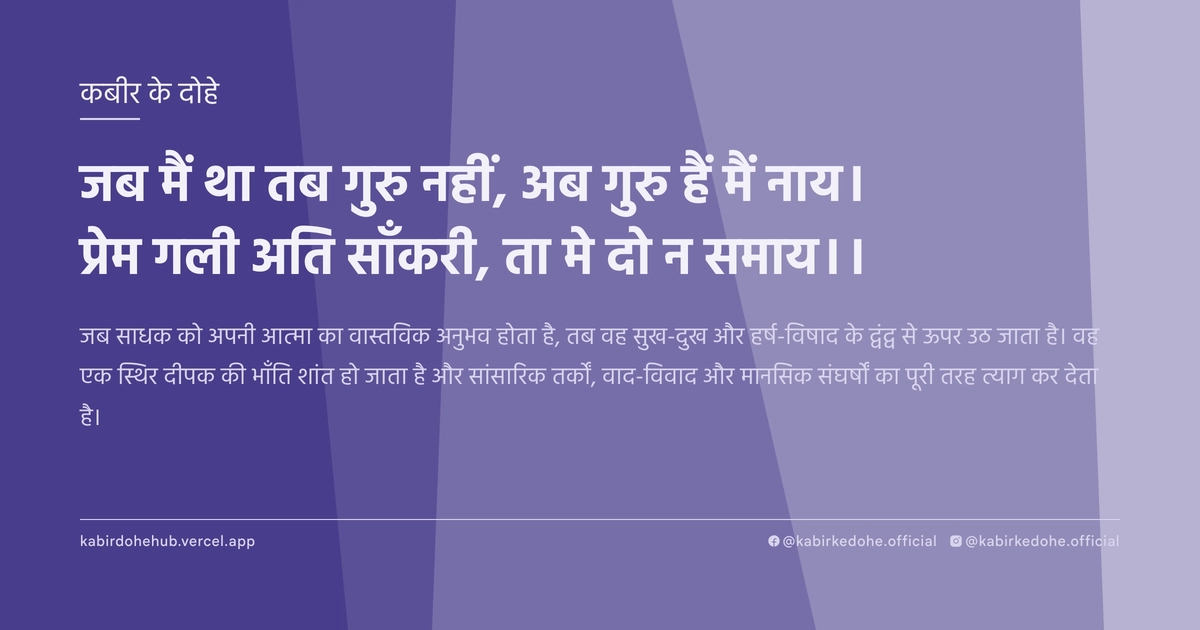
जब मैं था तब गुरु नहीं, अब गुरु हैं मैं नाय।
प्रेम गली अति साँकरी, ता मे दो न समाय।।
Jab main tha tab guru nahi, ab guru hain main naaye. Prem gali ati sankari, ta me do na samaye.
इस पृष्ठ पर इस कबीर दोहे का अर्थ (meaning), हिंदी व्याख्या और अंग्रेज़ी अनुवाद, दार्शनिक विश्लेषण और व्यावहारिक जीवन सीख दी गई है। यह दोहा अंतर ज्योति (The Inner Light) विषय से जुड़ा है — Kabir doha meaning and explanation in Hindi and English.
अर्थ (Meaning):
जब साधक को अपनी आत्मा का वास्तविक अनुभव होता है, तब वह सुख-दुख और हर्ष-विषाद के द्वंद्व से ऊपर उठ जाता है। वह एक स्थिर दीपक की भाँति शांत हो जाता है और सांसारिक तर्कों, वाद-विवाद और मानसिक संघर्षों का पूरी तरह त्याग कर देता है।
When the seeker attains the direct experiential realization of the Self, the oscillations of joy and sorrow cease to exist. Like a steady flame in a windless place, the soul remains poised in stillness, having abandoned all intellectual disputes and the futile noise of worldly arguments.
व्याख्या (Interpretation):
इस दोहे का शाब्दिक अर्थ है कि आत्म-साक्षात्कार के बाद भावनाएं समाप्त हो जाती हैं। गहराई में, यह 'निर्गुण भक्ति' की उस अवस्था को दर्शाता है जहाँ आत्मा और परमात्मा का द्वैत समाप्त हो जाता है। 'हर्ष विशाद' माया के दो छोर हैं; जब तक हम स्वयं को शरीर मानते हैं, हम इन लहरों में झूलते रहते हैं। 'चित्र दीप' का रूपक उस चैतन्य अवस्था का प्रतीक है जो बिना किसी बाहरी प्रभाव के निरंतर प्रज्ज्वलित है। यह अद्वैत वेदांत के उस सत्य को पुष्ट करता है कि शुद्ध चेतना (Atman) निर्लिप्त है। यहाँ 'बाद विवाद' का अर्थ केवल शब्दों का झगड़ा नहीं, बल्कि मन के भीतर चलने वाला अंतर्द्वंद्व है। जब सत्य का अनुभव होता है, तो तर्क की आवश्यकता समाप्त हो जाती है क्योंकि अनुभव ही अंतिम प्रमाण है।
Literally, the verse suggests that emotional volatility vanishes upon self-realization. Metaphorically, it describes the pinnacle of Nirgun Bhakti, where the duality between the seeker and the Sought dissolves. 'Harsh Vishaad' (joy and sorrow) are the two poles of Maya; as long as one identifies with the egoic self, one is tossed by these waves. The metaphor of the 'Chitra Deep' (the steady lamp) symbolizes a state of consciousness that burns steadily, unaffected by the winds of external circumstance. This aligns with Advaita Vedanta, asserting that the Atman is the witness, eternally detached. The 'Baad Vivaad' refers not merely to verbal arguments but to the internal psychic conflict. Once the Truth is experienced directly, the need for intellectual validation vanishes, for experience is the only ultimate proof.
दार्शनिक विश्लेषण (Philosophical Analysis):
कबीर का यह विचार उनके समय के कट्टरपंथी धार्मिक वातावरण के विरुद्ध एक सशक्त प्रहार है। उस युग में धर्म को केवल ग्रंथों, कर्मकांडों और शास्त्रार्थ (वाद-विवाद) के माध्यम से खोजा जा रहा था। कबीर ने स्पष्ट किया कि सत्य 'किताबों' में नहीं, बल्कि 'अनुभव' में है। यह दृष्टिकोण सूफीवाद के 'फना' (अहंकार का विलीनीकरण) और वेदांत के 'साक्षी भाव' का संगम है।
यहाँ कबीर ritualism का खंडन करते हुए यह समझाते हैं कि बाहरी पूजा या धार्मिक पहचान केवल अहंकार को बढ़ाती है। जब व्यक्ति 'मैं' और 'तू' के भेद को मिटा देता है, तब वह उस शून्य में प्रवेश करता है जहाँ कोई द्वंद्व नहीं बचता। यह मनोवैज्ञानिक रूपांतरण की प्रक्रिया है जहाँ व्यक्ति अपनी पहचान को सामाजिक भूमिकाओं से हटाकर सार्वभौमिक चेतना से जोड़ता है।
दार्शनिक रूप से, यह 'स्थितप्रज्ञ' की अवस्था है। कबीर तर्क देते हैं कि जब तक हम तर्क (logic) का सहारा लेते हैं, हम केवल बुद्धि के स्तर पर होते हैं। बुद्धि विभाजित करती है, जबकि अनुभव एकीकृत करता है। यह अद्वैत का सार है—जहाँ ज्ञाता, ज्ञान और ज्ञेय एक हो जाते हैं।
इस अवस्था में पहुँचने पर, व्यक्ति दुनिया को छोड़ता नहीं, बल्कि दुनिया में रहते हुए भी उससे अछूता रहता है। यह 'जीवनमुक्त' की स्थिति है। यहाँ अहंकार का विनाश (annihilation of ego) अनिवार्य है, क्योंकि अहंकार ही वह पर्दा है जो हमें 'आतम अनुभव' से रोकता है।
अतः, यह दोहा हमें यह सिखाता है कि आध्यात्मिक यात्रा का लक्ष्य किसी स्वर्ग की प्राप्ति नहीं, बल्कि इस वर्तमान क्षण में अपनी वास्तविक प्रकृति को पहचानना है। यह एक आंतरिक क्रांति है जो बाहरी शोर को मौन में बदल देती है।
Kabir's insight serves as a potent critique of the dogmatic religious atmosphere of his era. During his time, spirituality was largely reduced to scriptural adherence, ritualism, and scholarly debates (Shastras). Kabir asserts that Truth is not found in 'books' but in 'experience' (Anubhav). This perspective is a synthesis of the Sufi concept of 'Fana' (annihilation of the self) and the Vedantic 'Sakshi' (witness consciousness).
By rejecting ritualism, Kabir explains that external worship and religious identities only inflate the ego. When an individual erases the distinction between 'I' and 'Thou,' they enter a void where no conflict remains. This is a process of psychological transformation, shifting identity from social roles to universal consciousness.
Philosophically, this describes the state of the 'Sthitaprajna' (the one of steady wisdom). Kabir argues that as long as we rely on logic, we remain at the intellectual level. Logic divides, whereas experience integrates. This is the essence of Advaita—where the knower, the known, and the knowledge become one.
Upon reaching this state, the individual does not abandon the world but remains untouched by it while living within it. This is the state of 'Jivanmukta' (liberated while alive). The annihilation of the ego is mandatory here, as the ego is the veil preventing the 'Aatam Anubhav.'
Thus, this Doha teaches that the goal of the spiritual journey is not to attain a distant heaven, but to recognize one's true nature in the present moment. It is an internal revolution that transforms external noise into a profound, sacred silence.
मूल संदेश (Core Message):
- बाहरी शोर का अंत आंतरिक मौन की शुरुआत है।
- तर्क सत्य तक पहुँचा सकता है, लेकिन अनुभव ही सत्य है।
- सुख और दुख केवल मन की लहरें हैं, आत्मा स्थिर है।
- अहंकार का विसर्जन ही वास्तविक स्वतंत्रता का द्वार है।
- जब 'मैं' मिटता है, तब केवल 'वह' शेष रहता है।
- The end of external noise is the beginning of internal silence.
- Logic can lead to the truth, but experience IS the truth.
- Joy and sorrow are mere ripples of the mind; the Soul is still.
- The dissolution of the ego is the only gateway to true freedom.
- When the 'I' vanishes, only the 'Infinite' remains.
व्यावहारिक उदाहरण (Practical Example):
वाराणसी के एक पुराने घाट पर रहने वाले माधव नाम के एक वृद्ध बुनकर थे। माधव अपनी पूरी जिंदगी रेशमी साड़ियों के धागों को सुलझाने और बुनने में बिता चुके थे, लेकिन उनके मन के भीतर शिकायतों का एक अंतहीन जाल बुना हुआ था। वे हमेशा इस बात से परेशान रहते थे कि उनके पड़ोसी उन्हें पर्याप्त सम्मान नहीं देते या उनके परिवार ने उन्हें भुला दिया है।
माधव का दिन क्रोध और विषाद के बीच बीतता था। यदि कोई ग्राहक कम दाम लगाता, तो वे घंटों तक मन ही मन उससे लड़ते रहते। उनके लिए जीवन एक निरंतर 'वाद-विवाद' था, चाहे वह शब्दों में हो या विचारों में।
एक दिन, एक घुमंतू संत उनके पास आए और माधव की बेचैनी देखकर बस इतना कहा, "तुम धागों को तो सुलझा लेते हो, पर अपनी आत्मा के उलझे हुए धागों को कब सुलझाओगे?"
माधव ने इस बात पर गहराई से विचार करना शुरू किया। उन्होंने महसूस किया कि उनकी सारी पीड़ा इस बात से थी कि वे दुनिया से कुछ 'अपेक्षा' कर रहे थे। उन्होंने अपनी आँखें बंद कीं और केवल अपनी सांसों के साथ जुड़ना शुरू किया।
हफ्तों के मौन अभ्यास के बाद, एक सुबह जब वे करघे पर बैठे थे, उन्हें अचानक एक गहरा अहसास हुआ। उन्हें महसूस हुआ कि जिस 'माधव' के लिए वे लड़ रहे थे, वह केवल एक सामाजिक मुखौटा था। वास्तविक 'मैं' तो वह शांति है जो इस शोर के पीछे छिपी है।
उस क्षण, उनके भीतर एक 'आतम अनुभव' हुआ। अचानक, वह पुराना गुस्सा, वह पुरानी शिकायतें, सब वैसे ही गायब हो गईं जैसे सुबह की धुंध सूरज की पहली किरण से मिट जाती है।
अब माधव के जीवन में एक अद्भुत बदलाव आया। जब वही पड़ोसी उनसे बदतमीजी करता, तो माधव विचलित नहीं होते। वे बस मुस्कुरा देते। उनके भीतर अब कोई 'विवाद' नहीं था।
वे अब भी साड़ियाँ बुनते थे, लेकिन अब वे केवल काम नहीं कर रहे थे, बल्कि हर धागे में उस अनंत शांति को महसूस कर रहे थे।
उनके चेहरे पर एक ऐसी चमक थी जैसे कोई दीपक शांत हवा में जल रहा हो। लोग हैरान थे कि जो व्यक्ति कभी छोटी बातों पर चिल्लाता था, वह अब इतना शांत कैसे हो गया।
माधव ने जान लिया था कि जब आप स्वयं को जान लेते हैं, तो दुनिया की कोई भी बात आपको दुखी या उत्तेजित नहीं कर सकती।
On an ancient ghat in Varanasi lived an elderly weaver named Madhav. Madhav had spent his entire life untangling and weaving the threads of silk sarees, yet within his mind, an endless web of grievances was woven. He was perpetually troubled by the fact that his neighbors did not give him enough respect or that his family had forgotten him.
Madhav's days were spent oscillating between anger and sorrow. If a customer bargained too low, he would spend hours fighting with them internally. For him, life was a constant 'debate,' whether in words or in thoughts.
One day, a wandering saint visited him. Seeing Madhav's restlessness, the saint simply said, "You know how to untangle the threads of silk, but when will you untangle the knotted threads of your own soul?"
Madhav began to contemplate this deeply. He realized that all his suffering stemmed from the 'expectations' he held toward the world. He closed his eyes and began to connect solely with his breath.
After weeks of silent practice, one morning while sitting at his loom, he had a profound realization. He felt that the 'Madhav' he was fighting for was merely a social mask. The real 'I' was the silence hidden behind the noise.
In that moment, an 'Aatam Anubhav' (self-experience) occurred. Suddenly, the old anger and the old grievances vanished, just as the morning mist disappears with the first ray of the sun.
Now, a wonderful change came over Madhav's life. When the same neighbors behaved rudely, Madhav remained undisturbed. He would simply smile. There was no longer any 'conflict' within him.
He continued to weave sarees, but he was no longer just working; he was feeling that infinite peace in every single thread.
There was a glow on his face, like a lamp burning in a windless place. People were astonished that a man who once screamed over trivialities had become so serene.
Madhav had learned that once you know your true Self, nothing in the world can make you miserable or agitated.
अभ्यास मार्गदर्शन (Practice Guidance):
- प्रतिदिन 20 मिनट 'साक्षी भाव' का अभ्यास करें: अपने विचारों को बिना किसी निर्णय के केवल देखें, जैसे आप किसी फिल्म को देख रहे हों।
- स्व-पूछताछ जर्नल: जब भी आप क्रोध या दुख महसूस करें, लिखें—"यह भावना किसे हो रही है? क्या यह मेरी आत्मा है या मेरा अहंकार?"
- मौन व्रत: सप्ताह में एक दिन या दिन में कुछ घंटे पूर्ण मौन रहें, न केवल शब्दों से, बल्कि मानसिक तर्कों से भी।
- डायग्नोस्टिक चेकलिस्ट: यदि आप किसी बात पर बहस करने की तीव्र इच्छा महसूस करते हैं या किसी की आलोचना से विचलित होते हैं, तो समझें कि आप अभी भी 'अहंकार' के स्तर पर हैं, 'आत्मा' के नहीं।
- Practice 'Witness Consciousness' for 20 minutes daily: Observe your thoughts without judgment, as if you are watching a movie of your own mind.
- Self-Inquiry Journaling: Whenever you feel anger or sorrow, write—"Who is experiencing this emotion? Is it the Soul, or is it the Ego?"
- Vow of Silence: Observe complete silence for one day a week or a few hours a day, not just in words, but also in mental arguments.
- Diagnostic Checklist: If you feel an intense urge to win an argument or feel disturbed by someone's criticism, recognize that you are still operating from the 'Ego' level, not the 'Soul' level.
चिंतन प्रश्न (Reflection Questions):
- आपकी वह कौन सी पहचान है जिसे आप खोने से सबसे ज्यादा डरते हैं?
- क्या आपका 'सही' होने का आग्रह वास्तव में सत्य की खोज है, या केवल आपके अहंकार की भूख?
- यदि आपके जीवन से आपकी सारी उपलब्धियाँ और रिश्ते छीन लिए जाएँ, तो जो बचेगा, क्या आप उसे जानते हैं?
- आपकी डिजिटल पहचान (Social Media Ego) आपके वास्तविक आंतरिक मौन को कैसे बाधित करती है?
- क्या आप शांति चाहते हैं, या आप केवल उस स्थिति को चाहते हैं जहाँ आपकी इच्छाएँ पूरी हों?
- Which part of your identity are you most afraid of losing?
- Is your urge to be 'right' actually a search for truth, or merely the hunger of your ego?
- If all your achievements and relationships were stripped away, do you know who is left?
- How does your digital identity (Social Media Ego) disrupt your actual internal silence?
- Do you truly desire peace, or do you simply desire a state where your wishes are fulfilled?