
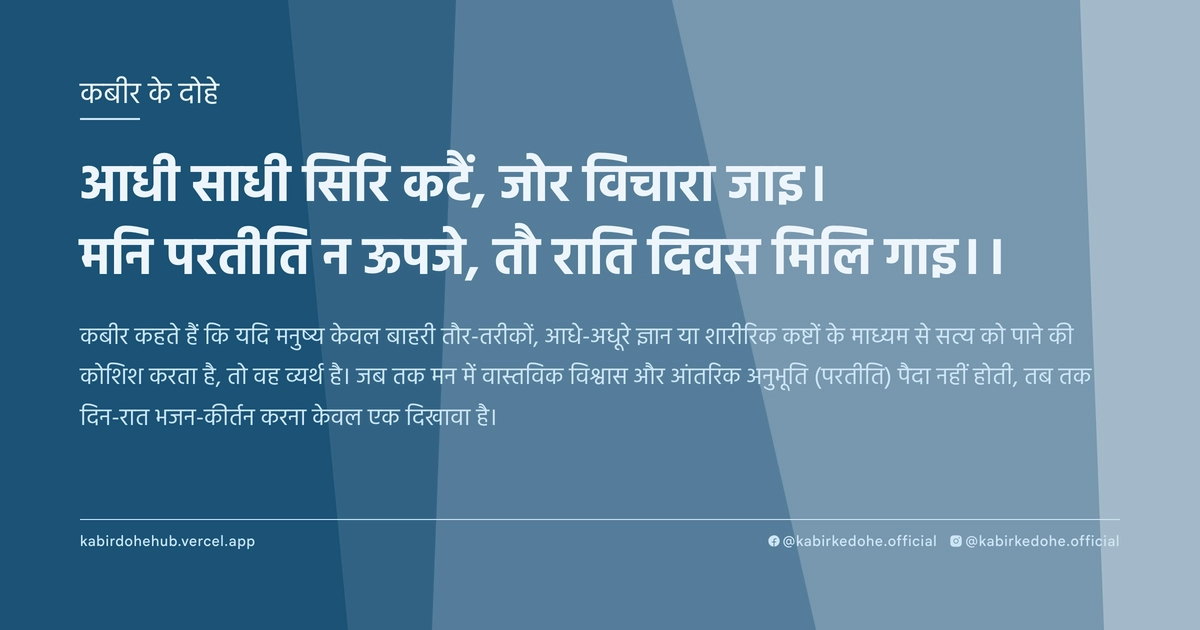
आधी साधी सिरि कटैं, जोर विचारा जाइ।
मनि परतीति न ऊपजे, तौ राति दिवस मिलि गाइ।।
Aadhi saadhi siri kataen, jor vichara jaai. Mani partit na oopje, tau raati divas mili gaai.
इस पृष्ठ पर इस कबीर दोहे का अर्थ (meaning), हिंदी व्याख्या और अंग्रेज़ी अनुवाद, दार्शनिक विश्लेषण और व्यावहारिक जीवन सीख दी गई है। यह दोहा प्रपत्ति (Surrender) विषय से जुड़ा है — Kabir doha meaning and explanation in Hindi and English.
अर्थ (Meaning):
कबीर कहते हैं कि यदि मनुष्य केवल बाहरी तौर-तरीकों, आधे-अधूरे ज्ञान या शारीरिक कष्टों के माध्यम से सत्य को पाने की कोशिश करता है, तो वह व्यर्थ है। जब तक मन में वास्तविक विश्वास और आंतरिक अनुभूति (परतीति) पैदा नहीं होती, तब तक दिन-रात भजन-कीर्तन करना केवल एक दिखावा है।
Kabir asserts that attempting to reach the Divine through superficial rituals, fragmented knowledge, or forced austerities is futile. Unless a genuine, intuitive conviction and inner realization (Parteet) awaken within the heart, the act of chanting and singing hymns day and night remains a mere mechanical performance without spiritual essence.
व्याख्या (Interpretation):
इस दोहे में कबीर 'साधना' और 'परतीति' के बीच के अंतर को स्पष्ट करते हैं। 'आधी साधी' का अर्थ है वह अधूरा प्रयास जो केवल बौद्धिक या शारीरिक स्तर पर होता है। 'सिरि कटैं' एक रूपक है उस चरम त्याग का जो बिना समझ के किया जाए। कबीर यहाँ निरगुण भक्ति के सिद्धांत को प्रतिपादित करते हैं, जहाँ ईश्वर किसी बाहरी क्रिया में नहीं, बल्कि आंतरिक विश्वास में बसता है। माया यहाँ उस भ्रम के रूप में है जो हमें विश्वास दिलाता है कि माला फेरने या व्रत रखने से मोक्ष मिल जाएगा। वास्तव में, जब तक आत्मा का ब्रह्म के साथ अद्वैत संबंध का अनुभव नहीं होता, तब तक सारी धार्मिक गतिविधियाँ केवल शोर हैं। यह विरोधाभास है कि मनुष्य ईश्वर को खोजने के लिए पूरी दुनिया घूमता है, जबकि वह केवल 'परतीति' या आंतरिक विश्वास की एक चिंगारी दूर है।
In this couplet, Kabir distinguishes between 'Sadhana' (disciplined practice) and 'Parteet' (intuitive conviction). 'Aadhi saadhi' refers to fragmented efforts limited to the intellectual or physical plane. 'Siri katai' serves as a metaphor for extreme asceticism or sacrifice performed without true understanding. Kabir champions the philosophy of Nirgun Bhakti, where the Divine resides not in external rites but in internal realization. Maya manifests here as the illusion that mechanical rituals—like counting beads or fasting—guarantee liberation. In truth, until the non-duality of Atman and Brahman is experienced, all religious activities are mere noise. The central paradox is that humanity searches the horizon for God, while the Divine is only a single spark of genuine inner conviction away.
दार्शनिक विश्लेषण (Philosophical Analysis):
कबीर का यह दोहा उनके समय के धार्मिक पाखंड और कर्मकांडवाद पर एक तीखा प्रहार है। मध्यकालीन भारत में, धर्म अक्सर बाहरी प्रतीकों—जैसे तिलक, जनेऊ, या कठिन तपस्या—तक सीमित हो गया था। कबीर ने इस 'साधना' को 'आधी' यानी अधूरा बताया क्योंकि इसमें हृदय की गहराई गायब थी। वे यहाँ अद्वैत वेदांत के उस सत्य को पुष्ट करते हैं कि सत्य अनुभव का विषय है, न कि सूचना का।
सूफी मत के 'इश्क-ए-हकीकी' (ईश्वर के प्रति सच्चा प्रेम) के समान, कबीर तर्क देते हैं कि बिना प्रेम और विश्वास के कोई भी इबादत शून्य है। उनके लिए, ईश्वर 'निर्गुण' है, जिसका अर्थ है कि वह किसी आकार, मंदिर या मस्जिद में नहीं, बल्कि चेतना की शुद्धता में पाया जाता है। जब अहंकार (Ego) यह सोचता है कि 'मैं पूजा कर रहा हूँ', तो वह स्वयं एक बाधा बन जाता है।
यह विश्लेषण मनोवैज्ञानिक परिवर्तन की आवश्यकता पर जोर देता है। कबीर कहते हैं कि जब तक 'मनि' (मन) में परतीति नहीं जागती, तब तक व्यक्ति केवल एक सामाजिक भूमिका निभा रहा होता है। यह 'धार्मिक व्यक्तित्व' (Religious Persona) वास्तव में सत्य से दूर ले जाता है क्योंकि यह व्यक्ति को विश्वास दिलाता है कि वह आध्यात्मिक है, जबकि वह केवल अनुकरण कर रहा होता है।
कबीर का दृष्टिकोण जाति और वर्ग से ऊपर उठकर मानवीय चेतना की बात करता है। वे स्पष्ट करते हैं कि एक अनपढ़ व्यक्ति जिसमें अटूट विश्वास है, वह उस विद्वान से कहीं अधिक उन्नत है जो शास्त्रों का पाठ तो करता है लेकिन जिसका हृदय संकीर्ण है। यह ज्ञान का लोकतंत्रीकरण था, जहाँ अनुभव को प्रमाण माना गया।
अंततः, यह दोहा हमें सिखाता है कि आध्यात्मिक प्रगति का पैमाना 'कितना समय' प्रार्थना की गई, यह नहीं है, बल्कि 'कितनी गहराई' से उस सत्य को महसूस किया गया, यह है। बिना अनुभूति के किया गया प्रयास केवल मानसिक थकान है, आध्यात्मिक उत्थान नहीं।
This couplet is a searing critique of the religious hypocrisy and ritualism prevalent during Kabir's era. In medieval India, spirituality had largely devolved into external symbols—tilaks, sacred threads, or grueling penances. Kabir labels such 'Sadhana' as 'Aadhi' (incomplete) because it lacked the depth of the heart. He reinforces the Advaita Vedanta truth that Reality is a matter of experience, not information.
Parallel to the Sufi concept of 'Ishq-e-Haqiqi' (Divine Love), Kabir argues that any worship devoid of genuine love and conviction is void. For him, the Divine is 'Nirgun' (formless), meaning God is found not in idols or architecture, but in the purity of consciousness. When the ego believes 'I am performing a ritual,' the ego itself becomes the primary obstacle to liberation.
This analysis emphasizes the necessity of psychological transformation. Kabir posits that until 'Mani' (the mind/heart) awakens to 'Parteet', the individual is merely playing a social role. This 'Religious Persona' actually distances the seeker from the Truth by creating a false sense of spiritual achievement based on imitation rather than realization.
Kabir's perspective transcends caste and class, focusing on the evolution of human consciousness. He asserts that an illiterate person with unwavering faith is far more advanced than a scholar who recites scriptures but possesses a narrow heart. This was a democratization of spirituality, where experience was the only valid evidence.
Ultimately, the couplet teaches that the metric of spiritual progress is not the 'duration' of prayer, but the 'depth' of the realization. Effort without intuitive awakening is merely mental exhaustion, not spiritual ascension.
मूल संदेश (Core Message):
- बाहरी कर्मकांड केवल शरीर को थकाते हैं, आत्मा को नहीं।
- सच्ची भक्ति शब्दों में नहीं, आंतरिक अनुभूति में है।
- अहंकार द्वारा की गई तपस्या केवल एक मानसिक जाल है।
- विश्वास वह सेतु है जो मनुष्य को परमात्मा से जोड़ता है।
- मौन और आत्म-साक्षात्कार ही वास्तविक प्रार्थना है।
- External rituals exhaust the body, not the soul.
- True devotion lies in intuitive realization, not in words.
- Austerity performed by the ego is merely a mental trap.
- Conviction is the only bridge connecting the human to the Divine.
- Silence and self-realization are the only authentic prayers.
व्यावहारिक उदाहरण (Practical Example):
एक समय की बात है, वाराणसी के घाटों पर रहने वाला एक वृद्ध बुनकर था, जिसका नाम माधव था। माधव जीवन भर धर्मग्रंथों को रटने और हर साल कठिन तीर्थयात्राएं करने में विश्वास रखता था। वह अपनी पूरी संपत्ति दान करता और दिन-रात मंत्रों का जाप करता, इस उम्मीद में कि मृत्यु के बाद उसे स्वर्ग मिलेगा।
माधव का एक पड़ोसी था, जो एक साधारण सा कुम्हार था। कुम्हार न तो मंदिर जाता था और न ही कोई कठिन व्रत रखता था, लेकिन वह हर जीव के प्रति अगाध प्रेम रखता था और शांत रहता था। माधव अक्सर उसका मजाक उड़ाता और कहता, "तुम कैसे मोक्ष पाओगे? क्या तुम्हें पता भी है कि सही विधि क्या है?"
एक दिन माधव ने एक बहुत कठिन तपस्या करने का निर्णय लिया। उसने कई दिनों तक अन्न-जल का त्याग किया और केवल एक ही मंत्र का जाप किया। वह शारीरिक रूप से टूट चुका था, लेकिन उसका मन अभी भी इस बात पर केंद्रित था कि लोग उसकी तपस्या की कितनी प्रशंसा करेंगे।
तभी उसकी मुलाकात एक घुमक्कड़ संत से हुई। संत ने माधव की हालत देखी और पूछा, "तुम क्या खोज रहे हो?"
माधव ने गर्व से कहा, "मैं ईश्वर को खोज रहा हूँ। मैंने अपनी देह को कष्ट दिया, शास्त्रों को पढ़ा, और दिन-रात जाप किया।"
संत मुस्कुराए और बोले, "तुमने शरीर को तो काट दिया, लेकिन मन को नहीं। तुम्हारी सारी मेहनत केवल एक बाहरी आवरण है। क्या तुम्हारे भीतर वह विश्वास जागा है कि ईश्वर तुम्हारे भीतर ही है, या तुम अभी भी उसे किसी बाहरी इनाम की तरह खोज रहे हो?"
माधव सन्न रह गया। उसे एहसास हुआ कि उसकी सारी 'साधना' केवल एक सामाजिक प्रदर्शन थी। उसने महसूस किया कि वह जिस ईश्वर को मंत्रों के शोर में खोज रहा था, वह वास्तव में उस शांति में था जिसे वह कुम्हार सहजता से जीता था।
उस दिन माधव ने अपनी सारी बाहरी दिखावटी रीतियाँ छोड़ दीं। उसने मंत्रों को रटना बंद किया और मौन में बैठना शुरू किया। उसने सीखा कि विश्वास का अर्थ यह नहीं है कि आप क्या कहते हैं, बल्कि यह है कि आप क्या महसूस करते हैं।
धीरे-धीरे माधव का अहंकार पिघल गया। अब वह केवल इसलिए नहीं गाता था कि उसे स्वर्ग चाहिए, बल्कि इसलिए गाता था क्योंकि उसका हृदय प्रेम से भर गया था। यह उसकी वास्तविक 'परतीति' थी, जिसने उसे वास्तव में मुक्त कर दिया।
Once, on the ghats of Varanasi, lived an elderly weaver named Madhav. Madhav believed in memorizing scriptures and undertaking grueling annual pilgrimages. He donated his wealth and chanted mantras day and night, hoping for a place in heaven after death.
Madhav had a neighbor, a simple potter. The potter neither visited temples nor observed rigorous fasts, yet he possessed an immense love for all living beings and remained profoundly peaceful. Madhav often mocked him, saying, "How will you attain liberation? Do you even know the correct method?"
One day, Madhav decided to undergo an extreme penance. He abstained from food and water for days, chanting a single mantra. He was physically broken, but his mind remained focused on how much people would admire his austerity.
During this time, he encountered a wandering saint. Seeing Madhav's state, the saint asked, "What are you searching for?"
Madhav replied with pride, "I am searching for God. I have tormented my body, read the texts, and chanted ceaselessly."
The saint smiled and said, "You have cut the body, but not the mind. All your effort is merely an external shell. Has the conviction awakened within you that God is already inside, or are you still searching for Him like an external reward?"
Madhav was stunned. He realized that all his 'Sadhana' was a social performance. He understood that the God he sought in the noise of mantras resided in the silence that the potter lived so effortlessly.
That day, Madhav abandoned all his superficial rituals. He stopped the mechanical recitation and began practicing silence. He learned that faith is not about what you proclaim, but what you intuitively feel.
Gradually, Madhav's ego melted. He no longer sang because he wanted heaven, but because his heart overflowed with love. This was his true 'Parteet'—his genuine conviction—which finally set him free.
अभ्यास मार्गदर्शन (Practice Guidance):
- प्रतिदिन 20 मिनट 'साक्षी भाव' का अभ्यास करें: अपने विचारों को बिना किसी निर्णय के देखें और यह पहचानें कि आप विचार नहीं, बल्कि उन्हें देखने वाले हैं।
- आत्म-पूछताछ जर्नल: हर रात लिखें कि आज आपने कौन सा कार्य केवल 'दिखावे' के लिए किया और उस समय आपके मन में क्या डर या अहंकार था।
- व्यवहार परिवर्तन: किसी भी धार्मिक क्रिया (पूजा, प्रार्थना) को करने से पहले 5 मिनट मौन रहें और स्वयं से पूछें, "क्या मैं यह विश्वास के साथ कर रहा हूँ या केवल आदत के कारण?"
- निदान चेकलिस्ट: यदि आप प्रार्थना के बाद भी क्रोधित या अहंकारी महसूस करते हैं, तो समझें कि आपकी साधना 'आधी' है। यदि आप शांति और करुणा महसूस करते हैं, तो 'परतीति' जाग रही है।
- Practice 'Witness Consciousness' for 20 minutes daily: Observe your thoughts without judgment and recognize that you are not the thought, but the observer.
- Self-Inquiry Journaling: Every night, record one action you performed today solely for 'appearance' and identify the fear or ego driving that action.
- Behavioral Shift: Before any religious or spiritual act (prayer, meditation), remain silent for 5 minutes and ask, "Am I doing this out of genuine conviction or mere habit?"
- Diagnostic Checklist: If you feel angry or superior after prayer, your practice is 'incomplete' (Aadhi). If you feel an expansion of peace and compassion, 'Parteet' is awakening.
चिंतन प्रश्न (Reflection Questions):
- मेरे जीवन में ऐसी कौन सी 'धार्मिक' या 'नैतिक' आदतें हैं जो केवल समाज को दिखाने के लिए हैं?
- क्या मैं ईश्वर को एक पुरस्कार के रूप में चाहता हूँ, या मैं वास्तव में सत्य का अनुभव करना चाहता हूँ?
- जब मैं दूसरों की आध्यात्मिक कमी निकालता हूँ, तो वह मेरी अपनी किस असुरक्षा को दर्शाता है?
- यदि कल से सारे मंदिर, मस्जिद और चर्च गायब हो जाएं, तो क्या मेरा विश्वास जीवित रहेगा?
- मेरी 'आध्यात्मिक पहचान' (Spiritual Identity) मेरे अहंकार को कैसे पोषित कर रही है?
- क्या मैं सत्य को खोजने का प्रयास कर रहा हूँ, या मैं केवल सत्य होने का नाटक कर रहा हूँ?
- Which 'religious' or 'moral' habits in my life are performed solely for social validation?
- Do I desire God as a reward, or do I genuinely seek the experience of Truth?
- When I criticize the spiritual shortcomings of others, what insecurity of my own am I projecting?
- If all temples, mosques, and churches vanished tomorrow, would my faith survive?
- How is my 'Spiritual Identity' feeding my ego rather than dissolving it?
- Am I striving to find the Truth, or am I merely pretending to be truthful?