
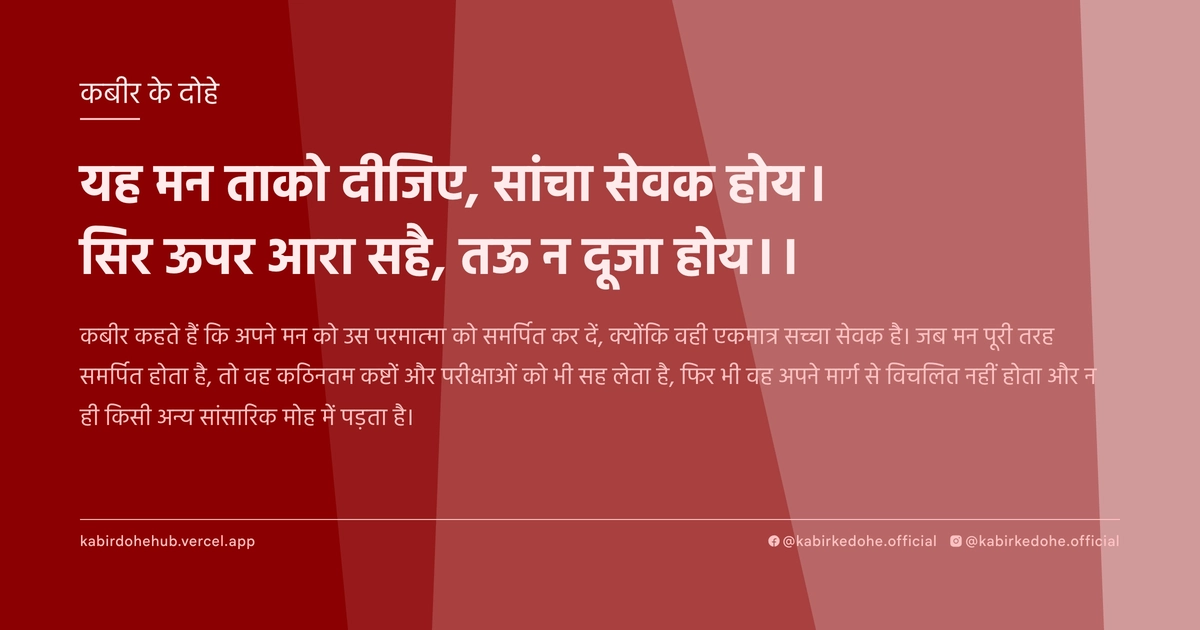
यह मन ताको दीजिए, सांचा सेवक होय।
सिर ऊपर आरा सहै, तऊ न दूजा होय।।
Yeh man taako deeje, sancha sevak hoye. Sir upar ara sahai, tau na dooja hoye.
इस पृष्ठ पर इस कबीर दोहे का अर्थ (meaning), हिंदी व्याख्या और अंग्रेज़ी अनुवाद, दार्शनिक विश्लेषण और व्यावहारिक जीवन सीख दी गई है। यह दोहा निष्ठा (Integrity) विषय से जुड़ा है — Kabir doha meaning and explanation in Hindi and English.
अर्थ (Meaning):
कबीर कहते हैं कि अपने मन को उस परमात्मा को समर्पित कर दें, क्योंकि वही एकमात्र सच्चा सेवक है। जब मन पूरी तरह समर्पित होता है, तो वह कठिनतम कष्टों और परीक्षाओं को भी सह लेता है, फिर भी वह अपने मार्ग से विचलित नहीं होता और न ही किसी अन्य सांसारिक मोह में पड़ता है।
Kabir urges the seeker to surrender the mind entirely to the Divine, for only in that surrender does one become a true servant. Such a mind is so steadfast in its devotion that even if a saw were to run across its head, it would remain unwavering, refusing to seek any other refuge or succumb to duality.
व्याख्या (Interpretation):
इस दोहे का शाब्दिक अर्थ है कि मन को ईश्वर को सौंप देना चाहिए। गहरे स्तर पर, 'आरा' (saw) अहंकार के विनाश और आध्यात्मिक विच्छेदन का प्रतीक है। यह निर्गुण भक्ति की उस अवस्था को दर्शाता है जहाँ साधक माया के भ्रम को पूरी तरह त्याग देता है। जब 'मैं' और 'तू' का भेद मिट जाता है, तब आत्मा और ब्रह्म की अद्वैत स्थिति प्राप्त होती है। यहाँ 'दूजा' का अर्थ है द्वैत या संसार की कोई भी अन्य इच्छा। यह विरोधाभास है कि पूर्ण समर्पण ही वास्तविक स्वतंत्रता है।
Literally, the verse advises surrendering the mind to God. Metaphorically, the 'saw' represents the agonizing process of ego-annihilation and the severing of worldly attachments. It reflects the state of Nirgun Bhakti where the seeker transcends the illusion of Maya. When the distinction between the 'I' and the 'Thou' vanishes, the non-duality of Atman and Brahman is realized. 'Dooja' refers to duality or any secondary desire. The central paradox is that absolute surrender is the only path to absolute liberation.
दार्शनिक विश्लेषण (Philosophical Analysis):
कबीर का यह दर्शन उस समय के कर्मकांडीय धर्म के विरुद्ध एक सशक्त प्रहार था, जहाँ भक्ति केवल बाहरी दिखावे और मंदिर-मस्जिद तक सीमित थी। वे कहते हैं कि सच्ची भक्ति बाहरी अनुष्ठानों में नहीं, बल्कि आंतरिक समर्पण में है। यह विचार सूफी मत के 'फना' (अहंकार का विनाश) और अद्वैत वेदांत के 'अहम ब्रह्मास्मि' के करीब है।
ऐतिहासिक रूप से, कबीर ने जाति और वर्ग के भेदभाव को नकारते हुए यह स्थापित किया कि ईश्वर तक पहुँचने का मार्ग केवल शुद्ध हृदय और अटूट विश्वास है। यहाँ 'सेवक' शब्द का प्रयोग दासता के लिए नहीं, बल्कि पूर्ण विश्वास और समर्पण के लिए किया गया है, जो अहंकार के पूर्ण विसर्जन की मांग करता है।
मनुष्य की सबसे बड़ी बाधा उसका 'अहंकार' है, जो उसे सत्य से दूर रखता है। कबीर समझाते हैं कि जब तक मन में 'दूसरा' (द्वैत) मौजूद है, तब तक शांति संभव नहीं है। यह मनोवैज्ञानिक रूपांतरण की प्रक्रिया है जहाँ व्यक्ति अपनी पहचान को सार्वभौमिक चेतना में विलीन कर देता है।
अक्सर लोग इसे केवल धार्मिक आज्ञाकारिता मान लेते हैं, लेकिन वास्तव में यह मानसिक अनुशासन की पराकाष्ठा है। यह उस स्थिति का वर्णन है जहाँ बाहरी परिस्थितियाँ—चाहे वे कितनी भी कष्टदायक क्यों न हों—आंतरिक शांति को भंग नहीं कर सकतीं।
अंततः, यह दोहा हमें सिखाता है कि सत्य की खोज में दर्द अपरिहार्य है, लेकिन वह दर्द ही वह उपकरण है जो हमें हमारे सीमित स्वरूप से मुक्त कर अनंत से जोड़ता है। यह एक ऐसी यात्रा है जहाँ साधक स्वयं को खोकर ही स्वयं को पाता है।
Kabir's philosophy serves as a potent critique of the ritualistic religion of his era, where devotion was confined to outward displays and the walls of temples and mosques. He asserts that true devotion lies not in external rituals, but in internal surrender. This aligns closely with the Sufi concept of 'Fana' (annihilation of the self) and the Advaita Vedanta realization of 'Aham Brahmasmi'.
Historically, by rejecting caste and class hierarchies, Kabir established that the path to the Divine is accessible only through a pure heart and unwavering faith. The term 'servant' here does not imply servitude in a social sense, but a state of total trust and surrender that demands the complete dissolution of the ego.
The primary obstacle for humanity is the 'ego', which creates a veil between the individual and the Truth. Kabir explains that as long as the 'other' (duality) exists in the mind, peace remains elusive. This is a process of psychological transformation where the individual merges their identity into the universal consciousness.
Common literalist interpretations often mistake this for religious obedience, but it is actually the pinnacle of mental discipline. It describes a state where external circumstances—no matter how agonizing—cannot disrupt the internal equilibrium of the soul.
Ultimately, this couplet teaches that pain is inevitable in the pursuit of Truth, but that very pain is the tool that liberates us from our limited form and connects us to the Infinite. It is a journey where the seeker finds themselves only after losing themselves completely.
मूल संदेश (Core Message):
- अहंकार का विसर्जन ही वास्तविक मुक्ति का एकमात्र द्वार है।
- समर्पण कमजोरी नहीं, बल्कि उच्चतम मानसिक शक्ति और साहस है।
- जब 'मैं' मिटता है, तब केवल अनंत सत्य का अस्तित्व बचता है।
- बाहरी कष्ट आंतरिक शांति को तब नहीं छू सकते जब मन समर्पित हो।
- द्वैत से अद्वैत की यात्रा ही जीवन का वास्तविक उद्देश्य है।
- The dissolution of the ego is the only gateway to true liberation.
- Surrender is not weakness, but the highest form of mental strength and courage.
- When the 'I' vanishes, only the existence of the Infinite Truth remains.
- External hardships cannot touch internal peace when the mind is fully surrendered.
- The journey from duality to non-duality is the ultimate purpose of life.
व्यावहारिक उदाहरण (Practical Example):
वाराणसी के घाटों पर रहने वाले एक वृद्ध विधवा, जानकी, की कहानी है। जानकी ने अपना पूरा जीवन दूसरों की सेवा और कठोर तपस्या में बिताया था, फिर भी उनके मन में एक टीस थी कि उनका बेटा उन्हें छोड़कर चला गया।
वे हर दिन गंगा किनारे बैठकर विलाप करती थीं और ईश्वर से शिकायत करती थीं कि उनके साथ ऐसा अन्याय क्यों हुआ। उनका मन दुखों के बोझ से दबा हुआ था और वे शांति की तलाश में थीं।
एक दिन उनकी मुलाकात एक घुमक्कड़ फकीर से हुई, जिसने उन्हें कबीर का यह दोहा सुनाया। फकीर ने कहा, 'माँ, तुम अपने दुख को पकड़कर बैठी हो, इसे उस परमात्मा को सौंप दो। जब तक तुम खुद को इस दुख का स्वामी मानोगी, यह तुम्हें जलाता रहेगा।'
जानकी ने पहले तो इसे नहीं समझा, लेकिन फिर उन्होंने एक प्रयोग किया। उन्होंने तय किया कि वे अपने बेटे के प्रति अपने मोह और अपने अकेलेपन के दर्द को 'ईश्वर का प्रसाद' मानकर उसे समर्पित कर देंगी।
शुरुआत में यह बहुत कठिन था। जब भी पुरानी यादें आतीं, उन्हें ऐसा लगता जैसे कोई उनके सीने पर आरा चला रहा हो। मानसिक पीड़ा असहनीय थी, लेकिन उन्होंने खुद से कहा, 'यह मेरा दर्द नहीं, यह परमात्मा की इच्छा है।'
धीरे-धीरे, जानकी के भीतर एक बदलाव आया। उन्होंने महसूस किया कि जब उन्होंने दर्द का स्वामित्व छोड़ दिया, तो दर्द तो रहा, लेकिन उसकी 'पीड़ा' समाप्त हो गई। वे अब दुखी नहीं थीं, बल्कि शांत थीं।
उन्होंने अपना समय अनाथ बच्चों को पढ़ाने और उनकी देखभाल करने में लगाना शुरू किया। अब वे किसी के आने या जाने से विचलित नहीं होती थीं।
एक दिन एक व्यक्ति ने उनसे पूछा कि वे इतने कष्टों के बाद भी इतनी शांत कैसे हैं। जानकी ने मुस्कुराकर कहा, 'मैंने अपना मन उसे दे दिया है, अब मैं केवल उसका एक यंत्र हूँ।'
इस 'कबीर ट्विस्ट' ने जानकी को एक पीड़ित से एक मार्गदर्शक बना दिया। उनका समर्पण उनके लिए एक ढाल बन गया, जिसने उन्हें संसार के द्वैत से ऊपर उठा दिया।
This is the story of Janaki, an elderly widow living on the ghats of Varanasi. Janaki had spent her entire life in service to others and rigorous austerity, yet a deep ache remained in her heart because her son had abandoned her.
Every day, she would sit by the Ganges, lamenting and questioning God as to why such injustice had befallen her. Her mind was weighed down by grief, and she spent her days searching for a peace that always seemed out of reach.
One day, she met a wandering fakir who recited this specific Doha by Kabir. The fakir told her, 'Mother, you are clinging to your sorrow. Surrender it to the Divine. As long as you believe you own this pain, it will continue to burn you.'
Janaki did not understand at first, but she decided to try an experiment. She resolved to treat her longing for her son and the pain of her loneliness as 'Prasad' (a divine offering) and surrender it entirely to the Almighty.
Initially, it was excruciating. Whenever old memories surfaced, it felt as if a saw were running across her chest. The mental agony was unbearable, but she kept telling herself, 'This is not my pain; this is the Divine's will.'
Gradually, a transformation occurred within Janaki. She realized that once she relinquished ownership of the pain, the sensation remained, but the 'suffering' vanished. She was no longer miserable; she was serene.
She began spending her time teaching and caring for orphaned children in the city. She was no longer disturbed by the arrival or departure of people in her life.
One day, a visitor asked her how she remained so peaceful despite such hardships. Janaki smiled and replied, 'I have given my mind to Him; now I am merely His instrument.'
This 'Kabir Twist' transformed Janaki from a victim into a guide. Her surrender became a shield, elevating her above the dualities of the world.
अभ्यास मार्गदर्शन (Practice Guidance):
- प्रतिदिन 20 मिनट मौन ध्यान करें, जहाँ आप अपने विचारों को 'मेरा' कहने के बजाय 'ईश्वर का' मानकर उन्हें केवल देखें।
- एक डायरी लिखें जिसमें उन स्थितियों का उल्लेख हो जहाँ आपका अहंकार चोटिल हुआ, और फिर लिखें कि कैसे उस स्थिति को परमात्मा को समर्पित करने से शांति मिली।
- व्यवहारिक परिवर्तन: जब भी क्रोध या ईर्ष्या आए, रुकें और सोचें—'क्या मैं इस भावना का स्वामी हूँ या मैं इसे ईश्वर के प्रति समर्पण के रास्ते में एक बाधा मानकर छोड़ सकता हूँ?'
- निदान चेकलिस्ट: क्या आप अभी भी 'मेरे' और 'तेरे' में उलझे हैं? क्या आप बाहरी प्रशंसा या आलोचना से विचलित होते हैं? यदि हाँ, तो समर्पण अभी अधूरा है।
- Practice 20 minutes of silent meditation daily, observing your thoughts not as 'mine' but as 'Divine movements' passing through you.
- Maintain a journal documenting instances where your ego was bruised, and reflect on how surrendering that specific event to the Divine brought peace.
- Behavioral Change: Whenever anger or jealousy arises, pause and ask—'Am I claiming ownership of this emotion, or can I release it as an obstacle to my surrender?'
- Diagnostic Checklist: Are you still entangled in 'mine' and 'thine'? Do you fluctuate based on external praise or criticism? If yes, the surrender is yet incomplete.
चिंतन प्रश्न (Reflection Questions):
- आपकी वह कौन सी पहचान है जिसे खोने के डर से आप सबसे ज्यादा डरते हैं?
- क्या आपका 'भक्ति' का भाव वास्तव में समर्पण है, या यह केवल ईश्वर से कुछ पाने की एक सूक्ष्म इच्छा है?
- जब आप सोशल मीडिया पर अपनी छवि गढ़ते हैं, तो वह 'मैं' कौन है जिसे आप संतुष्ट करना चाहते हैं?
- क्या आप वास्तव में कष्ट सहने के लिए तैयार हैं, या आप केवल कष्ट-मुक्त जीवन की प्रार्थना करते हैं?
- आपके जीवन में वह 'आरा' क्या है जो आपके अहंकार को काट रहा है, और क्या आप उसका स्वागत कर रहे हैं?
- Which part of your identity are you most terrified of losing?
- Is your sense of 'devotion' truly surrender, or is it a subtle desire to gain something from the Divine?
- When you curate your image on social media, who is the 'I' that you are trying to satisfy?
- Are you truly prepared to endure the 'saw' of transformation, or do you only pray for a life free of pain?
- What is the 'saw' in your current life that is cutting through your ego, and are you welcoming it?