
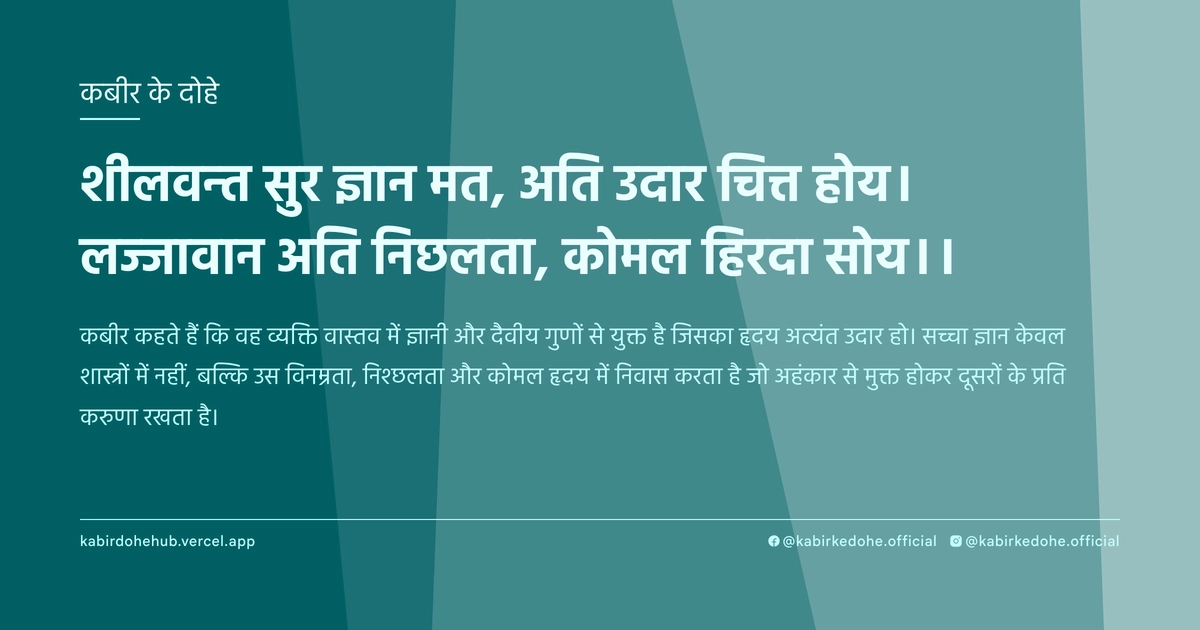
शीलवन्त सुर ज्ञान मत, अति उदार चित्त होय।
लज्जावान अति निछलता, कोमल हिरदा सोय।।
Sheelvant sur gyan mat, ati udar chitt hoye. Lajjawan ati nichhalta, komal hirda soye.
इस पृष्ठ पर इस कबीर दोहे का अर्थ (meaning), हिंदी व्याख्या और अंग्रेज़ी अनुवाद, दार्शनिक विश्लेषण और व्यावहारिक जीवन सीख दी गई है। यह दोहा विनम्रता (Humility) विषय से जुड़ा है — Kabir doha meaning and explanation in Hindi and English.
अर्थ (Meaning):
कबीर कहते हैं कि वह व्यक्ति वास्तव में ज्ञानी और दैवीय गुणों से युक्त है जिसका हृदय अत्यंत उदार हो। सच्चा ज्ञान केवल शास्त्रों में नहीं, बल्कि उस विनम्रता, निश्छलता और कोमल हृदय में निवास करता है जो अहंकार से मुक्त होकर दूसरों के प्रति करुणा रखता है।
Kabir asserts that true knowledge and divine grace are not found in scholarly credentials but in a heart characterized by immense generosity. A truly enlightened soul is one who possesses innate modesty, absolute sincerity, and a tender heart, remaining untouched by the hardness of ego.
व्याख्या (Interpretation):
इस दोहे का शाब्दिक अर्थ है कि शीलवान व्यक्ति देवताओं के समान ज्ञान रखता है क्योंकि उसका चित्त उदार होता है। रूपकात्मक रूप से, कबीर यहाँ 'ज्ञान' की परिभाषा बदल रहे हैं; उनके लिए ज्ञान सूचना का संचय नहीं, बल्कि स्वभाव का रूपांतरण है। यह निर्गुण भक्ति का सार है जहाँ ईश्वर किसी मूर्ति में नहीं, बल्कि मनुष्य की सरलता और निश्छलता में बसता है। जब हृदय 'कोमल' होता है, तब वह माया के कठोर आवरण को भेदकर आत्म-साक्षात्कार के योग्य बनता है। यहाँ 'लज्जा' का अर्थ सामाजिक शर्म नहीं, बल्कि उस आध्यात्मिक विनय से है जो यह जान लेने पर आती है कि 'मैं' कुछ भी नहीं हूँ और सब कुछ वह 'एक' ही है। यह अद्वैत वेदांत के उस सत्य की ओर संकेत है जहाँ व्यक्ति और ब्रह्म के बीच का द्वैत केवल अहंकार के कारण बना रहता है।
Literally, the verse suggests that a virtuous person possesses a divine intellect due to their expansive heart. Metaphorically, Kabir redefines 'knowledge' not as the accumulation of information, but as a transformation of being. This aligns with Nirgun Bhakti, where the Divine resides not in idols, but in the simplicity and sincerity of the human spirit. A 'tender heart' is a prerequisite for piercing the rigid veil of Maya to achieve self-realization. The 'modesty' mentioned here is not social shyness, but a spiritual humility born from the realization that the individual ego is an illusion and only the Universal Consciousness exists. It points toward the Advaita Vedanta truth that the perceived duality between the Atman and Brahman is maintained only by the stubbornness of the ego.
दार्शनिक विश्लेषण (Philosophical Analysis):
कबीर का यह दोहा उस युग की प्रतिक्रिया है जहाँ ज्ञान को केवल संस्कृत के श्लोकों और कर्मकांडों तक सीमित कर दिया गया था। उन्होंने ब्राह्मणवादी और कट्टरपंथी ढांचों को चुनौती देते हुए यह स्थापित किया कि पात्रता (Eligibility) जाति या शास्त्र-अध्ययन से नहीं, बल्कि आंतरिक गुणों से तय होती है। यह सूफी मत के 'इश्क' और 'फना' के करीब है, जहाँ प्रेमी अपने अहंकार को मिटाकर ईश्वर की करुणा में विलीन हो जाता है।
दार्शनिक स्तर पर, कबीर यहाँ 'शील' (Virtue) को ज्ञान की पूर्व शर्त मानते हैं। यदि कोई व्यक्ति महान विद्वान है लेकिन उसका हृदय कठोर है, तो वह ज्ञान केवल एक बोझ है। अद्वैत वेदांत के अनुसार, जब तक 'अहंकार' (I-ness) जीवित है, तब तक सत्य का अनुभव असंभव है। कोमल हृदय वह दर्पण है जिस पर धूल नहीं जमती, जिससे परमात्मा का प्रतिबिंब स्पष्ट दिखाई देता है।
कबीर का विरोध उन पाखंडियों से था जो बाहरी दिखावे (जैसे तिलक, माला या विशेष वस्त्र) को आध्यात्मिकता का प्रमाण मानते थे। उनके लिए, वास्तविक 'सुर' (देवत्व) वह है जो मनुष्य के व्यवहार में झलके। यह मनोवैज्ञानिक रूपांतरण की प्रक्रिया है जहाँ व्यक्ति 'पाने' की इच्छा को त्यागकर 'होने' की अवस्था में प्रवेश करता है।
यहाँ 'निछलता' (Sincerity) का अर्थ है वह अवस्था जहाँ विचार और व्यवहार के बीच कोई विरोधाभास न रहे। जब मनुष्य भीतर से पारदर्शी हो जाता है, तब वह माया के जाल से मुक्त हो जाता है। यह वह बिंदु है जहाँ भक्ति और ज्ञान का मिलन होता है—ज्ञान यह बताता है कि सब एक हैं, और भक्ति उस एकता को प्रेम के माध्यम से अनुभव कराती है।
अंततः, यह दोहा यह संदेश देता है कि करुणा ही सर्वोच्च बुद्धिमत्ता है। जो व्यक्ति दूसरों के दुख को अपना दुख समझने की क्षमता रखता है, वही वास्तव में 'ज्ञानी' है। यह सामाजिक समरसता का मार्ग है, जो जाति और धर्म की सीमाओं को तोड़कर मानवता के मूल तत्व को स्पर्श करता है।
This couplet is a direct response to an era where knowledge was restricted to Sanskrit shlokas and rigid rituals. Kabir challenged the Brahmanical and orthodox structures by establishing that spiritual eligibility is determined by inner virtues rather than caste or scholarly study. This mirrors the Sufi concepts of 'Ishq' (Divine Love) and 'Fana' (Annihilation of the Self), where the seeker dissolves their ego to merge with Divine Compassion.
Philosophically, Kabir posits 'Sheel' (Virtue) as a prerequisite for true knowledge. If a person is a great scholar but possesses a hardened heart, that knowledge is merely a burden. According to Advaita Vedanta, as long as 'Ahankara' (the ego-sense) persists, the experience of Truth remains impossible. A tender heart acts as a polished mirror, free from the dust of pride, allowing the reflection of the Divine to appear clearly.
Kabir's critique was aimed at hypocrites who viewed external symbols—such as tilaks, beads, or specific attire—as evidence of spirituality. For him, true 'Sur' (divinity) is that which manifests in one's conduct. This is a process of psychological transformation where the individual shifts from the desire to 'acquire' to the state of 'being'.
'Nichhalta' (Sincerity) refers to a state of total alignment where there is no contradiction between thought and action. When a human becomes transparent internally, they are liberated from the webs of Maya. This is the intersection of Bhakti and Jnana—knowledge reveals that all is One, and devotion allows one to experience that oneness through love.
Ultimately, the verse teaches that compassion is the highest form of intelligence. The person capable of feeling another's pain as their own is the only true 'Knower'. This is the path of social harmony, breaking the barriers of caste and creed to touch the fundamental essence of humanity.
मूल संदेश (Core Message):
- शास्त्रों का ज्ञान व्यर्थ है यदि हृदय में करुणा नहीं है।
- विनम्रता ही वह द्वार है जिससे वास्तविक ज्ञान प्रवेश करता है।
- अहंकार का विसर्जन ही आत्मा का वास्तविक उत्थान है।
- सादगी और निश्छलता ही ईश्वर के सबसे करीब होने के लक्षण हैं।
- सच्ची बुद्धिमत्ता दूसरों के दुख को महसूस करने की क्षमता में है।
- Scriptural knowledge is void if the heart lacks compassion.
- Humility is the only gateway through which true wisdom enters.
- The dissolution of ego is the only authentic ascent of the soul.
- Simplicity and sincerity are the hallmarks of proximity to the Divine.
- True intelligence is the capacity to feel the suffering of others.
व्यावहारिक उदाहरण (Practical Example):
वाराणसी के एक पुराने घाट पर रामदीन नाम का एक वृद्ध नाविक रहता था। वह बहुत कम पढ़ा-लिखा था और दिन भर नाव चलाकर मुश्किल से गुजारा करता था। शहर के बड़े-बड़े पंडित और विद्वान उसकी नाव पर बैठकर गंगा पार करते थे और अक्सर अपनी विद्वत्ता का प्रदर्शन करते हुए उसे अनपढ़ कहकर उपेक्षा करते थे।
रामदीन कभी बुरा नहीं मानता था। उसका हृदय अत्यंत कोमल था। एक बार एक बहुत बड़ा विद्वान उसकी नाव पर सवार हुआ। वह विद्वान अपनी पोथियों और शास्त्रों के ज्ञान पर बहुत गर्व करता था और रामदीन को तुच्छ समझता था।
तभी अचानक नाव के पास एक गरीब भिखारी गिरा, जो भूख और बीमारी से तड़प रहा था। विद्वान ने अपनी पोथी खोली और शास्त्रों के हवाले से तर्क देने लगा कि दान देने का सही समय और विधि क्या होनी चाहिए, और उसने भिखारी की मदद करने के बजाय उसे उपदेश देना शुरू कर दिया।
रामदीन ने यह देखा। उसने बिना एक शब्द बोले अपनी नाव रोकी, अपनी दिनभर की कमाई के कुछ सिक्के निकाले और अपनी पोटली से आधी रोटी निकालकर उस भिखारी को खिलाई। उसने बड़ी विनम्रता से भिखारी के घावों को अपने अंगोछे से साफ किया।
विद्वान यह सब देख रहा था। उसे अचानक महसूस हुआ कि वह शास्त्रों के बारे में सब कुछ जानता है, लेकिन उस ज्ञान का कोई उपयोग नहीं है यदि वह एक तड़पते हुए इंसान के प्रति करुणा महसूस नहीं कर सकता।
रामदीन की निश्छलता और उसके हृदय की कोमलता ने उस विद्वान के अहंकार को झकझोर दिया। विद्वान को समझ आया कि रामदीन, जिसे वह अनपढ़ समझ रहा था, वास्तव में उससे कहीं अधिक 'ज्ञानी' है क्योंकि उसका ज्ञान व्यवहार में है, शब्दों में नहीं।
उस दिन के बाद, उस विद्वान ने अपनी पोथियों को केवल सूचना मानना छोड़ दिया और रामदीन को अपना गुरु मान लिया। उसने सीखा कि असली ज्ञान वह है जो हृदय को उदार बनाए, न कि वह जो अहंकार को बढ़ाए।
रामदीन की इस सहजता ने एक अहंकारी मस्तिष्क को करुणा के मार्ग पर मोड़ दिया। यह 'कबीर ट्विस्ट' था—जहाँ एक साधारण नाविक की निश्छलता ने एक शास्त्रज्ञ के पाखंड को नष्ट कर दिया और उसे वास्तविक आध्यात्मिकता से परिचित कराया।
On an ancient ghat in Varanasi lived an elderly boatman named Ramdeen. He was barely literate and struggled to make a living rowing his boat all day. Great pundits and scholars of the city would use his boat to cross the Ganges, often flaunting their erudition and dismissing him as an ignorant peasant.
Ramdeen never took offense. His heart was profoundly tender. One day, a renowned scholar boarded his boat. This man took immense pride in his mastery of scriptures and viewed Ramdeen as insignificant.
Suddenly, a poor beggar collapsed near the boat, shivering from hunger and illness. The scholar opened his tome and began arguing, citing scriptures on the correct timing and method of charity, offering a lecture to the dying man instead of actual help.
Ramdeen witnessed this. Without uttering a single word, he stopped the boat, took out the few coins he had earned that day, and shared half of his own bread with the beggar. With deep humility, he used his coarse cloth to clean the beggar's wounds.
The scholar watched in silence. He suddenly realized that while he knew everything *about* the scriptures, that knowledge was useless if he could not feel compassion for a suffering human being.
Ramdeen's sincerity and the tenderness of his heart shook the scholar's ego. He realized that Ramdeen, whom he had deemed illiterate, was far more 'knowledgeable' because his wisdom lived in his actions, not in his words.
From that day forward, the scholar stopped treating his books as the ultimate truth and began viewing Ramdeen as his spiritual guide. He learned that true knowledge is that which expands the heart, not that which inflates the ego.
Ramdeen's simplicity triggered a 'Kabir Twist'—where the guileless nature of a simple boatman dismantled the hypocrisy of a scholar, introducing him to the essence of true spirituality.
अभ्यास मार्गदर्शन (Practice Guidance):
- प्रतिदिन 15 मिनट मौन बैठें और विचार करें कि आपके भीतर कौन सा 'कठोर' हिस्सा है जो दूसरों को क्षमा नहीं कर पाता।
- एक 'करुणा डायरी' लिखें: प्रतिदिन एक ऐसी घटना दर्ज करें जहाँ आपने बिना किसी स्वार्थ या अपेक्षा के किसी की मदद की हो।
- व्यवहार परिवर्तन: जब भी किसी से विवाद हो, तो प्रतिक्रिया देने से पहले स्वयं से पूछें—'क्या मेरा अहंकार बोल रहा है या मेरा हृदय?'
- निदान चेकलिस्ट: क्या आप अपनी उपलब्धियों का उल्लेख दूसरों के सामने करते हैं? क्या आप दूसरों की गलतियों पर तुरंत निर्णय लेते हैं? यदि हाँ, तो आपका हृदय अभी 'कोमल' नहीं हुआ है।
- Sit in silence for 15 minutes daily and contemplate which 'hardened' part of your inner self refuses to forgive others.
- Maintain a 'Compassion Journal': Record one daily instance where you helped someone without any selfish motive or expectation.
- Behavioral Shift: During a conflict, before reacting, ask yourself—'Is it my ego speaking, or is it my heart?'
- Diagnostic Checklist: Do you frequently mention your achievements to others? Do you judge people's mistakes instantly? If yes, your heart has not yet become 'tender'.
चिंतन प्रश्न (Reflection Questions):
- क्या मेरी 'आध्यात्मिक पहचान' वास्तव में मुझे विनम्र बना रही है, या यह मेरे अहंकार का एक नया सूक्ष्म रूप है?
- मैं उन लोगों के प्रति कितना कोमल हूँ जिन्हें मैं व्यक्तिगत रूप से नापसंद करता हूँ?
- मेरे जीवन में 'ज्ञान' का अर्थ सूचना एकत्र करना है या अपने स्वभाव को बदलना?
- जब मैं दूसरों की मदद करता हूँ, तो क्या मैं वास्तव में निश्छल होता हूँ, या मैं अपनी छवि सुधार रहा होता हूँ?
- मेरे भीतर का वह कौन सा डर है जो मुझे पूरी तरह से उदार और सरल होने से रोकता है?
- Is my 'spiritual identity' actually making me humble, or is it just a more subtle form of ego?
- How tender am I toward those whom I personally dislike?
- In my life, does 'knowledge' mean accumulating information or transforming my nature?
- When I help others, am I truly sincere, or am I merely polishing my public image?
- What is the fear within me that prevents me from being completely generous and simple?