
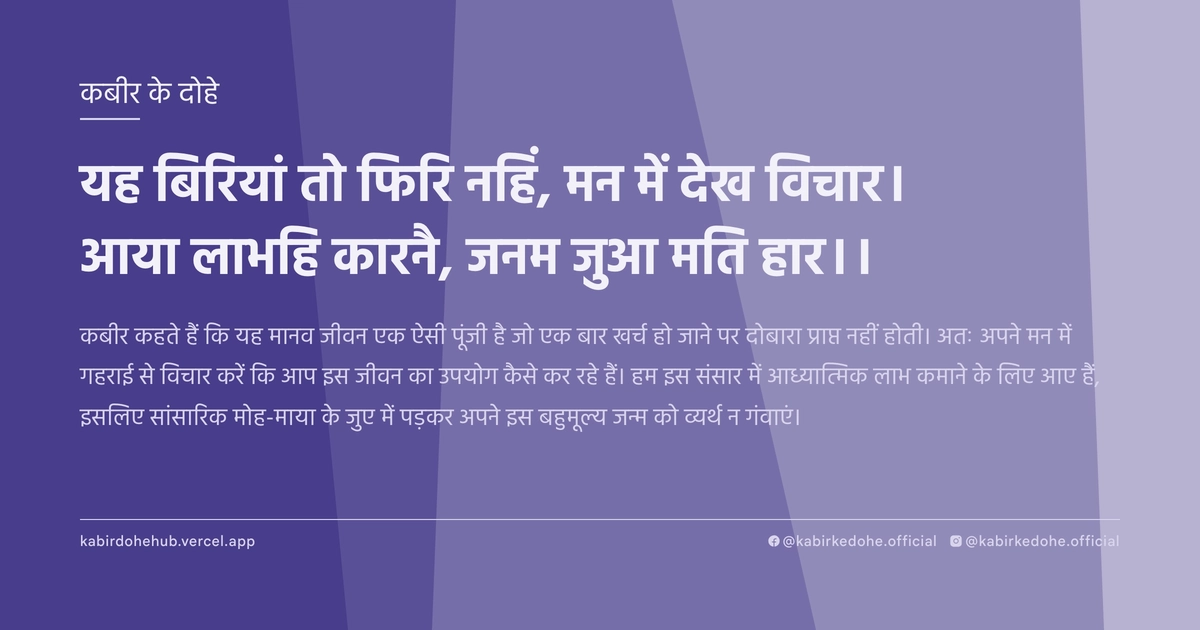
यह बिरियां तो फिरि नहिं, मन में देख विचार।
आया लाभहि कारनै, जनम जुआ मति हार।।
Yeh biriyan to phiri nahin, man me dekh vichaar. Aaya laabhahi kaarnai, janam jua mati haar.
इस पृष्ठ पर इस कबीर दोहे का अर्थ (meaning), हिंदी व्याख्या और अंग्रेज़ी अनुवाद, दार्शनिक विश्लेषण और व्यावहारिक जीवन सीख दी गई है। यह दोहा समय का महत्व (The Value of Time) विषय से जुड़ा है — Kabir doha meaning and explanation in Hindi and English.
अर्थ (Meaning):
कबीर कहते हैं कि यह मानव जीवन एक ऐसी पूंजी है जो एक बार खर्च हो जाने पर दोबारा प्राप्त नहीं होती। अतः अपने मन में गहराई से विचार करें कि आप इस जीवन का उपयोग कैसे कर रहे हैं। हम इस संसार में आध्यात्मिक लाभ कमाने के लिए आए हैं, इसलिए सांसारिक मोह-माया के जुए में पड़कर अपने इस बहुमूल्य जन्म को व्यर्थ न गंवाएं।
Kabir emphasizes that human life is a unique capital that, once spent, cannot be recovered. He urges us to reflect deeply within the mind on the purpose of our existence. We have entered this world to attain the ultimate spiritual profit; therefore, we must not gamble away this precious birth in the futile pursuits of worldly illusions and material desires.
व्याख्या (Interpretation):
शाब्दिक रूप से, 'बिरियां' का अर्थ यहाँ जीवन की पूंजी या अवसर से है। कबीर इस जीवन को एक निवेश के रूप में देखते हैं। यह दोहा निरगुण भक्ति के उस सिद्धांत पर आधारित है जहाँ आत्मा को माया के जाल से मुक्त होकर परमात्मा (ब्रह्म) में विलीन होना है। यहाँ 'जुआ' सांसारिक आसक्तियों और अहंकार का प्रतीक है, जो क्षणिक सुख तो देते हैं लेकिन अंततः आध्यात्मिक पतन का कारण बनते हैं। अद्वैत वेदांत के अनुसार, जब तक मनुष्य स्वयं को शरीर और मन की सीमाओं में देखता है, वह भ्रमित रहता है। वास्तविक लाभ 'आत्म-साक्षात्कार' है, न कि भौतिक संचय। यह विरोधाभास है कि मनुष्य जिसे लाभ समझता है, वही वास्तव में उसकी सबसे बड़ी हानि है।
Literally, 'biriyan' refers to the capital or the opportunity of life. Kabir views existence as a strategic investment. This couplet is rooted in the principle of Nirgun Bhakti, where the soul must liberate itself from the veil of Maya to merge with the formless Divine. The 'gamble' symbolizes worldly attachments and the ego, which offer fleeting pleasures but lead to spiritual bankruptcy. According to Advaita Vedanta, as long as a human perceives themselves through the limitations of the body and mind, they remain in illusion. The true 'profit' is Atman-Brahman realization, not material accumulation. It is a profound paradox that what humans perceive as gain is actually their greatest loss.
दार्शनिक विश्लेषण (Philosophical Analysis):
कबीर का यह दोहा उस कालखंड का है जब समाज कर्मकांडों और बाहरी आडंबरों में जकड़ा हुआ था। कबीर ने पुरोहितवाद और जातिगत श्रेष्ठता को नकारते हुए आंतरिक शुद्धि पर बल दिया। वे बताते हैं कि मोक्ष किसी तीर्थ या मंदिर में नहीं, बल्कि स्वयं के भीतर 'विचार' करने से मिलता है।
दार्शनिक स्तर पर, यह सूफी मत के 'फना' (अहंकार का विनाश) और वेदांत के 'विवेक' (नित्य और अनित्य के बीच अंतर करने की क्षमता) का संगम है। कबीर चेतावनी देते हैं कि समय सीमित है। यदि हम केवल सामाजिक प्रतिष्ठा और भौतिक सुखों के पीछे भागते हैं, तो हम उस 'जुए' में हार रहे हैं जहाँ दांव पर हमारी आत्मा की मुक्ति लगी है।
यहाँ 'लाभ' शब्द का प्रयोग अत्यंत सूक्ष्म है। यह सांसारिक लाभ नहीं, बल्कि 'चित्त-शुद्धि' और 'परमानंद' की प्राप्ति है। कबीर का तर्क है कि शरीर नश्वर है, लेकिन चेतना शाश्वत है। जो व्यक्ति इस सत्य को पहचान लेता है, वह बाहरी दुनिया के शोर से हटकर अंतर्मुखी हो जाता है।
यह विश्लेषण स्पष्ट करता है कि कबीर केवल एक कवि नहीं, बल्कि एक मनोवैज्ञानिक थे। वे जानते थे कि मनुष्य की सबसे बड़ी कमजोरी उसकी 'आशा' और 'लोभ' है। वे हमें सिखाते हैं कि वास्तविक बुद्धिमानी इस बात में है कि हम अपनी ऊर्जा को क्षय होने से बचाएं और उसे आत्म-उन्नति में लगाएं।
अंततः, यह दोहा हमें याद दिलाता है कि जीवन एक दुर्लभ अवसर है। यदि हम इसे केवल जैविक अस्तित्व (खाने, सोने, प्रजनन) तक सीमित रखते हैं, तो हम अपनी उच्चतम क्षमता का अपमान कर रहे हैं। मुक्ति का मार्ग केवल सजगता और निरंतर आत्म-निरीक्षण से ही प्रशस्त होता है।
This couplet emerges from an era where society was strangled by rigid rituals and external ostentations. Kabir rejected priestly hegemony and caste superiority, emphasizing internal purification over external piety. He posits that liberation is found not in pilgrimages or temples, but through deep internal 'reflection'.
Philosophically, this is a convergence of the Sufi concept of 'Fana' (annihilation of the ego) and the Vedantic principle of 'Viveka' (the discernment between the eternal and the ephemeral). Kabir warns that time is finite. If we chase only social prestige and material comforts, we are losing a gamble where the stake is the liberation of the soul.
The use of the word 'profit' (laabh) is highly nuanced. It does not refer to monetary gain, but to 'Chitta-Shuddhi' (purification of consciousness) and the attainment of supreme bliss. Kabir argues that while the body is perishable, consciousness is eternal. One who recognizes this truth withdraws from the noise of the external world to become introverted.
This analysis reveals Kabir as a psychologist of the spirit. He understood that humanity's greatest weaknesses are misplaced hope and greed. He teaches that true intelligence lies in preventing the dissipation of spiritual energy and channeling it toward self-transcendence.
Ultimately, the verse reminds us that human life is a rare opportunity. If we limit our existence to mere biological functions—eating, sleeping, and reproducing—we insult our highest potential. The path to liberation is paved only through mindfulness and constant self-inquiry.
मूल संदेश (Core Message):
- जीवन एक दुर्लभ अवसर है, इसे व्यर्थ न करें।
- सांसारिक मोह एक ऐसा जुआ है जिसमें केवल हानि है।
- वास्तविक लाभ केवल आत्म-ज्ञान और आंतरिक शांति में है।
- बाहरी दुनिया के शोर से हटकर अंतर्मुखी बनें।
- समय की सीमितता को पहचानें और प्राथमिकताएं बदलें।
- अहंकार का त्याग ही मोक्ष का एकमात्र द्वार है।
- Life is a rare opportunity; do not squander it.
- Worldly attachment is a gamble that yields only loss.
- True profit lies solely in self-knowledge and inner peace.
- Withdraw from the external noise and become introverted.
- Recognize the finitude of time and shift your priorities.
- The surrender of ego is the only gateway to liberation.
व्यावहारिक उदाहरण (Practical Example):
वाराणसी के एक पुराने घाट पर माधव नाम का एक वृद्ध नाविक रहता था। माधव का पूरा जीवन पर्यटकों को नदी की सैर कराने और चंद सिक्कों के लिए संघर्ष करने में बीता। वह हमेशा इस चिंता में रहता था कि कल उसके पास पर्याप्त पैसे होंगे या नहीं। वह अपनी नाव को ही अपनी पूरी दुनिया मानता था और हर छोटी लहर से डरता था।
एक दिन उसकी मुलाकात एक मौन साधु से हुई, जिसने माधव से पूछा, 'तुम इस नाव को बचाने में इतने व्यस्त हो कि यह भूल गए कि तुम खुद कहाँ जा रहे हो?' माधव को पहले तो यह बात समझ नहीं आई, लेकिन उस रात उसे कबीर का यह दोहा याद आया कि जीवन एक पूंजी है जिसे जुए में नहीं हारना चाहिए।
माधव ने महसूस किया कि उसका 'जुआ' उसकी अंतहीन चिंताएं और भविष्य का डर था। उसने तय किया कि वह अब केवल पैसे के लिए नाव नहीं चलाएगा, बल्कि हर यात्रा को एक सेवा और ध्यान के रूप में देखेगा। उसने अपनी कमाई का एक हिस्सा उन लोगों की मदद में लगाना शुरू किया जो वास्तव में असहाय थे।
धीरे-धीरे माधव के स्वभाव में बदलाव आया। उसकी घबराहट शांत हो गई और उसके चेहरे पर एक अलौकिक शांति छा गई। वह अब भी वही नाव चला रहा था, लेकिन उसका उद्देश्य बदल गया था। वह अब केवल नदी के पानी को नहीं, बल्कि अपने भीतर के प्रवाह को देख रहा था।
एक समय ऐसा आया जब माधव ने देखा कि उसकी नाव की भौतिक स्थिति से अधिक उसकी मानसिक स्थिति महत्वपूर्ण है। उसने पाया कि जब वह दूसरों के दुख को अपना समझकर मदद करता है, तो उसे वह 'लाभ' मिलता है जो सोने के सिक्कों से नहीं मिल सकता था।
गाँव के लोग हैरान थे कि जो माधव हमेशा चिड़चिड़ा रहता था, वह अब सबसे शांत व्यक्ति बन गया है। उसने अपनी भौतिक आवश्यकताओं को न्यूनतम कर लिया और अपना समय स्वाध्याय और चिंतन में बिताने लगा।
उसने महसूस किया कि जीवन की असली पूंजी 'शांति' और 'संतोष' है। उसने अपनी नाव को केवल जीविका का साधन नहीं, बल्कि मोक्ष का एक माध्यम बना लिया।
अंत में, माधव ने यह समझ लिया कि वह इस दुनिया में केवल नाव चलाने नहीं आया था, बल्कि अपनी आत्मा की नाव को पार लगाने आया था। यही उसका वास्तविक लाभ था।
On an ancient ghat in Varanasi lived an elderly boatman named Madhav. Madhav's entire life was spent giving tours to tourists and struggling for a few coins. He was perpetually anxious about whether he would have enough money for tomorrow. He viewed his boat as his entire world and feared every small ripple in the water.
One day, he encountered a silent monk who asked him, 'You are so busy saving this boat that you have forgotten where you yourself are going.' Madhav didn't understand at first, but that night, he recalled Kabir's verse about life being a capital that should not be lost in a gamble.
Madhav realized that his 'gamble' was his endless anxiety and fear of the future. He decided that he would no longer row his boat merely for money, but would view every journey as an act of service and meditation. He began allocating a portion of his earnings to help those who were truly destitute.
Gradually, a transformation occurred in Madhav's nature. His agitation subsided, and a divine peace settled upon his face. He was still rowing the same boat, but his purpose had shifted. He was no longer just observing the river's current, but the flow within himself.
There came a time when Madhav realized that his mental state was far more significant than the physical condition of his boat. He discovered that when he helped others by empathizing with their pain, he received a 'profit' that gold coins could never provide.
Villagers were astonished that Madhav, who was once perpetually irritable, had become the calmest man in the vicinity. He minimized his material needs and spent his time in self-study and contemplation.
He realized that the true capital of life is 'peace' and 'contentment'. He transformed his boat from a mere tool of livelihood into a vehicle for liberation.
In the end, Madhav understood that he had not come into this world merely to row a boat, but to ferry his own soul across the ocean of existence. This was his true profit.
अभ्यास मार्गदर्शन (Practice Guidance):
- प्रतिदिन 20 मिनट मौन बैठें और विचार करें कि आपकी ऊर्जा किन व्यर्थ की चिंताओं (जुए) में नष्ट हो रही है।
- एक 'मूल्य पत्रिका' (Value Journal) बनाएँ जहाँ आप लिखें कि आज आपने भौतिक लाभ के बजाय आध्यात्मिक लाभ (जैसे क्षमा, धैर्य, करुणा) के लिए क्या किया।
- व्यवहार परिवर्तन: जब भी आप किसी सांसारिक विवाद में उलझें, स्वयं से पूछें—'क्या यह विवाद मेरे जीवन की पूंजी के योग्य है?'
- निदान चेकलिस्ट: यदि आप दिन भर तनाव में रहते हैं, दूसरों से ईर्ष्या करते हैं, या केवल भविष्य की चिंता करते हैं, तो आप 'जीवन का जुआ' हार रहे हैं। यदि आप वर्तमान में सजग हैं और आंतरिक शांति महसूस करते हैं, तो आप लाभ कमा रहे हैं।
- Sit in silence for 20 minutes daily and contemplate which futile anxieties (the gamble) are draining your spiritual energy.
- Maintain a 'Value Journal' to record instances where you prioritized spiritual profit (such as forgiveness, patience, or compassion) over material gain.
- Behavioral Shift: Whenever embroiled in a worldly conflict, ask yourself—'Is this dispute worth the expenditure of my life's precious capital?'
- Diagnostic Checklist: If you spend your day in stress, envy others, or obsess over the future, you are losing the 'gamble of life'. If you are mindful in the present and feel inner peace, you are accumulating true profit.
चिंतन प्रश्न (Reflection Questions):
- मेरे जीवन की वह कौन सी 'पूंजी' है जिसे मैं अनजाने में व्यर्थ कर रहा हूँ?
- मैं अपनी पहचान को बाहरी उपलब्धियों से क्यों जोड़ता हूँ, जबकि वे नश्वर हैं?
- मेरे भीतर का वह कौन सा डर है जो मुझे आध्यात्मिक मार्ग पर चलने से रोकता है?
- क्या मेरी वर्तमान जीवनशैली मुझे मेरे वास्तविक स्वरूप के करीब ले जा रही है या दूर?
- यदि आज मेरा समय समाप्त हो जाए, तो क्या मैं अपने 'आध्यात्मिक खाते' में कुछ लाभ देख पाऊंगा?
- मैं दूसरों के सामने जो मुखौटा पहनता हूँ, वह मेरे वास्तविक स्वरूप को कितना ढक रहा है?
- What is that 'capital' in my life that I am unconsciously squandering?
- Why do I tie my identity to external achievements, knowing they are ephemeral?
- What is the specific fear within me that prevents me from walking the spiritual path?
- Is my current lifestyle bringing me closer to my true nature or pushing me further away?
- If my time ended today, would I find any significant 'profit' in my spiritual account?
- To what extent does the mask I wear for society obscure my authentic self?