
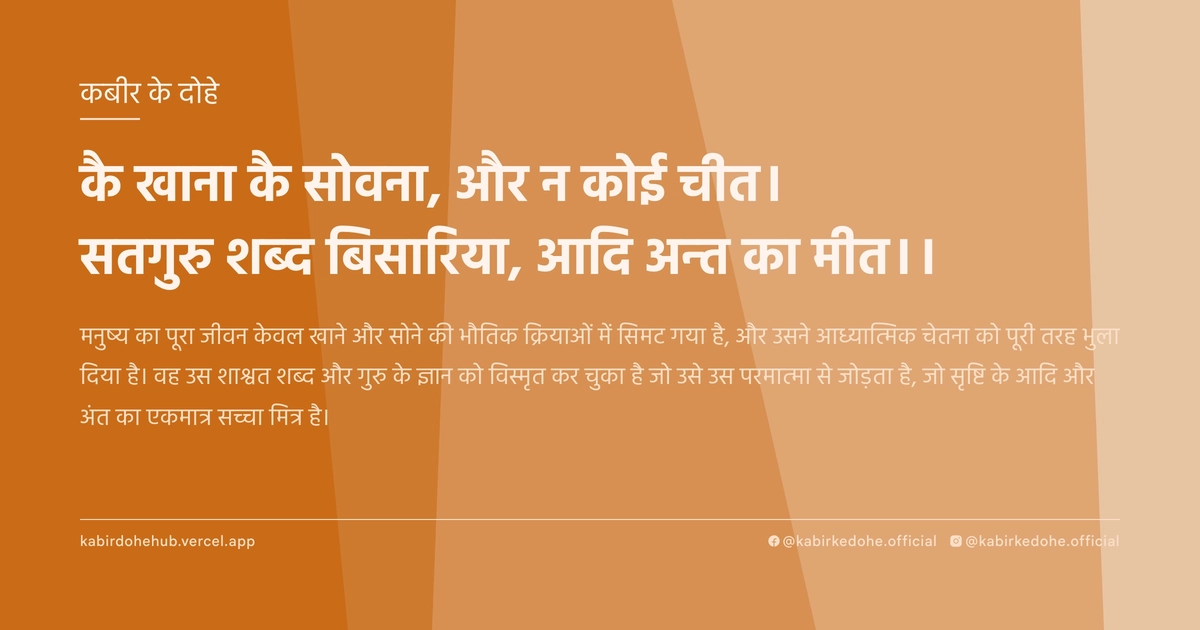
कै खाना कै सोवना, और न कोई चीत।
सतगुरु शब्द बिसारिया, आदि अन्त का मीत।।
Kai khaana kai sovna, aur na koi cheet. Satguru shabd bisariya, aadi ant ka meet.
इस पृष्ठ पर इस कबीर दोहे का अर्थ (meaning), हिंदी व्याख्या और अंग्रेज़ी अनुवाद, दार्शनिक विश्लेषण और व्यावहारिक जीवन सीख दी गई है। यह दोहा गुरु महत्व (The Guru's Importance) विषय से जुड़ा है — Kabir doha meaning and explanation in Hindi and English.
अर्थ (Meaning):
मनुष्य का पूरा जीवन केवल खाने और सोने की भौतिक क्रियाओं में सिमट गया है, और उसने आध्यात्मिक चेतना को पूरी तरह भुला दिया है। वह उस शाश्वत शब्द और गुरु के ज्ञान को विस्मृत कर चुका है जो उसे उस परमात्मा से जोड़ता है, जो सृष्टि के आदि और अंत का एकमात्र सच्चा मित्र है।
Human existence has been reduced to the mere biological cycles of eating and sleeping, devoid of any higher consciousness. The individual has forgotten the sacred 'Shabd' (Divine Word) imparted by the True Guru, neglecting the only eternal companion who exists beyond the beginning and the end of time.
व्याख्या (Interpretation):
यह दोहा भौतिकता और आध्यात्मिकता के बीच के गहरे अंतराल को दर्शाता है। 'खाना और सोना' यहाँ केवल शारीरिक क्रियाएँ नहीं, बल्कि अज्ञानता (Maya) की उस स्थिति का प्रतीक हैं जहाँ जीव केवल इंद्रिय सुखों में लीन रहता है। जब कबीर 'शब्द' की बात करते हैं, तो वे उस आंतरिक ध्वनि या नाद की ओर संकेत कर रहे हैं जो आत्मा को ब्रह्म से जोड़ती है। यह विस्मृति ही वास्तव में जन्म-मृत्यु के चक्र का कारण है। यहाँ 'आदि अंत का मीत' उस निर्गुण निराकार ईश्वर को कहा गया है जो समय की सीमाओं से परे है। इस प्रकार, यह दोहा हमें याद दिलाता है कि भौतिक अस्तित्व एक भ्रम है और वास्तविक सत्य केवल उस आंतरिक जागृति में है जिसे सतगुरु के शब्द द्वारा प्राप्त किया जा सकता है।
This couplet highlights the profound chasm between material existence and spiritual awakening. 'Eating and sleeping' are not mere physical acts but symbols of 'Maya' (illusion), where the soul is trapped in sensory gratification. When Kabir refers to the 'Shabd' (Word), he points toward the primordial vibration or internal sound that bridges the gap between the Atman (individual soul) and Brahman (universal consciousness). This spiritual amnesia is the root cause of the cycle of birth and death. The 'Friend of the beginning and the end' refers to the Nirgun (formless) Divine, who transcends the linear constraints of time. Thus, the verse serves as a reminder that while the body requires sustenance, the soul starves in the absence of divine remembrance, urging a transition from biological survival to spiritual realization.
दार्शनिक विश्लेषण (Philosophical Analysis):
कबीर का यह दर्शन सीधे तौर पर 'निर्गुण भक्ति' और 'अद्वैत वेदांत' से जुड़ा है। वे उस समय के समाज में व्याप्त कर्मकांडों और बाहरी आडंबरों पर प्रहार करते हैं, जहाँ धर्म केवल मंदिर जाने या व्रत रखने तक सीमित था। कबीर के अनुसार, वास्तविक धर्म आंतरिक है। वे तर्क देते हैं कि यदि मनुष्य केवल शारीरिक आवश्यकताओं की पूर्ति में लगा रहता है, तो वह अपनी ईश्वरीय प्रकृति को खो देता है।
सूफीवाद के प्रभाव में, कबीर 'शब्द' या 'ज़िक्र' की महत्ता बताते हैं। जिस प्रकार सूफी संत निरंतर ईश्वर के नाम का जाप करते हैं, कबीर भी उस आंतरिक ध्वनि के प्रति सजग होने की बात करते हैं। यहाँ 'अहंकार' (Ego) वह पर्दा है जो मनुष्य को उसके वास्तविक स्वरूप से अलग करता है। जब तक व्यक्ति खुद को केवल एक शरीर मानता है, वह 'खाने और सोने' के चक्र में फँसा रहता है।
दार्शनिक स्तर पर, यह दोहा 'जीव' और 'शिव' के एकीकरण की बात करता है। अद्वैत वेदांत के अनुसार, आत्मा और परमात्मा एक ही हैं, लेकिन अज्ञानता के कारण वे अलग प्रतीत होते हैं। कबीर इस अज्ञानता को 'भूलना' (बिसारिया) कहते हैं। यह विस्मृति ही वह मानसिक अवरोध है जिसे केवल गुरु की कृपा और आत्म-साक्षात्कार से हटाया जा सकता है।
कबीर का दृष्टिकोण क्रांतिकारी था क्योंकि उन्होंने मोक्ष को किसी विशेष जाति या धर्म के लिए आरक्षित नहीं रखा। उन्होंने सिखाया कि मुक्ति किसी बाहरी तीर्थयात्रा से नहीं, बल्कि अपने भीतर के 'शब्द' को खोजने से मिलती है। यह मनोवैज्ञानिक रूपांतरण की प्रक्रिया है जहाँ व्यक्ति अपनी पहचान को 'कर्ता' से बदलकर 'साक्षी' (Witness) बना लेता है।
अंततः, यह विश्लेषण हमें बताता है कि जीवन का उद्देश्य केवल जैविक अस्तित्व को बनाए रखना नहीं है। यदि जीवन केवल उपभोग और विश्राम तक सीमित है, तो वह पशु जीवन के समान है। मनुष्य की विशिष्टता उसकी चेतना में है, और उस चेतना का उच्चतम स्तर वह है जहाँ वह स्वयं को उस अनंत 'मीत' (मित्र) में विलीन कर देता है जो समय और स्थान से परे है।
Kabir's philosophy here is deeply rooted in 'Nirgun Bhakti' and 'Advaita Vedanta'. He strikes at the heart of the ritualism and external piety prevalent in his era, where religion was often reduced to temple visits or fasting. For Kabir, true spirituality is internal. He argues that if a human is consumed solely by physical needs, they lose touch with their inherent divine nature.
Influenced by Sufism, Kabir emphasizes the importance of the 'Shabd' or 'Zikr'. Just as Sufi saints engage in the constant remembrance of the Divine, Kabir advocates for an awareness of the internal primordial sound. The 'Ego' (Ahankar) acts as the veil that separates the individual from the Absolute. As long as one identifies solely as a body, they remain trapped in the cycle of 'eating and sleeping'.
On a philosophical level, this verse speaks to the unification of the Jiva (individual soul) and Shiva (universal consciousness). According to Advaita Vedanta, the soul and the Absolute are one, separated only by the illusion of duality. Kabir describes this state of ignorance as 'forgetting' (Bisariya). This spiritual amnesia is the mental barrier that can only be dismantled through the grace of a Satguru and rigorous self-inquiry.
Kabir's approach was revolutionary because he democratized liberation. He taught that salvation is not the preserve of a specific caste or religion but is accessible to anyone who can find the 'Word' within. This is a process of psychological transformation where the individual shifts their identity from the 'doer' to the 'witness'.
Ultimately, this analysis reveals that the purpose of life is not mere biological survival. If existence is limited to consumption and rest, it is no different from the life of an animal. The uniqueness of being human lies in consciousness, and the highest state of that consciousness is the realization of the 'Eternal Friend' who exists beyond the boundaries of time and space.
मूल संदेश (Core Message):
- जैविक अस्तित्व और आध्यात्मिक जीवन के बीच के अंतर को पहचानें।
- इंद्रिय सुखों की तृप्ति आत्मा की भूख को शांत नहीं कर सकती।
- गुरु द्वारा दिया गया 'शब्द' ही अज्ञानता के अंधेरे को मिटाने वाला दीपक है।
- परमात्मा कोई बाहरी सत्ता नहीं, बल्कि वह शाश्वत मित्र है जो भीतर स्थित है।
- चेतना का जागरण ही वास्तविक मुक्ति है, केवल जीवित रहना नहीं।
- अहंकार का विसर्जन ही उस आदि-अंत के मीत से मिलन का एकमात्र मार्ग है।
- Distinguish between mere biological survival and a conscious spiritual life.
- Sensory gratification can never satiate the hunger of the eternal soul.
- The 'Shabd' imparted by the Guru is the only lamp that dispels the darkness of ignorance.
- The Divine is not an external entity but the Eternal Friend residing within.
- True liberation is the awakening of consciousness, not just the continuation of breath.
- The dissolution of the ego is the only path to unite with the Friend of the beginning and end.
व्यावहारिक उदाहरण (Practical Example):
वाराणसी के एक पुराने घाट पर रामदीन नाम का एक वृद्ध नाविक रहता था। उसका पूरा जीवन केवल नाव चलाने, पैसे कमाने और रात को गहरी नींद सोने में बीता। वह एक कुशल नाविक था, लेकिन उसके जीवन में कोई उद्देश्य नहीं था। वह बस सुबह उठता, नाव चलाता, भोजन करता और सो जाता। उसके लिए जीवन का अर्थ केवल पेट भरना और शरीर को आराम देना था।
एक दिन, घाट पर एक फकीर आया जिसने रामदीन को देखा और मुस्कुराते हुए कहा, 'नाविक, तू लहरों को तो पहचानता है, पर क्या तूने उस गहराई को देखा है जहाँ लहरें शांत हो जाती हैं?' रामदीन ने अहंकार में उत्तर दिया, 'मैं इस नदी का सबसे बड़ा जानकार हूँ, मुझे सब पता है।'
फकीर ने शांति से जवाब दिया, 'तू नदी को जानता है, पर खुद को नहीं। तू बस खाने और सोने की मशीन बन गया है। तू उस मित्र को भूल गया है जिसने तुझे यह जीवन दिया।' यह बात रामदीन के हृदय में गहरे तक उतर गई। उसे महसूस हुआ कि उसने दशकों तक केवल जीवित रहने का अभ्यास किया, लेकिन वास्तव में 'जीया' नहीं।
अगले कुछ दिनों तक रामदीन ने गौर किया कि वह कैसे हर काम बिना सोचे-समझे, एक यंत्र की तरह कर रहा था। उसने महसूस किया कि उसकी पूरी पहचान उसके काम और उसकी शारीरिक जरूरतों से जुड़ी थी। उसने फकीर से पूछा कि वह 'शब्द' क्या है जिसे वह भूल गया है।
फकीर ने उसे सिखाया कि काम करते समय भी भीतर एक मौन रहे। उसने कहा, 'जब तू चप्पू चला रहा हो, तो केवल चप्पू मत देख, उस शक्ति को महसूस कर जो तुझे चला रही है।' रामदीन ने इस अभ्यास को अपनाया। उसने अपने दैनिक कार्यों को एक साधना बना लिया।
धीरे-धीरे, रामदीन का व्यवहार बदलने लगा। वह अब केवल पैसों के लिए नाव नहीं चलाता था, बल्कि हर यात्री में उस 'अनंत मित्र' को देखने लगा। उसका क्रोध कम हो गया और उसके चेहरे पर एक अलौकिक शांति आ गई।
एक शाम, जब वह नाव किनारे लगा रहा था, उसे अहसास हुआ कि अब उसे सोने की उतनी आवश्यकता नहीं है जितनी पहले थी, क्योंकि उसकी आत्मा जागृत हो चुकी थी। वह अब केवल शरीर का पोषण नहीं कर रहा था, बल्कि अपनी चेतना का पोषण कर रहा था।
रामदीन की कहानी यह दिखाती है कि कैसे एक साधारण व्यक्ति, जो केवल भौतिक चक्र में फँसा था, 'शब्द' के स्मरण से एक आध्यात्मिक योगी में बदल गया। उसने जाना कि जीवन केवल जीवित रहना नहीं, बल्कि उस शाश्वत सत्य के साथ एकाकार होना है।
On an ancient ghat in Varanasi lived an elderly boatman named Ramdin. His entire life had been spent in the repetitive cycle of rowing his boat, earning a meager living, and falling into a deep sleep at night. He was a skilled navigator, but his life lacked any higher purpose. For him, existence was merely about filling his stomach and resting his weary body.
One day, a wandering Sufi mystic arrived at the ghat. Observing Ramdin, the mystic smiled and asked, 'Boatman, you recognize the waves, but have you ever seen the depths where the waves become still?' Ramdin, blinded by his limited expertise, replied arrogantly, 'I am the greatest knower of this river; I know everything there is to know.'
The mystic calmly responded, 'You know the river, but you do not know yourself. You have become a mere machine of eating and sleeping. You have forgotten the Friend who breathed life into you.' These words pierced through Ramdin's complacency. He suddenly realized that for decades, he had practiced the art of surviving, but he had never actually 'lived'.
Over the next few days, Ramdin began to notice how he performed every action mechanically, without any conscious presence. He realized his entire identity was anchored to his labor and his physical cravings. He approached the mystic and asked about the 'Shabd' (Word) that he had forgotten.
The mystic taught him to maintain an inner silence even while engaged in work. He said, 'When you pull the oar, do not just see the wood and water; feel the cosmic energy that moves you.' Ramdin adopted this practice, turning his mundane labor into a spiritual discipline.
Gradually, Ramdin's behavior transformed. He no longer rowed the boat merely for coins; he began to see the 'Eternal Friend' in every passenger he carried. His anger vanished, replaced by a serene, otherworldly peace that radiated from his face.
One evening, as he moored his boat, he realized that he no longer craved the heavy, unconscious sleep of his past, for his soul had awakened. He was no longer just nourishing his body; he was nourishing his consciousness.
Ramdin's story illustrates how an ordinary man, trapped in a biological loop, could transform into a spiritual seeker through the remembrance of the 'Word'. He discovered that life is not about survival, but about merging with the eternal truth.
अभ्यास मार्गदर्शन (Practice Guidance):
- दैनिक मौन अभ्यास: प्रतिदिन 20 मिनट के लिए पूर्ण मौन धारण करें। इस दौरान केवल अपनी श्वास और शरीर के भीतर उठने वाली सूक्ष्म ध्वनियों (नाद) पर ध्यान केंद्रित करें।
- सजग उपभोग (Mindful Consumption): भोजन करते समय केवल स्वाद पर नहीं, बल्कि उस ऊर्जा पर ध्यान दें जो भोजन के माध्यम से आपके शरीर में प्रवेश कर रही है। यह प्रश्न पूछें: 'क्या मैं केवल शरीर को खिला रहा हूँ या आत्मा को भी?'
- आत्म-पूछताछ जर्नल: रात को सोने से पहले लिखें कि आज के दिन आपने कितनी बार 'ऑटो-पायलट' मोड में काम किया और कितनी बार आप वास्तव में वर्तमान क्षण में उपस्थित थे।
- डायग्नोस्टिक चेकलिस्ट: यदि आप अत्यधिक थकान, मानसिक रिक्तता, या जीवन में उद्देश्य की कमी महसूस कर रहे हैं, तो समझें कि आप 'खाने और सोने' के यांत्रिक चक्र में फँसे हैं। यदि आप साधारण कार्यों में भी आनंद और विस्मय महसूस करते हैं, तो आप 'शब्द' के करीब हैं।
- Daily Silence Practice: Observe complete silence for 20 minutes daily. During this time, focus solely on your breath and the subtle internal vibrations (Naad) within the body.
- Mindful Consumption: While eating, shift focus from taste to the energy entering your body. Ask yourself: 'Am I merely feeding the body, or am I nourishing the soul?'
- Self-Inquiry Journaling: Before sleeping, record how many times you operated on 'auto-pilot' today versus how many moments you were truly present and conscious.
- Diagnostic Checklist: If you experience chronic mental emptiness, persistent boredom, or a lack of purpose, you are likely trapped in the mechanical cycle of 'eating and sleeping'. If you find wonder and joy in mundane tasks, you are aligning with the 'Shabd'.
चिंतन प्रश्न (Reflection Questions):
- यदि मेरी सभी भौतिक आवश्यकताएं पूरी हो जाएं, तो मेरे पास वास्तव में क्या बचेगा?
- मैं अपनी दिनचर्या के किन हिस्सों में केवल एक मशीन की तरह व्यवहार करता हूँ?
- मेरा 'डिजिटल ईगो' मुझे वास्तविक आंतरिक शांति से कितनी दूर ले गया है?
- क्या मैं अपनी पहचान अपने पेशे, रिश्तों और संपत्ति से अलग देख सकता हूँ?
- वह कौन सा 'शब्द' या सत्य है जिसे मैंने अपनी सुविधा के लिए भुला दिया है?
- क्या मेरा प्रेम केवल शरीर और अपेक्षाओं तक सीमित है, या वह आत्मा से जुड़ा है?
- If all my material needs were permanently satisfied, what would truly remain of me?
- In which parts of my daily routine am I behaving merely as a biological machine?
- To what extent has my 'digital ego' distanced me from genuine internal stillness?
- Can I perceive my identity as something entirely separate from my profession, relationships, and assets?
- What is the fundamental truth or 'Word' that I have intentionally forgotten for the sake of convenience?
- Is my love limited to the body and expectations, or is it connected to the essence of the soul?