
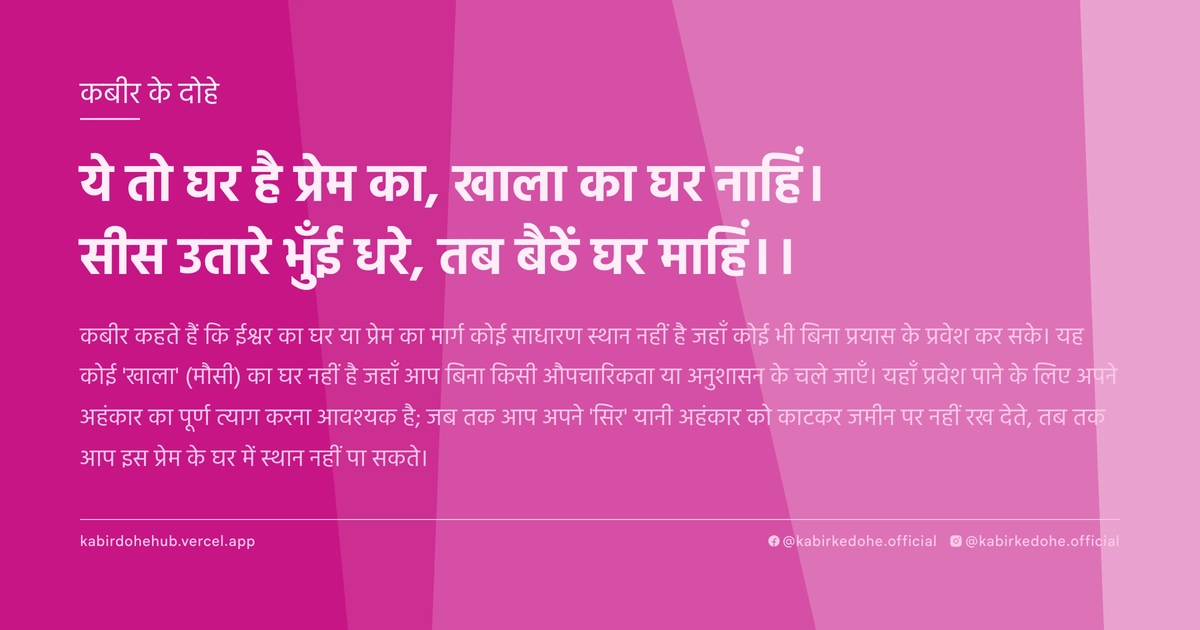
ये तो घर है प्रेम का, खाला का घर नाहिं।
सीस उतारे भुँई धरे, तब बैठें घर माहिं।।
Ye to ghar hai prem ka, khala ka ghar nahin. Sees utare bhunyi dhare, tab baithein ghar mahin.
इस पृष्ठ पर इस कबीर दोहे का अर्थ (meaning), हिंदी व्याख्या और अंग्रेज़ी अनुवाद, दार्शनिक विश्लेषण और व्यावहारिक जीवन सीख दी गई है। यह दोहा प्रपत्ति (Surrender) विषय से जुड़ा है — Kabir doha meaning and explanation in Hindi and English.
अर्थ (Meaning):
कबीर कहते हैं कि ईश्वर का घर या प्रेम का मार्ग कोई साधारण स्थान नहीं है जहाँ कोई भी बिना प्रयास के प्रवेश कर सके। यह कोई 'खाला' (मौसी) का घर नहीं है जहाँ आप बिना किसी औपचारिकता या अनुशासन के चले जाएँ। यहाँ प्रवेश पाने के लिए अपने अहंकार का पूर्ण त्याग करना आवश्यक है; जब तक आप अपने 'सिर' यानी अहंकार को काटकर जमीन पर नहीं रख देते, तब तक आप इस प्रेम के घर में स्थान नहीं पा सकते।
Kabir asserts that the abode of Divine Love is not a casual dwelling or a relative's house where one enters with ease and entitlement. It is not a 'maternal aunt's home' where hospitality is guaranteed without effort. To enter this sacred space, one must undergo a radical transformation: the complete surrender of the ego. Only when the 'head'—symbolizing the pride and the individual identity—is severed and laid upon the ground, can one truly sit within the sanctuary of Love.
व्याख्या (Interpretation):
इस दोहे में 'घर' आत्मा के वास्तविक स्वरूप और परमात्मा के मिलन का प्रतीक है। 'खाला का घर' उस सांसारिक सहजता और मोह का प्रतीक है जहाँ हम बिना किसी अनुशासन के स्वीकार किए जाते हैं। 'सीस उतारना' शारीरिक मृत्यु नहीं, बल्कि 'अहंकार की मृत्यु' (Ego Death) है। यह निर्गुण भक्ति का सार है, जहाँ भक्त को यह समझना होता है कि जब तक 'मैं' (अहंकार) जीवित है, तब तक 'वह' (परमात्मा) प्रकट नहीं हो सकता। यह अद्वैत वेदांत के उस सिद्धांत को दर्शाता है जहाँ ज्ञाता और ज्ञेय के बीच का पर्दा केवल अहंकार है। जब यह पर्दा गिरता है, तभी आत्मा का ब्रह्म से मिलन संभव होता है।
In this couplet, the 'home' symbolizes the state of ultimate realization and the union of the soul with the Divine. The 'maternal aunt's house' represents worldly comfort and the casual nature of human relationships where acceptance is unconditional and effortless. 'Severing the head' is not a literal act of violence but a profound metaphor for 'Ego Death.' This aligns with Nirgun Bhakti, suggesting that as long as the 'I' persists, the 'Divine' remains hidden. It echoes the Advaita Vedanta principle that the only barrier between the Atman and Brahman is the illusion of separate identity (Maya). The paradox is that one must 'die' to the self to truly 'live' in the Divine presence.
दार्शनिक विश्लेषण (Philosophical Analysis):
कबीर का यह दोहा उस युग की प्रतिक्रिया है जहाँ धर्म केवल बाहरी कर्मकांडों और सामाजिक प्रतिष्ठा का खेल बन गया था। वे स्पष्ट करते हैं कि प्रेम का मार्ग कठिन तपस्या का मार्ग है, न कि केवल माला जपने या तीर्थ यात्रा करने का। यहाँ 'प्रेम' का अर्थ कामुक या सांसारिक प्रेम नहीं, बल्कि 'इश्क-ए-हकीकी' (ईश्वरीय प्रेम) है, जो सूफी मत का मुख्य आधार है। सूफीवाद में 'फना' (स्वयं का विनाश) की अवधारणा है, जो कबीर के 'सीस उतारने' के समान है।
दार्शनिक स्तर पर, कबीर यहाँ द्वैतवाद (Duality) पर प्रहार कर रहे हैं। जब तक मनुष्य स्वयं को शरीर, जाति या पद से जोड़कर देखता है, वह द्वैत में रहता है। यह अहंकार ही वह दीवार है जो उसे परमात्मा से अलग करती है। कबीर का तर्क है कि भक्ति कोई बाहरी आवरण नहीं, बल्कि आंतरिक शून्यता की प्रक्रिया है।
वे जाति और धर्म के उन ढांचों को नकारते हैं जो मनुष्य को यह भ्रम देते हैं कि वे अपने जन्म या कुल के कारण ईश्वर के करीब हैं। 'खाला का घर' उन लोगों के लिए एक व्यंग्य है जो सोचते हैं कि भक्ति केवल एक पारिवारिक परंपरा या सरल रीति-रिवाज है।
मनोवैज्ञानिक रूप से, यह दोहा आत्म-निरीक्षण की मांग करता है। अहंकार का त्याग करने का अर्थ है अपनी उन सभी धारणाओं को छोड़ देना जिन्हें हमने अपनी पहचान बना लिया है। यह एक मानसिक मृत्यु है जो एक उच्च चेतना के जन्म का मार्ग प्रशस्त करती है।
अंततः, यह संदेश है कि सत्य की प्राप्ति के लिए समर्पण की पराकाष्ठा आवश्यक है। बिना पूर्ण समर्पण के, आध्यात्मिक अनुभव केवल सतही होते हैं। वास्तविक प्रेम वह है जो आपको पूरी तरह से मिटा दे और आपको ब्रह्मांडीय चेतना में विलीन कर दे।
Kabir's couplet is a sharp critique of an era where religion had devolved into mere ritualism and social status. He clarifies that the path of Love is one of rigorous discipline and internal alchemy, not simply the act of chanting beads or visiting shrines. The 'Love' mentioned here is not mundane or romantic, but 'Ishq-e-Haqiqi' (Divine Love), a cornerstone of Sufi mysticism. The Sufi concept of 'Fana' (annihilation of the self) is mirrored in Kabir's metaphor of 'severing the head.'
Philosophically, Kabir attacks the notion of duality. As long as a human identifies with their body, caste, or social rank, they remain trapped in the illusion of separation. This ego is the only veil obscuring the unity of Atman and Brahman. Kabir argues that devotion is not an external garment but a process of internal emptying.
He rejects the structural hierarchies of caste and creed that lead people to believe they have a birthright or a 'familial' shortcut to the Divine. The reference to the 'maternal aunt's house' is a satirical jab at those who treat spirituality as a casual hobby or a hereditary privilege.
Psychologically, the verse demands a radical introspection. To surrender the ego is to dismantle the curated identity we present to the world. It is a psychological death—the shedding of the persona—which is the prerequisite for the birth of a higher, universal consciousness.
Ultimately, the message is that the realization of Truth requires the zenith of surrender. Without total abandonment of the self, spiritual experiences remain superficial. True Love is that which consumes the lover entirely, leaving only the Beloved behind, merging the individual drop into the infinite ocean.
मूल संदेश (Core Message):
- अहंकार वह अंतिम दीवार है जो आत्मा को परमात्मा से अलग करती है।
- आध्यात्मिक प्रगति का अर्थ है अपनी पहचान का धीरे-धीरे विलोपन।
- प्रेम कोई अधिकार नहीं, बल्कि पूर्ण समर्पण का परिणाम है।
- जब तक 'मैं' है, तब तक 'सत्य' का अनुभव असंभव है।
- विनम्रता केवल एक गुण नहीं, बल्कि सत्य के घर की एकमात्र चाबी है।
- The ego is the final wall separating the soul from the Divine.
- Spiritual progress is the gradual dissolution of the individual identity.
- Love is not a right, but the fruit of absolute surrender.
- As long as the 'I' exists, the experience of Truth remains impossible.
- Humility is not just a virtue, but the only key to the house of Truth.
व्यावहारिक उदाहरण (Practical Example):
वाराणसी के एक पुराने मोहल्ले में माधव नाम का एक अत्यंत कुशल बुनकर रहता था। माधव अपनी कला में इतना निपुण था कि पूरे शहर में उसकी चर्चा थी। लेकिन इस निपुणता ने उसके भीतर एक गहरा अहंकार भर दिया था। वह खुद को 'सर्वश्रेष्ठ' मानता था और अन्य बुनकरों को तुच्छ समझता था। वह अक्सर कहता, "मेरी कला ईश्वर की देन है, और मैं ही उसका सच्चा प्रतिनिधि हूँ।"
एक दिन, एक फकीर उसके पास आया। फकीर ने माधव के बनाए वस्त्रों की प्रशंसा नहीं की, बल्कि उसकी आँखों में झाँककर कहा, "तेरी कला तो सुंदर है, पर तेरा अहंकार इस वस्त्र के धागों से भी अधिक उलझा हुआ है। तू इस घर में प्रवेश करना चाहता है जहाँ केवल प्रेम है, पर तू अपना सिर लेकर आया है, उसे यहाँ छोड़ना होगा।"
माधव को पहले तो यह बात समझ नहीं आई। उसने सोचा कि फकीर पागल है। लेकिन फकीर ने उसे एक चुनौती दी: "अगले सात दिनों तक, तू जो भी वस्त्र बनाएगा, उस पर अपना नाम नहीं लिखेगा और न ही उसकी कीमत अपनी मर्जी से तय करेगा। तू उसे उस व्यक्ति को देगा जिसे दुनिया सबसे नीचा समझती है।"
शुरुआत में माधव का अहंकार छटपटाया। उसे लगा कि उसकी कला का अपमान हो रहा है। तीसरे दिन, जब उसने एक अत्यंत सुंदर दुपट्टा एक बीमार भिखारी को दिया, तो उसने देखा कि उस भिखारी की आँखों में जो तृप्ति थी, वह उसे अपनी सबसे महंगी बिक्री में भी नहीं मिली थी।
चौथे दिन, उसने महसूस किया कि उसकी 'श्रेष्ठता' का बोझ उसे कितना थका चुका था। वह अब तक अपनी कला को अपनी पहचान (Identity) मान रहा था, जबकि कला तो केवल एक माध्यम थी।
पाँचवें दिन, माधव ने अपनी कार्यशाला के सभी अन्य बुनकरों को बुलाया और उनसे माफी मांगी। उसने स्वीकार किया कि उसने अपनी कला को अहंकार का हथियार बना लिया था।
छठे दिन, उसने अपनी सारी जमा पूँजी से एक साझा केंद्र बनाया जहाँ कोई भी बिना किसी भेदभाव के बुनना सीख सकता था। अब वह 'मास्टर बुनकर' नहीं, बल्कि एक 'सीखने वाला' बन गया था।
सातवें दिन, जब वह फकीर दोबारा आया, तो उसने देखा कि माधव के चेहरे पर एक अद्भुत शांति थी। माधव ने फकीर के पैर छुए और कहा, "मैंने अपना सिर (अहंकार) जमीन पर रख दिया है। अब मुझे समझ आया कि प्रेम के घर में प्रवेश के लिए 'मैं' का मिटना जरूरी है।"
माधव की जिंदगी बदल गई। अब वह केवल कपड़े नहीं बुनता था, बल्कि लोगों के दिलों को जोड़ने वाले धागे बुनने लगा था। उसकी कला अब प्रदर्शन नहीं, बल्कि प्रार्थना बन गई थी।
In an ancient lane of Varanasi lived Madhav, a weaver of extraordinary skill. His mastery was legendary throughout the city, but this brilliance had birthed a towering ego. Madhav viewed himself as the 'supreme artist' and looked down upon other weavers. He often proclaimed, "My art is a gift from God, and I am His sole true representative."
One day, a wandering Sufi dervish visited him. The dervish did not praise the fabrics; instead, he looked into Madhav's eyes and said, "Your art is beautiful, but your ego is more tangled than the threads of your loom. You wish to enter the house of Love, but you carry your head high; you must lay it on the ground first."
Madhav was initially bewildered and dismissed the dervish as a madman. However, the dervish gave him a challenge: "For the next seven days, every garment you weave must remain nameless. You shall not set the price; instead, you will give each piece to someone whom society deems the lowest."
At first, Madhav's ego recoiled. He felt his art was being insulted. But on the third day, as he handed a magnificent stole to a frail, ailing beggar, he saw a glimmer of gratitude in the man's eyes that he had never encountered in his most lucrative sales.
By the fourth day, Madhav realized how exhausting it was to carry the burden of 'superiority.' He had mistaken his skill for his identity, forgetting that art is merely a medium, not the destination.
On the fifth day, Madhav gathered all the other weavers in the neighborhood and asked for their forgiveness. He admitted that he had used his talent as a weapon of arrogance rather than a tool for service.
On the sixth day, he used his savings to establish a communal workshop where anyone, regardless of caste or status, could learn the craft. He ceased being the 'Master Weaver' and became a 'perpetual student.'
On the seventh day, the dervish returned. He found a profound serenity on Madhav's face. Madhav bowed deeply and said, "I have laid my head upon the earth. I now understand that to enter the house of Love, the 'I' must perish."
Madhav's life was transformed. He no longer just wove cloth; he wove bonds of compassion. His art was no longer a performance of ego, but a silent prayer of surrender.
अभ्यास मार्गदर्शन (Practice Guidance):
- प्रतिदिन 20 मिनट मौन ध्यान करें, जहाँ आप अपने भीतर उठने वाले 'मैं' (अहंकार) के विचारों को केवल एक साक्षी की तरह देखें, बिना उनसे जुड़े।
- एक 'अहंकार डायरी' लिखें: दिन भर में जब भी आपको महसूस हो कि आप किसी से श्रेष्ठ हैं या किसी को नीचा दिखा रहे हैं, उसे लिखें और फिर विश्लेषण करें कि वह भावना कहाँ से आई।
- सप्ताह में एक बार ऐसा कार्य करें जिसमें आपको अपनी पहचान पूरी तरह से छिपानी पड़े और आप केवल एक सेवक के रूप में कार्य करें (जैसे किसी अजनबी की गुप्त मदद करना)।
- निदान चेकलिस्ट: क्या मैं अपनी उपलब्धियों का श्रेय खुद लेता हूँ? क्या मुझे दूसरों की आलोचना सुनकर क्रोध आता है? क्या मैं अपनी मान्यताओं को दूसरों पर थोपता हूँ? यदि हाँ, तो 'सीस उतारने' की प्रक्रिया अभी शुरू करनी है।
- Practice 20 minutes of silent meditation daily, observing the arising thoughts of 'I' (the ego) as a detached witness without identifying with them.
- Maintain an 'Ego Journal': Record moments throughout the day when you felt superior to others or judged someone. Analyze the root cause of that feeling.
- Once a week, perform an act of service where your identity remains completely hidden, acting solely as a servant to another (e.g., anonymous charity).
- Diagnostic Checklist: Do I take sole credit for my achievements? Do I feel anger when criticized? Do I impose my beliefs on others? If yes, the process of 'severing the head' needs immediate attention.
चिंतन प्रश्न (Reflection Questions):
- मेरी वह कौन सी 'पहचान' है जिसे खोने के डर से मैं सबसे ज्यादा डरता हूँ?
- क्या मेरा धर्म और मेरी नैतिकता वास्तव में प्रेम पर आधारित हैं, या वे केवल मेरे अहंकार को संतुष्ट करने के साधन हैं?
- जब मैं दूसरों की मदद करता हूँ, तो क्या मैं वास्तव में निस्वार्थ होता हूँ, या मैं अपनी 'परोपकारी' छवि का आनंद ले रहा होता हूँ?
- मेरे जीवन का वह कौन सा क्षेत्र है जहाँ मैं अभी भी 'श्रेष्ठता' का मुखौटा पहने हुए हूँ?
- यदि आज मेरी सारी उपलब्धियाँ और पद छीन लिए जाएँ, तो मेरे भीतर क्या बचेगा?
- क्या मैं सत्य को जानने की इच्छा रखता हूँ, या मैं केवल सत्य जैसा दिखने की इच्छा रखता हूँ?
- Which part of my 'identity' am I most terrified of losing?
- Are my religion and morality truly based on love, or are they merely tools to feed my ego?
- When I help others, am I truly selfless, or am I enjoying the image of being a 'philanthropist'?
- In which area of my life am I still wearing the mask of 'superiority'?
- If all my achievements and titles were stripped away today, what would remain of me?
- Do I truly desire to know the Truth, or do I only desire to appear truthful?