
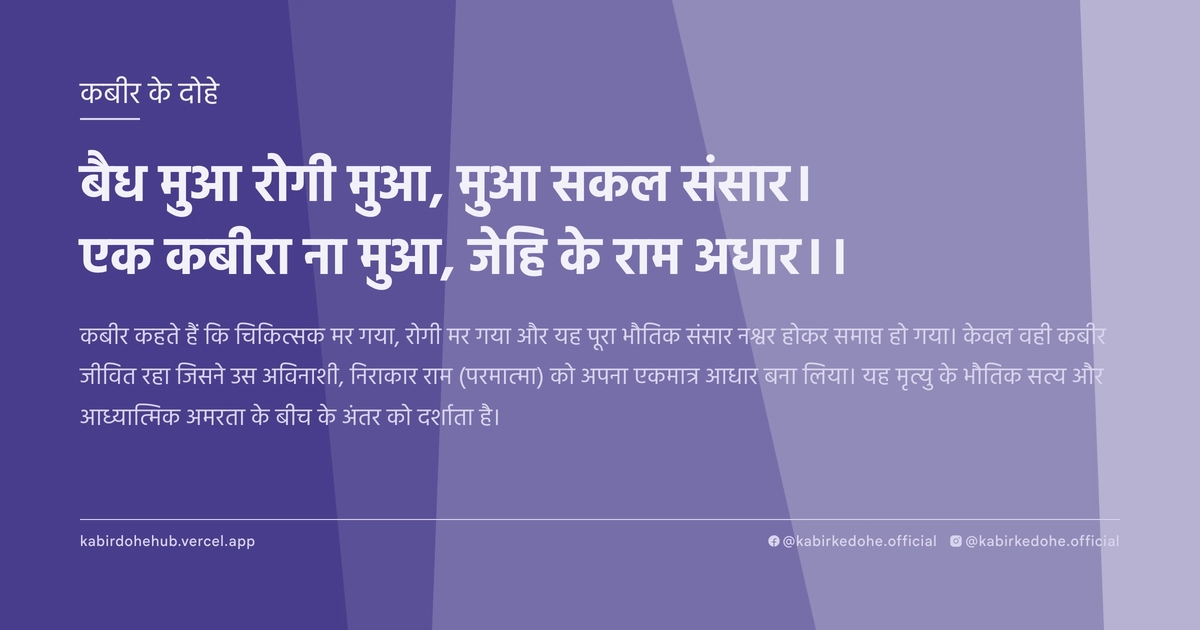
बैध मुआ रोगी मुआ, मुआ सकल संसार।
एक कबीरा ना मुआ, जेहि के राम अधार।।
Baidh mua rogi mua, mua sakal sansar. Ek kabira na mua, jehi ke ram adhar.
इस पृष्ठ पर इस कबीर दोहे का अर्थ (meaning), हिंदी व्याख्या और अंग्रेज़ी अनुवाद, दार्शनिक विश्लेषण और व्यावहारिक जीवन सीख दी गई है। यह दोहा निर्गुण ब्रह्म (Nirguna Brahman) विषय से जुड़ा है — Kabir doha meaning and explanation in Hindi and English.
अर्थ (Meaning):
कबीर कहते हैं कि चिकित्सक मर गया, रोगी मर गया और यह पूरा भौतिक संसार नश्वर होकर समाप्त हो गया। केवल वही कबीर जीवित रहा जिसने उस अविनाशी, निराकार राम (परमात्मा) को अपना एकमात्र आधार बना लिया। यह मृत्यु के भौतिक सत्य और आध्यात्मिक अमरता के बीच के अंतर को दर्शाता है।
Kabir proclaims that the physician has perished, the patient has perished, and the entire material world has succumbed to decay. Only Kabir remains immortal—not in the flesh, but in spirit—because he anchored his existence in the Eternal, Formless Ram, the ultimate foundation of all being.
व्याख्या (Interpretation):
इस दोहे का शाब्दिक अर्थ मृत्यु की अनिवार्यता है, लेकिन इसका आध्यात्मिक अर्थ 'अहंकार' की मृत्यु है। 'वैद' यहाँ सांसारिक ज्ञान और तर्क का प्रतीक है, जबकि 'रोगी' उस जीव का प्रतीक है जो माया के रोगों से ग्रस्त है। जब संसार की सारी नश्वरता समाप्त होती है, तब केवल वह तत्व बचता है जो शाश्वत है। कबीर यहाँ 'राम' शब्द का प्रयोग दशरथ पुत्र राम के लिए नहीं, बल्कि उस निर्गुण ब्रह्म के लिए कर रहे हैं जो कण-कण में व्याप्त है। यह अद्वैत वेदांत के उस सत्य को उजागर करता है जहाँ आत्मा और परमात्मा एक हो जाते हैं। जब व्यक्ति अपनी सीमित पहचान (जीवात्मा) को त्यागकर अनंत (ब्रह्म) में विलीन होता है, तब वह जन्म और मृत्यु के चक्र से मुक्त हो जाता है। यह विरोधाभास है कि मरने के लिए तैयार होने वाला ही वास्तव में अमर होता है।
Literally, the verse speaks of the inevitability of death, but metaphorically, it addresses the dissolution of the ego. The 'physician' represents worldly intellect and logic, while the 'patient' symbolizes the soul afflicted by the diseases of Maya (illusion). When the transient world vanishes, only that which is eternal remains. Kabir uses 'Ram' not as a mythological deity, but as the Nirgun Brahman—the formless, attributeless Absolute. This aligns with Advaita Vedanta, where the realization of the non-duality of Atman and Brahman liberates the seeker. The central paradox presented is that only he who 'dies' to his limited identity can truly live. By anchoring oneself in the Unchanging, the seeker transcends the cycle of Samsara, shifting from a fragile, temporary existence to an immutable spiritual state.
दार्शनिक विश्लेषण (Philosophical Analysis):
कबीर का यह दोहा उस युग की प्रतिक्रिया है जहाँ धर्म केवल कर्मकांडों और बाहरी दिखावों तक सीमित था। उन्होंने देखा कि लोग मोक्ष के लिए बाहरी गुरुओं और वैद्यों (उपचारकों) पर निर्भर थे, जबकि वास्तविक उपचार भीतर था। यह सूफी मत के 'फना' (अहंकार का विनाश) और वेदांत के 'मोक्ष' का एक सुंदर संगम है। कबीर तर्क देते हैं कि जब तक हम शरीर को ही सत्य मानते हैं, हम मृत्यु के भय से ग्रस्त रहेंगे।
यहाँ 'वैद' का मरना इस बात का संकेत है कि बौद्धिक ज्ञान और शास्त्र-विद्या अकेले मुक्ति नहीं दिला सकते। जब तर्क समाप्त होता है, तब केवल अनुभव और प्रेम बचता है। कबीर ने जाति और धर्म की सीमाओं को तोड़कर एक ऐसे मार्ग का 제시 किया जहाँ केवल 'राम' (परम तत्व) ही एकमात्र सत्य है। यह सामाजिक क्रांति का एक सूक्ष्म रूप था, जहाँ व्यक्ति को बाहरी संस्थाओं के बजाय अपनी अंतरात्मा पर भरोसा करने के लिए प्रेरित किया गया।
मनोवैज्ञानिक स्तर पर, यह दोहा 'अस्तित्वगत भय' (Existential Dread) का समाधान करता है। मनुष्य की सबसे बड़ी पीड़ा यह है कि वह नश्वर होते हुए भी अमर रहना चाहता है। कबीर बताते हैं कि अमरता शरीर की नहीं, बल्कि चेतना की होती है। जब चेतना अपनी पहचान को 'मैं' (ego) से हटाकर 'वह' (Universal Truth) में बदल लेती है, तो मृत्यु केवल एक वस्त्र बदलने जैसी प्रक्रिया बन जाती है।
यह विचार कि 'सकल संसार मुआ', यह दर्शाता है कि यह भौतिक जगत एक स्वप्न की तरह है। जिस प्रकार जागने पर स्वप्न लुप्त हो जाता है, उसी प्रकार ज्ञान प्राप्त होने पर माया का पर्दा हट जाता है। कबीर यहाँ एक 'साक्षी' (Witness) की स्थिति में हैं, जो देख रहे हैं कि सब कुछ परिवर्तनशील है और केवल आधार (Foundation) ही स्थिर है।
अंततः, यह दोहा हमें सिखाता है कि जीवन का उद्देश्य संचय नहीं, बल्कि समर्पण है। जब हम स्वयं को उस अनंत शक्ति को सौंप देते हैं, तो हम उस शक्ति का ही हिस्सा बन जाते हैं। यह समर्पण ही वह 'आधार' है जो हमें समय और स्थान की सीमाओं से ऊपर उठाता है, जिससे हम मृत्यु के भय से मुक्त होकर शाश्वत शांति को प्राप्त करते हैं।
Kabir's verse is a visceral reaction to an era dominated by rigid ritualism and external religious authorities. He observed that people sought liberation through external 'physicians'—priests and scholars—while the actual cure lay within. This philosophy is a synthesis of the Sufi concept of 'Fana' (annihilation of the self) and the Vedantic pursuit of 'Moksha'. Kabir argues that as long as we identify with the physical body, we remain prisoners of the fear of death.
The 'death of the physician' symbolizes the failure of intellectualism and scriptural knowledge to provide ultimate liberation. When logic reaches its limit, only direct experience and divine love remain. By stripping away the labels of caste and creed, Kabir presents a path where the 'Formless Ram' is the only reality. This was a subtle social revolution, urging the individual to trust their inner intuition over external institutions.
Psychologically, the poem addresses 'existential dread'. The core human agony is the desire for immortality within a decaying vessel. Kabir resolves this by shifting the definition of immortality from the biological to the conscious. When the consciousness shifts its identity from the 'I' (ego) to the 'That' (Universal Truth), death becomes a mere change of garments rather than an end.
The phrase 'the whole world perished' suggests that the material realm is akin to a dream. Just as a dream vanishes upon waking, the illusion of Maya dissolves upon the dawn of spiritual awakening. Kabir speaks from the vantage point of the 'Sakshi' (Witness), observing the transience of all forms while remaining anchored in the Immutable.
Ultimately, the teaching emphasizes surrender over accumulation. By surrendering the small self to the Infinite, the seeker becomes one with that Infinite. This surrender is the 'Adhaar' (Foundation) that elevates the soul above the constraints of time and space, transforming the terror of death into the tranquility of eternal presence.
मूल संदेश (Core Message):
- बाहरी उपचार केवल शरीर को टालते हैं, आत्मा को नहीं।
- अहंकार का विसर्जन ही वास्तविक अमरता का द्वार है।
- संसार की नश्वरता को स्वीकार करना ही शांति का मार्ग है।
- निराकार ब्रह्म ही एकमात्र स्थायी आधार है।
- मृत्यु अंत नहीं, बल्कि एक सीमित पहचान का समापन है।
- External cures only delay the inevitable; they do not liberate the soul.
- The dissolution of the ego is the only gateway to true immortality.
- Accepting the transience of the world is the only path to peace.
- The Formless Absolute is the only permanent foundation of existence.
- Death is not an end, but the conclusion of a limited identity.
व्यावहारिक उदाहरण (Practical Example):
एक समय की बात है, वाराणसी के घाटों पर 'माधव' नाम का एक वृद्ध बुनकर रहता था। माधव अपनी कला में निपुण था और उसने जीवन भर बेहतरीन वस्त्र बनाए। लेकिन जैसे-जैसे उम्र बढ़ी, उसके शरीर ने साथ छोड़ना शुरू कर दिया। उसके हाथ कांपने लगे और उसकी आंखों की रोशनी धुंधली हो गई।
माधव ने अपनी सारी जमापूंजी बड़े-बड़े वैद्यों और हकीमों को दी। उसने दुर्लभ जड़ी-बूटियाँ आजमाईं और महंगे उपचार कराए, लेकिन उसकी बीमारी कम नहीं हुई। वह जितना अधिक इलाज कराता, उतना ही अधिक निराश होता। उसे लगने लगा कि उसका पूरा जीवन व्यर्थ गया क्योंकि वह अपनी मृत्यु को टाल नहीं पा रहा था।
एक शाम, वह घाट पर बैठा एक फकीर को गाते हुए सुना, जो कबीर के इसी दोहे को गुनगुना रहा था। फकीर ने माधव की व्याकुलता देखी और मुस्कुराकर कहा, "माधव, तुम उस शरीर को बचाने की कोशिश कर रहे हो जो मिट्टी का है। तुम वैद्यों के पीछे भाग रहे हो, जबकि वैद खुद अपनी बारी का इंतज़ार कर रहे हैं।"
माधव ने पूछा, "तो क्या मैं बस मर जाऊं? क्या जीवन का कोई अर्थ नहीं है?"
फकीर ने उत्तर दिया, "मृत्यु शरीर की होती है, आत्मा की नहीं। तुम अपनी पहचान इस बुनकर के शरीर से जोड़कर बैठे हो, इसलिए डर रहे हो। जिस दिन तुम यह जान लोगे कि तुम वह अविनाशी तत्व हो जिसे कोई बीमारी नहीं छू सकती, उस दिन तुम वास्तव में जीना शुरू करोगे।"
यह बात माधव के हृदय में गहरे तक उतर गई। उसने बाहरी उपचारों की दौड़ छोड़ दी और प्रतिदिन मौन रहकर अपने भीतर के 'राम' का ध्यान करना शुरू किया। उसने यह स्वीकार कर लिया कि उसका शरीर एक पुराना वस्त्र है जिसे एक दिन उतारना ही होगा।
जैसे ही उसने मृत्यु के भय को स्वीकार किया और उसे परमात्मा को समर्पित कर दिया, उसके मन का बोझ हल्का हो गया। उसकी शारीरिक बीमारी तो बनी रही, लेकिन उसकी मानसिक पीड़ा समाप्त हो गई। वह अब बीमारी के साथ भी मुस्कुराना सीख गया था।
उसने अपने बचे हुए दिन अन्य बुनकरों को यह सिखाने में बिताए कि कला केवल कपड़े बुनना नहीं, बल्कि अपनी आत्मा को परमात्मा के धागों से जोड़ना है। वह अब एक 'रोगी' नहीं, बल्कि एक 'मुक्त आत्मा' बन गया था।
जब अंततः माधव की मृत्यु हुई, तो उसके चेहरे पर एक असीम शांति थी। उसके परिवार और शिष्यों ने महसूस किया कि माधव मरा नहीं है; उसकी चेतना और उसके शब्द अब भी उनके बीच जीवित थे। उसने शरीर को खोकर उस 'आधार' को पा लिया था जो कभी नष्ट नहीं होता।
Once in the sacred lanes of Varanasi, there lived an elderly weaver named Madhav. Madhav was a master of his craft, spending his entire life weaving the finest silks. However, as age advanced, his body began to betray him. His hands trembled, and his vision grew clouded.
Madhav spent his entire life's savings on renowned physicians and royal hakims. He tried rare herbs and expensive treatments, but his ailments persisted. The more he sought a cure, the deeper his despair grew. He felt his life was a failure because he could not outrun the inevitability of death.
One evening, while sitting on the ghats, he heard a wandering mystic singing this very doha of Kabir. The mystic noticed Madhav's distress and smiled, saying, "Madhav, you are trying to preserve a body made of clay. You chase physicians, forgetting that the physicians themselves are merely waiting for their turn to perish."
Madhav asked, "Then should I just give up? Is there no meaning to this life?"
The mystic replied, "Death belongs to the body, not the soul. You are terrified because you identify yourself solely as this weaver's body. The day you realize you are that Indestructible Element which no disease can touch, you will truly begin to live."
These words pierced Madhav's heart. He ceased his frantic search for external cures and began practicing silence, meditating on the 'Ram' within. He accepted that his body was merely an old garment that would one day need to be discarded.
As he embraced the fear of death and surrendered it to the Divine, the burden on his soul lifted. While his physical illness remained, his mental agony vanished. He learned to smile even in the midst of pain.
He spent his remaining days teaching other weavers that art is not just about weaving fabric, but about weaving one's soul into the threads of the Divine. He was no longer a 'patient'; he had become a 'liberated soul'.
When Madhav finally breathed his last, there was an infinite peace on his face. His family and disciples felt that Madhav had not died; his consciousness and his wisdom remained alive among them. He had lost the body but found the 'Foundation' that can never be destroyed.
अभ्यास मार्गदर्शन (Practice Guidance):
- प्रतिदिन 20 मिनट के लिए 'साक्षी भाव' का अभ्यास करें: अपने विचारों और शारीरिक संवेदनाओं को ऐसे देखें जैसे आप किसी और को देख रहे हों, यह महसूस करते हुए कि आप शरीर नहीं, बल्कि दृष्टा हैं।
- आत्म-पूछताछ जर्नल: प्रतिदिन लिखें कि आज आपने किन सांसारिक चीजों (पद, प्रतिष्ठा, वस्तुएं) से अपनी पहचान जोड़ी और कैसे वे चीजें क्षणभंगुर हैं।
- मृत्यु का चिंतन (Memento Mori): सप्ताह में एक बार शांत बैठकर यह विचार करें कि यदि आज अंतिम दिन हो, तो कौन से अहंकार और कौन सी शिकायतें निरर्थक हो जाएंगी।
- निदान चेकलिस्ट: क्या मैं अभी भी बाहरी समाधानों (दवा, सलाह, मान्यता) पर इतना निर्भर हूँ कि मैं अपने आंतरिक मौन को भूल गया हूँ? क्या मेरा डर मेरी पहचान से बड़ा हो गया है?
- Practice 'Witness Consciousness' for 20 minutes daily: Observe your thoughts and bodily sensations as if you are watching a stranger, realizing you are the Observer, not the object.
- Self-Inquiry Journaling: Record the instances where you attached your identity to transient things (status, possessions, roles) and reflect on their impermanence.
- Contemplation of Mortality (Memento Mori): Once a week, sit in silence and consider: if today were the final day, which egos and grievances would suddenly become meaningless?
- Diagnostic Checklist: Am I relying so heavily on external solutions (medication, advice, validation) that I have forgotten my inner silence? Has my fear become larger than my identity?
चिंतन प्रश्न (Reflection Questions):
- यदि मेरी सारी उपलब्धियां और सामाजिक पद छीन लिए जाएं, तो 'मैं' कौन हूँ?
- मैं किन ऐसी चीजों को पकड़े हुए हूँ जिन्हें समय पहले ही मिटा चुका है, लेकिन मेरा मन उन्हें जीवित रखे हुए है?
- क्या मेरी भक्ति वास्तव में ईश्वर के लिए है, या मैं केवल मृत्यु के डर से बचने के लिए प्रार्थना कर रहा हूँ?
- मेरे जीवन का वह कौन सा 'आधार' है जो मेरी परिस्थितियों के बदलने पर भी नहीं बदलता?
- मैं अपनी डिजिटल पहचान (सोशल मीडिया इमेज) को कितना वास्तविक मानता हूँ और वह मेरी आंतरिक शांति को कैसे प्रभावित करती है?
- If all my achievements and social titles were stripped away, who is the 'I' that remains?
- What am I clinging to that time has already erased, but my mind continues to keep alive?
- Is my devotion truly for the Divine, or am I merely praying to escape the terror of death?
- What is the 'Foundation' in my life that remains unchanged regardless of my external circumstances?
- How much do I mistake my digital identity for my real self, and how does this illusion affect my inner peace?