
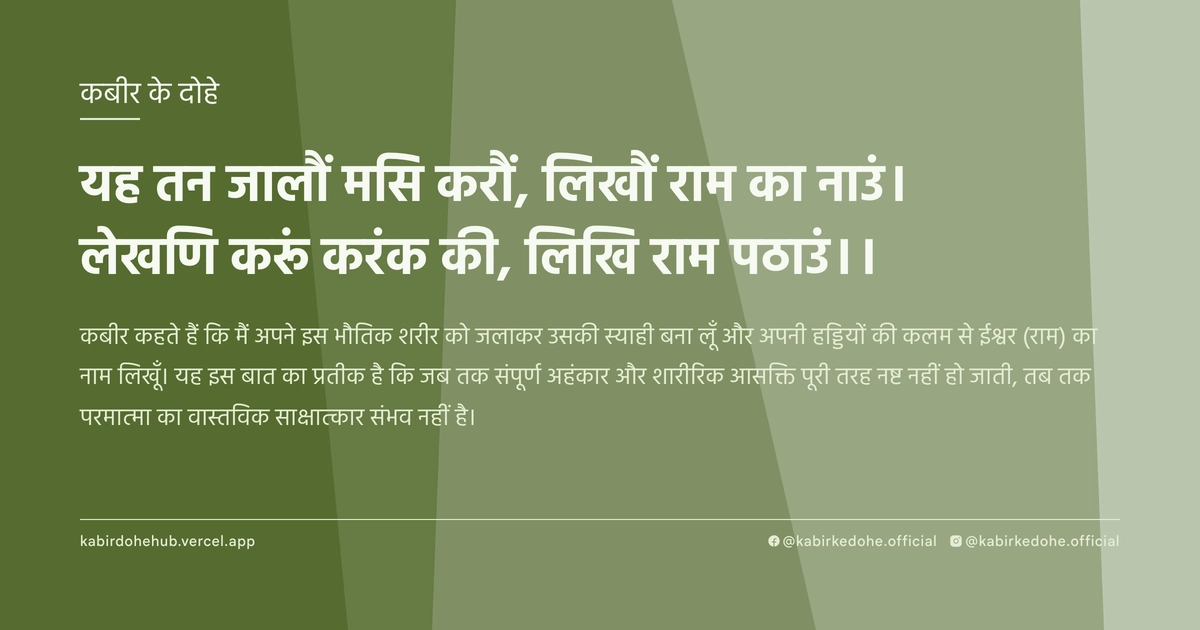
यह तन जालौं मसि करौं, लिखौं राम का नाउं।
लेखणि करूं करंक की, लिखि राम पठाउं।।
Yah tan jaloun masi karoun, likhoun ram ka naun. Lekhani karun karank ki, likhi ram pathaun.
इस पृष्ठ पर इस कबीर दोहे का अर्थ (meaning), हिंदी व्याख्या और अंग्रेज़ी अनुवाद, दार्शनिक विश्लेषण और व्यावहारिक जीवन सीख दी गई है। यह दोहा प्रपत्ति (Surrender) विषय से जुड़ा है — Kabir doha meaning and explanation in Hindi and English.
अर्थ (Meaning):
कबीर कहते हैं कि मैं अपने इस भौतिक शरीर को जलाकर उसकी स्याही बना लूँ और अपनी हड्डियों की कलम से ईश्वर (राम) का नाम लिखूँ। यह इस बात का प्रतीक है कि जब तक संपूर्ण अहंकार और शारीरिक आसक्ति पूरी तरह नष्ट नहीं हो जाती, तब तक परमात्मा का वास्तविक साक्षात्कार संभव नहीं है।
Kabir declares his intent to burn his physical body to create ink and use his own bones as a pen to write the name of the Divine (Ram). This is a powerful metaphor signifying that only through the total annihilation of the ego and the complete surrender of the physical self can one truly communicate with or reach the Ultimate Truth.
व्याख्या (Interpretation):
शाब्दिक रूप से यह दोहा आत्म-बलिदान की बात करता है, परंतु आध्यात्मिक स्तर पर यह 'अहं' के पूर्ण विसर्जन का आह्वान है। यहाँ 'तन को जलाना' वासनाओं और माया के मोह का अंत है। 'मसि' (स्याही) और 'करंक' (हड्डी) का उपयोग यह दर्शाता है कि साधना केवल बाहरी कर्मकांड नहीं, बल्कि आंतरिक रूपांतरण है। यह निर्गुण भक्ति का चरम है जहाँ साधक स्वयं को मिटाकर ब्रह्म में विलीन होना चाहता है। यह अद्वैत वेदांत के उस सत्य को दर्शाता है जहाँ 'मैं' का अंत ही 'वह' का प्रारंभ है। शरीर की नश्वरता को स्वीकार कर आत्मा की अमरता को खोजना ही इस विरोधाभास का मूल है।
Literally, the couplet speaks of self-immolation, but spiritually, it is a call for the absolute dissolution of the 'I-consciousness'. 'Burning the body' symbolizes the incineration of desires and the veil of Maya. Using bones as a pen and flesh as ink suggests that spiritual realization is not a ritualistic act but a total existential transformation. This represents the pinnacle of Nirgun Bhakti, where the seeker desires to erase their individual identity to merge with the Formless Absolute. It aligns with Advaita Vedanta, asserting that the end of the ego is the beginning of the realization of Brahman. The central paradox lies in the necessity of 'dying while living' to attain eternal life.
दार्शनिक विश्लेषण (Philosophical Analysis):
कबीर का यह दोहा उस युग की प्रतिक्रिया है जहाँ धर्म केवल बाहरी आडंबरों, तीर्थों और मूर्ति पूजा तक सीमित था। कबीर ने इस 'शरीर-चेतना' पर प्रहार किया है जो मनुष्य को ईश्वर से अलग करती है। उनका दर्शन सूफी मत के 'फना' (अहंकार का विनाश) और वेदांत के 'अद्वैत' का संगम है। वे तर्क देते हैं कि जब तक व्यक्ति अपनी सामाजिक पहचान, जाति और शारीरिक अहंकार को पकड़े रहता है, वह सत्य के करीब नहीं पहुँच सकता।
यहाँ 'राम' शब्द किसी व्यक्ति या अवतार के लिए नहीं, बल्कि उस सर्वव्यापी चेतना (Sabhagat) के लिए है जो कण-कण में व्याप्त है। कबीर का विद्रोह इस बात पर है कि लोग पत्थरों में ईश्वर खोजते हैं, जबकि ईश्वर स्वयं के भीतर है, बशर्ते कि 'मैं' का पर्दा हट जाए। यह मनोवैज्ञानिक रूपांतरण की प्रक्रिया है जहाँ साधक अपनी पहचान को पूरी तरह शून्य कर देता है।
ऐतिहासिक रूप से, कबीर ने बुनकर समुदाय से होते हुए समाज के सबसे निचले तबके को यह सिखाया कि मोक्ष किसी विशेष जाति या विधि का विशेषाधिकार नहीं है। उनका मार्ग 'सहज' है, लेकिन उसकी कीमत 'अहंकार की मृत्यु' है। यह सूफी संतों की उस तड़प जैसा है जहाँ प्रेमी अपने अस्तित्व को मिटाकर केवल प्रिय (ईश्वर) को शेष रखना चाहता है।
अक्सर लोग इस दोहे को केवल शारीरिक कष्ट या वैराग्य के रूप में देखते हैं, परंतु यह वास्तव में 'चेतना के शोधन' की बात है। शरीर को जलाना वास्तव में उन मानसिक संस्कारों को जलाना है जो हमें सीमित करते हैं। यह एक आध्यात्मिक कीमिया (Alchemy) है जहाँ अशुद्ध अहंकार शुद्ध प्रेम में बदल जाता है।
अंततः, कबीर यह संदेश देते हैं कि ईश्वर तक पहुँचने का कोई बाहरी रास्ता नहीं है। जब साधक स्वयं ही साधन (कलम) और माध्यम (स्याही) बन जाता है, तब वह और ईश्वर अलग नहीं रहते। यही वह बिंदु है जहाँ द्वैत समाप्त होता है और केवल एक अनंत सत्य शेष रह जाता है।
This doha is a visceral reaction to an era where religion was reduced to external rituals, pilgrimages, and idol worship. Kabir attacks the 'body-consciousness' that creates a perceived separation between the human and the Divine. His philosophy is a synthesis of the Sufi concept of 'Fana' (annihilation of the self) and the Vedantic principle of 'Non-duality'. He argues that as long as one clings to social identity, caste, or physical ego, the Truth remains elusive.
The term 'Ram' here does not refer to a mythological figure or an avatar, but to the Omnipresent Consciousness (Sabhagat) that permeates every atom. Kabir's rebellion lies in the fact that people seek God in stones while God resides within, provided the veil of 'I' is lifted. This is a process of psychological transmutation where the seeker reduces their identity to zero.
Historically, emerging from the weaver community, Kabir taught the marginalized that liberation is not the privilege of a specific caste or ritual. His path is 'Sahaja' (natural/spontaneous), yet its price is the 'death of the ego'. This mirrors the longing of Sufi mystics who wish to erase their existence so that only the Beloved remains.
Common literalist interpretations mistake this for a call to physical asceticism or self-harm. In reality, it is about the 'purification of consciousness'. 'Burning the body' refers to incinerating the mental impressions (Samskaras) that limit human perception. It is a spiritual alchemy where the lead of ego is converted into the gold of divine love.
Ultimately, Kabir asserts that there is no external path to the Divine. When the seeker becomes both the instrument (the pen) and the medium (the ink), the duality between the creator and the created vanishes. This is the point of singularity where only the Infinite Truth remains.
मूल संदेश (Core Message):
- अहंकार वह पर्दा है जो सत्य को ओझल करता है।
- पूर्ण समर्पण ही परमात्मा से मिलन का एकमात्र मार्ग है।
- स्वयं को मिटाकर ही अनंत में विलीन हुआ जा सकता है।
- बाहरी कर्मकांड व्यर्थ हैं यदि आंतरिक अहंकार जीवित है।
- जब 'मैं' समाप्त होता है, तब केवल 'वह' शेष रहता है।
- The ego is the veil that obscures the Ultimate Truth.
- Total surrender is the only path to union with the Divine.
- Only by erasing the self can one merge into the Infinite.
- External rituals are futile if the internal ego remains alive.
- When the 'I' ends, only the 'He/That' remains.
व्यावहारिक उदाहरण (Practical Example):
वाराणसी के एक पुराने घाट पर माधव नाम का एक वृद्ध कुम्हार रहता था। माधव अपनी कला में निपुण था और उसे अपनी मिट्टी के बर्तनों की श्रेष्ठता पर बहुत गर्व था। वह मानता था कि उसकी उंगलियों का जादू ही उसे दूसरों से अलग और महान बनाता है। वह अक्सर नए सीखने वालों को नीचा दिखाता था, यह सोचकर कि उसकी कला ईश्वरीय देन है और वह स्वयं उस कला का स्वामी है।
एक दिन एक फकीर उसके पास आया और उसने माधव से एक ऐसा घड़ा बनाने को कहा जो 'अहंकार रहित' हो। माधव हँसा और बोला, "मिट्टी तो वही है, कला तो मेरी है, अहंकार कैसा?"
फकीर ने शांति से जवाब दिया, "जब तक तू घड़े को 'अपना' कहता है, तू मिट्टी के साथ नहीं, बल्कि अपनी श्रेष्ठता के साथ खेल रहा है। जिस दिन तू खुद को मिट्टी मान लेगा, तब तेरा घड़ा वास्तव में ईश्वरीय होगा।"
माधव को यह बात समझ नहीं आई, लेकिन वह फकीर के शब्दों में कुछ ऐसा था जिसने उसे बेचैन कर दिया। अगले कुछ दिनों तक वह घड़े बनाता रहा, लेकिन हर बार उसे अपनी कुशलता का विचार आता। उसने महसूस किया कि उसकी कला उसकी खुशी नहीं, बल्कि उसका बंधन बन गई है।
एक रात, उसने कबीर के इस दोहे को सुना। उसे समझ आया कि उसकी 'कुशलता' ही वह शरीर (तन) है जिसे उसे जलाना है। उसने तय किया कि वह अब अपनी पहचान एक 'महान कलाकार' के रूप में नहीं, बल्कि केवल एक 'माध्यम' के रूप में करेगा।
उसने अपनी सारी पुरानी उपलब्धियों की सूची जला दी और अपनी कार्यशाला के द्वार सबके लिए खोल दिए। उसने सिखाना शुरू किया, लेकिन इस बार वह यह नहीं कहता था कि "मैं सिखा रहा हूँ", बल्कि वह कहता था, "मिट्टी हमें सिखा रही है।"
धीरे-धीरे माधव का स्वभाव बदलने लगा। वह अब बर्तनों की प्रशंसा नहीं चाहता था। वह केवल इस बात में आनंद पाता था कि वह मिट्टी को एक रूप दे रहा है, और उस रूप में वह स्वयं गायब हो चुका है।
एक दिन एक ग्राहक ने उसके बनाए घड़े की अद्भुत सुंदरता की तारीफ की। माधव ने मुस्कुराकर कहा, "यह मेरी सुंदरता नहीं, बल्कि उस शून्य की गूँज है जिसने मुझे मिटा दिया।"
माधव अब एक कुम्हार नहीं रहा था; वह स्वयं एक माध्यम बन गया था। उसकी कला अब उसकी पहचान नहीं, बल्कि उसकी प्रार्थना बन चुकी थी।
उसने अनुभव किया कि जब उसने अपनी 'महानता' की स्याही को जलाया, तभी उसके जीवन में वास्तविक शांति और ईश्वर का वास हुआ।
In the ancient ghats of Varanasi lived an elderly potter named Madhav. Madhav was a master of his craft and took immense pride in the superiority of his clay pots. He believed that the magic in his fingers set him apart and made him great. He often belittled apprentices, believing his art was a divine gift and that he was the sole master of that art.
One day, a wandering dervish approached him and asked Madhav to create a pot that was 'devoid of ego'. Madhav laughed and replied, "The clay is the same, the art is mine; where is the ego?"
The dervish calmly replied, "As long as you call the pot 'yours', you are not playing with clay, but with your own superiority. The day you consider yourself as mere clay, your pot will truly be divine."
Madhav didn't understand at first, but there was something in the dervish's words that left him restless. For the next few days, he continued making pots, but every time, the thought of his own skill surfaced. He realized that his art had become not his joy, but his shackle.
One night, he heard this specific doha of Kabir. He realized that his 'skill' was the very 'body' (tan) that he needed to burn. He decided that he would no longer identify as a 'great artist', but simply as a 'medium'.
He burned the list of all his past achievements and opened the doors of his workshop to everyone. He began to teach, but this time he didn't say, "I am teaching," instead he said, "The clay is teaching us."
Slowly, Madhav's nature transformed. He no longer craved praise for his pots. He found joy simply in giving form to the clay, while he himself vanished into the process.
One day, a customer praised the exquisite beauty of a pot he had made. Madhav smiled and said, "This is not my beauty, but the echo of the void that erased me."
Madhav was no longer just a potter; he had become a medium. His art was no longer his identity, but his prayer.
He experienced that only when he burned the ink of his 'greatness' did true peace and the presence of the Divine enter his life.
अभ्यास मार्गदर्शन (Practice Guidance):
- प्रतिदिन 20 मिनट मौन ध्यान करें, जहाँ आप अपने नाम, पद और पहचान को एक-एक कर मानसिक रूप से 'जलाते' हुए शून्य होने का प्रयास करें।
- एक 'अहंकार डायरी' बनाएँ। दिन भर में जब भी आपको अपनी श्रेष्ठता का अनुभव हो या किसी पर प्रभुत्व जमाने की इच्छा हो, उसे लिखें और फिर उस विचार को मानसिक रूप से मिटा दें।
- बिना किसी प्रशंसा की इच्छा के, गुप्त रूप से किसी की सेवा करें। यह सुनिश्चित करें कि सेवा पाने वाले को यह न पता चले कि आपने मदद की है।
- निदान चेकलिस्ट: क्या मैं अपनी उपलब्धियों का जिक्र बातचीत में बार-बार करता हूँ? क्या मुझे दूसरों की आलोचना करने पर संतुष्टि मिलती है? यदि हाँ, तो 'तन' (अहंकार) अभी जीवित है।
- Practice 20 minutes of silent meditation daily, where you mentally 'burn' your name, title, and identity one by one, striving to become a void.
- Maintain an 'Ego Diary'. Whenever you feel a sense of superiority or a desire to dominate others during the day, record it and then mentally erase that thought.
- Perform an act of service in complete secrecy, without any desire for recognition. Ensure the recipient never knows you were the one who helped.
- Diagnostic Checklist: Do I frequently mention my achievements in conversations? Do I feel a sense of satisfaction when criticizing others? If yes, the 'body' (ego) is still alive.
चिंतन प्रश्न (Reflection Questions):
- यदि आज मेरी सारी सामाजिक पहचान (नाम, पद, संपत्ति) छीन ली जाए, तो मेरे भीतर क्या बचेगा?
- मैं अपनी डिजिटल पहचान (सोशल मीडिया) को बनाए रखने के लिए अपनी वास्तविक शांति का कितना बलिदान कर रहा हूँ?
- मेरे जीवन का वह कौन सा 'गर्व' है जिसे मैं कभी नहीं जलाना चाहता, और वह मुझे कैसे सीमित कर रहा है?
- क्या मेरी भक्ति वास्तव में ईश्वर के लिए है, या मैं केवल 'भक्त' कहलाने के सुख का आनंद ले रहा हूँ?
- मेरे भीतर का वह कौन सा हिस्सा है जो दूसरों को छोटा महसूस कराकर खुद को बड़ा पाता है?
- If all my social identities (name, title, wealth) were stripped away today, what would remain inside me?
- How much of my actual peace am I sacrificing to maintain my digital identity (social media)?
- What is that one 'pride' in my life that I refuse to burn, and how is it limiting me?
- Is my devotion truly for the Divine, or am I simply enjoying the pleasure of being called a 'devotee'?
- Which part of me finds satisfaction in making others feel small to feel superior?