
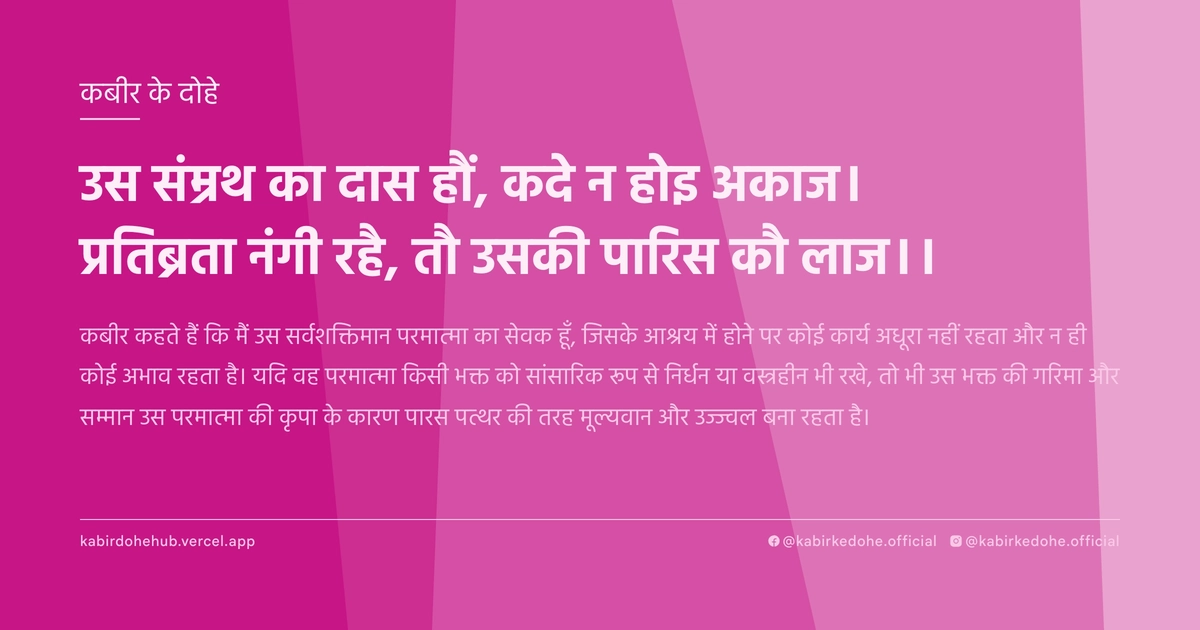
उस संम्रथ का दास हौं, कदे न होइ अकाज।
प्रतिब्रता नंगी रहै, तौ उसकी पारिस कौ लाज।।
Us samrath ka das haun, kade na hoi akaaj. Pratibrata nangi rahai, tau uski paris kau laaj.
इस पृष्ठ पर इस कबीर दोहे का अर्थ (meaning), हिंदी व्याख्या और अंग्रेज़ी अनुवाद, दार्शनिक विश्लेषण और व्यावहारिक जीवन सीख दी गई है। यह दोहा प्रपत्ति (Surrender) विषय से जुड़ा है — Kabir doha meaning and explanation in Hindi and English.
अर्थ (Meaning):
कबीर कहते हैं कि मैं उस सर्वशक्तिमान परमात्मा का सेवक हूँ, जिसके आश्रय में होने पर कोई कार्य अधूरा नहीं रहता और न ही कोई अभाव रहता है। यदि वह परमात्मा किसी भक्त को सांसारिक रूप से निर्धन या वस्त्रहीन भी रखे, तो भी उस भक्त की गरिमा और सम्मान उस परमात्मा की कृपा के कारण पारस पत्थर की तरह मूल्यवान और उज्ज्वल बना रहता है।
Kabir declares his absolute surrender to the Omnipotent Divine, asserting that under the shelter of the Almighty, no endeavor remains fruitless and no need goes unmet. He suggests that even if a devotee appears destitute or stripped of worldly possessions, the grace of the Divine transforms their existence into something as precious and luminous as the mythical philosopher's stone, ensuring their spiritual dignity remains intact.
व्याख्या (Interpretation):
यह दोहा पूर्ण समर्पण और ईश्वरीय कृपा के विरोधाभास को दर्शाता है। 'सम्रथ' शब्द निर्गुण ब्रह्म की उस अनंत शक्ति को इंगित करता है जो सृष्टि का आधार है। कबीर यहाँ 'दास' होने की बात कर रहे हैं, जो अहंकार के विसर्जन का प्रतीक है। जब मनुष्य अपना 'मैं' मिटाकर उस निराकार में विलीन होता है, तो वह सांसारिक अभावों से ऊपर उठ जाता है। 'नंगी रहै' का अर्थ केवल वस्त्रों का अभाव नहीं, बल्कि माया के आवरणों का हटना है। यहाँ पारिस (पारस) का उल्लेख यह बताने के लिए है कि परमात्मा का स्पर्श साधारण मनुष्य को भी दिव्य बना देता है। यह अद्वैत वेदांत के उस सत्य को पुष्ट करता है जहाँ आत्मा और परमात्मा एक हो जाते हैं, और फिर बाहरी दुनिया की गरीबी या अमीरी केवल एक भ्रम (माया) बन जाती है।
This couplet explores the paradox of absolute surrender and divine grace. The term 'Samrath' refers to the infinite power of the Nirgun Brahman, the formless foundation of existence. By calling himself a 'daas' (servant), Kabir symbolizes the total annihilation of the ego, which is the primary obstacle to liberation. The phrase 'nangi rahai' (remaining naked) transcends physical poverty, symbolizing the stripping away of the illusory veils of Maya. The reference to 'Paaris' (the philosopher's stone) signifies that the touch of the Divine transmutes the base metal of human existence into spiritual gold. This aligns with Advaita Vedanta, where the realization of non-duality between Atman and Brahman renders worldly lack irrelevant, as the soul discovers its inherent wholeness within the Divine.
दार्शनिक विश्लेषण (Philosophical Analysis):
कबीर का यह दृष्टिकोण उनके युग के कर्मकांडीय और जाति-आधारित समाज पर एक गहरा प्रहार है। उस समय धर्म का अर्थ बाहरी आडंबरों, महंगे वस्त्रों और विशेष कुल में जन्म लेने से लगाया जाता था। कबीर ने इस धारणा को चुनौती देते हुए कहा कि वास्तविक सम्मान बाहरी वस्त्रों या सामाजिक स्थिति से नहीं, बल्कि आंतरिक पवित्रता और परमात्मा के साथ संबंध से आता है।
दार्शनिक स्तर पर, यह दोहा सूफीवाद के 'फना' (अहंकार का विनाश) और भक्ति मार्ग के 'शरणागति' के सिद्धांतों का संगम है। जब साधक यह स्वीकार कर लेता है कि वह केवल एक माध्यम है और वास्तविक कर्ता परमात्मा है, तो वह 'अकाज' (विफलता) के भय से मुक्त हो जाता है। यह मनोवैज्ञानिक रूपांतरण है जहाँ चिंता का स्थान अटूट विश्वास ले लेता है।
अद्वैत वेदांत के अनुसार, संसार एक मिथ्या है। यदि कोई व्यक्ति इस सत्य को जान लेता है, तो उसे भौतिक अभावों का दुख नहीं होता। कबीर यहाँ यह समझा रहे हैं कि परमात्मा की शरण में जाने वाला व्यक्ति 'अपरिग्रह' की स्थिति में भी पूर्ण महसूस करता है। यह भौतिक गरीबी और आध्यात्मिक समृद्धि के बीच के अंतर को स्पष्ट करता है।
कबीर का 'दास' होना गुलामी नहीं, बल्कि उच्चतम स्वतंत्रता है। जब हम अपनी इच्छाओं के दास होना छोड़कर उस अनंत सत्ता के प्रति समर्पित होते हैं, तब हम वास्तव में स्वतंत्र होते हैं। यह अहंकार का विसर्जन ही वह द्वार है जिससे पारस की चमक प्राप्त होती है।
अंततः, यह दोहा हमें सिखाता है कि मनुष्य की पहचान उसके पास मौजूद संसाधनों से नहीं, बल्कि उसकी चेतना के स्तर से होती है। जो परमात्मा के साथ एकाकार है, वह शून्य में भी पूर्ण है।
Kabir's perspective serves as a profound critique of the ritualistic and caste-ridden society of his era. During his time, spiritual worth was often erroneously equated with outward displays of piety, expensive attire, or birth into a high-caste lineage. Kabir dismantles this notion, asserting that true dignity is derived not from social status or material adornments, but from internal purity and an authentic connection with the Divine.
Philosophically, this couplet is a synthesis of the Sufi concept of 'Fana' (the annihilation of the self) and the Bhakti principle of 'Sharanagati' (absolute surrender). When a seeker acknowledges that they are merely an instrument and that the Divine is the sole actor, they are liberated from the fear of 'akaaj' (failure or incompleteness). This represents a psychological shift where anxiety is replaced by an unwavering trust in the cosmic order.
Drawing from Advaita Vedanta, the world is viewed as Maya, an illusion. Once a practitioner realizes the non-dual nature of reality, material lack ceases to be a source of suffering. Kabir illustrates that one who resides in the shelter of the Formless Divine experiences a state of 'Aparigraha' (non-possessiveness), feeling complete even in total physical deprivation. This distinguishes between material poverty and spiritual opulence.
Kabir's identification as a 'daas' (servant) is not an admission of bondage, but a declaration of the highest freedom. By ceasing to be a slave to personal desires and egoic demands, the seeker finds liberation in the Infinite. The dissolution of the 'I' is the alchemy that transforms the soul into the 'Paaris' or philosopher's stone.
Ultimately, the teaching emphasizes that human identity should not be measured by accumulated resources but by the depth of one's consciousness. He who is unified with the Divine remains whole even in the midst of absolute void.
मूल संदेश (Core Message):
- बाहरी अभाव आध्यात्मिक पूर्णता का मार्ग बन सकते हैं।
- अहंकार का विसर्जन ही वास्तविक गरिमा का एकमात्र स्रोत है।
- परमात्मा की शरण में होने पर भौतिक गरीबी एक भ्रम मात्र है।
- समर्पण वह पारस है जो साधारण जीवन को दिव्य बना देता है।
- सच्ची स्वतंत्रता अपनी इच्छाओं का दास न होने में है।
- External lack can become the gateway to spiritual wholeness.
- The dissolution of ego is the only source of true dignity.
- In the shelter of the Divine, material poverty is but an illusion.
- Surrender is the alchemy that transmutes an ordinary life into a divine one.
- True freedom lies in ceasing to be a slave to one's own desires.
व्यावहारिक उदाहरण (Practical Example):
वाराणसी के एक पुराने घाट पर माधव नाम का एक वृद्ध बुनकर रहता था। माधव के पास न तो अपनी जमीन थी और न ही कोई बड़ा घर। वह दिन भर फटे हुए कपड़ों में अपनी करघे पर काम करता और जो कुछ मिलता, उससे अपना गुजारा करता। शहर के अमीर व्यापारी उसे तुच्छ समझते थे क्योंकि वह दिखने में अत्यंत गरीब और 'नंगा' जैसा लगता था।
माधव का जीवन केवल एक ही मंत्र पर टिका था—'जो होगा, वह उस मालिक की इच्छा होगी'। वह अपनी गरीबी को अभाव नहीं, बल्कि परमात्मा की इच्छा मानकर स्वीकार करता था। एक बार शहर में भीषण अकाल पड़ा। बड़े-बड़े सेठ और जमींदार अपनी तिजोरियों के खाली होने पर मानसिक तनाव और अवसाद में डूब गए। वे अपनी प्रतिष्ठा खोने के डर से रात भर सो नहीं पाते थे।
दूसरी ओर, माधव अभी भी उसी फटे कुर्ते में शांत बैठा रहता। वह अपनी छोटी सी रोटी भी दूसरों के साथ बांटकर खाता। जब एक अहंकारी व्यापारी ने उससे पूछा, "तुम्हारे पास तो कुछ नहीं है, फिर भी तुम इतने खुश और निडर कैसे हो? क्या तुम्हें अपनी गरीबी की शर्म नहीं आती?"
माधव ने मुस्कुराकर जवाब दिया, "सेठ जी, मैं तो उस मालिक का दास हूँ। उसने मुझे वस्त्र नहीं दिए, पर उसने मुझे संतोष का ऐसा आभूषण दिया है जो कभी पुराना नहीं होता। मेरी गरीबी मेरी शर्म नहीं, बल्कि मेरी मुक्ति है क्योंकि अब मुझे खोने का कोई डर नहीं है।"
व्यापारी को पहली बार अहसास हुआ कि उसकी अमीरी वास्तव में एक मानसिक जेल थी, जहाँ वह अपनी संपत्ति की रक्षा करने का गुलाम था। माधव की निर्भीकता और आंतरिक शांति ने व्यापारी को झकझोर दिया।
व्यापारी ने देखा कि माधव के चेहरे पर एक ऐसी चमक थी जो महलों के राजाओं में भी नहीं होती। वह चमक उस 'पारस' की थी, जो केवल पूर्ण समर्पण से आती है।
उस दिन व्यापारी ने अपनी सारी संपत्ति का एक बड़ा हिस्सा गरीबों में बांटना शुरू किया। उसने सीखा कि असली सम्मान बाहरी दिखावे में नहीं, बल्कि उस आंतरिक संतोष में है जो ईश्वर के प्रति पूर्ण समर्पण से मिलता है।
माधव का जीवन एक उदाहरण बन गया कि कैसे एक व्यक्ति भौतिक अभावों के बीच भी आध्यात्मिक रूप से सम्राट हो सकता है, यदि वह अपने अहंकार को परमात्मा के चरणों में समर्पित कर दे।
On an ancient ghat in Varanasi lived an elderly weaver named Madhav. Madhav possessed neither land nor a grand house. He spent his days working at his loom, dressed in tattered rags, barely earning enough to survive. The wealthy merchants of the city looked down upon him, viewing him as insignificant due to his outward appearance of extreme poverty.
Madhav's life was anchored in a single conviction: "Whatever happens is the will of the Master." He did not perceive his poverty as a lack, but as a divine arrangement, accepting it with profound grace. One year, a severe famine struck the city. The great merchants and landlords, seeing their treasuries deplete, sank into deep anxiety and depression. They spent sleepless nights fearing the loss of their social prestige.
In contrast, Madhav remained serene in his torn tunic. He continued to share his meager morsel of bread with others. One day, an arrogant merchant asked him, "You have nothing to your name, yet you are so happy and fearless. Do you not feel the shame of your poverty?"
Madhav replied with a gentle smile, "Seth ji, I am but a servant of the Master. He may not have given me fine clothes, but He has adorned me with the ornament of contentment, which never fades. My poverty is not my shame, but my liberation, for I no longer have anything to fear losing."
The merchant suddenly realized that his own wealth was actually a mental prison, where he had become a slave to the protection of his assets. Madhav's fearlessness and inner peace shook the merchant's foundations.
He noticed a radiance on Madhav's face—a glow that was absent even in the most powerful kings. This was the glow of the 'Paaris', the spiritual alchemy that comes only through total surrender.
From that day on, the merchant began distributing a large portion of his wealth to the needy. He learned that true dignity does not reside in outward displays, but in the internal contentment born of total surrender to the Divine.
Madhav's life became a living testament that a person can be a spiritual emperor even amidst material void, provided they surrender their ego at the feet of the Infinite.
अभ्यास मार्गदर्शन (Practice Guidance):
- प्रतिदिन 20 मिनट 'शून्य ध्यान' का अभ्यास करें, जहाँ आप अपनी पहचान, पद और संपत्ति के विचार को त्यागकर स्वयं को केवल एक 'निमित्त' या 'सेवक' के रूप में देखें।
- एक 'अहंकार पत्रिका' (Ego Journal) बनाएँ। हर उस क्षण को लिखें जब आपको अपनी उपलब्धि पर गर्व हुआ या किसी की कमी पर दया आई, और फिर उसे परमात्मा के चरणों में समर्पित कर दें।
- सप्ताह में एक बार जानबूझकर ऐसी स्थिति में जाएँ जहाँ आप अपनी सामाजिक स्थिति या सुख-सुविधाओं का त्याग करें (जैसे किसी जरूरतमंद की सेवा करना), ताकि आप बाहरी आवरणों से अपनी पहचान को अलग कर सकें।
- डायग्नोस्टिक चेकलिस्ट: क्या मैं अपनी भौतिक हानि पर विचलित होता हूँ? क्या मैं दूसरों को उनके कपड़ों या स्थिति से आंकता हूँ? क्या मुझे अपनी 'उपलब्धियों' का बोझ महसूस होता है? यदि हाँ, तो समर्पण का अभ्यास बढ़ाएँ।
- Practice 20 minutes of 'Shunya Meditation' daily, stripping away thoughts of identity, rank, and possession, viewing yourself solely as an instrument or a servant of the Divine.
- Maintain an 'Ego Journal'. Record every moment you felt pride in an achievement or pity for another's lack, and consciously surrender those judgments to the Infinite.
- Once a week, intentionally place yourself in a situation where you relinquish your social status or comforts (such as serving the marginalized) to detach your identity from external layers.
- Diagnostic Checklist: Do I become distressed by material loss? Do I judge others by their attire or status? Do I feel the burden of my 'achievements'? If yes, intensify the practice of surrender.
चिंतन प्रश्न (Reflection Questions):
- यदि आज मुझसे मेरी सारी सामाजिक प्रतिष्ठा और संपत्ति छीन ली जाए, तो मेरे पास ऐसा क्या बचेगा जिसे मैं गर्व से 'मैं' कह सकूँ?
- मैं अपनी सार्वजनिक छवि (Public Image) को बनाए रखने के लिए अंदरूनी तौर पर कितना तनाव और झूठ ढो रहा हूँ?
- क्या मेरी करुणा वास्तव में निस्वार्थ है, या यह मेरी श्रेष्ठता की भावना को पुष्ट करने का एक तरीका है?
- मेरे जीवन में वह कौन सा 'वस्त्र' (मुखौटा) है जिसे मैं उतारने से सबसे ज्यादा डरता हूँ?
- क्या मैं वास्तव में परमात्मा का 'दास' हूँ, या मैं चाहता हूँ कि परमात्मा मेरी इच्छाओं का दास बने?
- If all my social prestige and assets were stripped away today, what would remain that I could proudly call 'I'?
- How much internal stress and falsehood am I carrying just to maintain my public image?
- Is my compassion truly selfless, or is it a subtle way of reinforcing my own sense of superiority?
- What is the 'garment' (mask) in my life that I am most afraid to take off?
- Am I truly a servant of the Divine, or do I secretly want the Divine to be a servant to my desires?