
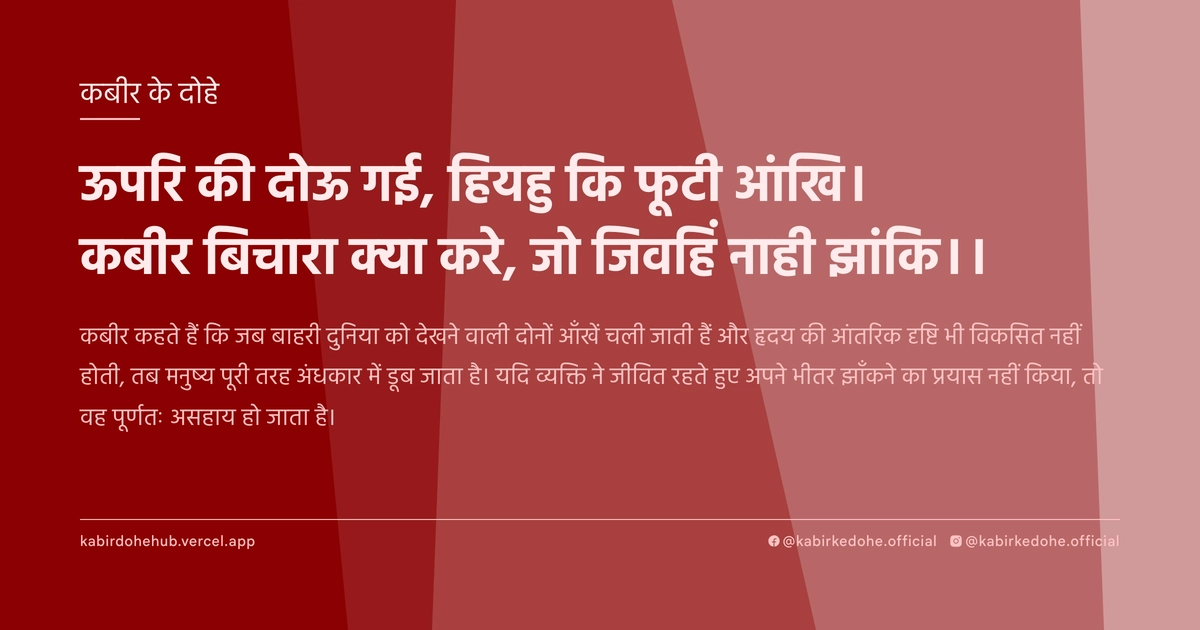
ऊपरि की दोऊ गई, हियहु कि फूटी आंखि।
कबीर बिचारा क्या करे, जो जिवहिं नाही झांंकि।।
Upari ki dou gayi, hiyahu ki phooti aankhi. Kabir bichara kya kare, jo jivahin nahi jhaankin.
इस पृष्ठ पर इस कबीर दोहे का अर्थ (meaning), हिंदी व्याख्या और अंग्रेज़ी अनुवाद, दार्शनिक विश्लेषण और व्यावहारिक जीवन सीख दी गई है। यह दोहा आत्मनिरीक्षण (Self-introspection) विषय से जुड़ा है — Kabir doha meaning and explanation in Hindi and English.
अर्थ (Meaning):
कबीर कहते हैं कि जब बाहरी दुनिया को देखने वाली दोनों आँखें चली जाती हैं और हृदय की आंतरिक दृष्टि भी विकसित नहीं होती, तब मनुष्य पूरी तरह अंधकार में डूब जाता है। यदि व्यक्ति ने जीवित रहते हुए अपने भीतर झाँकने का प्रयास नहीं किया, तो वह पूर्णतः असहाय हो जाता है।
Kabir asserts that when the two physical eyes lose their sight and the inner eye of the heart remains unopened, a person is plunged into absolute darkness. If one fails to peer into their own soul while alive, they remain utterly helpless and lost in spiritual blindness.
व्याख्या (Interpretation):
यह दोहा दृष्टि के दो स्तरों की बात करता है: स्थूल और सूक्ष्म। 'ऊपरि की दोऊ' भौतिक आँखों का प्रतीक हैं जो केवल माया और द्वैत को देखती हैं। 'हियहु की आंखि' वह अंतःप्रज्ञा या ज्ञान-चक्षु है जो आत्मा और परमात्मा की एकता को पहचानती है। कबीर यहाँ एक भयानक विरोधाभास प्रस्तुत करते हैं—एक ऐसा व्यक्ति जो शारीरिक रूप से तो जीवित है, लेकिन आध्यात्मिक रूप से मृत है क्योंकि उसने कभी आत्म-निरीक्षण नहीं किया। यह निर्गुण भक्ति का सार है, जहाँ बाहरी कर्मकांडों के बजाय आंतरिक अनुभव को प्राथमिकता दी गई है। जब अहंकार (माया) का पर्दा नहीं हटता, तो हृदय की आँखें 'फूटी' या बंद रहती हैं, जिससे मनुष्य सत्य से वंचित रह जाता है।
This couplet addresses two levels of vision: the gross and the subtle. 'Upari ki dou' symbolizes the physical eyes that perceive only Maya and duality. 'Hiyahu ki aankhi' represents the intuitive eye or the eye of wisdom that recognizes the non-duality of Atman and Brahman. Kabir presents a poignant paradox—a person who is physically alive but spiritually dead because they never practiced introspection. This is the essence of Nirgun Bhakti, prioritizing internal realization over external rituals. When the veil of ego (Maya) is not lifted, the eye of the heart remains 'broken' or closed, leaving the individual estranged from the ultimate truth of existence.
दार्शनिक विश्लेषण (Philosophical Analysis):
कबीर का यह दर्शन अद्वैत वेदांत और सूफीवाद के संगम पर स्थित है। वे बाहरी धार्मिक पहचानों—चाहे वह हिंदू धर्म की मूर्ति पूजा हो या इस्लाम के कठोर कर्मकांड—को निरर्थक मानते हैं यदि वे आंतरिक रूपांतरण की ओर नहीं ले जाते। उनके समय में, धर्म केवल बाहरी दिखावे और सामाजिक श्रेष्ठता का साधन बन गया था। कबीर इस 'बाहरी दृष्टि' के मोह को तोड़कर 'भीतरी दृष्टि' की मांग करते हैं।
दार्शनिक स्तर पर, यह दोहा 'अविद्या' (अज्ञान) पर प्रहार करता है। अद्वैत वेदांत के अनुसार, हम स्वयं को शरीर और मन मानते हैं, जो कि एक भ्रम है। जब तक हम इस भ्रम में रहते हैं, हम केवल 'ऊपरी' दुनिया को देखते हैं। हृदय की आँख खुलने का अर्थ है इस भ्रम का विनाश और स्वयं के वास्तविक स्वरूप—शुद्ध चेतना—का अनुभव करना।
सूफी मत के 'नफ्स' (अहंकार) के विलोपन की प्रक्रिया यहाँ स्पष्ट है। जब तक 'मैं' का अस्तित्व है, तब तक सत्य ओझल रहता है। कबीर चेतावनी देते हैं कि मृत्यु के समय केवल वह ज्ञान काम आएगा जो अनुभव किया गया हो, न कि वह जो किताबों में पढ़ा गया हो।
यह दोहा मनोवैज्ञानिक रूप से आत्म-जागरूकता की कमी को दर्शाता है। आधुनिक संदर्भ में, हम डिजिटल दुनिया और बाहरी उपलब्धियों में इतने व्यस्त हैं कि हम अपनी आंतरिक शून्यता को नहीं देख पाते। कबीर इसे 'अंधापन' कहते हैं।
अंततः, कबीर का संदेश यह है कि मुक्ति किसी बाहरी ईश्वर की कृपा से नहीं, बल्कि स्वयं के भीतर की गहराई में उतरने से मिलती है। जो व्यक्ति जीवित रहते हुए अपने अंतर्मन की यात्रा नहीं करता, वह मृत्यु के बाद भी उस अंधकार में रहता है जिसे उसने जीवन भर अनदेखा किया था।
Kabir's philosophy sits at the intersection of Advaita Vedanta and Sufism. He views external religious identities—whether the idol worship of Hinduism or the rigid rituals of Islam—as futile if they do not lead to internal transformation. In his era, religion had largely become a tool for outward display and social hierarchy. Kabir challenges this 'external vision' and demands an 'inner sight.'
Philosophically, this doha attacks 'Avidya' (ignorance). According to Advaita Vedanta, we mistakenly identify ourselves with the body and mind, which is a delusion. As long as we remain in this illusion, we only perceive the 'upper' world. The opening of the heart's eye signifies the destruction of this delusion and the realization of one's true nature as pure consciousness.
The Sufi process of the annihilation of the 'Nafs' (ego) is evident here. As long as the 'I' exists, the Truth remains hidden. Kabir warns that at the moment of death, only the knowledge gained through direct experience will be of value, not the theoretical knowledge gleaned from scriptures.
Psychologically, this couplet highlights a profound lack of self-awareness. In a modern context, we are so preoccupied with the digital world and external achievements that we fail to notice our internal void. Kabir characterizes this as a form of blindness.
Ultimately, Kabir's message is that liberation does not come from the grace of an external deity, but from descending into the depths of one's own being. He who does not undertake the journey inward while alive remains in the same darkness after death that they ignored throughout their life.
मूल संदेश (Core Message):
- बाहरी दृष्टि केवल भ्रम दिखाती है, आंतरिक दृष्टि सत्य प्रकट करती है।
- अहंकार का पर्दा हटना ही वास्तविक ज्ञान की प्राप्ति है।
- धार्मिक कर्मकांड तब तक व्यर्थ हैं जब तक आत्म-साक्षात्कार न हो।
- जीवन का असली उद्देश्य स्वयं के भीतर की गहराई को खोजना है।
- शारीरिक अंधापन दुखद है, लेकिन आध्यात्मिक अंधापन विनाशकारी है।
- External vision shows only illusion; internal vision reveals the Truth.
- The lifting of the veil of ego is the only true attainment of knowledge.
- Religious rituals are futile until self-realization is achieved.
- The true purpose of life is to explore the depths of one's own being.
- Physical blindness is tragic, but spiritual blindness is catastrophic.
व्यावहारिक उदाहरण (Practical Example):
वाराणसी के एक पुराने घाट पर रहने वाले एक वृद्ध बुनकर, माधव, का जीवन केवल धागों और रंगों के इर्द-गिर्द सिमटा था।
माधव अपनी कला में निपुण थे, लेकिन उनका मन हमेशा दूसरों की प्रगति और अपनी सामाजिक स्थिति की तुलना में उलझा रहता था।
वे दिन भर मंदिर जाते, लंबी मालाएँ जपते और शहर के सबसे बड़े धर्मगुरुओं के प्रवचन सुनते, यह सोचकर कि यही मोक्ष का मार्ग है।
उनकी दृष्टि केवल बाहरी दुनिया की चमक-धमक और धार्मिक आडंबरों पर टिकी थी; वे अपने भीतर के क्रोध और ईर्ष्या को कभी नहीं देखते थे।
एक दिन, एक भीषण बीमारी ने उनकी आँखों की रोशनी छीन ली। अचानक, वह दुनिया जिसे वे देखते थे, गायब हो गई।
शुरुआत में वे विलाप करने लगे, क्योंकि अब वे न तो अपने सुंदर वस्त्र देख सकते थे और न ही मंदिर की मूर्तियाँ।
अंधेरे के उस सन्नाटे में, उन्हें पहली बार अपने भीतर की चीख सुनाई दी—वह अकेलापन और अहंकार जो उन्होंने जीवन भर दबाया था।
उन्हें एहसास हुआ कि जिस 'दृष्टि' पर वे गर्व करते थे, वह केवल बाहरी माया थी; उनके हृदय की आँखें तो अब तक बंद ही थीं।
इस गहरे संकट ने उन्हें विवश किया कि वे बाहरी शोर को छोड़कर अपने भीतर झाँकें और अपनी त्रुटियों को स्वीकार करें।
माधव ने अब माला जपना छोड़कर मौन साधना शुरू की, और अंततः उन्हें वह शांति मिली जो उन्हें वर्षों के बाहरी तीर्थों में नहीं मिली थी।
Madhav, an elderly weaver living on an ancient ghat in Varanasi, had a life confined entirely to threads and colors.
Madhav was a master of his craft, but his mind was constantly entangled in comparisons with others' progress and his own social standing.
He spent his days visiting temples, chanting long rosaries, and listening to the sermons of the city's greatest religious leaders, believing this to be the path to salvation.
His vision was fixed only on the glitter of the external world and religious pomposity; he never looked at the anger and envy within himself.
One day, a severe illness robbed him of his physical eyesight. Suddenly, the world he perceived vanished.
Initially, he wailed in grief, for he could no longer see his beautiful fabrics nor the idols in the temples.
In the silence of that darkness, he heard for the first time the scream within—the loneliness and ego he had suppressed for a lifetime.
He realized that the 'vision' he had prided himself on was merely external Maya; the eyes of his heart had remained closed until now.
This profound crisis forced him to abandon the external noise and peer into his own soul, accepting his flaws and shadows.
Madhav stopped the mechanical chanting and began a practice of silence, finally finding a peace that years of external pilgrimages had never provided.
अभ्यास मार्गदर्शन (Practice Guidance):
- प्रतिदिन 20 मिनट का 'साक्षी भाव' ध्यान करें, जहाँ आप अपने विचारों को बिना किसी निर्णय के केवल देखें।
- एक डायरी लिखें जिसमें आप अपनी उन आदतों को दर्ज करें जो आपके अहंकार को बढ़ाती हैं (जैसे प्रशंसा की भूख या दूसरों को नीचा दिखाना)।
- सप्ताह में एक दिन 'मौन व्रत' रखें ताकि बाहरी शोर कम हो और आंतरिक संवाद शुरू हो सके।
- निदान चेकलिस्ट: क्या मैं अपनी खुशी के लिए बाहरी प्रशंसा पर निर्भर हूँ? क्या मैं दूसरों की गलतियों को आसानी से देख पाता हूँ लेकिन अपनी नहीं? यदि हाँ, तो हृदय की आँखें अभी बंद हैं।
- Practice 20 minutes of 'Witness Consciousness' meditation daily, observing your thoughts without any judgment.
- Maintain a journal to record habits that inflate your ego, such as the hunger for praise or the tendency to belittle others.
- Observe a 'Day of Silence' once a week to diminish external noise and initiate an internal dialogue.
- Diagnostic Checklist: Do I depend on external validation for my happiness? Do I easily spot others' flaws but ignore my own? If yes, the eye of the heart remains closed.
चिंतन प्रश्न (Reflection Questions):
- यदि आज मेरी सभी सामाजिक पहचानें (पद, प्रतिष्ठा, संबंध) छीन ली जाएँ, तो मेरे पास क्या बचेगा?
- मैं अपनी छवि को दूसरों की नज़रों में बेहतर बनाने के लिए अपने भीतर के किस सच को दबा रहा हूँ?
- क्या मेरी प्रार्थनाएँ ईश्वर तक पहुँचने का माध्यम हैं या केवल मेरे अहंकार को संतुष्ट करने का तरीका?
- मेरे जीवन का वह कौन सा कोना है जहाँ मैं झाँकने से सबसे ज्यादा डरता हूँ?
- क्या मैं वास्तव में 'देख' रहा हूँ, या मैं केवल वही देख रहा हूँ जो मेरा मन मुझे दिखाना चाहता है?
- If all my social identities (rank, prestige, relationships) were stripped away today, what would remain of me?
- What internal truth am I suppressing just to make my image look better in the eyes of others?
- Are my prayers a means to reach the Divine, or merely a way to satisfy my own ego?
- Which corner of my inner life am I most afraid to peer into?
- Am I truly 'seeing,' or am I only seeing what my mind wants me to see?