
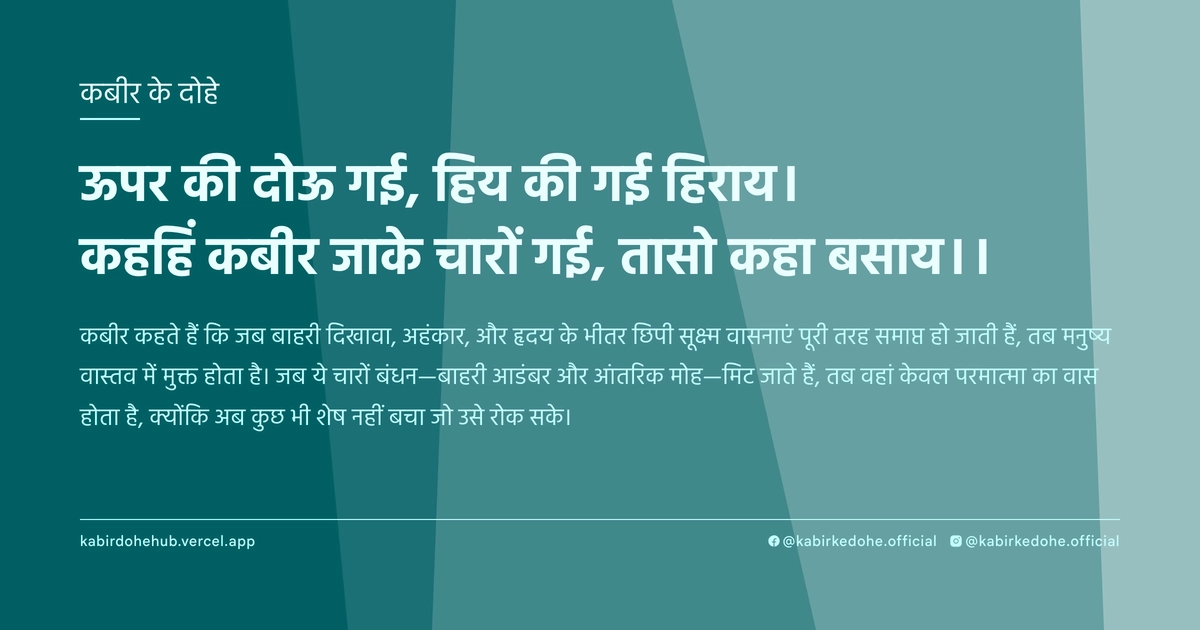
ऊपर की दोऊ गई, हिय की गई हिराय।
कहहिं कबीर जाके चारों गई, तासो कहा बसाय।।
Upar ki dou gayi, hiy ki gayi hiraye. Kahahin Kabir jaake chaaron gayi, taaso kaha basaye.
इस पृष्ठ पर इस कबीर दोहे का अर्थ (meaning), हिंदी व्याख्या और अंग्रेज़ी अनुवाद, दार्शनिक विश्लेषण और व्यावहारिक जीवन सीख दी गई है। यह दोहा आत्मनिरीक्षण (Self-introspection) विषय से जुड़ा है — Kabir doha meaning and explanation in Hindi and English.
अर्थ (Meaning):
कबीर कहते हैं कि जब बाहरी दिखावा, अहंकार, और हृदय के भीतर छिपी सूक्ष्म वासनाएं पूरी तरह समाप्त हो जाती हैं, तब मनुष्य वास्तव में मुक्त होता है। जब ये चारों बंधन—बाहरी आडंबर और आंतरिक मोह—मिट जाते हैं, तब वहां केवल परमात्मा का वास होता है, क्योंकि अब कुछ भी शेष नहीं बचा जो उसे रोक सके।
Kabir asserts that when the two external layers of pretension and the internal hidden desires of the heart are completely eradicated, a human is truly liberated. When these four bonds—outward ritualism and inward attachments—vanish, only the Divine remains, for there is nothing left to obstruct the Absolute.
व्याख्या (Interpretation):
इस दोहे में 'ऊपर की दोऊ' बाहरी धार्मिक पाखंड और सामाजिक प्रतिष्ठा के अहंकार को दर्शाते हैं। 'हिय की गई हिराय' का अर्थ है हृदय के गहरे स्तरों में छिपी हुई सूक्ष्म इच्छाएं और 'मैं' का भाव। शाब्दिक अर्थ यह है कि जब बाहरी और आंतरिक दोनों स्तरों की गंदगी साफ हो जाती है, तो शून्य की स्थिति पैदा होती है। यह स्थिति निर्गुण भक्ति का सार है, जहाँ भक्त अपनी पहचान को पूरी तरह मिटा देता है। अद्वैत वेदांत के अनुसार, जब माया का पर्दा हटता है, तो आत्मा और ब्रह्म की एकता प्रकट होती है। यह विरोधाभास है कि जब सब कुछ खो जाता है, तभी सब कुछ प्राप्त होता है।
In this couplet, 'Upar ki dou' represents the external layers of religious hypocrisy and the ego of social prestige. 'Hiya ki gayi hiray' refers to the subtle desires and the sense of 'I' hidden in the depths of the heart. Literally, it suggests that when both external and internal impurities are cleansed, a state of void is created. This state is the essence of Nirgun Bhakti, where the devotee completely annihilates their identity. According to Advaita Vedanta, when the veil of Maya is lifted, the non-duality of Atman and Brahman is revealed. It is the central paradox that only when everything is lost, is everything truly gained.
दार्शनिक विश्लेषण (Philosophical Analysis):
कबीर का यह दर्शन उस समय के कट्टरपंथी समाज के विरुद्ध एक प्रहार था, जहाँ धर्म केवल बाहरी कर्मकांडों और जातिगत श्रेष्ठता तक सीमित था। वे स्पष्ट करते हैं कि मोक्ष किसी मंदिर, मस्जिद या तिलक लगाने से नहीं, बल्कि आंतरिक शुद्धिकरण से मिलता है। यह दृष्टिकोण सूफी मत के 'फना' (अहंकार का विनाश) के समान है, जहाँ साधक ईश्वर में विलीन होने के लिए अपने अस्तित्व को मिटा देता है।
यहाँ 'चारों' का जाना केवल भौतिक हानि नहीं, बल्कि मनोवैज्ञानिक रूपांतरण है। यह अहंकार के विभिन्न स्तरों—स्थूल (शरीर), सूक्ष्म (मन), कारण (संस्कार) और अंततः 'मैं' की धारणा—के विलोपन की बात करता है। कबीर यह समझाते हैं कि जब तक मनुष्य अपनी पहचान को संजोकर रखता है, वह परमात्मा से अलग रहता है।
अद्वैत वेदांत के परिप्रेक्ष्य में, यह 'नेति-नेति' (यह नहीं, वह नहीं) की प्रक्रिया है। जब हम यह जान लेते हैं कि हम न शरीर हैं, न मन, न भावनाएं, तो जो बचता है वही शुद्ध चेतना है। कबीर का विद्रोह केवल धर्म के खिलाफ नहीं, बल्कि उस भ्रम के खिलाफ था जो मनुष्य को उसकी वास्तविक प्रकृति से दूर रखता है।
यह विश्लेषण हमें बताता है कि आध्यात्मिक प्रगति का मार्ग संचय का नहीं, बल्कि त्याग का है। यह त्याग वस्तुओं का नहीं, बल्कि उन धारणाओं का है जिन्हें हम 'स्वयं' समझते हैं। जब यह मानसिक बोझ उतर जाता है, तब आत्मा का विस्तार होता है।
अंततः, कबीर यह संदेश देते हैं कि परमात्मा किसी बाहरी स्थान पर नहीं रहता, बल्कि वह तब प्रकट होता है जब 'अहंकार' का स्थान खाली होता है। रिक्तता ही वह द्वार है जिससे अनंत प्रवेश करता है।
Kabir's philosophy was a direct assault on the dogmatic society of his era, where religion was confined to external rituals and caste superiority. He clarifies that liberation is not achieved through temples, mosques, or ritual markings, but through internal purification. This perspective mirrors the Sufi concept of 'Fana' (annihilation of the self), where the seeker dissolves their existence to merge with the Divine.
The 'vanishing of the four' is not a physical loss but a psychological transformation. It speaks of the dissolution of different layers of ego—the gross (body), the subtle (mind), the causal (latent impressions), and finally the very notion of 'I'. Kabir explains that as long as a human clings to their identity, they remain separate from the Absolute.
From the lens of Advaita Vedanta, this is the process of 'Neti-Neti' (not this, not that). When we realize we are neither the body, nor the mind, nor the emotions, what remains is pure consciousness. Kabir's rebellion was not merely against religion, but against the illusion that keeps a human estranged from their true nature.
This analysis reveals that the path of spiritual progress is not one of accumulation, but of shedding. This is not a renunciation of material objects, but of the conceptual identities we mistake for 'self'. When this mental burden is lifted, the soul expands.
Ultimately, Kabir conveys that the Divine does not reside in an external location but manifests when the space occupied by the 'ego' becomes vacant. Emptiness is the only gateway through which the Infinite can enter.
मूल संदेश (Core Message):
- बाहरी आडंबर केवल आत्मा के मार्ग में बाधाएं हैं।
- अहंकार का विलोपन ही वास्तविक आध्यात्मिक उपलब्धि है।
- जब 'मैं' समाप्त होता है, तब 'वह' प्रकट होता है।
- शून्यता ही पूर्णता का एकमात्र द्वार है।
- सच्ची भक्ति स्वयं को मिटाने की प्रक्रिया है।
- External pretenses are merely obstacles on the soul's path.
- The annihilation of ego is the only true spiritual achievement.
- When the 'I' ends, the 'Absolute' manifests.
- Emptiness is the only gateway to wholeness.
- True devotion is the process of erasing oneself.
व्यावहारिक उदाहरण (Practical Example):
वाराणसी के एक पुराने घाट पर रहने वाले माधव एक कुशल बुनकर थे, जो अपनी बारीकी के लिए प्रसिद्ध थे। माधव को अपनी कला पर बहुत गर्व था और वे मानते थे कि उनकी श्रेष्ठता उनके कौशल में निहित है। वे अक्सर अन्य बुनकरों को नीचा दिखाते थे, यह सोचकर कि वे ही सबसे शुद्ध रेशम का काम जानते हैं।
एक दिन उनकी मुलाकात एक फकीर से हुई, जिसने माधव के सबसे महंगे वस्त्र को देखा और मुस्कुराते हुए कहा, 'कपड़ा तो सुंदर है, पर इसे पहनने वाला अहंकार में डूबा है।' माधव को यह बात चुभी, लेकिन उन्होंने इसे नजरअंदाज कर दिया।
समय बीता और एक भीषण महामारी ने शहर को घेर लिया। माधव ने अपने परिवार को खो दिया और धीरे-धीरे उनकी दृष्टि कमजोर होने लगी। अब वे वह बारीकी नहीं रख पा रहे थे जिसके लिए वे जाने जाते थे।
उनकी सामाजिक प्रतिष्ठा गिर गई। जो लोग उनकी प्रशंसा करते थे, उन्होंने उन्हें भुला दिया। माधव गहरे अवसाद में चले गए, क्योंकि उनकी पूरी पहचान उनके 'हुनर' और 'नाम' पर टिकी थी।
एक रात, भूख और हताशा में, वे उसी फकीर के पास गए। फकीर ने उनसे कहा, 'अब तुम वास्तव में देखने के योग्य हो, क्योंकि तुम्हारी वह ऊपरी परत—तुम्हारा गर्व—उतर चुका है।'
माधव ने महसूस किया कि जिस 'श्रेष्ठता' को वे अपनी पहचान मानते थे, वह वास्तव में एक बोझ था जिसने उन्हें दूसरों से अलग कर दिया था। उन्होंने अपनी कला को अब अहंकार के लिए नहीं, बल्कि सेवा के लिए उपयोग करना शुरू किया।
उन्होंने गरीब बच्चों को मुफ्त में बुनना सिखाया। अब वे खुद को 'सबसे बड़ा बुनकर' नहीं, बल्कि केवल एक 'माध्यम' मानते थे।
जब उन्होंने अपनी श्रेष्ठता का मोह छोड़ा, तो उन्हें एक ऐसी शांति मिली जो उन्हें उनके सबसे महंगे वस्त्रों के समय भी नहीं मिली थी।
उनकी आंतरिक तड़प अब शांत हो गई थी। उन्होंने पाया कि जब 'मैं' मिटा, तो पूरा संसार उनका अपना हो गया।
यह माधव का 'कबीर ट्विस्ट' था—अपनी पहचान के विनाश में ही उन्होंने अपनी वास्तविक आत्मा को खोज लिया।
Madhav was a skilled weaver living on an old ghat in Varanasi, renowned for the intricacy of his work. Madhav took immense pride in his art, believing his superiority lay in his technical skill. He often looked down upon other weavers, convinced that only he understood the true essence of fine silk.
One day, he met a wandering dervish who looked at Madhav's most expensive garment and smiled, saying, 'The fabric is beautiful, but the one wearing it is drowned in ego.' Madhav felt stung by the remark but chose to ignore it.
Time passed, and a severe plague gripped the city. Madhav lost his family, and gradually, his eyesight began to fail. He could no longer maintain the precision for which he was famous.
His social prestige crumbled. Those who once praised him forgot him. Madhav fell into a deep depression because his entire identity was anchored in his 'skill' and 'fame'.
One night, driven by hunger and despair, he sought out the dervish again. The dervish told him, 'Now you are finally fit to see, for your outer layer—your pride—has been stripped away.'
Madhav realized that the 'superiority' he considered his identity was actually a burden that had isolated him from others. He began to use his art not for ego, but for service.
He started teaching weaving to poor children for free. He no longer saw himself as the 'greatest weaver,' but merely as a 'medium'.
When he let go of the attachment to his superiority, he found a peace that had eluded him even during the height of his success.
His internal turmoil ceased. He discovered that when the 'I' vanished, the entire world became his own.
This was Madhav's 'Kabir Twist'—in the destruction of his constructed identity, he discovered his authentic soul.
अभ्यास मार्गदर्शन (Practice Guidance):
- प्रतिदिन 20 मिनट मौन ध्यान करें, जहाँ आप केवल अपने विचारों को देखें और उन्हें 'मैं' के बजाय 'एक विचार' के रूप में पहचानें।
- एक डायरी लिखें जिसमें आप अपनी उन तीन सामाजिक पहचानों (जैसे पद, प्रतिष्ठा, संबंध) को लिखें जिनसे आप सबसे अधिक चिपके हुए हैं, और विचार करें कि यदि ये कल गायब हो जाएं, तो आप कौन होंगे।
- व्यवहार परिवर्तन: दिन में कम से कम एक बार किसी ऐसे व्यक्ति की मदद करें जिससे आप असहज महसूस करते हैं, बिना किसी को बताए, ताकि 'परोपकारी' होने का अहंकार भी न जागे।
- निदान चेकलिस्ट: क्या आप किसी की आलोचना सुनकर विचलित होते हैं? क्या आप अपनी उपलब्धियों का जिक्र बार-बार करते हैं? यदि हाँ, तो आपकी 'ऊपरी परतें' अभी भी मौजूद हैं।
- Practice 20 minutes of silent meditation daily, observing your thoughts and identifying them as 'a thought' rather than 'I'.
- Maintain a journal listing three social identities (e.g., rank, prestige, relationships) you cling to most, and contemplate who you would be if they vanished tomorrow.
- Behavioral Change: Once a day, help someone you feel uncomfortable with, keeping it secret so that the ego of being a 'benefactor' does not arise.
- Diagnostic Checklist: Do you get distressed by criticism? Do you frequently mention your achievements? If yes, your 'outer layers' are still intact.
चिंतन प्रश्न (Reflection Questions):
- यदि आपकी सारी डिग्रियां, पद और पारिवारिक संबंध छीन लिए जाएं, तो आपके भीतर क्या बचेगा?
- आपकी वह कौन सी 'पवित्र' आदत है जो वास्तव में दूसरों को यह दिखाने के लिए है कि आप आध्यात्मिक हैं?
- क्या आप वास्तव में सत्य की खोज कर रहे हैं, या आप केवल अपनी ईगो को 'सत्य' के लेबल से सजाना चाहते हैं?
- आपके जीवन का वह कौन सा हिस्सा है जिसे आप कभी नहीं छोड़ना चाहते? वही आपका सबसे बड़ा बंधन है।
- If all your degrees, titles, and family connections were stripped away, what would remain within you?
- Which of your 'holy' habits is actually a performance to show others that you are spiritual?
- Are you truly seeking the Truth, or are you merely trying to decorate your ego with the label of 'Truth'?
- What part of your life are you most unwilling to let go of? That is your greatest bondage.