
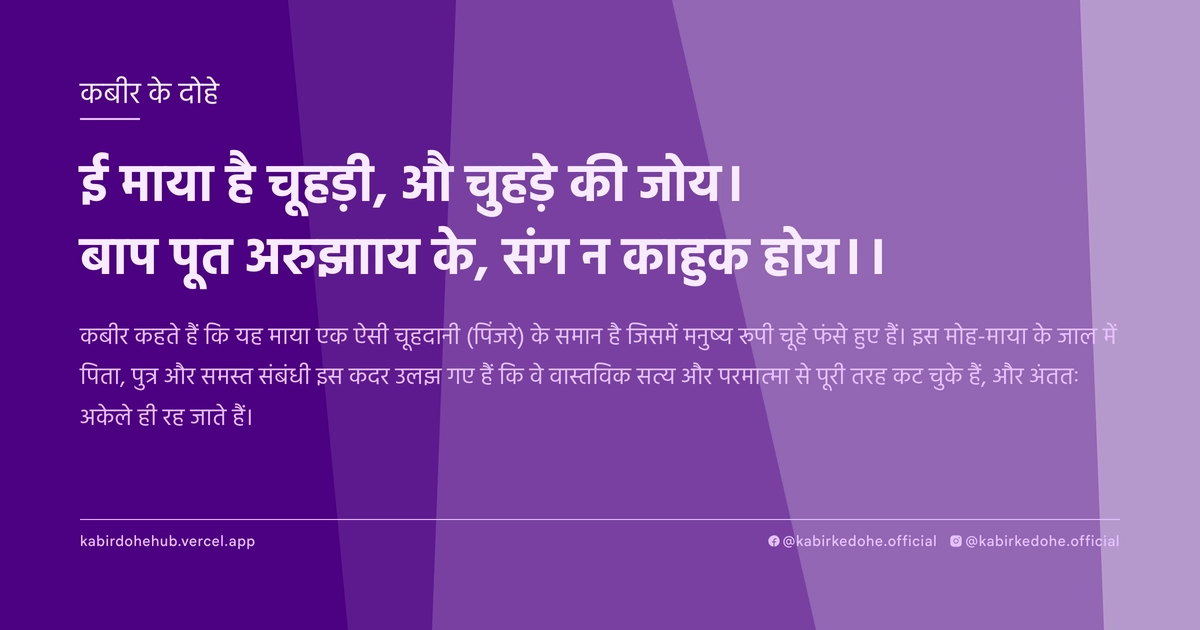
ई माया है चूहड़ी, औ चुहड़े की जोय।
बाप पूत अरुझााय के, संग न काहुक होय।।
Ee maya hai chuhaadi, au chuhaade ki joy. Baap put arujhaaye ke, sang na kahuk hoye.
इस पृष्ठ पर इस कबीर दोहे का अर्थ (meaning), हिंदी व्याख्या और अंग्रेज़ी अनुवाद, दार्शनिक विश्लेषण और व्यावहारिक जीवन सीख दी गई है। यह दोहा माया (Maya) विषय से जुड़ा है — Kabir doha meaning and explanation in Hindi and English.
अर्थ (Meaning):
कबीर कहते हैं कि यह माया एक ऐसी चूहदानी (पिंजरे) के समान है जिसमें मनुष्य रूपी चूहे फंसे हुए हैं। इस मोह-माया के जाल में पिता, पुत्र और समस्त संबंधी इस कदर उलझ गए हैं कि वे वास्तविक सत्य और परमात्मा से पूरी तरह कट चुके हैं, और अंततः अकेले ही रह जाते हैं।
Kabir asserts that Maya (the cosmic illusion) is like a rat-trap, and human beings are the rats caught within it. Bound by the attachments of family, such as fathers and sons, people become so entangled in worldly bonds that they lose sight of the Eternal Truth, eventually discovering that in the final reckoning, no one truly accompanies the soul.
व्याख्या (Interpretation):
यहाँ 'चूहड़ी' शब्द माया के सूक्ष्म लेकिन शक्तिशाली बंधन का प्रतीक है। कबीर पहले भौतिक स्तर पर पारिवारिक मोह की बात करते हैं, फिर उसे आध्यात्मिक स्तर पर ले जाते हैं। यह दोहा निर्गुण भक्ति के उस सिद्धांत को दर्शाता है जहाँ संसार को एक भ्रम माना गया है। माया वह पर्दा है जो आत्मा (Atman) को ब्रह्म (Brahman) के साथ उसके वास्तविक अद्वैत संबंध को देखने नहीं देता। जब मनुष्य 'मैं' और 'मेरा' के अहंकार में डूबता है, तो वह एक ऐसे चक्रव्यूह में फंस जाता है जहाँ प्रेम भी बंधन बन जाता है। अंततः, यह विरोधाभास है कि जिस परिवार के लिए मनुष्य अपना पूरा जीवन खपा देता है, वही बंधन उसे मोक्ष से दूर ले जाते हैं।
The term 'Chuha-di' (rat-trap) serves as a potent metaphor for the subtle yet inescapable grip of Maya. Kabir begins with the literal attachment to kin—fathers and sons—and elevates it to a metaphysical critique of existence. This aligns with Nirgun Bhakti, where the world is viewed as a transient illusion. Maya is the veil preventing the Atman from realizing its non-duality with Brahman. When a human identifies with the ego ('I' and 'Mine'), they enter a labyrinth where even love becomes a shackle. The central paradox highlighted is that the very familial bonds humans cherish most are the primary obstacles to spiritual liberation, leaving the soul fundamentally alone in its journey toward the Infinite.
दार्शनिक विश्लेषण (Philosophical Analysis):
कबीर का यह दोहा मध्यकालीन भारत के उस सामाजिक परिवेश में लिखा गया था जहाँ कर्मकांड और पारिवारिक मर्यादाओं को ही धर्म माना जाता था। कबीर ने इस व्यवस्था पर प्रहार करते हुए बताया कि बाहरी रिश्तों की पवित्रता तब तक व्यर्थ है जब तक आंतरिक जागृति न हो। यह विचार अद्वैत वेदांत के करीब है, जो कहता है कि जगत मिथ्या है और केवल ब्रह्म सत्य है।
सूफी मत के 'फना' के सिद्धांत की तरह, कबीर यहाँ अहंकार के विनाश की बात कर रहे हैं। जब तक व्यक्ति खुद को एक 'पुत्र' या 'पिता' के रूप में सीमित रखता है, वह अपनी सार्वभौमिक पहचान को नहीं पहचान पाता। माया यहाँ केवल धन-दौलत नहीं, बल्कि वह भावनात्मक आसक्ति है जो हमें सत्य से दूर ले जाती है।
कबीर का विरोध केवल परिवार से नहीं, बल्कि उस 'मोह' से है जो विवेक को नष्ट कर देता है। वे तर्क देते हैं कि जो व्यक्ति केवल रक्त-संबंधों में विश्वास करता है, वह उस परमात्मा को कभी नहीं पा सकता जो सबका पिता है। यह एक मनोवैज्ञानिक रूपांतरण की मांग है, जहाँ व्यक्ति 'सांसारिक पहचान' को त्यागकर 'दिव्य पहचान' को अपनाता है।
अक्सर लोग इस दोहे को परिवार के त्याग के रूप में गलत समझते हैं, जबकि कबीर का संकेत 'आसक्ति' (Attachment) के त्याग की ओर है। वे सिखाते हैं कि कर्तव्यों का पालन करें, लेकिन हृदय में यह बोध रखें कि कोई भी सांसारिक बंधन स्थायी नहीं है।
अंततः, यह विश्लेषण हमें इस निष्कर्ष पर ले जाता है कि मुक्ति केवल तभी संभव है जब हम माया के इस सूक्ष्म जाल को पहचान लें। जब चूहा (मनुष्य) यह जान जाता है कि वह पिंजरे में है, तभी उसके बाहर निकलने की प्रक्रिया शुरू होती है।
This Doha emerged from the socio-cultural milieu of medieval India, where ritualism and familial hierarchies were equated with righteousness. Kabir challenges this by asserting that external social piety is futile without internal awakening. His perspective mirrors Advaita Vedanta, which posits that the empirical world is 'Maya' (illusion) and only Brahman is the ultimate reality.
Drawing parallels with the Sufi concept of 'Fana' (annihilation of the self), Kabir emphasizes the destruction of the ego. As long as an individual identifies solely as a 'son' or 'father,' they remain trapped in a limited identity, unable to perceive their universal essence. Maya here is not merely material wealth, but the emotional clinging that obscures spiritual clarity.
Kabir's critique is not directed at the family unit itself, but at the 'Moh' (delusional attachment) that erodes discernment. He argues that those who rely solely on blood ties fail to recognize the Formless Divine, who is the true Father of all existence. This necessitates a psychological shift from a 'worldly identity' to a 'divine identity.'
Common literalist interpretations often mistake this as a call to abandon one's family. However, Kabir advocates for the detachment of the heart, not the abandonment of duty. He teaches that one should perform their roles while remaining consciously aware that no earthly bond is permanent.
Ultimately, the analysis reveals that liberation begins with the recognition of the trap. Just as a rat must first realize it is caged to seek an exit, the human soul must recognize the illusory nature of Maya to begin its ascent toward the Absolute.
मूल संदेश (Core Message):
- सांसारिक रिश्ते केवल अस्थायी पड़ाव हैं, अंतिम गंतव्य नहीं।
- मोह और प्रेम के बीच के सूक्ष्म अंतर को पहचानना ही जागृति है।
- अहंकार जब 'मेरा' कहता है, तभी वह बंधन बनता है।
- सच्ची स्वतंत्रता रिश्तों को छोड़ने में नहीं, बल्कि उनमें आसक्ति छोड़ने में है।
- परमात्मा ही एकमात्र स्थायी साथी है, बाकी सब माया का खेल है।
- Worldly relationships are temporary milestones, not the final destination.
- Awakening lies in distinguishing between delusional attachment and pure love.
- The ego creates bondage the moment it claims ownership through 'mine.'
- True freedom is not in abandoning relationships, but in abandoning attachment to them.
- The Divine is the only permanent companion; all else is a play of illusion.
व्यावहारिक उदाहरण (Practical Example):
एक समय की बात है, वाराणसी के घाटों पर रहने वाला एक वृद्ध बुनकर था, जिसका नाम माधव था। माधव ने अपना पूरा जीवन अपने इकलौते बेटे को पढ़ाने और उसे बड़ा आदमी बनाने में लगा दिया। उसने अपनी हर खुशी, अपनी नींद और यहाँ तक कि अपनी सेहत का भी त्याग कर दिया ताकि उसका बेटा शहर जाकर बड़ा अफसर बन सके।
माधव का मानना था कि उसका बेटा ही उसका मोक्ष है। वह अक्सर कहता, 'मेरा बेटा जब सफल होगा, तब मेरा जीवन सार्थक होगा।' उसने अपने बेटे के प्रति एक ऐसा गहरा मोह विकसित कर लिया था कि वह उसके बिना एक पल भी नहीं सोच सकता था।
समय बीता, बेटा शहर गया, बड़ा अधिकारी बना और उसने अपनी अलग दुनिया बसा ली। धीरे-धीरे वह अपने पिता को भूलने लगा। जब माधव बीमार पड़ा और उसे सहारे की जरूरत थी, तब उसके बेटे ने 'काम की व्यस्तता' का बहाना बनाकर उसे अकेला छोड़ दिया।
एक शाम, माधव घाट की सीढ़ियों पर बैठा था। उसके पास कोई नहीं था। तभी उसकी नजर एक साधु पर पड़ी जो शांति से ध्यान में लीन थे। माधव ने उनसे पूछा, 'मैंने अपना सब कुछ अपने बेटे पर न्योछावर कर दिया, फिर भी मैं आज अकेला क्यों हूँ?'
साधु ने मुस्कुराते हुए कहा, 'माधव, तुमने बेटे से प्रेम नहीं किया, बल्कि अपनी इच्छाओं को बेटे के रूप में देखा। तुमने उसे एक पिंजरा बना लिया जिसमें तुमने खुद को कैद कर लिया। तुमने यह मान लिया कि तुम्हारी खुशी किसी दूसरे व्यक्ति पर निर्भर है।'
यह सुनकर माधव के भीतर एक बिजली सी कौंधी। उसे अहसास हुआ कि वह जिस 'पारिवारिक प्रेम' के नाम पर जी रहा था, वह वास्तव में उसकी अपनी आसक्ति और अहंकार था। उसने महसूस किया कि उसने अपनी आत्मा को एक ऐसे रिश्ते में बांध दिया था जो स्वभाव से ही अस्थायी था।
उस क्षण माधव ने अपने बेटे के प्रति क्रोध या दुख महसूस करना बंद कर दिया। उसने अपनी आँखें बंद कीं और उस शून्य में झाँका जहाँ कोई पिता या पुत्र नहीं था, केवल एक अनंत शांति थी।
माधव ने अब अपने बचे हुए दिन दूसरों की सेवा और ध्यान में बिताने का निर्णय लिया। उसने पाया कि जब उसने 'मेरा बेटा'라는 विचार को छोड़ा, तो उसे पूरी दुनिया में अपने बच्चे नजर आने लगे।
उसका जीवन अब किसी की उम्मीदों का गुलाम नहीं था। वह अब उस चूहदानी से आजाद हो चुका था जिसे वह जीवन भर 'प्रेम' समझकर पूजता रहा था।
अंत में, माधव की मृत्यु शांतिपूर्ण हुई, क्योंकि वह अब अकेला नहीं था; वह उस परमात्मा के साथ था जिसने उसे कभी नहीं छोड़ा था।
Once, in the ghats of Varanasi, lived an elderly weaver named Madhav. Madhav spent his entire life dedicating every resource to his only son's education, dreaming of making him a great man. He sacrificed his health, his sleep, and his own desires, believing his son's success was his own salvation.
Madhav's attachment was absolute. He often claimed, 'My life will be meaningful only when my son succeeds.' He had woven a web of emotional dependency so thick that he could not imagine a single moment of existence without his son's validation.
Years passed; the son moved to the city, became a high-ranking official, and built a life of luxury. Slowly, he began to distance himself from his father. When Madhav fell gravely ill and needed support, the son cited 'professional commitments' and left him alone in the old house.
One evening, sitting on the stone steps of the Ganges, Madhav encountered a wandering monk in deep meditation. Madhav asked him, 'I gave everything to my son, yet why am I utterly alone in my final days?'
The monk smiled and replied, 'Madhav, you did not love your son; you loved the image of yourself reflected in him. You turned your relationship into a cage and locked yourself inside. You believed your happiness belonged to another.'
These words struck Madhav like a bolt of lightning. He realized that what he had called 'familial love' was actually a form of spiritual blindness—a desperate clinging to a temporary identity.
In that moment, Madhav stopped feeling anger or grief toward his son. He closed his eyes and peered into the silence where there was no father, no son, only an infinite, unchanging peace.
He decided to spend his remaining days in selfless service and meditation. He discovered that once he let go of the concept of 'my son,' he began to see every child in the village as his own.
His life was no longer a slave to expectations. He had finally escaped the rat-trap that he had spent a lifetime decorating and calling 'love.'
Ultimately, Madhav passed away in profound serenity, for he was no longer alone; he had merged with the Divine that never leaves the soul.
अभ्यास मार्गदर्शन (Practice Guidance):
- प्रतिदिन 20 मिनट 'साक्षी भाव' का अभ्यास करें: अपने पारिवारिक रिश्तों को एक फिल्म की तरह देखें, यह महसूस करते हुए कि आप केवल एक दर्शक हैं, न कि उन रिश्तों के कैदी।
- स्व-पूछताछ जर्नल: हर रात लिखें कि आज आपने किस बात पर 'मेरा' या 'मेरे परिवार' का दावा किया और वह दावा आपकी मानसिक शांति को कैसे प्रभावित कर रहा था।
- व्यवहार परिवर्तन: किसी ऐसे व्यक्ति की निस्वार्थ मदद करें जिससे आपका कोई रक्त-संबंध न हो, ताकि आप 'सीमित प्रेम' से 'सार्वभौमिक प्रेम' की ओर बढ़ सकें।
- निदान चेकलिस्ट: यदि आप किसी प्रियजन के व्यवहार से अत्यधिक विचलित होते हैं या उनकी सफलता/असफलता को अपनी पहचान मानते हैं, तो समझ लें कि आप अभी भी 'माया की चूहदानी' में हैं।
- Practice 'Witness Consciousness' for 20 minutes daily: Observe your familial roles as if watching a movie, realizing you are the observer, not the prisoner of these identities.
- Self-Inquiry Journaling: Each night, record instances where you claimed 'mine' or 'my family' and analyze how that attachment affected your inner peace.
- Behavioral Shift: Perform a selfless act of service for someone with whom you share no blood relation, transitioning from 'limited love' to 'universal compassion.'
- Diagnostic Checklist: If you find your peace entirely dependent on a loved one's behavior or equate your worth with their success, recognize that you are still caught in the 'rat-trap of Maya.'
चिंतन प्रश्न (Reflection Questions):
- यदि आज आपकी सारी सामाजिक और पारिवारिक पहचान छीन ली जाए, तो आपके पास 'स्वयं' के रूप में क्या बचेगा?
- क्या आपका प्रेम वास्तव में दूसरे के कल्याण के लिए है, या वह आपकी अपनी भावनात्मक जरूरतों को पूरा करने का एक साधन है?
- आप अपने जीवन में किन 'अदृश्य पिंजरों' को प्रेम का नाम देकर संजो रहे हैं?
- डिजिटल युग में, आपकी 'ऑनलाइन पहचान' किस तरह की नई माया निर्मित कर रही है जो आपको वास्तविक शांति से दूर ले जा रही है?
- क्या आप अकेले रहने से डरते हैं, या आप उस अकेलेपन से डरते हैं जहाँ आपको अपने वास्तविक स्वरूप का सामना करना पड़ता है?
- If all your social and familial identities were stripped away today, what would remain of 'you'?
- Is your love truly for the well-being of the other, or is it a tool to satisfy your own emotional needs?
- Which 'invisible cages' in your life are you cherishing under the guise of love?
- In the digital age, what new forms of Maya is your 'online persona' creating that distance you from authentic peace?
- Do you fear being alone, or do you fear the solitude where you must confront your true nature?