
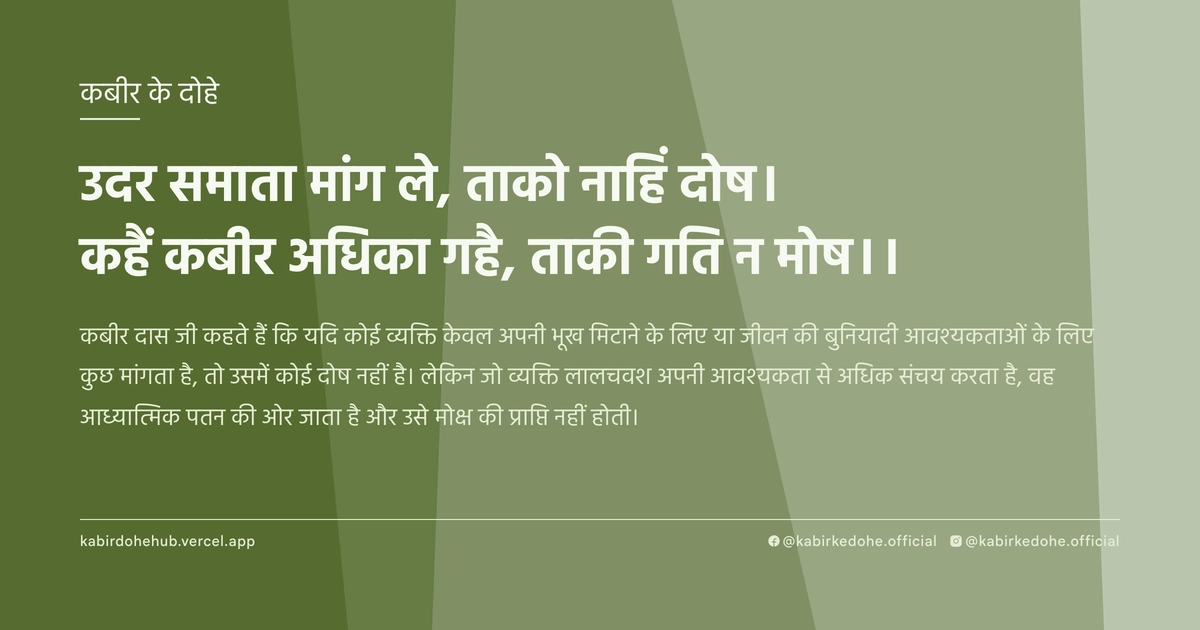
उदर समाता मांग ले, ताको नाहिं दोष।
कहैं कबीर अधिका गहै, ताकी गति न मोष।।
Udar samaata maang le, taako naahin dosh. Kahein kabir adhika gahai, taaki gati na mosh.
इस पृष्ठ पर इस कबीर दोहे का अर्थ (meaning), हिंदी व्याख्या और अंग्रेज़ी अनुवाद, दार्शनिक विश्लेषण और व्यावहारिक जीवन सीख दी गई है। यह दोहा संतोष (Contentment) विषय से जुड़ा है — Kabir doha meaning and explanation in Hindi and English.
अर्थ (Meaning):
कबीर दास जी कहते हैं कि यदि कोई व्यक्ति केवल अपनी भूख मिटाने के लिए या जीवन की बुनियादी आवश्यकताओं के लिए कुछ मांगता है, तो उसमें कोई दोष नहीं है। लेकिन जो व्यक्ति लालचवश अपनी आवश्यकता से अधिक संचय करता है, वह आध्यात्मिक पतन की ओर जाता है और उसे मोक्ष की प्राप्ति नहीं होती।
Kabir asserts that there is no sin in seeking only what is necessary to sustain the body and satisfy hunger. However, he warns that those who grasp and accumulate beyond their actual needs, driven by greed, obstruct their own spiritual liberation and distance themselves from the state of Moksha.
व्याख्या (Interpretation):
शाब्दिक रूप से यह दोहा भौतिक आवश्यकताओं और लालच के बीच के अंतर को स्पष्ट करता है। गहराई में, यह 'संतोष' और 'तृष्णा' के द्वंद्व को दर्शाता है। 'उदर समाता' केवल पेट भरने की बात नहीं है, बल्कि यह न्यूनतम जीवन जीने की कला है। जब मनुष्य अपनी आवश्यकताओं को सीमित करता है, तो वह माया के जाल से मुक्त होने लगता है। निर्गुण भक्ति के अनुसार, ईश्वर का वास अहंकार और लोभ के अभाव में होता है। जो व्यक्ति संचय की वृत्ति में फँसा है, वह 'अहंकार' (Ego) को पुष्ट करता है, जो आत्मा और परमात्मा के बीच की सबसे बड़ी बाधा है। यह दोहा हमें सिखाता है कि भौतिकता का त्याग पूर्ण संन्यास नहीं, बल्कि संतुलित उपभोग है ताकि चेतना का विस्तार हो सके।
Literally, this couplet distinguishes between basic survival and insatiable greed. Metaphorically, it explores the tension between 'Santosha' (contentment) and 'Trishna' (craving). 'Udar samata' refers not just to filling the stomach, but to the art of minimal living. When a human limits their desires, they begin to unravel the web of Maya. In Nirgun Bhakti, the Divine resides where ego and greed are absent. One who is consumed by the urge to accumulate reinforces the 'Ahamkara' (Ego), which acts as the primary veil between the Atman and Brahman. The verse teaches that liberation does not necessarily require total renunciation of the world, but a balanced consumption that prevents the spiritual suffocation of the soul.
दार्शनिक विश्लेषण (Philosophical Analysis):
कबीर का यह विचार उनके युग के सामाजिक और धार्मिक पाखंड के विरुद्ध एक प्रहार था। उस समय धर्म के नाम पर संचय और कर्मकांडों का बोलबाला था। कबीर ने स्पष्ट किया कि मोक्ष किसी मंदिर या मस्जिद में नहीं, बल्कि मन की शुद्धि और संतोष में है। यह विचार अद्वैत वेदांत के इस सिद्धांत से मेल खाता है कि संसार एक भ्रम (माया) है और वस्तुओं का संचय इस भ्रम को और गहरा करता है।
सूफीवाद के 'फक्र' (spiritual poverty) की अवधारणा यहाँ स्पष्ट दिखती है, जहाँ साधक भौतिक निर्भरता को कम करके ईश्वर पर निर्भरता बढ़ाता है। कबीर का तर्क है कि जब हम 'अधिक' की इच्छा करते हैं, तो हम वास्तव में अपनी पूर्णता को बाहर खोज रहे होते हैं, जबकि पूर्णता भीतर है। यह मनोवैज्ञानिक रूप से एक अंतहीन चक्र है जहाँ इच्छाएं कभी समाप्त नहीं होतीं।
जाति और वर्ग के भेदभाव को नकारते हुए, कबीर यह संदेश देते हैं कि लालच किसी भी वर्ग के व्यक्ति को आध्यात्मिक रूप से अंधा कर सकता है। चाहे वह राजा हो या रंक, यदि वह अपनी आवश्यकता से अधिक पकड़ता है, तो वह बंधन में बंध जाता है।
यहाँ 'मोष' (मोक्ष) का अर्थ केवल मृत्यु के बाद की मुक्ति नहीं, बल्कि जीवित रहते हुए मानसिक और भावनात्मक बंधनों से मुक्ति है। यह एक ऐसी अवस्था है जहाँ व्यक्ति 'कर्ता' होने के भाव को त्याग कर 'साक्षी' बन जाता है।
अंततः, यह दोहा भौतिकवाद के विरुद्ध एक चेतावनी है। यह बताता है कि संचय की प्रवृत्ति आत्मा को भारी कर देती है, जिससे वह ऊपर की ओर (दिव्यता की ओर) नहीं उठ पाती। मुक्ति केवल उन्हीं को मिलती है जो हल्के हैं—अर्थात जो मोह और लोभ के बोझ से मुक्त हैं।
Kabir's insight serves as a critique of the social and religious hypocrisy of his era, where accumulation of wealth and ritualistic piety were often conflated. He clarifies that liberation is found not in temples or mosques, but in the purity of the heart and the practice of contentment. This aligns with the Advaita Vedanta principle that the world is Maya (illusion), and the hoarding of material objects only deepens this delusion.
There is a strong resonance here with the Sufi concept of 'Faqr' (spiritual poverty), where the seeker minimizes material dependence to maximize reliance on the Divine. Kabir argues that the desire for 'more' is a misplaced search for wholeness in the external world, whereas true wholeness is internal. Psychologically, this creates an infinite loop of craving that prevents inner peace.
By rejecting caste and class hierarchies, Kabir suggests that greed can spiritually blind anyone, regardless of their social standing. Whether a king or a pauper, the act of grasping beyond necessity binds the soul to the cycle of suffering.
In this context, 'Mosh' (Moksha) is not merely liberation after death, but a state of psychological and emotional freedom while alive. It is the transition from being the 'doer' (Karta) to becoming the 'witness' (Sakshi).
Ultimately, the verse is a warning against materialism. It posits that the habit of accumulation weighs down the soul, preventing its ascent toward divinity. Liberation is reserved for those who are 'light'—those who have shed the heavy burdens of attachment and greed.
मूल संदेश (Core Message):
- आवश्यकता और लालच के बीच की सूक्ष्म रेखा को पहचानें।
- अत्यधिक संचय आत्मा की आध्यात्मिक उड़ान को बाधित करता है।
- संतोष ही वास्तविक समृद्धि और आंतरिक शांति का एकमात्र मार्ग है।
- बाहरी वस्तुओं का मोह आंतरिक रिक्तता को कभी नहीं भर सकता।
- मुक्ति केवल उन्हीं को मिलती है जो मोह के बोझ को त्याग देते हैं।
- Recognize the thin line between genuine necessity and insatiable greed.
- Excessive accumulation obstructs the spiritual ascent of the soul.
- Contentment is the only true path to prosperity and inner peace.
- Attachment to external objects can never fill an internal void.
- Liberation is reserved for those who shed the burden of attachment.
व्यावहारिक उदाहरण (Practical Example):
वाराणसी के घाटों पर रहने वाले एक वृद्ध बुनकर थे, जिनका नाम माधव था। माधव अपनी पूरी जिंदगी रेशमी साड़ियाँ बुनने में बिता चुके थे। उनके पास हुनर की कमी नहीं थी, लेकिन उनके मन में एक गहरी असुरक्षा थी। वे हमेशा सोचते थे कि उनके पास और अधिक धन होना चाहिए ताकि वे शहर के सबसे बड़े व्यापारी बन सकें। इस लालच में उन्होंने अपनी नींद, अपनी शांति और अपने परिवार के साथ के सुख को दांव पर लगा दिया।
वे दिन-रात काम करते, लेकिन जितना कमाते, उनकी इच्छाएं उतनी ही बढ़ जातीं। वे अपनी साड़ियों की कीमत बढ़ाते और ग्राहकों से अधिक लाभ कमाने की कोशिश करते, जिससे धीरे-धीरे लोग उनसे दूर होने लगे। माधव के पास धन तो बढ़ रहा था, लेकिन उनके मन में बेचैनी और क्रोध बढ़ता गया। वे हर समय इस डर में रहते कि कोई उनका धन चुरा न ले या बाजार गिर न जाए।
एक दिन उनकी मुलाकात एक फकीर से हुई जो घाट की सीढ़ियों पर बैठा था। फकीर के पास केवल एक फटा हुआ झोला था, लेकिन उसके चेहरे पर एक ऐसी शांति थी जो माधव ने अपने जीवन के सबसे महंगे रेशम में भी नहीं देखी थी। माधव ने उनसे पूछा, "बाबा, मेरे पास सब कुछ है, फिर भी मैं अशांत हूँ। आपके पास कुछ नहीं है, फिर भी आप इतने प्रसन्न कैसे हैं?"
फकीर ने मुस्कुराते हुए माधव की ओर देखा और कहा, "बेटा, तूने अपनी जरूरत से ज्यादा पकड़ लिया है। जब हाथ में बहुत कुछ होता है, तो हम उसे पकड़ने के लिए इतनी ताकत लगाते हैं कि हम जीवन को महसूस करना भूल जाते हैं। तूने पेट भरने के लिए नहीं, बल्कि अहंकार को पालने के लिए संचय किया है।"
माधव को यह बात बिजली की तरह लगी। उन्हें एहसास हुआ कि उनकी 'अधिक' पाने की दौड़ ने उन्हें वास्तव में 'शून्य' कर दिया है। उन्होंने महसूस किया कि जिस सुरक्षा को वे धन में खोज रहे थे, वह वास्तव में संतोष में थी।
अगले ही दिन से माधव ने अपना नजरिया बदला। उन्होंने अपनी साड़ियों की कीमतें उचित कीं और केवल उतना ही कमाने का लक्ष्य रखा जिससे उनका परिवार सम्मानपूर्वक जी सके। उन्होंने अपने समय का एक बड़ा हिस्सा गरीबों की मदद करने और संगीत सीखने में लगाया।
जैसे-जैसे उन्होंने अपनी संचय की वृत्ति को छोड़ा, उनके मन का बोझ हल्का होने लगा। उनकी नींद वापस आ गई और उनके चेहरे पर वही शांति छा गई जो उन्होंने उस फकीर में देखी थी।
अब माधव केवल एक बुनकर नहीं थे, बल्कि वे संतोष के एक जीवित उदाहरण बन गए थे। उन्होंने सीखा कि जीवन की सार्थकता इस बात में नहीं है कि हमने कितना इकट्ठा किया, बल्कि इस बात में है कि हमने कितना साझा किया और कितने हल्के मन से जिए।
In the ghats of Varanasi lived an elderly weaver named Madhav. Madhav had spent his entire life weaving exquisite silk sarees. He possessed immense skill, but his heart was plagued by a deep-seated insecurity. He believed that he must accumulate vast wealth to become the most prominent merchant in the city.
Driven by this greed, he sacrificed his sleep, his peace, and the simple joys of family. He worked day and night, but as his earnings grew, so did his desires. He began inflating the prices of his sarees to maximize profit, which gradually alienated his loyal customers. While his coffers filled, his mind became a cauldron of restlessness and anger. He lived in constant fear of theft or a market crash.
One day, he encountered a wandering dervish sitting on the stone steps of the ghat. The dervish possessed nothing but a tattered bag, yet his face radiated a serenity that Madhav had never seen even in the finest silks. Madhav asked, "Baba, I have everything, yet I am restless. You have nothing, yet you are so peaceful. How?"
The dervish smiled and replied, "Son, you have grasped more than your need. When the hands hold too much, we spend so much energy gripping that we forget how to feel life. You did not accumulate to feed your stomach, but to feed your ego."
These words struck Madhav like a bolt of lightning. He realized that his race for 'more' had actually left him 'empty.' He understood that the security he sought in gold was actually found in contentment.
From the next day, Madhav changed his approach. He set fair prices for his work and aimed only to earn enough for his family to live with dignity. He dedicated a significant portion of his time to helping the poor and learning music.
As he relinquished the habit of hoarding, the burden on his mind lightened. His sleep returned, and a profound peace settled over his countenance, mirroring the serenity of the dervish.
Madhav was no longer just a weaver; he became a living testament to contentment. He learned that the meaning of life is not found in how much we accumulate, but in how much we share and how lightly we travel through existence.
अभ्यास मार्गदर्शन (Practice Guidance):
- दैनिक अभ्यास: प्रतिदिन 15 मिनट मौन बैठें और विचार करें कि आपकी कौन सी इच्छाएं वास्तव में आवश्यकता हैं और कौन सी केवल सामाजिक दिखावा या लालच हैं।
- आत्म-पूछताछ जर्नल: हर रात लिखें—'आज मैंने ऐसी कौन सी चीज पाने की कोशिश की जिसकी मुझे वास्तव में जरूरत नहीं थी?' और विश्लेषण करें कि उस इच्छा के पीछे का डर क्या था।
- व्यवहारिक परिवर्तन: महीने में एक बार अपनी किसी ऐसी वस्तु का दान करें जिसे आप बहुत संभाल कर रखते हैं लेकिन उपयोग नहीं करते, ताकि 'पकड़ने' की आदत छूट सके।
- नैदानिक चेकलिस्ट: यदि आप भविष्य की चिंता में वर्तमान का आनंद नहीं ले पा रहे हैं, या दूसरों की प्रगति देखकर ईर्ष्या महसूस कर रहे हैं, तो समझें कि आप 'अधिका गहै' (अत्यधिक संचय) की मानसिक स्थिति में हैं।
- Daily Practice: Spend 15 minutes in silence daily, contemplating which of your desires are genuine needs and which are merely social projections or greed.
- Self-Inquiry Journal: Every night, write—'What did I strive to acquire today that I did not actually need?' and analyze the underlying fear driving that desire.
- Behavioral Shift: Once a month, donate an object you hold onto tightly but rarely use, specifically to break the psychological habit of 'grasping.'
- Diagnostic Checklist: If you find yourself unable to enjoy the present due to future anxieties, or feeling envy at others' progress, recognize that you are in the state of 'Adhika Gahai' (excessive grasping).
चिंतन प्रश्न (Reflection Questions):
- मेरी पहचान मेरी उपलब्धियों और मेरी संपत्ति से कितनी जुड़ी है? यदि यह सब छिन जाए, तो मैं कौन रहूँगा?
- मैं अपनी 'जरूरतों' को 'इच्छाओं' के रूप में कैसे परिभाषित करता हूँ, और क्या यह परिभाषा समाज द्वारा थोपी गई है?
- क्या मेरा संचय वास्तव में सुरक्षा के लिए है, या यह मेरे भीतर के किसी गहरे डर या हीन भावना को छिपाने का प्रयास है?
- डिजिटल युग में, 'लाइक' और 'फॉलोअर्स' का संचय मेरे मानसिक स्वास्थ्य और आध्यात्मिक शांति को कैसे प्रभावित कर रहा है?
- क्या मैं वास्तव में स्वतंत्र हूँ, या मैं उन चीजों का गुलाम हूँ जिन्हें मैंने अपना कहा है?
- How deeply is my identity tied to my achievements and possessions? Who would I be if everything were stripped away?
- How do I define my 'needs' versus my 'wants,' and to what extent is this definition imposed by societal pressure?
- Is my accumulation truly for security, or is it an attempt to mask a deeper fear or sense of inadequacy within?
- In the digital age, how does the accumulation of 'likes' and 'followers' affect my mental health and spiritual stillness?
- Am I truly free, or have I become a slave to the things I claim to own?