
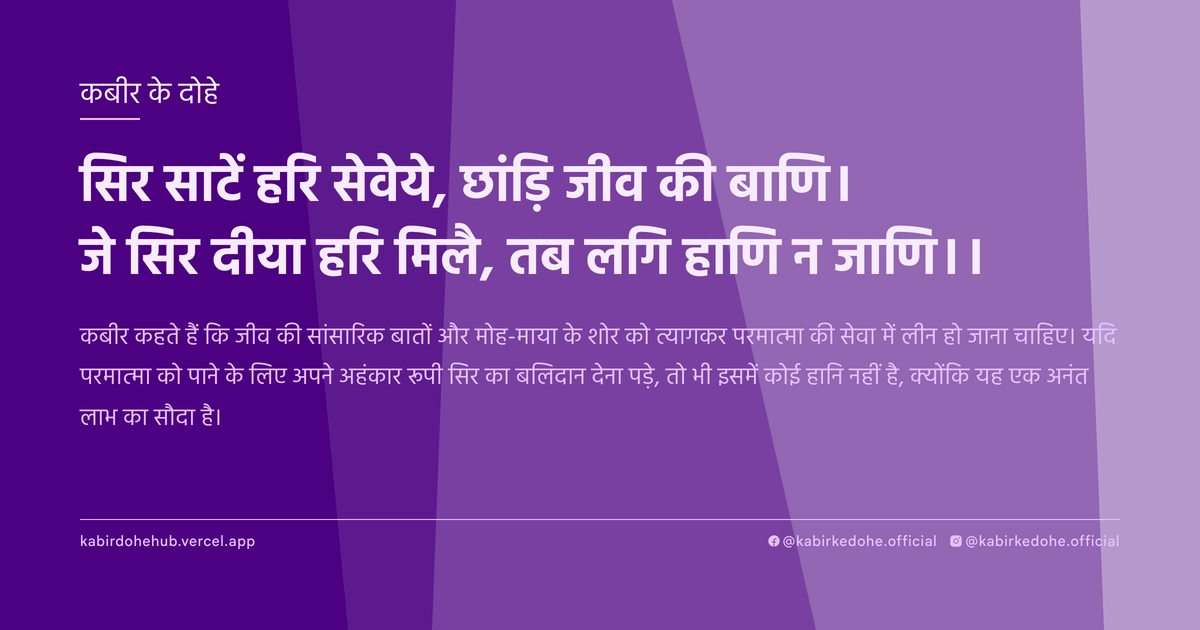
सिर साटें हरि सेवेये, छांड़ि जीव की बाणि।
जे सिर दीया हरि मिलै, तब लगि हाणि न जाणि।।
Sir saaten hari seveye, chhandi jeev ki baani. Je sir diya hari milai, tab lagi haani na jaani.
इस पृष्ठ पर इस कबीर दोहे का अर्थ (meaning), हिंदी व्याख्या और अंग्रेज़ी अनुवाद, दार्शनिक विश्लेषण और व्यावहारिक जीवन सीख दी गई है। यह दोहा प्रपत्ति (Surrender) विषय से जुड़ा है — Kabir doha meaning and explanation in Hindi and English.
अर्थ (Meaning):
कबीर कहते हैं कि जीव की सांसारिक बातों और मोह-माया के शोर को त्यागकर परमात्मा की सेवा में लीन हो जाना चाहिए। यदि परमात्मा को पाने के लिए अपने अहंकार रूपी सिर का बलिदान देना पड़े, तो भी इसमें कोई हानि नहीं है, क्योंकि यह एक अनंत लाभ का सौदा है।
Kabir urges the seeker to abandon the chatter of the ego and the worldly desires of the individual soul to serve the Divine. He asserts that even if one must sacrifice their very head—symbolizing the total annihilation of the ego—to attain the Divine, it is not a loss, but the ultimate gain.
व्याख्या (Interpretation):
इस दोहे का शाब्दिक अर्थ है कि सांसारिक बातों को छोड़कर ईश्वर की भक्ति करें। आध्यात्मिक स्तर पर, 'जीव की बाणि' उस आंतरिक शोर और अहंकार को दर्शाता है जो हमें सत्य से अलग करता है। 'सिर देना' शारीरिक मृत्यु नहीं, बल्कि 'अहंकार की मृत्यु' (Ego Death) है। यह निर्गुण भक्ति का सार है जहाँ भक्त स्वयं को शून्य कर देता है ताकि परमात्मा उसमें समा सके। यह अद्वैत वेदांत के उस सिद्धांत को पुष्ट करता है जहाँ 'मैं' का विलोप होने पर ही 'ब्रह्म' का अनुभव होता है। यहाँ विरोधाभास यह है कि पूर्ण समर्पण ही वास्तविक प्राप्ति है।
Literally, the verse advises replacing worldly discourse with divine service. Metaphorically, 'jeev ki baani' represents the incessant noise of the ego and the illusory narratives of the persona. The 'offering of the head' is not a call for physical martyrdom but for the 'death of the ego.' In the context of Nirgun Bhakti, this signifies the transition from the limited 'I' to the limitless 'One.' It aligns with Advaita Vedanta, where the realization of non-duality occurs only when the veil of Maya—the false identity—is torn away. The central paradox is that only by losing oneself completely can one truly be found in the Divine.
दार्शनिक विश्लेषण (Philosophical Analysis):
कबीर का यह दोहा उस युग की उपज है जहाँ धर्म कर्मकांडों और बाहरी आडंबरों में फंसा था। कबीर ने स्पष्ट किया कि ईश्वर मंदिर या मस्जिद में नहीं, बल्कि अहंकार के विसर्जन में मिलता है। यहाँ 'साटें' (विनिमय) शब्द का प्रयोग एक आध्यात्मिक व्यापार की तरह किया गया है, जहाँ हम अपनी तुच्छ पहचान को अनंत चेतना के लिए बदलते हैं।
यह विचार सूफीवाद के 'फना' (Fana) के सिद्धांत से गहराई से जुड़ा है, जिसका अर्थ है ईश्वर में विलीन हो जाना। जब तक 'मैं' जीवित है, तब तक 'वह' नहीं मिल सकता। कबीर यहाँ जाति और संप्रदाय की सीमाओं को तोड़कर सीधे आत्मा और परमात्मा के संबंध की बात करते हैं।
अद्वैत वेदांत के अनुसार, जीव और ब्रह्म एक ही हैं, लेकिन अज्ञान (माया) के कारण हम स्वयं को अलग मानते हैं। कबीर का 'सिर देना' इसी अज्ञान की परत को हटाने की प्रक्रिया है। यह मनोवैज्ञानिक रूपांतरण है जहाँ व्यक्ति अपनी सामाजिक पहचान से ऊपर उठकर शुद्ध अस्तित्व में प्रवेश करता है।
सांसारिक लोग इसे हानि मान सकते हैं क्योंकि वे शरीर और नाम को ही सत्य मानते हैं। लेकिन कबीर के लिए, यह शरीर और अहंकार एक बोझ हैं। इस बोझ को उतारना ही वास्तविक मुक्ति है।
अंततः, यह दोहा यह सिखाता है कि भक्ति कोई बाहरी क्रिया नहीं, बल्कि आंतरिक शून्यता की यात्रा है। जब तक पात्र खाली नहीं होगा, उसमें दिव्य अमृत नहीं भरा जा सकता।
Kabir’s verse emerges from an era dominated by rigid ritualism and sectarian divides. He strips away the facade of organized religion, asserting that the Divine is found not in shrines, but in the dissolution of the self. The use of the word 'Saten' (exchange) frames spiritual evolution as a cosmic trade: trading the finite, fragile identity for the infinite, eternal consciousness.
This philosophy resonates profoundly with the Sufi concept of 'Fana'—the annihilation of the self in God. The core premise is that the 'I' is the only barrier between the seeker and the Sought. By advocating for the 'death of the head,' Kabir is calling for the dismantling of the intellectual ego that categorizes, judges, and separates.
From the lens of Advaita Vedanta, the perceived separation between Atman (soul) and Brahman (universal consciousness) is an illusion created by Maya. Kabir’s demand for sacrifice is actually a demand for the removal of this illusion. It is a psychological alchemy where the lead of the ego is transmuted into the gold of pure awareness.
To the worldly mind, giving up one's identity is a catastrophic loss. However, Kabir redefines 'loss' (haani). He suggests that clinging to the ego is the true loss, as it keeps the soul imprisoned in a cycle of suffering and longing.
Ultimately, this teaching emphasizes that devotion is not an additive process—adding prayers or rituals—but a subtractive one. It is the art of unlearning and undoing until only the Truth remains.
मूल संदेश (Core Message):
- सांसारिक शोर और मानसिक द्वंद्व ही परमात्मा के बीच की सबसे बड़ी दीवार हैं।
- अहंकार का विसर्जन कोई क्षति नहीं, बल्कि अनंत चेतना की प्राप्ति है।
- सच्ची भक्ति बाहरी दिखावे में नहीं, बल्कि आंतरिक शून्यता में निहित है।
- जब 'मैं' मिटता है, तभी 'वह' प्रकट होता है।
- समर्पण ही वह एकमात्र द्वार है जिससे मुक्ति का मार्ग खुलता है।
- Worldly noise and mental conflict are the primary barriers between the soul and the Divine.
- The dissolution of the ego is not a loss, but the attainment of infinite consciousness.
- True devotion lies not in external displays, but in the cultivation of inner emptiness.
- Only when the 'I' vanishes does the 'One' manifest.
- Total surrender is the only gateway through which the path to liberation opens.
व्यावहारिक उदाहरण (Practical Example):
वाराणसी के घाटों पर रहने वाला एक वृद्ध विधवा, जानकी, अपना पूरा जीवन केवल एक ही उद्देश्य के लिए समर्पित कर चुकी थी: अपनी मृत संतान की यादों को सहेज कर रखना। वह हर दिन गंगा किनारे बैठती और अपनी पुरानी यादों के दुख में डूबी रहती, मानती कि यही उसकी एकमात्र पहचान है।
वह अपनी इस पीड़ा को एक पवित्र गहने की तरह पहनती थी। उसे लगता था कि यदि वह इस दुख को छोड़ देगी, तो वह अपनी संतान के प्रति विश्वासघात करेगी। उसका अहंकार उसके 'दुख' में छिपा था।
एक दिन उसकी मुलाकात एक घुमक्कड़ साधु से हुई जिसने उसे कबीर का यह दोहा सुनाया। साधु ने उससे पूछा, 'तुम जिसे अपनी पहचान मान रही हो, क्या वह वास्तव में तुम हो, या केवल एक याद का बोझ है?'
जानकी को पहली बार महसूस हुआ कि उसका 'शोक' वास्तव में उसका अहंकार बन गया था। वह खुद को 'दुखी माँ' की छवि में कैद कर चुकी थी और इसी कारण वह अपने आसपास के अन्य दुखी लोगों की मदद नहीं कर पा रही थी।
उसने महसूस किया कि वह अपनी इस पहचान (सिर) को पकड़े हुए है, जबकि परमात्मा उसे मुक्त करना चाहता है। उसने तय किया कि वह अपनी इस पहचान का त्याग करेगी।
उसने धीरे-धीरे अपनी यादों के बोझ को ईश्वर को सौंपना शुरू किया। उसने अपनी पीड़ा को व्यक्तिगत न रखकर, उसे सार्वभौमिक कर दिया।
उसने देखा कि जब उसने 'दुखी माँ' होने के अहंकार को छोड़ा, तो उसके भीतर एक असीम करुणा का जन्म हुआ। अब वह अन्य अनाथ बच्चों और विधवाओं के लिए एक सहारा बन गई।
उसकी आँखों में अब आंसू तो थे, लेकिन वे विलाप के नहीं, बल्कि प्रेम के थे। उसने अपनी छोटी पहचान को खोकर एक विराट प्रेम को पा लिया था।
जानकी के जीवन में अब कोई 'हानि' नहीं थी, क्योंकि उसने स्वयं को खोकर सबको पा लिया था। वह अब केवल एक विधवा नहीं, बल्कि प्रेम की एक बहती धारा बन चुकी थी।
यह उसका 'साटा' था—अपनी सीमित पहचान का विनिमय सार्वभौमिक करुणा के साथ।
In the ancient lanes of Varanasi lived Janaki, an elderly widow who had spent decades clinging to the memory of her deceased son. She spent her days by the Ganges, wrapped in a shroud of grief, believing that her sorrow was the only authentic part of her existence.
Janaki wore her pain like a sacred ornament. She felt that letting go of this agony would be a betrayal of her child's memory. Unbeknownst to her, her ego had found a home in her suffering; she had identified herself as the 'Sufferer.'
One afternoon, she encountered a wandering ascetic who recited Kabir’s verse about exchanging the self for the Divine. The ascetic asked her, 'Is this grief who you are, or is it merely a heavy cloak you refuse to take off?'
For the first time, Janaki realized that her identity as a 'grieving mother' had become a wall between her and the world. By clinging to her personal tragedy, she had become blind to the suffering of others around her.
She understood that the 'head' Kabir spoke of was her attachment to her own narrative of loss. To find the Divine, she had to sacrifice the image of herself as a victim of fate.
Slowly, she began to surrender her grief to the river and the Divine. She stopped saying 'my loss' and started seeing the universal nature of impermanence.
As the ego of the 'Sufferer' dissolved, a vast, oceanic compassion emerged within her. She no longer spent her days in isolation but began caring for other orphaned children and lonely widows in the city.
Her tears did not vanish, but their nature changed. They were no longer tears of lamentation, but tears of empathy and love.
Janaki discovered that by losing her narrow identity, she had gained a connection to every living soul. The void left by her son was now filled with a universal presence.
This was her 'exchange'—she traded the small, suffocating identity of a grieving mother for the expansive identity of a divine servant.
अभ्यास मार्गदर्शन (Practice Guidance):
- प्रतिदिन 20 मिनट मौन अभ्यास करें, जहाँ आप अपने विचारों को केवल एक दर्शक की तरह देखें और उनसे अपनी पहचान न जोड़ें।
- एक 'अहंकार डायरी' लिखें: दिन भर में जब भी आपको लगे कि 'मैं' (मेरा सम्मान, मेरी जीत, मेरा दुख) हावी हो रहा है, उसे लिखें और फिर उसे मानसिक रूप से परमात्मा को समर्पित कर दें।
- स्वयं से पूछें: 'यदि मेरी वर्तमान सामाजिक पहचान, पद और उपलब्धियां छीन ली जाएं, तो मैं वास्तव में कौन हूँ?'
- निदान चेकलिस्ट: क्या मैं दूसरों की आलोचना करते समय श्रेष्ठ महसूस करता हूँ? क्या मैं अपनी पीड़ा को अपनी पहचान बना चुका हूँ? क्या मैं केवल बाहरी अनुष्ठानों से शांति खोज रहा हूँ? यदि हाँ, तो अहंकार अभी जीवित है।
- Practice 20 minutes of daily silence, observing your thoughts as a detached witness rather than identifying with them as 'mine'.
- Maintain an 'Ego Journal': Record moments throughout the day when the 'I' (my honor, my victory, my pain) dominates your thoughts, then consciously surrender that thought to the Divine.
- Contemplate the question: 'If my social identity, titles, and achievements were stripped away, who would I actually be?'
- Diagnostic Checklist: Do I feel superior while criticizing others? Have I turned my suffering into a badge of identity? Am I seeking peace only through external rituals? If yes, the ego is still operational.
चिंतन प्रश्न (Reflection Questions):
- वह कौन सी 'पहचान' है जिसे खोने के डर से मैं अपनी पूरी ऊर्जा खर्च कर रहा हूँ?
- क्या मेरा धर्म और मेरी आध्यात्मिकता वास्तव में मुझे विनम्र बना रहे हैं, या वे मेरे अहंकार को एक नया 'धार्मिक' रूप दे रहे हैं?
- मेरे जीवन का वह कौन सा दुख है जिसे मैं गुप्त रूप से संजोकर रखता हूँ क्योंकि वह मुझे दूसरों से अलग या विशेष महसूस कराता है?
- यदि मुझे आज अपनी सारी उपलब्धियों को त्यागना पड़े, तो क्या मेरे भीतर कोई ऐसा केंद्र है जो अभी भी स्थिर और शांत रहेगा?
- मैं अपनी डिजिटल पहचान (सोशल मीडिया) को कितना सच मानता हूँ, और वह मेरे वास्तविक स्वरूप से कितनी दूर है?
- What is the specific 'identity' I am so afraid of losing that I spend all my energy protecting it?
- Is my spirituality actually making me humble, or is it merely giving my ego a new 'religious' mask to wear?
- Which pain in my life do I secretly cherish because it makes me feel unique or special compared to others?
- If I were forced to renounce all my achievements today, is there a center within me that would remain still and peaceful?
- To what extent do I mistake my digital persona for my true self, and how far has that image drifted from my actual being?