
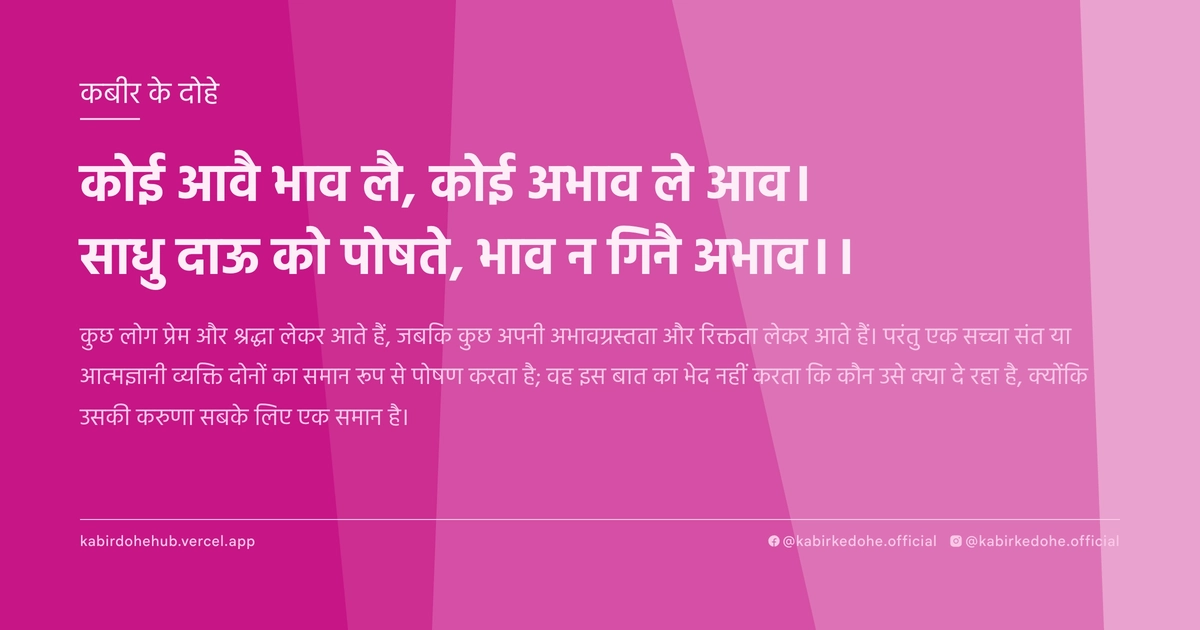
कोई आवै भाव लै, कोई अभाव ले आव।
साधु दाऊ को पोषते, भाव न गिनै अभाव।।
Koi aave bhav lai, koi abhav le aav. Sadhu dau ko poshte, bhav na ginai abhav.
इस पृष्ठ पर इस कबीर दोहे का अर्थ (meaning), हिंदी व्याख्या और अंग्रेज़ी अनुवाद, दार्शनिक विश्लेषण और व्यावहारिक जीवन सीख दी गई है। यह दोहा करुणा (Compassion) विषय से जुड़ा है — Kabir doha meaning and explanation in Hindi and English.
अर्थ (Meaning):
कुछ लोग प्रेम और श्रद्धा लेकर आते हैं, जबकि कुछ अपनी अभावग्रस्तता और रिक्तता लेकर आते हैं। परंतु एक सच्चा संत या आत्मज्ञानी व्यक्ति दोनों का समान रूप से पोषण करता है; वह इस बात का भेद नहीं करता कि कौन उसे क्या दे रहा है, क्योंकि उसकी करुणा सबके लिए एक समान है।
Some approach with love and devotion, while others come burdened by lack and emptiness. However, a true saint or enlightened soul nourishes both equally; they do not differentiate between the abundance of the giver or the void of the seeker, for their compassion is universal and unconditional.
व्याख्या (Interpretation):
शाब्दिक अर्थ में, यह दोहा दान और ग्रहण करने की प्रक्रिया को दर्शाता है। गहराई में, 'भाव' केवल भौतिक वस्तु नहीं, बल्कि आंतरिक प्रेम और 'अभाव' केवल गरीबी नहीं, बल्कि आध्यात्मिक शून्यता है। यह निर्गुण भक्ति के उस सिद्धांत को पुष्ट करता है जहाँ ईश्वर या संत किसी बाहरी योग्यता को नहीं देखते। यहाँ 'साधु' वह है जिसने द्वैत (duality) को मिटा दिया है। जब अहंकार मिट जाता है, तो देने वाला और लेने वाला एक हो जाते हैं। यह अद्वैत वेदांत की उस स्थिति को दर्शाता है जहाँ आत्मा और ब्रह्म के बीच कोई अंतर नहीं रहता, और करुणा एक स्वाभाविक गुण बन जाती है, न कि कोई सचेत प्रयास।
Literally, this couplet describes the act of giving and receiving. Metaphorically, 'Bhaav' is not merely material offering but internal love, and 'Abhaav' is not just poverty but spiritual void. It reinforces the Nirgun Bhakti principle where the Divine or the Saint perceives no external merit. The 'Sadhu' here represents one who has dissolved duality. When the ego vanishes, the distinction between the giver and the receiver disappears. This mirrors the Advaita Vedanta state where the Atman and Brahman are one, and compassion becomes a spontaneous nature rather than a conscious effort, bridging the paradox of human lack and divine abundance.
दार्शनिक विश्लेषण (Philosophical Analysis):
कबीर का यह दोहा उस सामाजिक और धार्मिक पाखंड पर प्रहार करता है जहाँ दान को केवल पुण्य कमाने का साधन माना जाता था। उनके समय में, उच्च वर्ग अक्सर अपनी श्रेष्ठता सिद्ध करने के लिए दान देता था, जबकि निम्न वर्ग को केवल याचक माना जाता था। कबीर यहाँ 'साधु' की परिभाषा बदल रहे हैं। उनके लिए साधु वह नहीं जो केवल पूजा-पाठ करता है, बल्कि वह है जो 'समत्व' (equanimity) को जीता है।
यह विचार सूफी मत के 'इश्क-ए-हकीकी' (ईश्वरीय प्रेम) से मेल खाता है, जहाँ प्रेम बिना किसी शर्त के बहता है। जब एक व्यक्ति अपनी पहचान (ego) को पूरी तरह मिटा देता है, तो वह केवल एक माध्यम बन जाता है। यहाँ 'अभाव' को भी 'भाव' के समान महत्व दिया गया है, क्योंकि अभावग्रस्त व्यक्ति की पुकार में अक्सर अधिक तीव्रता और सच्चाई होती है।
अद्वैत वेदांत के परिप्रेक्ष्य में, यदि सब कुछ ब्रह्म है, तो देने वाला और लेने वाला दोनों एक ही चेतना के दो रूप हैं। अतः, एक आत्मज्ञानी के लिए यह मायने नहीं रखता कि सामने वाला क्या लाया है। वह केवल उस चेतना को देखता है जो शरीर के भीतर छिपी है।
मनोवैज्ञानिक स्तर पर, यह दोहा हमें सिखाता है कि हमारी कीमत इस बात से नहीं है कि हमारे पास क्या है, बल्कि इस बात से है कि हम दूसरों के प्रति कैसे हैं। यह 'अहंकार' के विसर्जन की प्रक्रिया है। जब हम यह सोचना बंद कर देते हैं कि 'मैं' दे रहा हूँ, तब वास्तविक सेवा शुरू होती है।
अंततः, कबीर यह संदेश देते हैं कि करुणा का मार्ग किसी श्रेणी या योग्यता पर आधारित नहीं हो सकता। यदि करुणा केवल 'भाव' (प्रेम/संपन्नता) वालों के लिए है, तो वह करुणा नहीं, बल्कि एक व्यापार है। सच्ची आध्यात्मिकता वह है जो अभाव को भी गरिमा प्रदान करे।
Kabir’s couplet strikes at the social and religious hypocrisy of his era, where charity was often viewed as a tool for accumulating merit or asserting superiority. In his time, the elite gave to validate their status, while the marginalized were seen merely as beggars. Kabir redefines the 'Sadhu' not as a ritualist, but as one who embodies 'Samatva' (equanimity).
This philosophy aligns with the Sufi concept of 'Ishq-e-Haqiqi' (Divine Love), where love flows unconditionally. When an individual annihilates their ego, they become a mere conduit for divine grace. Here, 'Abhaav' (lack) is given equal weight to 'Bhaav' (devotion), acknowledging that the cry of the void often carries more authenticity and intensity.
From the lens of Advaita Vedanta, if all is Brahman, then the giver and the receiver are simply two manifestations of the same consciousness. For the enlightened one, the external offering is irrelevant; they perceive only the underlying consciousness within the human form.
Psychologically, this teaching suggests that our value is not determined by our possessions, but by our orientation toward others. It is a process of ego-dissolution. When the notion of 'I am the giver' vanishes, true service begins.
Ultimately, Kabir asserts that the path of compassion cannot be based on hierarchy or merit. If compassion is reserved only for those who bring 'Bhaav' (love or wealth), it is not compassion but a transaction. True spirituality is that which grants dignity even to the void.
मूल संदेश (Core Message):
- बाहरी संपन्नता और आंतरिक रिक्तता दोनों केवल माया के खेल हैं।
- सच्ची करुणा वह है जो बिना किसी भेदभाव के प्रवाहित हो।
- अहंकार का विसर्जन ही वास्तविक आध्यात्मिक उपलब्धि है।
- देने वाले की पात्रता से अधिक, लेने वाले की गरिमा महत्वपूर्ण है।
- जब 'मैं' मिटता है, तब केवल सार्वभौमिक प्रेम शेष रहता है।
- External abundance and internal void are both mere plays of Maya.
- True compassion is that which flows without any discrimination.
- The dissolution of the ego is the only real spiritual achievement.
- The dignity of the receiver outweighs the merit of the giver.
- When the 'I' vanishes, only universal love remains.
व्यावहारिक उदाहरण (Practical Example):
वाराणसी के एक पुराने घाट पर, एक वृद्ध विधवा रहती थी जिसका नाम जानकी थी। उसके पास पहनने को फटे कपड़े थे और पेट भरने के लिए कोई निश्चित साधन नहीं था। वह शहर के सबसे बड़े मंदिर के बाहर बैठती थी, जहाँ अमीर लोग सोने के सिक्के और कीमती वस्त्र दान करते थे।
वहीं पास में एक युवा साधु, जिन्हें लोग 'स्वामी' कहते थे, एक छोटी सी कुटिया में रहते थे। स्वामी जी के पास कोई संपत्ति नहीं थी, लेकिन उनकी आँखों में एक असीम शांति थी।
एक दिन एक समृद्ध व्यापारी स्वामी जी के पास आया। उसने रेशमी वस्त्र, सुगंधित चंदन और स्वर्ण मुद्राएँ भेंट कीं। व्यापारी ने गर्व से कहा, 'स्वामी जी, मैं आपकी सेवा में यह सब लाया हूँ ताकि आप मेरी भक्ति स्वीकार करें।' स्वामी जी ने उन वस्तुओं को सहजता से स्वीकार किया और व्यापारी को आशीर्वाद दिया, बिना किसी विशेष उत्साह या मोह के।
ठीक उसी समय, जानकी वहाँ आई। उसके हाथ में केवल एक सूखा हुआ फल था, जो उसे किसी ने दयावश दिया था। वह कांपते हाथों से वह फल स्वामी जी के चरणों में रख दिया और धीमी आवाज़ में कहा, 'बाबा, मेरे पास देने को कुछ नहीं है, बस यह एक फल है।'
भीड़ में मौजूद कुछ लोगों ने उपहास किया कि एक भिखारी साधु को क्या देगा। लेकिन स्वामी जी ने उस सूखे फल को ऐसे ग्रहण किया जैसे वह दुनिया का सबसे कीमती रत्न हो। उन्होंने जानकी का हाथ थामा और उसे अपने पास बिठाकर उसे प्रेम से खिलाया।
व्यापारी यह देखकर चकित रह गया। उसने पूछा, 'स्वामी जी, मैंने आपको स्वर्ण दिया और इस स्त्री ने केवल एक सूखा फल, फिर भी आपने उसे अधिक सम्मान और प्रेम दिया। क्या आपको मेरे स्वर्ण का मूल्य नहीं दिखा?'
स्वामी जी मुस्कुराए और बोले, 'पुत्र, तुम 'भाव' लाए थे और यह 'अभाव' लाई थी। लेकिन मेरी दृष्टि में तुम दोनों केवल आत्मा हो। स्वर्ण की चमक मुझे नहीं दिखती, मुझे केवल तुम्हारी भावना दिखती है। और इस माँ के अभाव में जो तड़प और समर्पण है, वह तुम्हारे स्वर्ण से कहीं अधिक मूल्यवान है।'
उस क्षण व्यापारी का अहंकार टूट गया। उसे समझ आया कि उसकी 'भक्ति' वास्तव में उसका अहंकार था, जबकि जानकी की 'रिक्तता' ही उसकी सबसे बड़ी संपत्ति थी।
व्यापारी ने उस दिन से अपना जीवन बदल दिया। उसने केवल दान देना नहीं, बल्कि अभावग्रस्त लोगों के साथ सम्मानपूर्वक रहना सीखा। उसने जाना कि असली सेवा वह है जहाँ देने वाला खुद को बड़ा न समझे।
जानकी को अब केवल भोजन नहीं, बल्कि एक ऐसा परिवार मिला जिसने उसे सम्मान दिया। स्वामी जी ने एक ही कृत्य से एक अमीर को विनम्र बनाया और एक गरीब को गरिमा दी।
On an ancient ghat in Varanasi lived an elderly widow named Janaki. She possessed nothing but tattered clothes and had no steady means of survival. She sat outside the city's grandest temple, where the wealthy donated gold coins and precious silks.
Nearby, in a small hut, lived a young monk known as 'Swami'. He owned no property, yet his eyes mirrored an infinite peace.
One day, a wealthy merchant approached Swami. He offered silk robes, fragrant sandalwood, and gold coins. The merchant said with pride, 'Swami ji, I bring these offerings so that you may accept my devotion.' Swami accepted the gifts calmly and blessed him, without any special excitement or attachment.
At that moment, Janaki approached. In her hand was only a single withered fruit, given to her by someone out of pity. With trembling hands, she placed the fruit at Swami's feet and whispered, 'Baba, I have nothing to give, only this fruit.'
Some in the crowd mocked her, questioning what a beggar could possibly offer a saint. But Swami received that withered fruit as if it were the world's most precious gem. He took Janaki's hand and sat her beside him, feeding her with immense love.
The merchant was astonished. He asked, 'Swami ji, I gave you gold and this woman gave only a withered fruit, yet you gave her more honor and love. Did you not see the value of my gold?'
Swami smiled and replied, 'Son, you brought 'Bhaav' (abundance/devotion) and she brought 'Abhaav' (lack). But in my sight, you are both merely souls. I do not see the glitter of gold; I see only the intent. The longing and surrender in this mother's lack are far more precious than your gold.'
In that instant, the merchant's ego shattered. He realized that his 'devotion' was actually his pride, while Janaki's 'emptiness' was her greatest asset.
The merchant changed his life from that day forward. He learned not just to give charity, but to live with dignity alongside the marginalized. He understood that true service is where the giver does not perceive themselves as superior.
Janaki found not just food, but a family that gave her respect. With a single act, Swami made a rich man humble and a poor woman dignified.
अभ्यास मार्गदर्शन (Practice Guidance):
- दैनिक अभ्यास: दिन में कम से कम एक बार किसी ऐसे व्यक्ति की मदद करें जिससे आपको बदले में कुछ मिलने की कोई उम्मीद न हो, और इस भावना के साथ करें कि आप उन्हें नहीं, बल्कि स्वयं को दे रहे हैं।
- आत्म-पूछताछ जर्नल: लिखें कि जब आप किसी की मदद करते हैं, तो क्या आपके मन में 'दाता' होने का अहंकार आता है? इस अहंकार को पहचानने और उसे विसर्जित करने का प्रयास करें।
- व्यवहारात्मक परिवर्तन: जब आप किसी अभावग्रस्त व्यक्ति से मिलें, तो अपनी शारीरिक भाषा (body language) में विनम्रता लाएं। उन्हें दया की दृष्टि से नहीं, बल्कि सम्मान की दृष्टि से देखें।
- निदान चेकलिस्ट: क्या मैं केवल उन्हीं लोगों के प्रति दयालु हूँ जो मेरे प्रति अच्छे हैं? क्या मैं किसी की मदद करते समय अपनी श्रेष्ठता महसूस करता हूँ? यदि हाँ, तो आप अभी भी 'भाव' और 'अभाव' के द्वैत में फंसे हैं।
- Daily Practice: At least once a day, help someone from whom you expect absolutely nothing in return, acting with the realization that you are not giving to them, but to yourself.
- Self-Inquiry Journal: Document whether a sense of 'superiority' as a provider arises when you help others. Practice identifying and dissolving this subtle ego.
- Behavioral Shift: When interacting with those in need, consciously adopt a posture of humility. View them not with pity, but with profound respect for their inherent divinity.
- Diagnostic Checklist: Am I kind only to those who are kind to me? Do I feel a sense of superiority while helping? If yes, you are still trapped in the duality of 'Bhaav' and 'Abhaav'.
चिंतन प्रश्न (Reflection Questions):
- क्या मेरी उदारता वास्तव में निस्वार्थ है, या यह मेरे आत्म-सम्मान को बढ़ाने का एक गुप्त तरीका है?
- मैं उन लोगों के प्रति कैसा व्यवहार करता हूँ जिनके पास मुझे देने के लिए कुछ भी नहीं है—क्या मेरी विनम्रता वास्तविक है या दिखावा?
- मेरे जीवन में 'अभाव' क्या है? क्या मैं अपनी आध्यात्मिक रिक्तता को भौतिक वस्तुओं से भरने की कोशिश कर रहा हूँ?
- यदि मेरी सारी सामाजिक पहचान और संपत्ति छीन ली जाए, तो क्या मेरे भीतर कोई ऐसा 'भाव' बचेगा जो मुझे ईश्वर से जोड़ सके?
- क्या मैं दूसरों की कमियों को उनकी पहचान मानता हूँ, या मैं उनके भीतर छिपी उस अनंत चेतना को देख पाता हूँ?
- Is my generosity truly selfless, or is it a covert method to bolster my own self-esteem?
- How do I treat those who have absolutely nothing to offer me—is my humility authentic or a performance?
- What is the 'Abhaav' (lack) in my own life? Am I attempting to fill a spiritual void with material acquisitions?
- If all my social identities and assets were stripped away, would there be any 'Bhaav' left within me to connect me to the Divine?
- Do I perceive the flaws of others as their identity, or can I see the infinite consciousness hidden within them?