
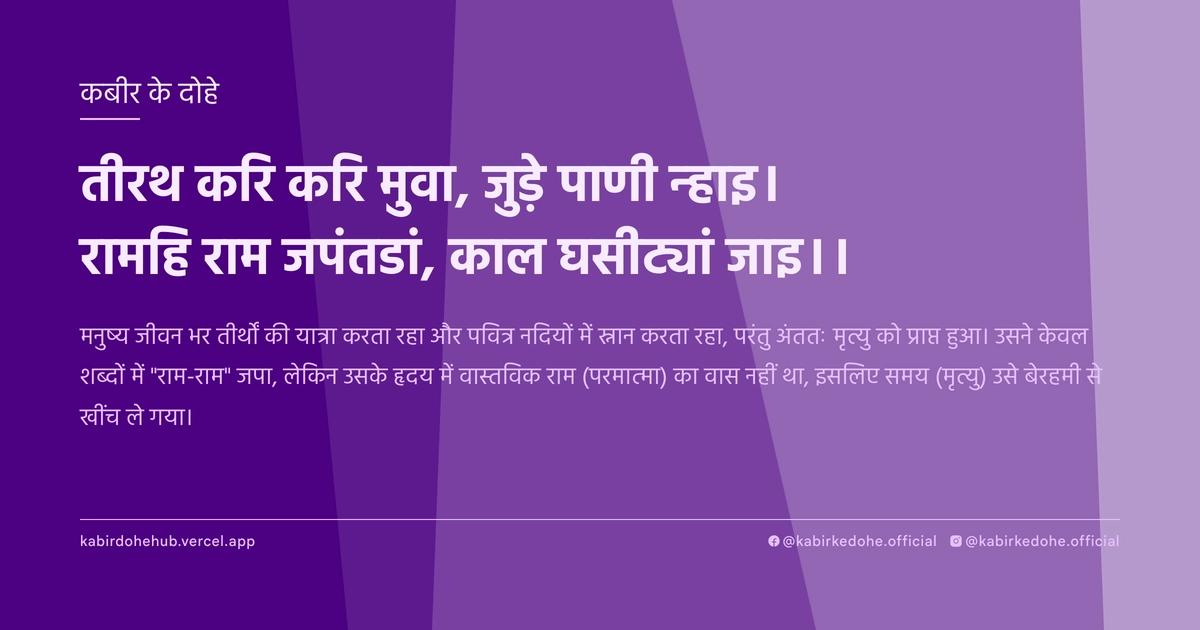
तीरथ करि करि मुवा, जुड़े पाणी न्हाइ।
रामहि राम जपंतडां, काल घसीट्यां जाइ।।
Teerath kari kari muva, jude paani nhai. Ramhi Ram japantadan, kaal ghaseetyan jaaye.
इस पृष्ठ पर इस कबीर दोहे का अर्थ (meaning), हिंदी व्याख्या और अंग्रेज़ी अनुवाद, दार्शनिक विश्लेषण और व्यावहारिक जीवन सीख दी गई है। यह दोहा कर्मकांड विरोध (Critique of Ritualism) विषय से जुड़ा है — Kabir doha meaning and explanation in Hindi and English.
अर्थ (Meaning):
मनुष्य जीवन भर तीर्थों की यात्रा करता रहा और पवित्र नदियों में स्नान करता रहा, परंतु अंततः मृत्यु को प्राप्त हुआ। उसने केवल शब्दों में "राम-राम" जपा, लेकिन उसके हृदय में वास्तविक राम (परमात्मा) का वास नहीं था, इसलिए समय (मृत्यु) उसे बेरहमी से खींच ले गया।
A person spends their entire life visiting pilgrimage sites and bathing in holy waters, yet eventually meets death without liberation. Though they chanted the name of 'Ram' mechanically, they never realized the Divine within; consequently, the inevitable force of Time drags them away into the void.
व्याख्या (Interpretation):
इस दोहे का शाब्दिक अर्थ बाहरी कर्मकांडों की व्यर्थता को दर्शाता है। कबीर यहाँ 'तीर्थ' और 'स्नान' को केवल शारीरिक क्रियाओं के रूप में देखते हैं, जो आत्मा की शुद्धि नहीं कर सकतीं। आध्यात्मिक स्तर पर, यह 'माया' के उस भ्रम की ओर संकेत है जहाँ मनुष्य सोचता है कि बाहरी क्रियाओं से आंतरिक परिवर्तन संभव है। 'राम' यहाँ दशरथ पुत्र राम नहीं, बल्कि 'निरुपाधिक' या 'निर्गुण' ब्रह्म हैं जो हर कण में व्याप्त हैं। जब तक साधक केवल शब्दों का जाप करता है और अहंकार को नहीं मिटाता, वह वास्तव में परमात्मा से नहीं जुड़ता। यह विरोधाभास है कि व्यक्ति जिसे पाने के लिए तीर्थ जाता है, वह उसके अपने भीतर ही मौजूद है, परंतु वह उसे बाहर खोजता रहता है। अंततः, काल (समय) उसे उसकी अज्ञानता के साथ ले जाता है क्योंकि उसने केवल 'रूप' की पूजा की, 'तत्व' की नहीं।
Literally, this couplet exposes the futility of external rituals. Kabir views 'pilgrimage' and 'bathing' as mere physical acts incapable of purifying the soul. Metaphorically, it points to the illusion of Maya, where humans believe external gestures can trigger internal transformation. 'Ram' here does not refer to the mythological king, but to the 'Nirgun' (formless) Brahman permeating every atom. As long as the seeker chants mechanically without dissolving the ego, they remain disconnected from the Divine. The central paradox lies in seeking externally that which is eternally internal. Ultimately, 'Kaal' (Time/Death) drags the soul away because the individual worshipped the 'form' rather than the 'essence,' remaining trapped in the cycle of ignorance.
दार्शनिक विश्लेषण (Philosophical Analysis):
कबीर का यह प्रहार उनके युग के गहरे धार्मिक पाखंड और कर्मकांडवाद के विरुद्ध था। उन्होंने देखा कि कैसे लोग मोक्ष की इच्छा तो रखते थे, लेकिन उसे केवल बाहरी प्रतीकों—जैसे गंगा स्नान या मंदिर यात्रा—में खोज रहे थे। यह दृष्टिकोण अद्वैत वेदांत के उस सिद्धांत से मेल खाता है जहाँ 'अहं ब्रह्मास्मि' (मैं ही ब्रह्म हूँ) की बात कही गई है। यदि ईश्वर सर्वव्यापी है, तो किसी विशेष भौगोलिक स्थान की यात्रा का कोई आध्यात्मिक औचित्य नहीं रह जाता।
सूफीवाद के प्रभाव में, कबीर 'इश्क-ए-हकीकी' (ईश्वरीय प्रेम) पर जोर देते हैं, जो केवल हृदय की गहराई में मिलता है, न कि किसी पत्थर की मूर्ति या पवित्र नदी में। उनके लिए, वास्तविक तीर्थ वह है जहाँ मनुष्य अपने अहंकार का विसर्जन करे। वे समझाते हैं कि 'नाम जप' तब तक व्यर्थ है जब तक वह केवल जीभ का व्यायाम है; जब तक वह ध्यान और आत्म-साक्षात्कार में नहीं बदलता, वह केवल एक मानसिक आदत है।
यहाँ 'काल' का उल्लेख केवल मृत्यु के रूप में नहीं, बल्कि उस समय के रूप में है जो निरंतर बीत रहा है और हमें चेतावनी दे रहा है। कबीर का दर्शन यह है कि मुक्ति किसी स्थान पर जाने से नहीं, बल्कि अपनी वर्तमान स्थिति में जागृत होने से मिलती है। वे जाति और धर्म के भेदों को नकारते हुए यह स्पष्ट करते हैं कि परमात्मा किसी विशेष संप्रदाय की बपौती नहीं है।
मनोवैज्ञानिक स्तर पर, यह दोहा 'पुष्टि' (Confirmation Bias) की बात करता है। मनुष्य को लगता है कि उसने तीर्थ जाकर पुण्य कमा लिया है, और यही झूठा संतोष उसे वास्तविक आध्यात्मिक खोज से रोकता है। यह एक प्रकार का 'आध्यात्मिक अहंकार' है जो उसे यह विश्वास दिलाता है कि वह सुरक्षित है, जबकि वह वास्तव में अज्ञान के गहरे गर्त में है।
अंततः, कबीर का संदेश यह है कि बाहरी शुद्धि एक भ्रम है। वास्तविक शुद्धि 'चित्त' की शुद्धि है। जब तक मनुष्य अपने भीतर के विकारों—काम, क्रोध, लोभ, मोह—को नहीं मारता, तब तक हज़ारों नदियों में स्नान करना भी व्यर्थ है। यह निर्गुण भक्ति का सार है: ईश्वर को बाहर खोजने के बजाय, स्वयं को जानना ही ईश्वर को जानना है।
Kabir's critique is a fierce assault on the deep-seated religious hypocrisy and ritualism of his era. He observed people yearning for salvation yet seeking it through external symbols—such as bathing in the Ganges or visiting temples. This aligns with the Advaita Vedanta principle of 'Aham Brahmasmi' (I am Brahman). If the Divine is omnipresent, the spiritual justification for traveling to a specific geographical location vanishes.
Influenced by Sufism, Kabir emphasizes 'Ishq-e-Haqiqi' (Divine Love), which is found only in the depths of the heart, not in stone idols or holy rivers. For him, the true pilgrimage is the dissolution of the ego. He argues that the repetition of a divine name is futile if it remains a mere exercise of the tongue; unless it evolves into deep meditation and self-realization, it is nothing more than a mental habit.
The mention of 'Kaal' (Time) serves not just as a reminder of death, but as a ticking clock warning the seeker. Kabir's philosophy posits that liberation is not achieved by going somewhere, but by awakening where one already is. By rejecting caste and sectarian divides, he clarifies that the Divine is not the monopoly of any specific creed.
Psychologically, this couplet addresses 'Confirmation Bias.' The believer feels a false sense of security and merit after completing a ritual, and this delusion prevents them from pursuing genuine spiritual inquiry. It is a form of 'spiritual ego' that masks the void of actual realization.
Ultimately, Kabir asserts that external purity is an illusion. True purity is the purification of the 'Chitta' (consciousness). Until one eradicates internal vices—lust, anger, greed, and attachment—bathing in a thousand rivers is meaningless. This is the essence of Nirgun Bhakti: instead of searching for God externally, knowing oneself is the only way to know the Divine.
मूल संदेश (Core Message):
- बाहरी कर्मकांड आत्मा की मुक्ति का मार्ग नहीं हैं।
- परमात्मा किसी स्थान में नहीं, बल्कि चेतना में है।
- बिना प्रेम और करुणा के किया गया जाप व्यर्थ है।
- अहंकार का विसर्जन ही वास्तविक तीर्थ यात्रा है।
- जीवन का अंतिम सत्य आंतरिक रूपांतरण है, बाहरी प्रदर्शन नहीं।
- External rituals are not the path to spiritual liberation.
- The Divine resides in consciousness, not in geographical locations.
- Chanting without love and compassion is a futile exercise.
- The dissolution of the ego is the only true pilgrimage.
- The ultimate truth of life is internal transformation, not external display.
व्यावहारिक उदाहरण (Practical Example):
वाराणसी के एक प्राचीन घाट पर माधव नाम का एक वृद्ध व्यक्ति रहता था। माधव का पूरा जीवन 'पुण्य' कमाने की होड़ में बीता। वह हर साल कुंभ जाता, हर सोमवार को गंगा में डुबकी लगाता और दिन भर माला जपते हुए शहर के सभी मंदिरों के चक्कर लगाता। वह खुद को बहुत धार्मिक मानता था और उन लोगों को तुच्छ समझता था जो इन रीति-रिवाजों का पालन नहीं करते थे।
माधव का एक बेटा था, जो बीमार और अत्यंत दुखी था। वह अक्सर माधव से कहता, "पिताजी, मुझे आपकी मालाओं से ज्यादा आपकी करुणा और समय की जरूरत है।" लेकिन माधव का उत्तर हमेशा यही होता, "मैं तुम्हारे लिए ही तो तीर्थ यात्रा कर रहा हूँ, ताकि तुम्हें पुण्य मिले।"
एक दिन माधव की मुलाकात एक फकीर से हुई, जो घाट की सीढ़ियों पर चुपचाप बैठा था। माधव ने गर्व से अपनी यात्राओं की सूची गिनाई। फकीर ने मुस्कुराकर पूछा, "माधव, तूने पानी में शरीर तो धो लिया, पर क्या उस क्रोध और अहंकार को धोया जो तुझे तेरे बेटे से दूर करता है?"
माधव को लगा कि फकीर उसका अपमान कर रहा है। उसने गुस्से में कहा, "मैं राम का नाम जपता हूँ!"
फकीर ने शांति से जवाब दिया, "राम नाम जीभ पर है, पर क्या वह तेरे व्यवहार में है? यदि राम तेरे भीतर हैं, तो तेरा बेटा तेरे पास दुखी क्यों है? तूने राम को पत्थरों और नदियों में खोजा, पर अपने घर के उस इंसान में नहीं खोजा जो वास्तव में राम का रूप है।"
यह बात माधव के हृदय में एक बिजली की तरह कौंधी। उसे एहसास हुआ कि वह जिस 'राम' को खोज रहा था, वह वास्तव में उसके भीतर की करुणा और प्रेम था, जिसे उसने कर्मकांडों के बोझ तले दबा दिया था।
उस रात माधव ने पहली बार अपनी माला किनारे रखी और अपने बेटे के सिर पर हाथ रखकर उसके दुख को महसूस किया। उसने महसूस किया कि एक आंसू जो सहानुभूति में गिरता है, वह हज़ारों तीर्थों के स्नान से अधिक पवित्र है।
माधव का व्यवहार बदल गया। अब वह मंदिरों में कम और सेवा में अधिक समय बिताने लगा। उसने सीखा कि वास्तविक तीर्थ वह है जहाँ अहंकार समाप्त हो और प्रेम का जन्म हो।
जब माधव की मृत्यु आई, तो उसके चेहरे पर एक ऐसी शांति थी जो उसने हज़ारों तीर्थ यात्राओं के बावजूद कभी महसूस नहीं की थी। वह अब 'काल' से डर नहीं रहा था, क्योंकि उसने अंततः अपने भीतर के राम को पा लिया था।
On an ancient ghat in Varanasi lived an elderly man named Madhav. Madhav's entire life was spent in a race to accumulate 'punya' (spiritual merit). Every year he attended the Kumbh Mela, bathed in the Ganges every Monday, and spent his days circling all the city's temples while chanting beads. He considered himself profoundly religious and looked down upon those who did not follow these rituals.
Madhav had a son who was chronically ill and deeply distressed. The son often told him, "Father, I need your compassion and time more than I need your prayer beads." But Madhav's answer was always, "I am performing these pilgrimages for you, so that you may receive the merit."
One day, Madhav encountered a fakir sitting silently on the steps of the ghat. Madhav proudly listed his travels and rituals. The fakir smiled and asked, "Madhav, you have washed your body in the water, but have you washed away the anger and ego that distance you from your son?"
Madhav felt insulted. He snapped, "I chant the name of Ram!"
The fakir replied calmly, "Ram's name is on your tongue, but is it in your conduct? If Ram resides within you, why is your son suffering in your presence? You searched for Ram in stones and rivers, but not in the human being in your own home, who is the true form of Ram."
These words struck Madhav like a bolt of lightning. He realized that the 'Ram' he was searching for was actually the compassion and love within him, which he had buried under the weight of rituals.
That night, for the first time, Madhav set aside his beads and placed his hand on his son's head, truly feeling his pain. He realized that a single tear shed in empathy is holier than bathing in a thousand pilgrimage sites.
Madhav's behavior transformed. He spent less time in temples and more time in selfless service. He learned that the true pilgrimage is where the ego ends and love begins.
When death finally came for Madhav, there was a peace on his face that he had never felt despite his countless journeys. He no longer feared 'Kaal,' for he had finally found the Ram within.
अभ्यास मार्गदर्शन (Practice Guidance):
- प्रतिदिन 20 मिनट मौन बैठें और विचार करें कि क्या आपके धार्मिक या नैतिक कार्य केवल बाहरी दिखावा हैं या वे आपके व्यवहार में बदलाव ला रहे हैं।
- एक 'अहंकार पत्रिका' (Ego Journal) बनाएँ। लिखें कि दिन भर में कितनी बार आपने अपनी श्रेष्ठता सिद्ध करने के लिए किसी नियम या परंपरा का सहारा लिया।
- व्यवहार परिवर्तन: किसी ऐसे व्यक्ति की निस्वार्थ सेवा करें जिससे आपका वैचारिक मतभेद हो, यह मानते हुए कि वह भी उसी परमात्मा का अंश है।
- निदान चेकलिस्ट: क्या मैं दूसरों को उनके विश्वासों के लिए आंकता हूँ? क्या मेरी शांति केवल मंदिर/मस्जिद में मिलती है या भीड़भाड़ वाले बाज़ार में भी? क्या मैं शब्दों के जाप से अधिक मौन की गहराई को महत्व देता हूँ?
- Sit in silence for 20 minutes daily and contemplate whether your religious or moral acts are mere external displays or if they are actually transforming your behavior.
- Maintain an 'Ego Journal.' Record every instance during the day where you used a rule or tradition to assert your superiority over others.
- Behavioral Shift: Perform selfless service for someone with whom you have a deep ideological conflict, acknowledging that they too are a manifestation of the Divine.
- Diagnostic Checklist: Do I judge others for their beliefs? Is my peace found only in temples/mosques, or does it persist in a crowded marketplace? Do I value the depth of silence more than the repetition of words?
चिंतन प्रश्न (Reflection Questions):
- यदि मेरे जीवन से सभी धार्मिक प्रतीक और रीति-रिवाज हटा दिए जाएँ, तो मेरे भीतर की आध्यात्मिकता का क्या बचेगा?
- मैं अपनी 'धार्मिक पहचान' का उपयोग दूसरों को छोटा महसूस कराने के लिए किस तरह करता हूँ?
- क्या मेरा 'राम' या 'ईश्वर' केवल एक शब्द है, या वह मेरे क्रोध और ईर्ष्या के क्षणों में मुझे रोकता है?
- मैं अपनी डिजिटल पहचान (सोशल मीडिया) पर जो 'आध्यात्मिक' छवि दिखाता हूँ, वह मेरे वास्तविक निजी जीवन से कितनी अलग है?
- क्या मैं वास्तव में सत्य की खोज कर रहा हूँ, या मैं केवल अपनी मान्यताओं की पुष्टि करने वाले प्रमाण खोज रहा हूँ?
- If all religious symbols and rituals were removed from my life, what would remain of my spirituality?
- In what ways do I use my 'religious identity' to make others feel inferior?
- Is my 'Ram' or 'God' merely a word, or does that presence actually restrain me during moments of anger and jealousy?
- How different is the 'spiritual' image I project on social media from the reality of my private life?
- Am I truly searching for the Truth, or am I merely seeking confirmation for my existing beliefs?