
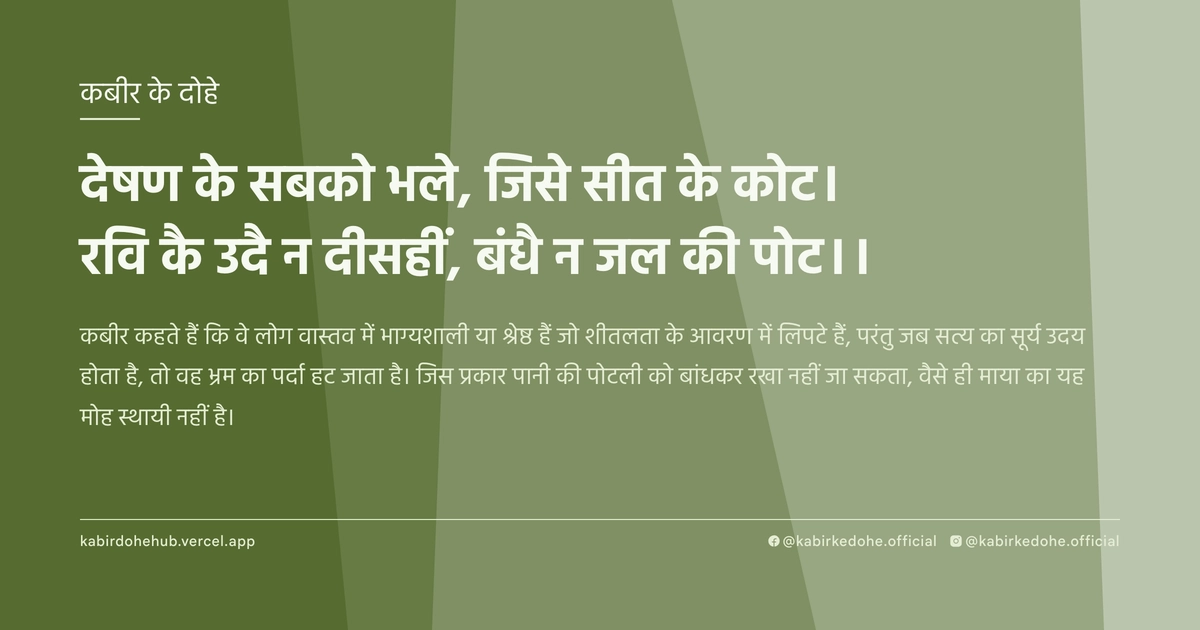
देषण के सबको भले, जिसे सीत के कोट।
रवि कै उदै न दीसहीं, बंधै न जल की पोट।।
Deshan ke sabko bhale, jise seet ke kot. Ravi kai udai na disehin, bandhai na jal ki pot.
इस पृष्ठ पर इस कबीर दोहे का अर्थ (meaning), हिंदी व्याख्या और अंग्रेज़ी अनुवाद, दार्शनिक विश्लेषण और व्यावहारिक जीवन सीख दी गई है। यह दोहा अहंकार (The Ego) विषय से जुड़ा है — Kabir doha meaning and explanation in Hindi and English.
अर्थ (Meaning):
कबीर कहते हैं कि वे लोग वास्तव में भाग्यशाली या श्रेष्ठ हैं जो शीतलता के आवरण में लिपटे हैं, परंतु जब सत्य का सूर्य उदय होता है, तो वह भ्रम का पर्दा हट जाता है। जिस प्रकार पानी की पोटली को बांधकर रखा नहीं जा सकता, वैसे ही माया का यह मोह स्थायी नहीं है।
Kabir suggests that those who believe they are secure in the cold comfort of ignorance or worldly illusions are mistaken. When the sun of spiritual realization rises, these veils vanish. Just as water cannot be contained in a cloth bundle, the illusions of the material world cannot be held onto forever.
व्याख्या (Interpretation):
यहाँ 'सीत के कोट' (ठंड का कोट) अज्ञानता और सांसारिक सुखों के उस सुरक्षात्मक आवरण का प्रतीक है जिसमें मनुष्य स्वयं को सुरक्षित महसूस करता है। कबीर इस विरोधाभास को रेखांकित करते हैं कि जिसे हम सुरक्षा समझते हैं, वह वास्तव में एक पर्दा है जो हमें सत्य से दूर रखता है। 'रवि' या सूर्य यहाँ आत्म-ज्ञान (Self-realization) का प्रतीक है। जब ज्ञान का उदय होता है, तो माया का सारा आडंबर नष्ट हो जाता है। यह निर्गुण भक्ति का सार है, जहाँ भक्त को यह समझना होता है कि भौतिक जगत की कोई भी वस्तु स्थायी नहीं है। जैसे जल को पोटली में नहीं बांधा जा सकता, वैसे ही चेतना को शरीर या अहंकार की सीमाओं में कैद नहीं किया जा सकता। यह अद्वैत वेदांत के उस सिद्धांत की पुष्टि करता है जहाँ आत्मा और ब्रह्म की एकता को पहचानने के लिए पहले मिथ्या अहंकार का विसर्जन आवश्यक है।
The 'coat of cold' serves as a metaphor for the insulating layer of ignorance and worldly attachments that provide a false sense of security. Kabir highlights the paradox where the very things we cling to for comfort are the barriers preventing our spiritual awakening. The 'Sun' represents the dawn of Gnosis or Atman-realization. When this light emerges, the artificial constructs of the ego dissolve instantly. This aligns with Nirgun Bhakti, emphasizing that the Divine is formless and cannot be captured by ritual or material possession. The analogy of the 'water bundle' illustrates the futility of trying to possess the infinite or the transient. It mirrors the Advaita Vedanta concept of Maya—the cosmic illusion—which appears real only until the light of truth reveals its emptiness, proving that the individual soul (Atman) is an inseparable part of the universal consciousness (Brahman).
दार्शनिक विश्लेषण (Philosophical Analysis):
कबीर का यह दोहा उनके युग के उस सामाजिक और धार्मिक परिवेश पर प्रहार करता है जहाँ लोग बाहरी कर्मकांडों और धार्मिक पहचानों (जैसे कि विशेष वस्त्र या तिलक) को अपनी आध्यात्मिक सुरक्षा मानते थे। वे इसे 'सीत के कोट' की तरह देखते हैं—एक ऐसा भ्रम जो केवल तब तक काम करता है जब तक कि व्यक्ति वास्तव में जागृत नहीं होता। कबीर ने जाति और धर्म के भेदों को पूरी तरह नकारा, क्योंकि उनके अनुसार ये सभी मानसिक निर्माण हैं जो सत्य को ढक लेते हैं।
दार्शनिक स्तर पर, यह सूफीवाद के 'फना' (अहंकार का विनाश) और वेदांत के 'माया' सिद्धांत का संगम है। सूफी मत में, जब तक साधक अपनी व्यक्तिगत पहचान (नफ्स) को नहीं मिटाता, वह ईश्वर से मिलन नहीं कर सकता। इसी तरह, कबीर कहते हैं कि जब तक हम अपनी सामाजिक और भौतिक पहचान के 'कोट' को नहीं उतारते, हम उस सार्वभौमिक सत्य को नहीं देख सकते जो सूर्य की तरह प्रज्वलित है।
यहाँ 'जल की पोटली' का उदाहरण अत्यंत गहरा है। जल प्रवाह का प्रतीक है, और पोटली बंधन का। यह इस बात की ओर संकेत करता है कि चेतना स्वभाव से मुक्त है। इसे किसी भी धर्म, संप्रदाय या भौतिक वस्तु में बांधने का प्रयास करना प्रकृति के विरुद्ध है। कबीर यहाँ यह स्पष्ट कर रहे हैं कि मोक्ष किसी बाहरी वस्तु को प्राप्त करने में नहीं, बल्कि उन भ्रमों को छोड़ने में है जिन्हें हमने अपनी पहचान मान लिया है।
मनोवैज्ञानिक रूप से, यह दोहा 'पुष्टि पूर्वाग्रह' (Confirmation Bias) की बात करता है। मनुष्य केवल उसी सत्य को देखना चाहता है जो उसे आरामदायक लगे। लेकिन आध्यात्मिक विकास तब शुरू होता है जब वह आरामदायक झूठ टूटता है। कबीर हमें चेतावनी देते हैं कि यह सुरक्षा का अहसास क्षणभंगुर है।
अंततः, यह दोहा हमें यह सिखाता है कि वास्तविक शांति बाहरी आवरणों में नहीं, बल्कि आंतरिक शून्यता और सत्य की स्वीकारोक्ति में है। जब हम यह जान लेते हैं कि हम न तो यह शरीर हैं और न ही यह सामाजिक पद, तब हम उस 'सूर्य' के प्रकाश में विलीन हो जाते हैं जहाँ कोई द्वैत नहीं बचता।
This couplet is a sharp critique of the socio-religious climate of Kabir's era, where individuals sought spiritual security through outward rituals, caste hierarchies, and religious symbols. Kabir views these as a 'coat of cold'—a psychological insulation that offers a false sense of warmth and safety while keeping the seeker isolated from the raw, scorching truth of existence. By rejecting the validity of these external markers, Kabir dismantles the structure of institutionalized religion in favor of a direct, personal experience of the Divine.
Philosophically, this work bridges the gap between the Sufi concept of 'Fana' (the annihilation of the self) and the Vedantic doctrine of 'Maya'. In Sufism, the ego (nafs) must be extinguished for the lover to merge with the Beloved. Similarly, Kabir argues that the 'coat' of identity must be shed before the light of the Atman can be perceived. He suggests that our identities—be they religious, professional, or social—are merely temporary garments that obscure our inherent divinity.
The metaphor of the 'water bundle' is a profound commentary on the nature of consciousness. Water represents the fluid, eternal flow of Spirit, while the bundle represents the attempt to categorize, label, and contain that Spirit within the limits of a human ego or a specific creed. Kabir asserts that attempting to bind the Infinite within the Finite is a logical impossibility and a spiritual tragedy.
From a psychological perspective, Kabir addresses the human tendency toward cognitive dissonance and the craving for comfort over truth. We prefer the 'cold coat' of a familiar lie to the 'burning sun' of an uncomfortable truth. However, spiritual evolution requires the courage to stand naked before the truth, stripped of all preconceived notions and social masks.
Ultimately, the poem teaches that liberation is not an acquisition of something new, but a subtraction of everything that is false. When the illusion of the separate self is dissolved, the duality between the seeker and the sought vanishes, leaving only the singular, radiant reality of the Nirgun Brahman.
मूल संदेश (Core Message):
- अहंकार का आवरण सत्य के प्रकाश को रोकता है।
- सांसारिक सुरक्षा एक भ्रम है, जो समय के साथ मिट जाता है।
- आत्मा को किसी भी सीमित पहचान में बांधना असंभव है।
- सच्ची मुक्ति अपनी बनावटी पहचान को त्यागने में है।
- ज्ञान का उदय होने पर सभी सांसारिक मोह नष्ट हो जाते हैं।
- The veil of ego obstructs the light of ultimate truth.
- Worldly security is a mirage that dissolves with time.
- The soul cannot be bound by any limited identity.
- True liberation lies in shedding the artificial self.
- All material attachments vanish upon the dawn of wisdom.
व्यावहारिक उदाहरण (Practical Example):
वाराणसी के एक पुराने घाट पर माधव नाम का एक वृद्ध बुनकर रहता था। माधव अपनी कला में इतना निपुण था कि उसके बनाए रेशमी वस्त्रों की मांग दूर-दूर तक थी। वह अपनी इस कला और उससे मिलने वाले सम्मान को ही अपनी असली पहचान मानता था। वह अक्सर कहता, "मेरी यह कला ही मेरा धर्म है, यही मेरी सुरक्षा है।"
माधव ने अपने जीवन भर की कमाई से एक बड़ा घर बनाया और अपने चारों ओर सुख-सुविधाओं का एक ऐसा 'कोट' तैयार किया कि उसे अब किसी की आवश्यकता नहीं थी। वह खुद को आध्यात्मिक रूप से श्रेष्ठ मानने लगा क्योंकि वह दान करता था, लेकिन उसका अहंकार उसकी रेशमी साड़ियों की तरह ही महीन और अदृश्य था।
एक दिन, शहर में एक फकीर आया जिसने माधव के अहंकार को पहचान लिया। फकीर ने माधव को एक चुनौती दी। उसने माधव से कहा, "तुम्हारी यह पहचान, यह सम्मान और यह घर—सब एक पोटली की तरह हैं। क्या तुम दिखा सकते हो कि तुम इस पोटली के बिना कौन हो?"
माधव हँसा और बोला, "मैं तो इस शहर का सबसे बड़ा कलाकार हूँ, मेरी पहचान मेरी कला है।"
फकीर ने मुस्कुराते हुए एक मिट्टी के बर्तन में पानी भरा और उसे एक कपड़े की पोटली में बांधने की कोशिश की। जैसे ही उसने पोटली कसी, पानी रिसकर बाहर निकल गया। फकीर ने कहा, "देखो माधव, जैसे यह पानी इस कपड़े में नहीं समा सकता, वैसे ही तुम्हारी आत्मा इस 'कलाकार' की पहचान में नहीं समा सकती। तुम जिसे अपनी सुरक्षा समझ रहे हो, वह केवल एक पर्दा है।"
उस रात माधव को नींद नहीं आई। उसने महसूस किया कि वह अपनी उपलब्धियों के 'कोट' में इतना लिपट गया था कि उसने अपने भीतर के वास्तविक मनुष्य को भुला दिया था। उसे समझ आया कि उसकी कला एक साधन थी, लेकिन उसने उसे ही अपना गंतव्य मान लिया था।
अगले कुछ महीनों में, माधव का व्यवहार बदलने लगा। उसने अपनी कला को जारी रखा, लेकिन अब वह उसे 'अपना' नहीं कहता था। वह अब रेशमी वस्त्रों को केवल धागे और रंग के रूप में देखता था, न कि अपनी श्रेष्ठता के प्रमाण के रूप में।
उसने अपने घर के दरवाजे उन लोगों के लिए खोल दिए जिन्हें समाज ने तिरस्कृत किया था। वह अब अपनी पहचान को अपनी कला से नहीं, बल्कि अपनी सेवा से जोड़ने लगा।
जब लोग उससे उसकी सफलता का राज पूछते, तो वह बस मुस्कुराकर कहता, "मैंने अपना कोट उतार दिया है, अब मुझे सूर्य की रोशनी महसूस होती है।"
माधव अब एक कलाकार से एक साधक बन चुका था। उसने जान लिया था कि वास्तविक सुरक्षा भौतिक उपलब्धियों में नहीं, बल्कि इस सत्य को स्वीकार करने में है कि हम इस संसार में केवल यात्री हैं, मालिक नहीं।
On an ancient ghat in Varanasi lived an elderly weaver named Madhav. Madhav was so skilled in his craft that his silk garments were coveted far and wide. He viewed his artistry and the prestige accompanying it as his true identity, often claiming, "My art is my religion; it is my only true security."
Over the years, Madhav used his earnings to build a grand house and surround himself with a 'coat' of luxuries, believing he had achieved a state of total stability. He began to perceive himself as spiritually superior because he gave alms, yet his ego remained as fine and invisible as the silk he wove.
One day, a wandering dervish arrived at the ghat and recognized the subtle pride in Madhav's eyes. The dervish challenged him, saying, "Your identity, your fame, and this house—they are all like a bundle. Can you show me who you are without this bundle?"
Madhav laughed and replied, "I am the greatest artist in this city; my identity is woven into my work."
The dervish smiled, filled a clay pot with water, and attempted to tie the water inside a cloth bundle. As soon as he tightened the knot, the water leaked out completely. The dervish remarked, "Look, Madhav, just as this water cannot be contained in a cloth, your soul cannot be contained within the identity of an 'artist'. What you consider your security is merely a veil."
That night, Madhav found no peace. He realized he had wrapped himself so tightly in the 'coat' of his achievements that he had forgotten the raw, authentic human being within. He understood that his art was meant to be a vehicle, but he had mistaken it for the destination.
Over the following months, Madhav's behavior underwent a profound shift. He continued to weave, but he no longer called the work 'his'. He began to see the silk garments as mere threads and dyes, rather than evidence of his superiority.
He opened the doors of his home to those marginalized by society, shifting his identity from a master craftsman to a humble servant of humanity.
When people asked about his newfound peace, he would simply smile and say, "I have shed my coat; now I can finally feel the warmth of the sun."
Madhav had evolved from an artist into a seeker. He had realized that true security does not lie in material or social acquisitions, but in the acceptance that we are merely travelers in this world, not its owners.
अभ्यास मार्गदर्शन (Practice Guidance):
- प्रतिदिन 20 मिनट मौन ध्यान करें, जहाँ आप अपनी सभी सामाजिक भूमिकाओं (पिता, पुत्र, कर्मचारी, विशेषज्ञ) को मानसिक रूप से उतार दें और केवल एक 'साक्षी' बनकर रहें।
- एक डायरी लिखें जिसमें आप उन तीन चीजों की सूची बनाएं जिन्हें आप अपनी 'पहचान' मानते हैं, और फिर विश्लेषण करें कि यदि ये चीजें कल छिन जाएं, तो आपके अस्तित्व का क्या बचेगा।
- व्यवहार परिवर्तन: दिन में एक बार ऐसा कार्य करें जिसमें आपको कोई श्रेय न मिले और जिसे कोई न देखे, ताकि आप 'पहचान के कोट' को उतारने का अभ्यास कर सकें।
- निदान चेकलिस्ट: क्या आप अपनी प्रशंसा सुनकर उत्साहित होते हैं? क्या आप अपनी उपलब्धियों के बिना खुद को अधूरा महसूस करते हैं? यदि हाँ, तो आप अभी भी 'सीत के कोट' में हैं।
- Practice 20 minutes of silent meditation daily, mentally stripping away all social roles (parent, child, employee, expert) and remaining only as a 'witness'.
- Maintain a journal listing three things you consider your 'identity', then analyze what would remain of your existence if these were stripped away tomorrow.
- Behavioral Shift: Perform one anonymous act of service daily where you receive no credit, practicing the art of shedding the 'coat of identity'.
- Diagnostic Checklist: Do you feel an emotional surge upon receiving praise? Do you feel incomplete without your achievements? If yes, you are still wrapped in the 'coat of cold'.
चिंतन प्रश्न (Reflection Questions):
- वह कौन सा 'कोट' (पहचान) है जिसे मैंने दुनिया के सामने सबसे गर्व से पहना है, और उसके पीछे मैं क्या छुपा रहा हूँ?
- यदि मेरी सारी डिजिटल पहचान (सोशल मीडिया, पद, प्रतिष्ठा) आज मिट जाए, तो क्या मैं स्वयं को स्वीकार कर पाऊंगा?
- मैं किन लोगों को अपनी 'श्रेष्ठता' के कारण कमतर आंकता हूँ, और यह श्रेष्ठता वास्तव में कितनी वास्तविक है?
- क्या मेरी आध्यात्मिक साधना वास्तव में मुझे मुक्त कर रही है, या यह केवल एक नया 'धार्मिक कोट' बन गई है?
- मेरे जीवन का वह कौन सा 'जल' (सत्य) है जिसे मैं अपनी इच्छाओं की 'पोटली' में बांधने की कोशिश कर रहा हूँ?
- What is the 'coat' (identity) I wear most proudly before the world, and what am I hiding behind it?
- If all my digital identities (social media, titles, prestige) vanished today, would I still be able to accept myself?
- Whom do I consider inferior due to my perceived 'superiority', and how real is that superiority actually?
- Is my spiritual practice truly liberating me, or has it simply become a new 'religious coat'?
- What is the 'water' (truth) in my life that I am desperately trying to bind within the 'bundle' of my desires?