
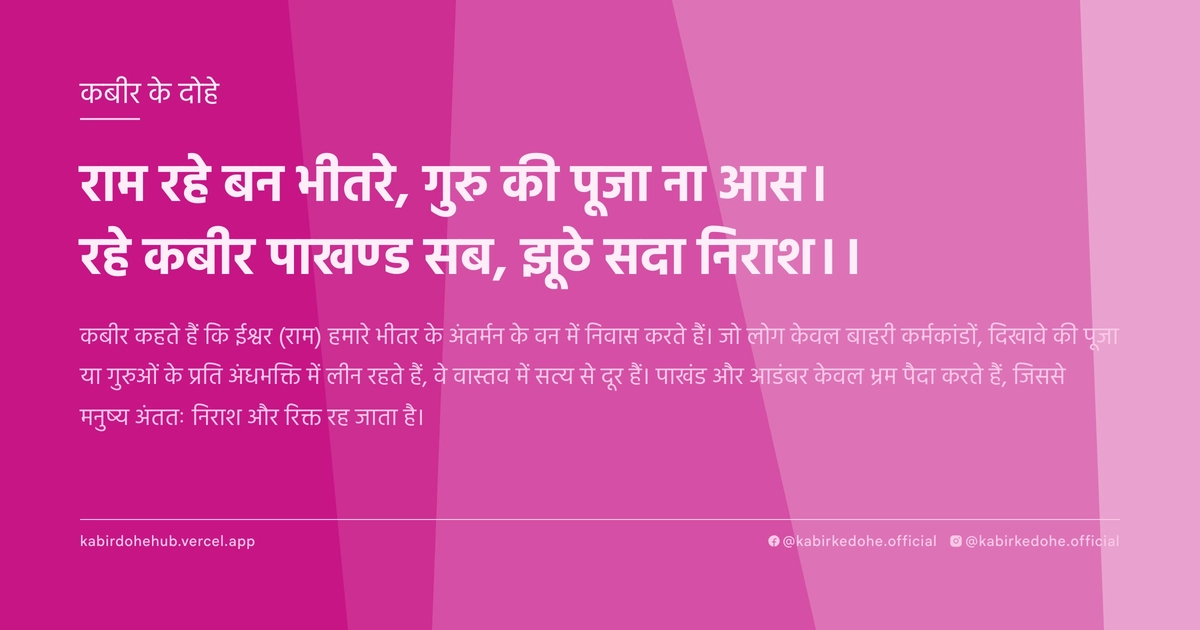
राम रहे बन भीतरे, गुरु की पूजा ना आस।
रहे कबीर पाखण्ड सब, झूठे सदा निराश।।
Ram rahe ban bhitare, guru ki puja na aas. Rahe Kabir pakhand sab, jhoothe sada nirash.
इस पृष्ठ पर इस कबीर दोहे का अर्थ (meaning), हिंदी व्याख्या और अंग्रेज़ी अनुवाद, दार्शनिक विश्लेषण और व्यावहारिक जीवन सीख दी गई है। यह दोहा कर्मकांड विरोध (Critique of Ritualism) विषय से जुड़ा है — Kabir doha meaning and explanation in Hindi and English.
अर्थ (Meaning):
कबीर कहते हैं कि ईश्वर (राम) हमारे भीतर के अंतर्मन के वन में निवास करते हैं। जो लोग केवल बाहरी कर्मकांडों, दिखावे की पूजा या गुरुओं के प्रति अंधभक्ति में लीन रहते हैं, वे वास्तव में सत्य से दूर हैं। पाखंड और आडंबर केवल भ्रम पैदा करते हैं, जिससे मनुष्य अंततः निराश और रिक्त रह जाता है।
Kabir asserts that the Divine (Ram) resides within the inner forest of one's own soul. Those who seek God through external rituals, superficial worship, or blind adherence to gurus without internal realization are chasing shadows. Hypocrisy and ritualistic pretension only lead to spiritual exhaustion and ultimate disappointment.
व्याख्या (Interpretation):
इस दोहे का शाब्दिक अर्थ है कि राम वन के भीतर हैं, लेकिन लोग बाहरी पूजा में उलझे हैं। रूपकात्मक रूप से, 'बन' (वन) मानव मन की जटिलताओं और अचेतन गहराई का प्रतीक है। कबीर यहाँ 'राम' को किसी व्यक्ति या मूर्ति के रूप में नहीं, बल्कि 'निरुपाधिक' ब्रह्म या शुद्ध चेतना के रूप में परिभाषित करते हैं। यह निर्गुण भक्ति का सार है, जहाँ ईश्वर को खोजने के लिए मंदिर या मस्जिद जाने की आवश्यकता नहीं है, बल्कि अंतर्मुखी होने की आवश्यकता है। माया हमें यह विश्वास दिलाती है कि सत्य बाहर है, जबकि अद्वैत वेदांत के अनुसार आत्मा और परमात्मा एक ही हैं। जब तक साधक बाहरी पाखंड को त्यागकर अपने भीतर नहीं झांकता, वह केवल एक अंतहीन चक्र में घूमता रहता है। यह विरोधाभास है कि हम जिसे पूरी दुनिया में खोज रहे हैं, वह हमारे अपने अस्तित्व की गहराई में छिपा है।
Literally, the verse suggests Ram resides in the forest, yet people cling to external worship. Metaphorically, the 'forest' represents the dense, untamed wilderness of the human psyche and the subconscious. Kabir defines 'Ram' not as a mythological figure, but as the formless Absolute (Nirgun Brahman) or pure consciousness. This is the essence of Nirgun Bhakti, where the Divine is accessed not through pilgrimage or idols, but through inwardness. Maya creates the illusion that truth is an external destination, whereas Advaita Vedanta posits the non-duality of Atman and Brahman. The central paradox is that the seeker is simultaneously the search and the destination. Until the practitioner discards the 'pakhand' (hypocrisy) of external performance, they remain trapped in a cycle of spiritual longing without fulfillment.
दार्शनिक विश्लेषण (Philosophical Analysis):
कबीर का यह दोहा उस युग की प्रतिक्रिया है जहाँ धर्म केवल कर्मकांडों, जातिगत श्रेष्ठता और पुरोहितवाद तक सीमित हो गया था। उन्होंने स्पष्ट रूप से उन धार्मिक ढांचों को चुनौती दी जो ईश्वर और भक्त के बीच एक मध्यस्थ (बिचौलिया) खड़ा करते थे। कबीर का दर्शन यहाँ सूफी मत के 'इन्सान-ए-कामिल' और वेदांत के 'आत्म-साक्षात्कार' का संगम है, जहाँ बाहरी आवरण का विसर्जन अनिवार्य है।
उनका 'पाखंड' शब्द केवल दूसरों के लिए नहीं, बल्कि स्वयं के अहंकार के लिए भी है। जब हम यह दावा करते हैं कि हम 'धार्मिक' हैं क्योंकि हम पूजा करते हैं, तो वह धार्मिकता ही हमारा सबसे बड़ा अवरोध बन जाती है। यह मनोवैज्ञानिक विस्थापन है, जहाँ व्यक्ति अपनी आंतरिक कमियों को बाहरी अनुष्ठानों से ढकने की कोशिश करता है।
निर्गुण भक्ति का मार्ग यह सिखाता है कि ईश्वर किसी विशेष आकार, रंग या स्थान में सीमित नहीं है। वह 'शून्य' भी है और 'पूर्ण' भी। कबीर के अनुसार, जो व्यक्ति केवल गुरु की पूजा करता है लेकिन गुरु द्वारा दिखाए गए मार्ग (अंतर्मुखता) पर नहीं चलता, वह केवल एक नए बंधन में बंध रहा है।
यहाँ सूफीवाद का प्रभाव दिखता है, जहाँ 'फना' (अहंकार का विनाश) के बिना 'बका' (परमात्मा में विलीन होना) संभव नहीं है। कबीर का प्रहार उन लोगों पर है जो धर्म को एक सामाजिक पहचान या प्रतिष्ठा का साधन मानते हैं।
अंततः, यह विश्लेषण हमें इस निष्कर्ष पर ले जाता है कि वास्तविक आध्यात्मिकता 'पाने' की प्रक्रिया नहीं, बल्कि 'छोड़ने' की प्रक्रिया है। जब हम अपनी धारणाओं, अपनी पहचान और अपने पाखंडों को छोड़ देते हैं, तब जो बचता है, वही राम है।
This couplet is a visceral reaction to an era where religion had devolved into mere ritualism, caste-based superiority, and priestly hegemony. Kabir explicitly challenges the structures that place a mediator between the seeker and the Divine. His philosophy here is a confluence of the Sufi concept of the 'Perfect Human' and the Vedantic realization of the Self, where the shedding of external layers is mandatory.
The term 'pakhand' (hypocrisy) refers not only to social pretense but to the ego's subtle deception. When we claim spiritual superiority based on the frequency of our prayers, that very piety becomes the primary obstacle to liberation. This is a psychological displacement where the individual attempts to mask internal voids with external performances.
Nirgun Bhakti teaches that the Divine is not confined to a specific form, color, or geography. The Absolute is simultaneously the Void (Shunya) and the Fullness (Purna). Kabir argues that one who worships the Guru as an idol rather than following the Guru's instruction toward inwardness is merely exchanging one chain for another.
There is a strong resonance with Sufism here, specifically the concept of 'Fana' (annihilation of the ego) as a prerequisite for 'Baqa' (eternal subsistence in God). Kabir attacks the commodification of faith, where religion is used as a tool for social status or identity politics.
Ultimately, this analysis reveals that true spirituality is not a process of acquisition, but a process of subtraction. When we strip away our assumptions, our curated identities, and our ritualistic masks, what remains is the essence—the Ram within.
मूल संदेश (Core Message):
- बाहरी आडंबर केवल आत्मा के मार्ग में बाधा हैं।
- सत्य किसी मंदिर या मस्जिद में नहीं, अंतर्मन में है।
- अंधभक्ति सत्य की खोज को बाधित करती है।
- अहंकार का त्याग ही वास्तविक पूजा है।
- ईश्वर का अनुभव मौन और ईमानदारी में है।
- External pretenses are merely obstacles on the soul's path.
- Truth resides not in temples or mosques, but within the inner self.
- Blind devotion obstructs the authentic search for Truth.
- The annihilation of ego is the only true act of worship.
- The experience of the Divine is found in silence and honesty.
व्यावहारिक उदाहरण (Practical Example):
वाराणसी के घाटों पर रहने वाले एक वृद्ध विधवा, जानकी, का जीवन केवल मंदिर की सीढ़ियों और माला जपने तक सीमित था। वह मानती थी कि जितना अधिक वह बाहरी अनुष्ठानों में समय बिताएगी, उसका मोक्ष उतना ही निश्चित होगा। वह अन्य महिलाओं को भी यही सलाह देती थी कि केवल कठोर नियमों का पालन ही ईश्वर तक पहुँचने का एकमात्र रास्ता है।
एक दिन, जानकी की मुलाकात एक फकीर से हुई जो घाट के किनारे चुपचाप बैठा था। फकीर ने उससे पूछा, 'तुम जिस राम को पत्थर की मूर्तियों में खोज रही हो, क्या तुमने कभी अपने भीतर के सन्नाटे को सुना है?' जानकी ने इसे अंधविश्वास कहकर नकार दिया और अपनी पूजा जारी रखी।
कुछ समय बाद, जानकी के जीवन में एक गहरा संकट आया। उसके परिवार ने उसे पूरी तरह भुला दिया और वह गंभीर बीमारी से घिर गई। अब उसके पास माला जपने की शक्ति भी नहीं बची थी और वह मंदिर जाने में असमर्थ थी। वह अत्यंत निराश और भयभीत हो गई क्योंकि उसे लगा कि उसकी 'पूजा' रुक गई है, तो ईश्वर उसे छोड़ देंगे।
अंधेरी रात में, जब वह बिस्तर पर पड़ी थी, उसे अचानक उस फकीर की बात याद आई। उसने पहली बार अपनी आँखें बंद कीं और बाहरी शोर को छोड़कर अपने भीतर के दर्द और सांसों पर ध्यान केंद्रित किया। उसने महसूस किया कि जिस शांति की तलाश में वह सालों तक घाटों पर भटकती रही, वह उसके अपने हृदय की धड़कन में मौजूद थी।
उसने महसूस किया कि उसकी अब तक की सारी पूजा केवल एक 'मुखौटा' थी ताकि वह अपने अकेलेपन और डर का सामना न कर सके। वह मंदिर की पूजा इसलिए करती थी ताकि वह समाज में 'पवित्र' दिख सके, न कि इसलिए कि वह वास्तव में परमात्मा से मिलना चाहती थी।
यह एक 'कबीर मोड़' था। जानकी ने महसूस किया कि उसकी निराशा का कारण ईश्वर की अनुपस्थिति नहीं, बल्कि उसका अपना पाखंड था। उसने बाहरी आडंबरों को त्याग दिया और अब वह केवल मौन में बैठती थी।
उसकी व्यवहारिक जीवन में बदलाव आया; वह अब दूसरों को नियमों के लिए नहीं टोकती थी, बल्कि उनके दुख में उनके साथ चुपचाप बैठती थी। उसकी करुणा अब किसी धार्मिक कर्तव्य से नहीं, बल्कि आंतरिक एकता के बोध से उपजी थी।
अंत में, जानकी ने पाया कि जब उसने 'राम' को बाहर खोजना बंद किया, तभी वह उसके भीतर प्रकट हुए। उसकी निराशा अब एक गहरे संतोष में बदल चुकी थी, क्योंकि उसने जान लिया था कि सत्य किसी मंदिर की देहली पर नहीं, बल्कि आत्मा के वन में मिलता है।
Janaki, an elderly widow living on the ghats of Varanasi, had spent her entire existence confined to temple steps and the rhythmic counting of prayer beads. She believed that the more she adhered to external rituals, the more certain her salvation would be. She frequently advised other women that strict adherence to orthopraxy was the only path to the Divine.
One day, Janaki encountered a wandering fakir sitting silently by the river. The fakir asked her, 'The Ram you seek in stone idols, have you ever heard Him in the silence of your own being?' Janaki dismissed this as heresy and continued her rigid rituals.
Some time later, a profound crisis struck Janaki's life. Her family completely abandoned her, and she fell gripped by a severe illness. She no longer had the strength to chant her beads, nor the physical ability to visit the temple. She became consumed by despair and fear, believing that since her 'worship' had stopped, God would abandon her.
In the depths of a dark night, lying on her bed, the fakir's words suddenly echoed in her mind. For the first time, she closed her eyes and, ignoring the external noise, focused on her own pain and the rhythm of her breath. She realized that the peace she had spent years searching for on the ghats was present in the very beat of her heart.
She recognized that all her previous worship had been a 'mask'—a way to avoid facing her own loneliness and fear. She had performed rituals not to meet the Divine, but to maintain a social image of 'purity' and 'piety.'
This was the 'Kabir Twist.' Janaki realized that her despair was not caused by God's absence, but by her own hypocrisy. She abandoned the external pretenses and began to simply sit in silence.
Her behavior changed fundamentally; she stopped policing others' adherence to rules and instead began to sit in silent empathy with those in pain. Her compassion was no longer a religious duty, but a natural outflow of an experienced inner unity.
Ultimately, Janaki discovered that the moment she stopped searching for 'Ram' outside, He manifested within. Her despair transformed into a profound contentment, for she had learned that truth is not found on a temple threshold, but in the forest of the soul.
अभ्यास मार्गदर्शन (Practice Guidance):
- प्रतिदिन 20 मिनट का 'मौन अवलोकन' करें, जहाँ आप किसी मंत्र या विचार के बिना केवल अपनी सांसों और आंतरिक ध्वनियों को सुनें।
- स्व-पूछताछ जर्नल: लिखें कि आपके कौन से धार्मिक या सामाजिक व्यवहार केवल 'दिखावे' के लिए हैं और आप उन्हें कैसे सरल बना सकते हैं।
- व्यवहारिक परिवर्तन: किसी ऐसे व्यक्ति की मदद करें जिसे समाज 'अपवित्र' या 'अपात्र' मानता है, यह महसूस करते हुए कि वही दिव्य तत्व उसमें भी है।
- नैदानिक चेकलिस्ट: क्या मैं पूजा इसलिए कर रहा हूँ क्योंकि मुझे शांति चाहिए, या इसलिए ताकि लोग मुझे 'धार्मिक' समझें? क्या मेरी शांति बाहरी परिस्थितियों पर निर्भर है?
- Practice 20 minutes of 'Silent Observation' daily, listening only to your breath and internal sounds without any mantras or curated thoughts.
- Self-Inquiry Journaling: List the religious or social behaviors you perform solely for 'image' and brainstorm how to simplify them into authentic acts.
- Behavioral Shift: Serve someone whom society deems 'impure' or 'unworthy,' consciously recognizing the same divine spark within them.
- Diagnostic Checklist: Am I practicing this ritual for inner peace, or to be perceived as 'spiritual' by others? Is my stability dependent on external validation?
चिंतन प्रश्न (Reflection Questions):
- मेरे जीवन का वह कौन सा 'धार्मिक मुखौटा' है जिसे मैं उतारने से डरता हूँ?
- यदि मेरी सारी बाहरी पहचान (जाति, धर्म, पद) छीन ली जाए, तो मेरे भीतर क्या बचेगा?
- क्या मैं वास्तव में सत्य की खोज कर रहा हूँ, या मैं केवल अपनी मान्यताओं की पुष्टि चाहता हूँ?
- मेरे भीतर का 'वन' कितना घना है, और क्या मैं उसमें अकेले चलने का साहस रखता हूँ?
- मैं अपनी आध्यात्मिक प्रगति को दूसरों की तुलना में कैसे मापता हूँ, और यह पाखंड कैसे है?
- What is the 'religious mask' in my life that I am most afraid to remove?
- If all my external identities (caste, religion, status) were stripped away, what would remain within me?
- Am I truly searching for Truth, or am I merely seeking confirmation of my existing beliefs?
- How dense is the 'forest' within me, and do I possess the courage to walk through it alone?
- How do I measure my spiritual progress against others, and in what way is this a form of hypocrisy?