
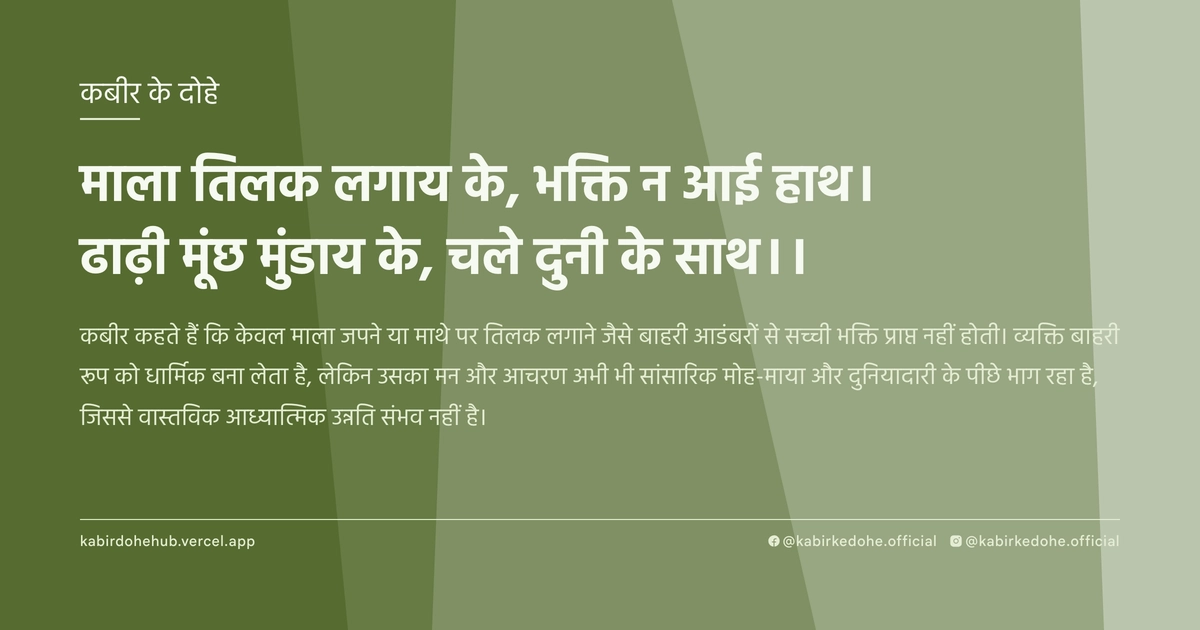
माला तिलक लगाय के, भक्ति न आई हाथ।
ढाढ़ी मूंछ मुंडाय के, चले दुनी के साथ।।
Maala tilak lagay ke, bhakti na aayi haath. Dhaadhi moonchh munday ke, chale duni ke saath.
इस पृष्ठ पर इस कबीर दोहे का अर्थ (meaning), हिंदी व्याख्या और अंग्रेज़ी अनुवाद, दार्शनिक विश्लेषण और व्यावहारिक जीवन सीख दी गई है। यह दोहा कर्मकांड विरोध (Critique of Ritualism) विषय से जुड़ा है — Kabir doha meaning and explanation in Hindi and English.
अर्थ (Meaning):
कबीर कहते हैं कि केवल माला जपने या माथे पर तिलक लगाने जैसे बाहरी आडंबरों से सच्ची भक्ति प्राप्त नहीं होती। व्यक्ति बाहरी रूप को धार्मिक बना लेता है, लेकिन उसका मन और आचरण अभी भी सांसारिक मोह-माया और दुनियादारी के पीछे भाग रहा है, जिससे वास्तविक आध्यात्मिक उन्नति संभव नहीं है।
Kabir asserts that true devotion cannot be attained simply through external rituals like wearing prayer beads or applying a sectarian mark on the forehead. While one may adopt the outward appearance of a devotee, if the inner consciousness remains enslaved to worldly desires and social conformity, the essence of spirituality remains elusive.
व्याख्या (Interpretation):
यह दोहा बाहरी दिखावे और आंतरिक सत्य के बीच के गहरे विरोधाभास को दर्शाता है। 'माला' और 'तिलक' यहाँ धार्मिक प्रतीकों के बजाय अहंकार के नए मुखौटों का प्रतिनिधित्व करते हैं। कबीर का तर्क है कि जब तक साधक 'माया' के प्रभाव से मुक्त नहीं होता, तब तक कर्मकांड केवल एक मानसिक सुरक्षा कवच हैं। यह निर्गुण भक्ति का सार है, जहाँ ईश्वर किसी मूर्ति या चिह्न में नहीं, बल्कि शुद्ध चेतना में निवास करता है। यहाँ 'दुनी के साथ चलना' का अर्थ है सामाजिक स्वीकृति की भूख और इंद्रिय सुखों के प्रति आसक्ति। अंततः, यह आत्मा और ब्रह्म के अद्वैत की ओर ले जाने वाले मार्ग में 'अहंकार' की बाधा को रेखांकित करता है।
This couplet highlights the profound paradox between external performance and internal realization. The 'beads' and 'tilak' serve not as spiritual tools, but as masks for the ego. Kabir argues that as long as the seeker is governed by 'Maya' (illusion), rituals are merely psychological shields. This aligns with Nirgun Bhakti, where the Divine is formless and resides in pure consciousness rather than in sectarian symbols. To 'walk with the world' signifies a craving for social validation and sensory gratification. Ultimately, it underscores the barrier of the ego in the journey toward the non-duality of Atman and Brahman, suggesting that true devotion requires the death of the false persona.
दार्शनिक विश्लेषण (Philosophical Analysis):
कबीर का यह प्रहार उस युग की सामाजिक और धार्मिक जड़ता के विरुद्ध था जहाँ धर्म केवल एक सामाजिक पहचान बन गया था। वे ritualism (कर्मकांड) का विरोध करते हैं क्योंकि यह व्यक्ति को सत्य से दूर ले जाकर एक झूठी श्रेष्ठता की भावना देता है। यह दृष्टिकोण अद्वैत वेदांत के करीब है, जहाँ 'अहं' का विसर्जन ही मोक्ष का एकमात्र मार्ग है।
सूफी मत के 'फना' (अहंकार का विनाश) की तरह, कबीर भी मानते हैं कि जब तक 'मैं' जीवित है, तब तक 'वह' (ईश्वर) प्रकट नहीं हो सकता। वे बताते हैं कि तिलक लगाना आसान है, लेकिन क्रोध, लोभ और मोह को त्यागना कठिन। बाहरी शुद्धि केवल शरीर की होती है, जबकि आंतरिक शुद्धि आत्मा की होती है।
ऐतिहासिक रूप से, कबीर ने जाति और धर्म के भेदों को चुनौती दी। उनके लिए भक्ति कोई विशेष वर्ग का विशेषाधिकार नहीं थी, बल्कि एक व्यक्तिगत अनुभव था। वे चेतावनी देते हैं कि धर्म जब प्रदर्शन बन जाता है, तो वह आध्यात्मिक प्रगति के बजाय एक बाधा बन जाता है।
मनोवैज्ञानिक स्तर पर, यह दोहा 'संज्ञानात्मक विसंगति' (cognitive dissonance) को दर्शाता है, जहाँ व्यक्ति खुद को धार्मिक मानता है लेकिन उसके कार्य सांसारिक वासनाओं से प्रेरित होते हैं। यह आत्म-धोखे की प्रक्रिया है जिसे कबीर बेनकाब करते हैं।
निष्कर्षतः, कबीर का दर्शन यह है कि ईश्वर को पाने के लिए किसी बाहरी उपकरण की आवश्यकता नहीं है। केवल अंतःकरण की पवित्रता और सत्य के प्रति ईमानदारी ही वास्तविक 'माला' है।
Kabir’s critique is a direct assault on the social and religious inertia of his era, where faith had devolved into a mere social identity. He rejects ritualism because it fosters a false sense of superiority, distracting the seeker from the actual labor of inner transformation. This perspective mirrors Advaita Vedanta, where the dissolution of the 'I' (Ahamkara) is the only path to liberation.
Similar to the Sufi concept of 'Fana' (annihilation of the self), Kabir posits that as long as the ego persists, the Divine cannot manifest. He emphasizes that applying a tilak is effortless, but eradicating greed, anger, and attachment is the true spiritual struggle. External purity is merely physical; internal purity is metaphysical.
Historically, Kabir challenged the caste and creed hierarchies of his time. For him, devotion was not a privilege of a specific class but a raw, personal experience. He warns that when religion becomes a performance, it transforms from a bridge to the Divine into a wall of separation.
Psychologically, this doha addresses 'cognitive dissonance,' where an individual identifies as spiritual while their actions remain driven by mundane desires. It is a process of self-deception that Kabir ruthlessly exposes to wake the seeker from their slumber.
In conclusion, Kabir’s philosophy asserts that no external tool is required to reach the Divine. The only authentic 'mala' is a heart purified by honesty and an unwavering commitment to Truth.
मूल संदेश (Core Message):
- बाहरी दिखावा आध्यात्मिक शून्य को नहीं भर सकता।
- सच्ची भक्ति हृदय की शुद्धि में है, प्रतीकों में नहीं।
- अहंकार का त्याग ही ईश्वर से मिलन की पहली शर्त है।
- धर्म प्रदर्शन नहीं, बल्कि एक आंतरिक रूपांतरण है।
- सत्य वह है जो पर्दे के पीछे भी अपरिवर्तित रहे।
- External displays cannot fill a spiritual void.
- True devotion lies in the purity of heart, not in symbols.
- The surrender of ego is the primary condition for Divine union.
- Faith is not a performance, but an internal transformation.
- Truth is that which remains unchanged even behind the curtain.
व्यावहारिक उदाहरण (Practical Example):
वाराणसी के एक पुराने घाट पर माधव नाम का एक वृद्ध नाविक रहता था। माधव हर समय गले में बड़ी सी माला पहनता और माथे पर गहरा तिलक लगाता था। वह शहर के सबसे बड़े 'भक्त' के रूप में जाना जाता था और अक्सर दूसरों को धर्म का उपदेश देता था।
लेकिन वास्तव में, माधव का मन लालच से भरा था। वह पर्यटकों से अधिक पैसे वसूलता और छोटी-छोटी बातों पर अपने साथी नाविकों से झगड़ता था। वह धर्म को एक व्यापार की तरह इस्तेमाल करता था ताकि लोग उस पर भरोसा करें और वह अधिक लाभ कमा सके।
एक दिन, एक मौन साधु उसकी नाव पर सवार हुए। साधु ने माधव के तिलक और माला को देखा और फिर उसकी आँखों में झाँका। साधु ने कुछ नहीं कहा, बस एक छोटा सा पत्थर पानी में फेंका और उसकी लहरों को देखने लगे।
माधव ने पूछा, 'महाराज, आप इस पत्थर में क्या देख रहे हैं?' साधु ने शांति से उत्तर दिया, 'मैं देख रहा हूँ कि कैसे पत्थर ऊपर से शांत दिखता है, लेकिन वह पानी की गहराई में डूब जाता है, ठीक वैसे ही जैसे तुम्हारा तिलक ऊपर से चमकता है, लेकिन तुम्हारा मन लालच की गहराई में डूबा है।'
यह बात माधव के हृदय पर चोट कर गई। उसे एहसास हुआ कि उसकी माला केवल एक धागा थी और तिलक केवल एक रंग, जबकि उसका जीवन वास्तव में धर्म से कोसों दूर था।
उस रात माधव सो नहीं सका। उसने अपनी माला उतार दी और यह सोचने लगा कि क्या वह वास्तव में ईश्वर को चाहता था या केवल ईश्वर के नाम पर सम्मान और पैसा।
अगले दिन से माधव ने अपना व्यवहार बदलना शुरू किया। उसने नाविकों के साथ ईमानदारी से काम करना शुरू किया और गरीबों की मदद करने लगा, बिना किसी को बताए कि वह ऐसा कर रहा है।
अब वह तिलक नहीं लगाता था, लेकिन उसके चेहरे पर एक ऐसी शांति थी जो पहले कभी नहीं देखी गई थी। उसने सीखा कि सच्ची भक्ति प्रदर्शन में नहीं, बल्कि सेवा और सत्य में है।
गाँव के लोग हैरान थे कि बिना माला के माधव अब अधिक 'धार्मिक' लगने लगा था। माधव ने जान लिया था कि बाहरी आवरण को हटाकर ही आंतरिक प्रकाश को पाया जा सकता है।
अंततः, माधव की नाव अब केवल लोगों को नदी पार नहीं कराती थी, बल्कि वह उनके जीवन में ईमानदारी और करुणा का संदेश भी पहुँचाने लगा था।
On an ancient ghat in Varanasi lived an elderly boatman named Madhav. Madhav always wore a large prayer bead necklace and a prominent tilak on his forehead. He was known as one of the city's most 'devout' men and frequently lectured others on righteousness.
In reality, Madhav's heart was consumed by greed. He overcharged tourists and frequently quarreled with fellow boatmen over petty disputes. He used religion as a business tool, leveraging his pious appearance to gain trust and maximize profit.
One day, a silent monk boarded his boat. The monk observed Madhav's tilak and beads, then looked deeply into his eyes. The monk said nothing; he simply tossed a small pebble into the river and watched the ripples.
Madhav asked, 'Master, what do you see in that stone?' The monk replied calmly, 'I see how the stone appears still on the surface but sinks into the depths, just as your tilak shines on the surface while your soul is drowned in the depths of greed.'
These words struck Madhav's heart like a thunderbolt. He realized that his beads were merely string and his tilak merely paint, while his actual life was miles away from any true spiritual path.
Madhav could not sleep that night. He removed his beads and contemplated whether he truly sought the Divine or merely the respect and money that came with the appearance of piety.
From the next day, Madhav began to change his behavior. He worked honestly with other boatmen and started helping the poor in secret, without announcing his charity to the world.
He stopped wearing the tilak, yet a serenity appeared on his face that had never been seen before. He learned that true devotion is not found in performance, but in service and truth.
The villagers were astonished that without his religious markers, Madhav seemed more 'spiritual' than ever. He had discovered that only by stripping away the outer shell could the inner light be found.
Ultimately, Madhav's boat no longer just transported people across the river; it became a vessel for the messages of honesty and compassion in their lives.
अभ्यास मार्गदर्शन (Practice Guidance):
- दैनिक आत्म-निरीक्षण: प्रतिदिन 15 मिनट मौन बैठें और विचार करें कि आपके कौन से कार्य केवल दूसरों को दिखाने के लिए हैं।
- अहंकार का विसर्जन: किसी ऐसे कार्य को गुप्त रूप से करें जिससे किसी की मदद हो, और सुनिश्चित करें कि किसी को भी आपके इस कार्य का पता न चले।
- जर्नलिंग प्रॉम्प्ट: 'यदि मेरी सभी धार्मिक और सामाजिक पहचानें छीन ली जाएं, तो मेरा वास्तविक स्वरूप क्या होगा?' इस पर गहराई से लिखें।
- डायग्नोस्टिक चेकलिस्ट: क्या मैं अपनी धार्मिक पहचान के कारण दूसरों को छोटा महसूस करता हूँ? क्या मेरी शांति बाहरी प्रशंसा पर निर्भर है? यदि हाँ, तो आप अभी भी 'दुनी के साथ' चल रहे हैं।
- Daily Self-Inquiry: Sit in silence for 15 minutes daily and identify which of your actions are performed solely for social validation.
- Dissolution of Ego: Perform an act of kindness in complete secrecy, ensuring that no one—not even the recipient—knows you were the source.
- Journaling Prompt: Write deeply on the question: 'If all my religious and social identities were stripped away, what would remain of my true self?'
- Diagnostic Checklist: Do I feel superior to others because of my spiritual practices? Is my inner peace dependent on external praise? If yes, you are still 'walking with the world'.
चिंतन प्रश्न (Reflection Questions):
- मेरे जीवन में ऐसे कौन से 'तिलक' हैं जिन्हें मैं अपनी कमियों को छिपाने के लिए उपयोग करता हूँ?
- क्या मेरी आध्यात्मिकता मुझे विनम्र बना रही है या मुझे दूसरों से श्रेष्ठ महसूस करा रही है?
- यदि समाज में मेरी धार्मिक छवि नष्ट हो जाए, तो क्या मेरा विश्वास बना रहेगा?
- मैं अपनी डिजिटल पहचान (सोशल मीडिया) पर कितनी 'आध्यात्मिकता' प्रदर्शित करता हूँ और वास्तव में कितना जीता हूँ?
- मेरे भीतर का वह कौन सा हिस्सा है जो अभी भी दुनिया की स्वीकृति के लिए तड़प रहा है?
- What are the 'tilaks' in my life that I use as shields to hide my internal flaws?
- Is my spirituality making me humble, or is it fueling a sense of superiority over others?
- If my religious image in society were destroyed, would my faith remain intact?
- How much 'spirituality' do I perform for my digital ego, and how much do I actually embody in private?
- Which part of me is still desperately craving the validation of the worldly crowd?