
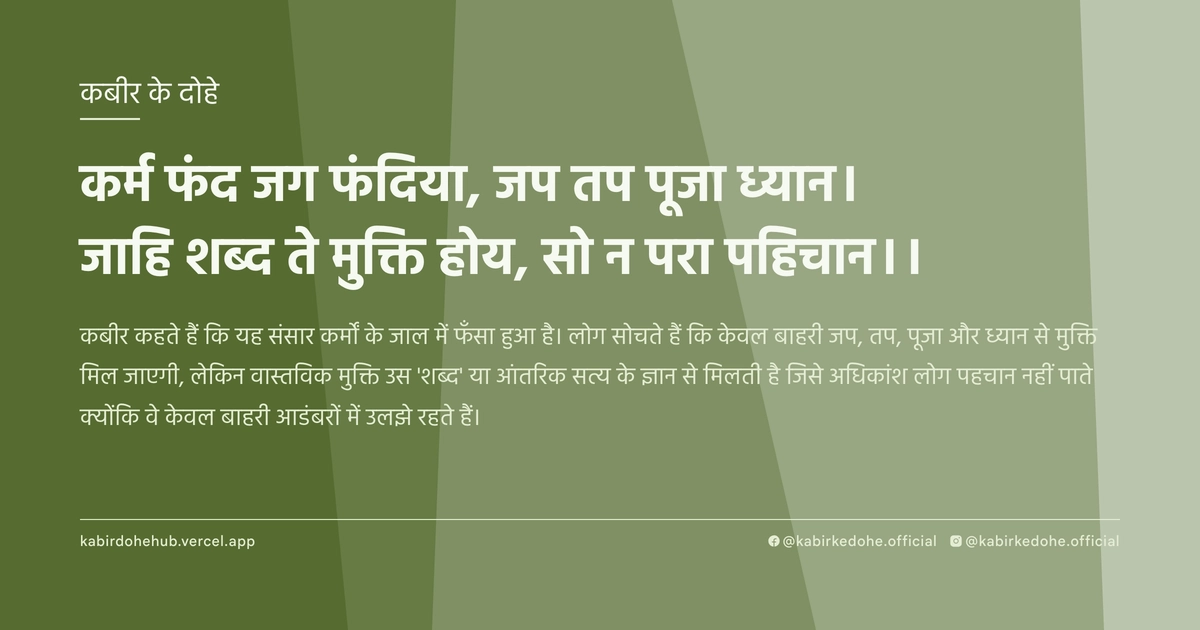
कर्म फंद जग फंदिया, जप तप पूजा ध्यान।
जाहि शब्द ते मुक्ति होय, सो न परा पहिचान।।
Karm phand jag phandiya, jap tap pooja dhyaan. Jaahi shabd te mukti hoye, so na para pahichaan.
इस पृष्ठ पर इस कबीर दोहे का अर्थ (meaning), हिंदी व्याख्या और अंग्रेज़ी अनुवाद, दार्शनिक विश्लेषण और व्यावहारिक जीवन सीख दी गई है। यह दोहा कर्मकांड विरोध (Critique of Ritualism) विषय से जुड़ा है — Kabir doha meaning and explanation in Hindi and English.
अर्थ (Meaning):
कबीर कहते हैं कि यह संसार कर्मों के जाल में फँसा हुआ है। लोग सोचते हैं कि केवल बाहरी जप, तप, पूजा और ध्यान से मुक्ति मिल जाएगी, लेकिन वास्तविक मुक्ति उस 'शब्द' या आंतरिक सत्य के ज्ञान से मिलती है जिसे अधिकांश लोग पहचान नहीं पाते क्योंकि वे केवल बाहरी आडंबरों में उलझे रहते हैं।
Kabir asserts that the world is ensnared in the web of karma. People believe that liberation is achieved through external rituals like chanting, austerity, worship, and meditation. However, true liberation comes from the realization of the 'Shabd' (the Divine Word/Inner Sound), which remains unrecognized by those blinded by superficial religious practices.
व्याख्या (Interpretation):
इस दोहे का शाब्दिक अर्थ है कि सांसारिक क्रियाएं और धार्मिक अनुष्ठान अक्सर बंधन बन जाते हैं। कबीर यहाँ 'फंद' (जाल) शब्द का प्रयोग कर रहे हैं, जो यह दर्शाता है कि जब धर्म केवल एक प्रदर्शन बन जाता है, तो वह मुक्ति का मार्ग नहीं बल्कि एक नया बंधन बन जाता है। यह निर्गुण भक्ति का सार है, जहाँ ईश्वर किसी मूर्ति या कर्मकांड में नहीं, बल्कि आत्मा के भीतर गूँजने वाले 'अनहद नाद' या शब्द में है। माया हमें यह विश्वास दिलाती है कि बाहरी अनुशासन से मोक्ष संभव है, जबकि अद्वैत वेदांत के अनुसार, जब तक 'मैं' (अहंकार) का विलोप नहीं होता, तब तक कोई भी पूजा फलदायी नहीं होती। यह विरोधाभास है कि हम जिसे मुक्ति का साधन मानते हैं, वही अक्सर हमारी आध्यात्मिक प्रगति में बाधा बन जाता है।
Literally, the verse suggests that worldly actions and religious rituals often become traps. Kabir uses the term 'phand' (snare) to illustrate that when spirituality becomes a performance, it ceases to be a path to liberation and instead becomes a new form of bondage. This is the essence of Nirgun Bhakti, where the Divine is not found in idols or rituals, but in the 'Anhad Naad' or the inner vibration of the Word. Maya deceives the seeker into believing that external discipline leads to salvation, whereas Advaita Vedanta teaches that no ritual is fruitful until the 'I' (ego) is annihilated. The central paradox is that the very tools we use for liberation—ritualistic prayer and austerity—often become the veils that hide the Truth from us.
दार्शनिक विश्लेषण (Philosophical Analysis):
कबीर का यह दोहा उनके युग के धार्मिक पाखंड पर एक तीखा प्रहार है। 15वीं शताब्दी में, धर्म अक्सर जातिगत श्रेष्ठता और जटिल कर्मकांडों का साधन बन गया था। कबीर ने इस बात को पहचाना कि ब्राह्मणवादी कर्मकांड और सूफी बाहरी स्वरूप, दोनों ही यदि हृदय की शुद्धता के बिना किए जाएं, तो वे केवल अहंकार को पुष्ट करते हैं। वे यहाँ 'कर्म' को केवल कार्य नहीं, बल्कि उस मानसिक आसक्ति के रूप में देखते हैं जो मनुष्य को जन्म-मरण के चक्र में बांधती है।
अद्वैत वेदांत के परिप्रेक्ष्य में, यह दोहा 'अविद्या' (अज्ञान) की चर्चा करता है। जब साधक यह मानता है कि वह पूजा के माध्यम से ईश्वर को 'प्राप्त' करेगा, तो वह द्वैत (duality) को जन्म देता है—एक करने वाला और एक प्राप्त करने वाला। कबीर इस द्वैत को मिटाने की बात करते हैं। उनके लिए 'शब्द' वह सेतु है जो व्यक्ति को उसके वास्तविक स्वरूप (ब्रह्म) से जोड़ता है। यह शब्द कोई बाहरी मंत्र नहीं, बल्कि वह चेतना है जो मौन में सुनाई देती है।
सूफी मत के 'ज़िक्र' और 'फना' की अवधारणा यहाँ स्पष्ट दिखती है। जिस प्रकार सूफीवाद में अहंकार का विनाश (फना) आवश्यक है, वैसे ही कबीर कहते हैं कि जब तक 'पहचान' (अहंकार युक्त पहचान) बनी रहेगी, तब तक मुक्ति संभव नहीं है। वे चेतावनी देते हैं कि जप और तप यदि अहंकार को बढ़ाते हैं ('मैं तपस्वी हूँ'), तो वे मुक्ति के मार्ग में सबसे बड़ी बाधा हैं।
मनोवैज्ञानिक स्तर पर, यह दोहा 'कंडीशनिंग' की बात करता है। समाज हमें सिखाता है कि धर्म का अर्थ है मंदिर जाना या माला फेरना। कबीर इस कंडीशनिंग को तोड़कर हमें अंतर्मुखी होने के लिए प्रेरित करते हैं। वे तर्क देते हैं कि सत्य 'बाहर' नहीं, बल्कि 'भीतर' है, और बाहरी शोर (अनुष्ठान) आंतरिक संगीत (शब्द) को सुनने नहीं देता।
अंततः, कबीर का संदेश यह है कि मुक्ति किसी क्रिया (Doing) का परिणाम नहीं है, बल्कि एक बोध (Being) है। जब हम 'करने' की इच्छा को छोड़कर केवल 'होने' की अवस्था में आते हैं, तब वह शब्द स्वतः प्रकट होता है। यह कर्मकांड से चेतना की ओर संक्रमण है, जहाँ धर्म एक सामाजिक पहचान के बजाय एक व्यक्तिगत अनुभव बन जाता है।
This couplet is a piercing critique of the religious hypocrisy prevalent during Kabir's era. In the 15th century, religion had largely become a tool for caste superiority and complex ritualism. Kabir recognized that both Brahmanical rituals and the external forms of Sufism, if performed without purity of heart, served only to reinforce the ego. He views 'Karma' not merely as action, but as the mental attachment that binds the human soul to the cycle of birth and death.
From the perspective of Advaita Vedanta, this verse addresses 'Avidya' (ignorance). When a seeker believes they can 'attain' God through worship, they create duality—a doer and a receiver. Kabir advocates for the dissolution of this duality. For him, the 'Shabd' (Word) is the bridge that connects the individual to their true nature (Brahman). This Word is not an external mantra but the consciousness that resonates in absolute silence.
The Sufi concepts of 'Zikr' (remembrance) and 'Fana' (annihilation) are evident here. Just as Sufism requires the annihilation of the ego, Kabir suggests that as long as the 'identity' (the ego-driven self) persists, liberation is impossible. He warns that if chanting and austerity increase the sense of pride ('I am an ascetic'), they become the greatest obstacles to liberation.
Psychologically, the verse speaks to the concept of social conditioning. Society teaches that religion equals visiting temples or counting beads. Kabir urges us to break this conditioning and turn inward. He argues that Truth is not 'out there' but 'in here,' and the external noise of rituals prevents one from hearing the internal music of the soul.
Ultimately, Kabir's message is that liberation is not the result of 'Doing' but a state of 'Being.' When we cease the desire to achieve and simply exist in presence, the Word reveals itself. This is a transition from ritualism to consciousness, where religion ceases to be a social identity and becomes a direct, personal experience.
मूल संदेश (Core Message):
- बाहरी कर्मकांड अक्सर आत्मा की वास्तविक पुकार को दबा देते हैं।
- मुक्ति किसी क्रिया का परिणाम नहीं, बल्कि अहंकार के विलोपन का परिणाम है।
- सच्चा धर्म वह है जो हमें 'श्रेष्ठ' नहीं, बल्कि 'शून्य' बनाता है।
- आंतरिक मौन ही वह 'शब्द' है जो जन्म-मरण के बंधन को काटता है।
- भक्ति जब प्रदर्शन बन जाती है, तो वह बंधन बन जाती है।
- External rituals often stifle the authentic call of the soul.
- Liberation is not the result of an action, but the result of the ego's annihilation.
- True spirituality is that which makes us 'empty' rather than 'superior.'
- Inner silence is the 'Word' that severs the bonds of birth and death.
- When devotion becomes a performance, it transforms into a bondage.
व्यावहारिक उदाहरण (Practical Example):
वाराणसी के एक पुराने मोहल्ले में माधव नाम का एक वृद्ध बुनकर रहता था। माधव का पूरा जीवन धर्म के नाम पर बीता था। वह हर सुबह गंगा स्नान करता, घंटों माला जपता और शहर के सबसे बड़े मंदिर में दान देता था। उसे गर्व था कि वह अपने क्षेत्र का सबसे 'धार्मिक' व्यक्ति है। वह अक्सर दूसरों को उपदेश देता कि बिना कठिन तप और पूजा के मोक्ष संभव नहीं है।
एक दिन, माधव की मुलाकात एक फकीर से हुई जो मंदिर की सीढ़ियों पर चुपचाप बैठा था। फकीर के पास न माला थी, न कोई विशेष वस्त्र। माधव ने उससे पूछा, 'तुम यहाँ बैठे समय बर्बाद कर रहे हो, क्या तुम जप और तप नहीं करते? मुक्ति कैसे मिलेगी?'
फकीर ने मुस्कुराकर कहा, 'माधव, तुम जिस माला को फेर रहे हो, क्या वह तुम्हारे भीतर के शोर को शांत कर रही है या केवल तुम्हारी उंगलियों को व्यस्त रख रही है?' माधव को यह बात चुभ गई, लेकिन उसने अहंकार में उत्तर दिया, 'मैं वर्षों से तपस्या कर रहा हूँ!'
फकीर ने माधव को एक प्रयोग करने को कहा। उसने कहा, 'कल सुबह जब तुम गंगा में डुबकी लगाओ, तो यह मत सोचना कि तुम पाप धो रहे हो। बस यह देखना कि पानी तुम्हारे शरीर को कैसे छू रहा है और उस समय तुम्हारे मन में कौन सा विचार आ रहा है।'
अगले दिन माधव ने ऐसा ही किया। जैसे ही वह पानी में उतरा, उसने महसूस किया कि उसका मन 'पुण्य' कमाने की लालसा से भरा था। वह पूजा नहीं कर रहा था, बल्कि एक सौदा कर रहा था—'मैं इतनी पूजा करूँगा, तो ईश्वर मुझे स्वर्ग देंगे।' उसे अचानक अहसास हुआ कि उसकी सारी पूजा वास्तव में उसके अहंकार की खुराक थी।
उसने महसूस किया कि वह 'मुक्ति' के नाम पर एक नए जाल में फँस गया था। वह जितना अधिक 'धार्मिक' बन रहा था, उतना ही वह दूसरों से श्रेष्ठ महसूस करने लगा था। यह श्रेष्ठता का भाव ही उसका सबसे बड़ा बंधन था।
माधव ने उस दिन माला फेरना बंद नहीं किया, लेकिन माला फेरने का उद्देश्य बदल गया। अब वह पुण्य कमाने के लिए नहीं, बल्कि अपने भीतर के अहंकार को देखने के लिए शांत बैठता था। उसने पाया कि जब वह 'मैं तपस्वी हूँ' के विचार को छोड़ देता है, तब उसके भीतर एक असीम शांति का अनुभव होता है।
उसने समझा कि असली 'शब्द' वह मौन था जो उसकी सारी पहचानों—बुनकर, भक्त, दानवीर—के मिट जाने के बाद बचता था। माधव अब मंदिर तो जाता था, लेकिन अब वह वहां कुछ मांगने या दिखाने नहीं, बल्कि उस विराट शून्य में विलीन होने जाता था।
In an old lane of Varanasi lived an elderly weaver named Madhav. Madhav's entire life was dedicated to religion. He bathed in the Ganges every morning, spent hours chanting with beads, and donated generously to the city's largest temple. He took immense pride in being the most 'religious' man in his neighborhood, often lecturing others that salvation was impossible without rigorous austerity and worship.
One day, Madhav encountered a wandering dervish sitting silently on the temple steps. The dervish had no beads, no special robes, and no ritualistic tools. Madhav asked him, 'Why are you wasting your time sitting here? Do you not practice chanting and austerity? How will you achieve liberation?'
The dervish smiled and replied, 'Madhav, the beads you are turning—are they silencing the noise within you, or are they merely keeping your fingers busy?' Madhav felt stung by the remark, but replied arrogantly, 'I have been practicing austerity for years!'
The dervish proposed an experiment. He said, 'Tomorrow morning, when you dip into the Ganges, do not think about washing away your sins. Simply observe how the water touches your body and notice which thought arises in your mind at that moment.'
Madhav did exactly that the next morning. As he submerged himself, he realized his mind was filled with a craving for 'merit.' He wasn't worshipping; he was negotiating—'If I perform this much worship, God will grant me heaven.' He suddenly realized that all his rituals were merely feeding his ego.
He understood that in the name of 'liberation,' he had fallen into a new trap. The more 'religious' he became, the more he felt superior to others. This sense of superiority was his greatest bondage.
Madhav did not stop using his beads, but the purpose of the practice changed. He no longer sat in silence to earn merit, but to observe the arising of his own ego. He discovered that when he let go of the thought 'I am an ascetic,' a profound, boundless peace emerged.
He realized that the true 'Shabd' was the silence that remained after all his identities—weaver, devotee, philanthropist—had dissolved. Madhav continued to visit the temple, but no longer to ask for something or to show his piety, but to merge into the vast emptiness.
अभ्यास मार्गदर्शन (Practice Guidance):
- प्रतिदिन 20 मिनट 'साक्षी भाव' का अभ्यास करें: अपनी प्रार्थनाओं या मंत्रों के दौरान यह देखें कि क्या आप पुण्य कमाने की इच्छा से ऐसा कर रहे हैं या वास्तव में समर्पित हैं।
- आत्म-पूछताछ जर्नल: प्रतिदिन लिखें कि आज आपने कितनी बार अपनी धार्मिक या नैतिक श्रेष्ठता का उपयोग दूसरों को छोटा महसूस कराने के लिए किया।
- मौन का अभ्यास: सप्ताह में एक दिन ऐसा रखें जहाँ आप किसी भी बाहरी धार्मिक अनुष्ठान को न करें और केवल अपनी सांसों के संगीत (शब्द) को सुनने का प्रयास करें।
- डायग्नोस्टिक चेकलिस्ट: यदि आप पूजा के बाद अधिक 'पवित्र' महसूस करते हैं और दूसरों को 'अपवित्र' देखते हैं, तो आप अभी भी 'फंद' (जाल) में हैं। यदि पूजा के बाद आपका अहंकार मिटता है और करुणा बढ़ती है, तो आप सही मार्ग पर हैं।
- Practice 'Witness Consciousness' for 20 minutes daily: During your prayers or mantras, observe whether you are acting out of a desire for merit or genuine surrender.
- Self-Inquiry Journaling: Daily record instances where you used your religious or moral superiority to make others feel inferior.
- Practice of Silence: Dedicate one day a week to abstain from all external religious rituals and instead attempt to listen to the music of your breath (the Shabd).
- Diagnostic Checklist: If after worship you feel more 'pure' and perceive others as 'impure,' you are still in the 'phand' (trap). If worship leads to the dissolution of ego and an increase in compassion, you are on the right path.
चिंतन प्रश्न (Reflection Questions):
- क्या मेरी आध्यात्मिक साधना मुझे अधिक विनम्र बना रही है, या यह मेरे भीतर एक सूक्ष्म अहंकार पैदा कर रही है कि मैं 'जागरूक' हूँ?
- यदि मुझसे मेरे सभी धार्मिक लेबल (जाति, संप्रदाय, पद) छीन लिए जाएं, तो मेरी वास्तविक पहचान क्या बचेगी?
- मैं किन बाहरी अनुष्ठानों के पीछे छिपकर अपने आंतरिक खालीपन और डर से भाग रहा हूँ?
- क्या मैं ईश्वर को खोज रहा हूँ, या मैं केवल अपनी मान्यताओं की पुष्टि करने वाला एक दर्पण खोज रहा हूँ?
- मेरे जीवन में 'शब्द' (सत्य) की गूँज कहाँ है—मेरे शब्दों में, या मेरे मौन में?
- Is my spiritual practice making me more humble, or is it creating a subtle ego that I am 'awakened'?
- If all my religious labels (caste, sect, title) were stripped away, what would remain of my true identity?
- Behind which external rituals am I hiding to escape my internal emptiness and fear?
- Am I searching for the Divine, or am I merely searching for a mirror that confirms my existing beliefs?
- Where does the resonance of the 'Word' (Truth) lie in my life—in my speech, or in my silence?