
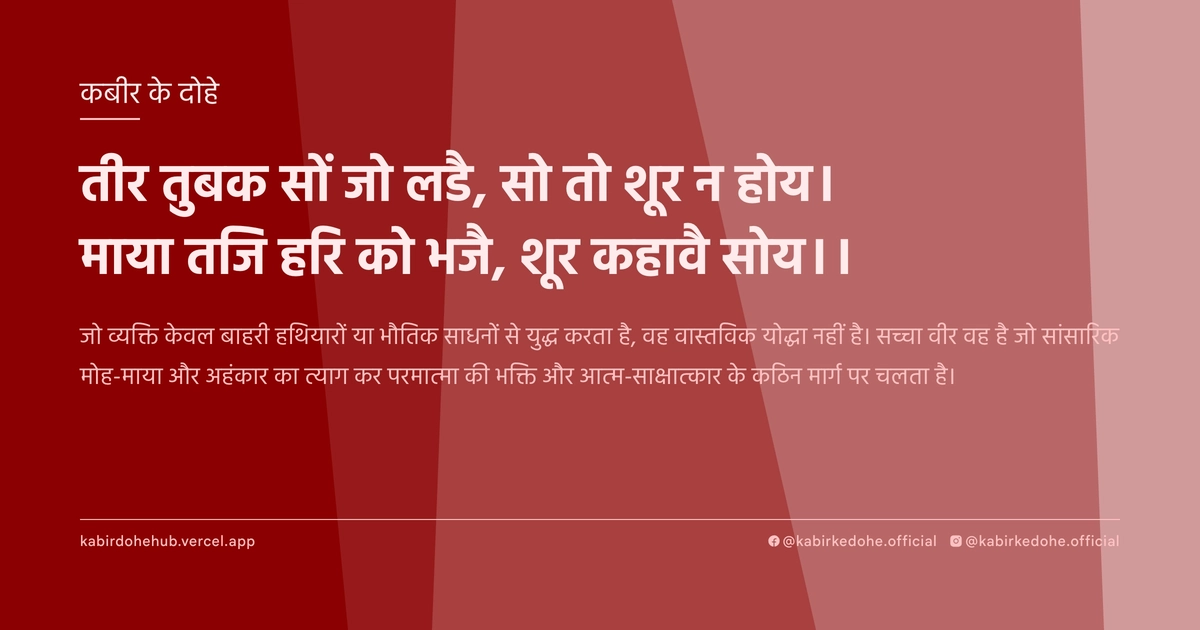
तीर तुबक सों जो लडै, सो तो शूर न होय।
माया तजि हरि को भजै, शूर कहावै सोय।।
Teer tubak son jo ladai, so to shoor na hoye. Maya taji hari ko bhajai, shoor kahavai soy.
इस पृष्ठ पर इस कबीर दोहे का अर्थ (meaning), हिंदी व्याख्या और अंग्रेज़ी अनुवाद, दार्शनिक विश्लेषण और व्यावहारिक जीवन सीख दी गई है। यह दोहा वैराग्य (Detachment) विषय से जुड़ा है — Kabir doha meaning and explanation in Hindi and English.
अर्थ (Meaning):
जो व्यक्ति केवल बाहरी हथियारों या भौतिक साधनों से युद्ध करता है, वह वास्तविक योद्धा नहीं है। सच्चा वीर वह है जो सांसारिक मोह-माया और अहंकार का त्याग कर परमात्मा की भक्ति और आत्म-साक्षात्कार के कठिन मार्ग पर चलता है।
One who fights using mere arrows and physical weapons cannot be called a true warrior. The real hero is the one who renounces the illusions of Maya and devotes themselves to the Divine, conquering the internal battle of the ego.
व्याख्या (Interpretation):
कबीर यहाँ 'शूर' (वीर) की परिभाषा को भौतिक युद्ध से हटाकर आध्यात्मिक युद्ध की ओर ले जाते हैं। 'तीर तुबक' बाहरी संघर्षों और अहंकारपूर्ण प्रदर्शन का प्रतीक हैं। वास्तविक युद्ध बाहरी दुनिया में नहीं, बल्कि अंतर्मन में है जहाँ माया (भ्रम) मनुष्य को सत्य से दूर रखती है। निर्गुण भक्ति के अनुसार, जब साधक अपनी पहचान को भौतिक उपलब्धियों से हटाकर निराकार ब्रह्म में विलीन करता है, तब वह वास्तविक वीरता प्राप्त करता है। यह अद्वैत वेदांत के उस सिद्धांत को दर्शाता है जहाँ आत्मा का परमात्मा से मिलन ही अंतिम विजय है।
Kabir redefines the concept of a 'Shoor' (warrior), shifting the battlefield from the external world to the internal landscape of the soul. The 'arrows and weapons' symbolize the superficial conflicts and the ego-driven pursuit of dominance. The true battle is against Maya—the cosmic illusion that veils the non-dual nature of reality. In the context of Nirgun Bhakti, the warrior is not he who conquers lands, but he who conquers the 'I-consciousness'. This reflects the Advaita Vedanta principle where the annihilation of the separate self is the only victory that matters, bridging the gap between Atman and Brahman.
दार्शनिक विश्लेषण (Philosophical Analysis):
कबीर का यह दोहा उस युग की सामाजिक और धार्मिक पृष्ठभूमि में लिखा गया था जहाँ वीरता को केवल युद्ध कौशल और जातिगत श्रेष्ठता से जोड़ा जाता था। कबीर ने इस धारणा को चुनौती देते हुए वीरता का 'आध्यात्मिकीकरण' किया। उन्होंने स्पष्ट किया कि शस्त्रों से जीता गया क्षेत्र अस्थायी है, जबकि मन पर विजय स्थायी है।
यह विचार सूफी मत के 'नफ्स' (अहंकार) के विनाश के समान है। सूफीवाद में भी माना जाता है कि सबसे कठिन युद्ध स्वयं के विरुद्ध है। कबीर यहाँ ritualism (कर्मकांड) और बाहरी दिखावे का खंडन करते हैं, यह बताते हुए कि मंदिर, मस्जिद या शस्त्रों का प्रदर्शन आध्यात्मिक प्रगति का पैमाना नहीं हो सकता।
अद्वैत वेदांत के परिप्रेक्ष्य में, माया वह पर्दा है जो हमें यह विश्वास दिलाता है कि हम अलग-अलग इकाइयाँ हैं। जब कबीर 'माया तजि' कहते हैं, तो वे केवल धन के त्याग की बात नहीं कर रहे, बल्कि उस मानसिक संरचना के विनाश की बात कर रहे हैं जो हमें 'मैं' और 'मेरा' के बंधन में जकड़े रखती है।
मनोवैज्ञानिक स्तर पर, यह दोहा संज्ञानात्मक पुनर्गठन की बात करता है। बाहरी संघर्ष अक्सर आंतरिक रिक्तता को भरने का प्रयास होते हैं। सच्चा साहस अपनी कमियों का सामना करने और अहंकार को मिटाने में है, न कि दूसरों को नीचा दिखाने में।
अंततः, कबीर यह संदेश देते हैं कि भक्ति केवल प्रार्थना नहीं, बल्कि एक क्रांतिकारी कृत्य है। यह समाज द्वारा थोपी गई 'वीरता' की परिभाषा को नकार कर सत्य की खोज में ली गई एक साहसी छलांग है।
Kabir's couplet emerges from a socio-religious era where valor was strictly equated with martial prowess and caste-based dominance. By redefining the 'warrior', Kabir performs a radical spiritualization of courage, asserting that territorial conquests are ephemeral, while the conquest of the mind is eternal.
This philosophy aligns closely with the Sufi concept of 'Jihad-an-Nafs'—the greater struggle against the lower self. Both traditions emphasize that the most formidable enemy is the ego. Kabir rejects the ritualistic obsession with outward symbols of power, suggesting that neither weaponry nor religious orthodoxy can facilitate a genuine encounter with the Divine.
From the lens of Advaita Vedanta, Maya is the ontological illusion that creates the perception of duality. When Kabir urges to 'renounce Maya', he is not merely advocating for poverty, but for the dissolution of the 'I-thought' (Ahamkara) that separates the individual soul from the universal consciousness.
Psychologically, this teaching addresses the tendency of humans to project internal conflicts onto the external world. External aggression is often a mask for internal fragility. True bravery lies in the vulnerability of surrender to the Truth and the courage to dismantle one's own constructed identity.
Ultimately, Kabir presents Bhakti not as a passive devotion, but as a revolutionary act. It is a conscious rebellion against the societal definitions of success and strength, replacing the sword of steel with the sword of discernment (Viveka).
मूल संदेश (Core Message):
- बाहरी जीत एक भ्रम है; आंतरिक विजय ही सत्य है।
- अहंकार का त्याग ही वास्तविक वीरता की पहली शर्त है।
- माया वह पर्दा है जो हमें हमारी वास्तविक दिव्यता से अलग करता है।
- भक्ति केवल पूजा नहीं, बल्कि स्वयं के विसर्जन की प्रक्रिया है।
- सच्चा योद्धा वह है जो क्रोध को करुणा में बदल दे।
- आत्मा का परमात्मा में विलय ही अंतिम और सर्वोच्च विजय है।
- External victory is an illusion; internal conquest is the only truth.
- The renunciation of ego is the primary prerequisite for true bravery.
- Maya is the veil that separates us from our inherent divinity.
- Devotion is not mere ritual, but the process of dissolving the self.
- A true warrior is one who transmutes anger into compassion.
- The merging of the Atman into Brahman is the ultimate and supreme victory.
व्यावहारिक उदाहरण (Practical Example):
वाराणसी के एक पुराने मोहल्ले में माधव नाम का एक कुम्हार रहता था। वह अपनी कला में निपुण था, लेकिन उसका स्वभाव अत्यंत क्रोधी और अहंकारी था। वह अक्सर अपने पड़ोसियों से इस बात पर लड़ता था कि उसके बनाए बर्तन सबसे श्रेष्ठ हैं। वह खुद को एक 'योद्धा' मानता था क्योंकि वह अपनी बात को सही साबित करने के लिए किसी से भी भिड़ जाता था।
एक दिन माधव की मुलाकात एक शांत साधु से हुई। साधु ने माधव के अहंकार को देखकर उससे पूछा, "तुम किस युद्ध को जीतना चाहते हो?" माधव ने गर्व से कहा, "मैं अपनी श्रेष्ठता का युद्ध जीतना चाहता हूँ।"
साधु मुस्कुराए और बोले, "मिट्टी को आकार देना आसान है, लेकिन अपने अहंकार को मिटाना कठिन। जो दूसरों को हराता है वह केवल एक लड़ाका है, लेकिन जो खुद को जीत लेता है, वही असली शूरवीर है।"
माधव को यह बात चुभी, लेकिन उसने विचार करना शुरू किया। उसने महसूस किया कि उसकी जीत की भूख वास्तव में उसके भीतर के डर और असुरक्षा का परिणाम थी। वह अपनी श्रेष्ठता सिद्ध करने के लिए दूसरों को छोटा महसूस कराता था।
अगले कुछ महीनों तक, माधव ने एक नया प्रयोग किया। जब भी उसे क्रोध आता या वह अपनी श्रेष्ठता सिद्ध करने की इच्छा महसूस करता, वह चुपचाप अपनी आँखें बंद करता और सोचता कि वह भी उसी मिट्टी का हिस्सा है जिससे वह बर्तन बनाता है।
उसने धीरे-धीरे अपनी कला को 'प्रसिद्धि' के बजाय 'सेवा' से जोड़ा। उसने गरीब बच्चों को मुफ्त में मिट्टी के खिलौने बनाना सिखाया और अपने प्रतिद्वंद्वियों की मदद करनी शुरू की।
उसने पाया कि जब उसने दूसरों को हराने की इच्छा छोड़ दी, तो उसके मन की अशांति समाप्त हो गई। अब वह वास्तव में शांत था और उसकी कला में एक नई गहराई आ गई थी।
गाँव के लोग अब उसे उसके क्रोध के लिए नहीं, बल्कि उसकी विनम्रता और करुणा के लिए जानने लगे। माधव ने महसूस किया कि असली जीत किसी को नीचा दिखाने में नहीं, बल्कि स्वयं के अहंकार को विसर्जित करने में है।
उसने समझ लिया कि 'तीर तुबक' (बाहरी संघर्ष) केवल थकान देते हैं, जबकि 'माया का त्याग' (अहंकार का अंत) वास्तविक मुक्ति और वीरता प्रदान करता है।
अब माधव एक सच्चा 'शूर' बन चुका था, जिसने बाहरी युद्ध छोड़कर आंतरिक शांति का मार्ग चुना था।
In an ancient lane of Varanasi lived a potter named Madhav. He was exceptionally skilled in his craft, but his temperament was volatile and arrogant. He frequently clashed with his neighbors, claiming his pottery was the finest in the city. He viewed himself as a 'warrior' because he never backed down from a confrontation to prove his superiority.
One day, Madhav encountered a serene monk. Observing Madhav's pride, the monk asked, "Which war are you trying to win?" Madhav replied with pride, "I seek to win the war of supremacy over all others."
The monk smiled and replied, "Giving shape to clay is easy, but erasing the ego is the hardest task. He who defeats others is merely a fighter, but he who conquers himself is the true warrior."
These words stung Madhav, but they planted a seed of introspection. He began to realize that his hunger for victory was actually a manifestation of deep-seated insecurity and fear.
Over the next few months, Madhav practiced a new discipline. Whenever anger flared or the urge to prove his superiority arose, he would close his eyes and remind himself that he was made of the same earth as the clay he molded.
He shifted his focus from 'fame' to 'service'. He began teaching underprivileged children the art of pottery for free and started helping his competitors improve their techniques.
He discovered that once he abandoned the desire to defeat others, the turmoil in his mind vanished. A profound peace settled over him, and his art acquired a spiritual depth it never had before.
The community no longer feared his temper; instead, they revered his humility and compassion. Madhav realized that true victory is not in belittling others, but in dissolving the ego.
He understood that 'arrows and weapons' (external conflicts) only bring exhaustion, while 'renouncing Maya' (the end of ego) brings genuine liberation and strength.
Madhav had finally become a true 'Shoor', having traded the futile battles of the world for the triumphant peace of the soul.
अभ्यास मार्गदर्शन (Practice Guidance):
- दैनिक आत्म-अवलोकन: दिन के अंत में उन क्षणों को लिखें जब आपने अपनी श्रेष्ठता सिद्ध करने के लिए किसी से बहस की। विश्लेषण करें कि उस समय आपका 'अहंकार' क्या चाहता था।
- मौन का अभ्यास: जब भी कोई आपको उकसाए, तुरंत प्रतिक्रिया देने के बजाय 10 गहरी साँसें लें। यह बाहरी युद्ध को आंतरिक शांति में बदलने का अभ्यास है।
- अहंकार विसर्जन ध्यान: ध्यान के दौरान कल्पना करें कि आपका व्यक्तित्व और आपकी उपलब्धियाँ मिट्टी की तरह पिघल रही हैं और आप केवल एक शुद्ध चेतना (Pure Consciousness) हैं।
- निदान चेकलिस्ट: क्या मैं दूसरों की सफलता से जलता हूँ? क्या मैं अपनी पहचान अपनी उपलब्धियों से जोड़ता हूँ? क्या मुझे सही साबित होने की तीव्र इच्छा रहती है? यदि हाँ, तो आप अभी भी 'तीर तुबक' के युद्ध में उलझे हैं।
- Daily Self-Observation: Journal the moments when you felt the need to prove your superiority. Analyze what the 'ego' was seeking—validation, power, or fear of being forgotten.
- Practice of Silence: When provoked, instead of reacting instantly, take 10 deep breaths. This is a practical exercise in converting an external conflict into internal stillness.
- Ego-Dissolution Meditation: During meditation, visualize your identity and achievements melting away like clay, leaving only the essence of Pure Consciousness.
- Diagnostic Checklist: Do I feel resentment toward others' success? Do I tie my self-worth to my achievements? Do I have an obsessive need to be 'right'? If yes, you are still fighting with 'arrows and weapons'.
चिंतन प्रश्न (Reflection Questions):
- मेरी वह कौन सी 'उपलब्धियाँ' हैं जिन्हें मैं ढाल बनाकर अपनी कमियों को छिपाता हूँ?
- क्या मेरी धार्मिक या आध्यात्मिक पहचान वास्तव में मुझे विनम्र बना रही है, या यह एक नया 'आध्यात्मिक अहंकार' बन गया है?
- डिजिटल युग में, 'लाइक' और 'फॉलोअर्स' की दौड़ किस तरह के नए 'तीर तुबक' (हथियारों) का निर्माण कर रही है?
- यदि मेरी सारी सामाजिक पहचान (पद, पैसा, प्रतिष्ठा) छीन ली जाए, तो मेरे भीतर क्या बचेगा?
- मैं किन लोगों को 'हराने' की कोशिश कर रहा हूँ, और वास्तव में मैं उनसे क्या पाना चाहता हूँ?
- Which of my 'achievements' do I use as a shield to hide my internal vulnerabilities?
- Is my religious or spiritual identity making me truly humble, or has it become a new form of 'spiritual ego'?
- In the digital age, how is the pursuit of 'likes' and 'followers' creating new forms of 'arrows and weapons'?
- If all my social identities (position, wealth, reputation) were stripped away, what would remain within me?
- Who am I trying to 'defeat' in my life, and what am I actually seeking from them?