
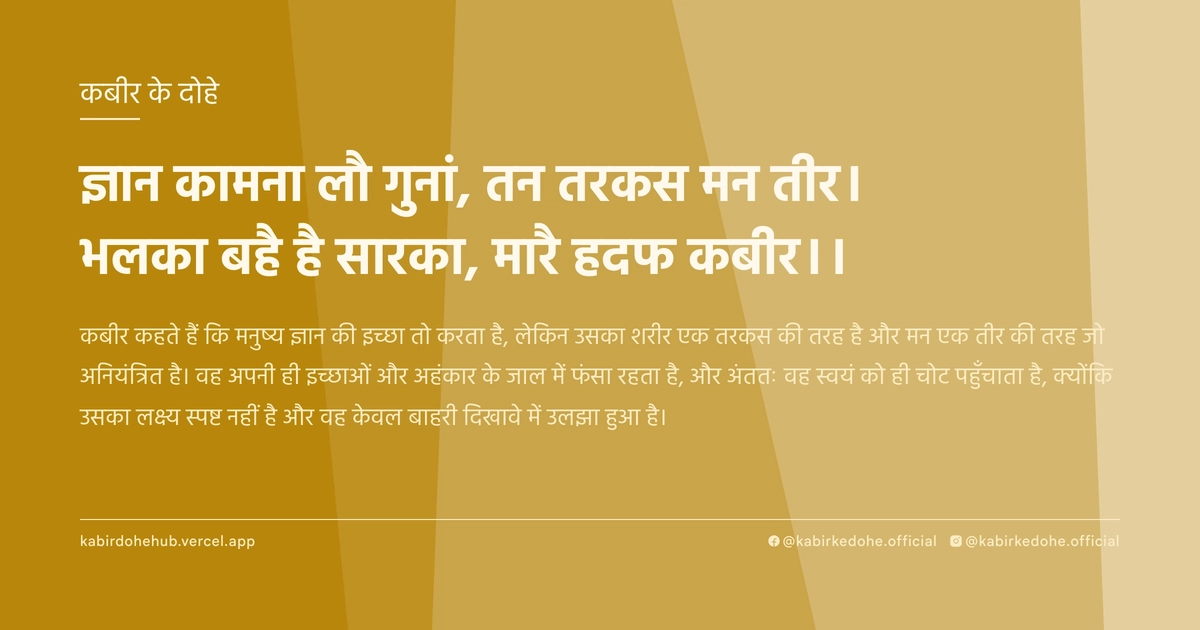
ज्ञान कामना लौ गुनां, तन तरकस मन तीर।
भलका बहै है सारका, मारै हदफ कबीर।।
Gyaan kaamna lau gunaan, tan tarkas man teer. Bhalka bahai hai saarka, maarai hadaf kabir.
इस पृष्ठ पर इस कबीर दोहे का अर्थ (meaning), हिंदी व्याख्या और अंग्रेज़ी अनुवाद, दार्शनिक विश्लेषण और व्यावहारिक जीवन सीख दी गई है। यह दोहा आत्मनिरीक्षण (Self-introspection) विषय से जुड़ा है — Kabir doha meaning and explanation in Hindi and English.
अर्थ (Meaning):
कबीर कहते हैं कि मनुष्य ज्ञान की इच्छा तो करता है, लेकिन उसका शरीर एक तरकस की तरह है और मन एक तीर की तरह जो अनियंत्रित है। वह अपनी ही इच्छाओं और अहंकार के जाल में फंसा रहता है, और अंततः वह स्वयं को ही चोट पहुँचाता है, क्योंकि उसका लक्ष्य स्पष्ट नहीं है और वह केवल बाहरी दिखावे में उलझा हुआ है।
Kabir observes that while humans crave spiritual knowledge, their physical existence acts as a quiver and the mind as an erratic arrow. Caught in the web of desires and ego, the seeker wanders aimlessly, ultimately wounding themselves because their aim is skewed by superficiality and the lack of true internal alignment.
व्याख्या (Interpretation):
इस दोहे में कबीर ने मानव शरीर और मन की तुलना एक धनुष-बाण के तंत्र से की है। 'तन तरकस' का अर्थ है कि शरीर केवल एक साधन है, लेकिन 'मन तीर' वह सक्रिय शक्ति है जो यदि दिशाहीन हो तो विनाशकारी होती है। यह निर्गुण भक्ति का संकेत है जहाँ बाहरी ज्ञान (किताबी ज्ञान) के बजाय आंतरिक अनुभव को प्राथमिकता दी गई है। माया यहाँ उस भ्रम के रूप में है जो साधक को लगता है कि वह लक्ष्य की ओर बढ़ रहा है, जबकि वह वास्तव में अपने ही अहंकार के चक्र में घूम रहा है। अद्वैत वेदांत के अनुसार, जब तक मन का द्वैत (मैं और मेरा) समाप्त नहीं होता, तब तक ज्ञान का तीर सत्य के केंद्र को नहीं छू सकता। कबीर यहाँ उस विरोधाभास को दर्शाते हैं जहाँ ज्ञान की खोज करने वाला व्यक्ति ही अपने अज्ञान के कारण स्वयं का शत्रु बन जाता है।
In this couplet, Kabir employs the metaphor of archery to describe the human condition. The 'body as a quiver' suggests that the physical form is merely a container, while the 'mind as an arrow' represents the active, driving force of consciousness. If the mind is erratic, the arrow misses the mark of Truth. This aligns with Nirgun Bhakti, emphasizing that intellectual accumulation is useless without internal realization. Maya is the illusion of progress; the seeker believes they are advancing, yet they are merely circling their own ego. From the perspective of Advaita Vedanta, the duality of the 'I' and the 'Other' prevents the arrow of awareness from hitting the target of Brahman. Kabir highlights the central paradox: the very desire for knowledge, when driven by ego, becomes the primary obstacle to attaining it.
दार्शनिक विश्लेषण (Philosophical Analysis):
कबीर का यह दोहा उनके युग के धार्मिक पाखंड और केवल शास्त्रों के रटने की प्रवृत्ति पर एक तीखा प्रहार है। उस समय के पंडित और मौलवी ज्ञान को केवल शब्दों और अनुष्ठानों तक सीमित रखते थे, जिसे कबीर ने 'कागद की लेख' कहकर नकारा। वे तर्क देते हैं कि वास्तविक ज्ञान वह है जो अहंकार का विसर्जन करे, न कि उसे बढ़ाए।
दार्शनिक रूप से, यह सूफी मत के 'फना' (अहंकार का विनाश) और अद्वैत वेदांत के 'अहं ब्रह्मास्मि' के बीच का सेतु है। जब तक 'मैं' (ego) मौजूद है, तब तक तीर (मन) कभी भी सही दिशा में नहीं जा सकता क्योंकि वह व्यक्तिगत इच्छाओं से प्रेरित होता है। कबीर यहाँ यह समझा रहे हैं कि ज्ञान की 'कामना' (desire) स्वयं में एक बाधा है, क्योंकि कामना वासना का ही एक परिष्कृत रूप है।
वे जाति और धर्म के बाहरी ढांचों को पूरी तरह खारिज करते हैं। उनके लिए, एक बुनकर का अनुभव एक शास्त्रज्ञ के किताबी ज्ञान से कहीं अधिक श्रेष्ठ है यदि वह अनुभव सत्य की अनुभूति से उपजा हो। यह दृष्टिकोण सामाजिक समानता और आध्यात्मिक लोकतंत्र की नींव रखता है, जहाँ सत्य किसी विशेष वर्ग की जागीर नहीं है।
मनोवैज्ञानिक स्तर पर, कबीर 'संज्ञानात्मक विसंगति' (cognitive dissonance) की बात कर रहे हैं। हम चाहते तो मोक्ष हैं, लेकिन हमारी आदतें और मानसिक प्रवृत्तियाँ हमें संसार की ओर खींचती हैं। यह आंतरिक संघर्ष ही वह 'हदफ' (लक्ष्य) है जिसे कबीर मारते हैं—अर्थात वे उस झूठे लक्ष्य को नष्ट करते हैं जिसे हमने अपनी कल्पनाओं में गढ़ा है।
अंततः, यह दोहा हमें यह सिखाता है कि आध्यात्मिक यात्रा बाहरी संग्रह की नहीं, बल्कि आंतरिक विसर्जन की यात्रा है। जब तरकस (शरीर) और तीर (मन) के बीच का द्वंद्व समाप्त हो जाता है और केवल 'साक्षी' बचता है, तब ज्ञान स्वतः घटित होता है। यह ज्ञान प्राप्त करने की प्रक्रिया नहीं, बल्कि अज्ञान के परतों को हटाने की प्रक्रिया है।
Kabir's verse is a scathing critique of the religious hypocrisy and the rote memorization of scriptures prevalent in his era. The scholars of his time reduced knowledge to mere words and rituals, which Kabir dismissed as 'paper-writing.' He argues that true knowledge is that which dissolves the ego, rather than inflating it.
Philosophically, this serves as a bridge between the Sufi concept of 'Fana' (annihilation of the self) and the Advaita Vedanta realization of 'Aham Brahmasmi.' As long as the 'I' (ego) persists, the arrow (mind) can never travel in the right direction because it is propelled by personal cravings. Kabir suggests that the very 'desire' for knowledge is a hurdle, as desire is simply a refined form of attachment.
He utterly rejects the external structures of caste and creed. For Kabir, the lived experience of a weaver is far superior to the scholarly knowledge of a priest if that experience springs from the realization of Truth. This perspective lays the foundation for social equality and spiritual democracy, asserting that Truth is not the monopoly of any specific class.
On a psychological level, Kabir addresses the state of cognitive dissonance. We aspire for liberation, yet our ingrained habits and mental tendencies pull us toward worldly attachments. This internal conflict is the 'hadaf' (target) that Kabir strikes—he destroys the false goals we have constructed within our imaginations.
Ultimately, this doha teaches us that the spiritual journey is not one of external accumulation but of internal subtraction. When the conflict between the quiver (body) and the arrow (mind) ceases and only the 'Witness' remains, knowledge manifests spontaneously. It is not a process of acquiring knowledge, but a process of shedding ignorance.
मूल संदेश (Core Message):
- ज्ञान का संचय अहंकार को बढ़ाता है, जबकि अनुभव उसे मिटाता है।
- जब तक 'मैं' मौजूद है, तब तक सत्य का लक्ष्य असंभव है।
- बाहरी अनुष्ठान केवल तरकस हैं; असली शक्ति मन की स्थिरता में है।
- इच्छा रहित ज्ञान ही वास्तविक मुक्ति का मार्ग प्रशस्त करता है।
- सरलता ही वह एकमात्र तीर है जो सीधे हृदय के केंद्र को भेदता है।
- अद्वैत का अर्थ है—खोजने वाले और खोजे जाने वाले का एक हो जाना।
- Accumulation of knowledge inflates the ego; lived experience dissolves it.
- As long as the 'I' persists, the target of Truth remains unreachable.
- External rituals are mere quivers; real power lies in mental stillness.
- Desireless knowledge is the only path that leads to genuine liberation.
- Simplicity is the only arrow that pierces the center of the heart.
- Non-duality means the seeker and the sought becoming one.
व्यावहारिक उदाहरण (Practical Example):
वाराणसी के एक पुराने घाट पर माधव नाम का एक वृद्ध बुनकर रहता था। माधव ने अपना पूरा जीवन रेशमी धागों को बुनने में बिताया था, लेकिन उसका मन हमेशा इस बात से अशांत रहता था कि वह पर्याप्त 'धार्मिक' नहीं है। वह हर दिन घंटों तक कठिन मंत्रों का जाप करता और भारी ग्रंथों को पढ़ने की कोशिश करता, यह सोचकर कि इसी से उसे ईश्वर की प्राप्ति होगी।
उसका शरीर (तरकस) तो मंदिर की सीढ़ियों पर बैठा रहता, लेकिन उसका मन (तीर) हमेशा इस चिंता में रहता कि क्या वह सही विधि अपना रहा है या क्या उसके पड़ोसी उससे अधिक ज्ञानी हो गए हैं। वह ज्ञान की कामना तो करता था, लेकिन उसका अहंकार उसे यह विश्वास दिलाता था कि वह दूसरों से श्रेष्ठ है क्योंकि वह अधिक कठिन अनुष्ठान करता है।
एक दिन, माधव ने एक फकीर को देखा जो बिना किसी किताब के, बस एक मुस्कान के साथ सड़क किनारे बैठा था। माधव ने उससे पूछा, "महात्मन, मैंने हज़ारों श्लोक रटे हैं, फिर भी शांति क्यों नहीं मिलती?"
फकीर ने माधव के करघे की ओर इशारा किया और कहा, "तुम धागों को बहुत कसकर पकड़ते हो, इसलिए कपड़ा कभी-कभी खिंच जाता है। तुम्हारा ज्ञान भी वैसा ही है—तुमने उसे पकड़ा हुआ है, उसे जिया नहीं है। तुम तीर तो चला रहे हो, लेकिन निशाना तुम्हारी अपनी ही परछाईं पर है।"
माधव को अचानक समझ आया कि उसकी ज्ञान की खोज वास्तव में उसकी श्रेष्ठता सिद्ध करने की भूख थी। वह जिसे 'भक्ति' समझ रहा था, वह वास्तव में उसके अहंकार का एक नया आवरण था।
उस रात, माधव ने अपनी सारी किताबें एक तरफ रख दीं। उसने महसूस किया कि जब वह बिना किसी उद्देश्य के, बिना किसी फल की इच्छा के, केवल प्रेम से अपना काम करता है, तो वह शांति स्वतः आ जाती है।
उसने अब मंत्रों को रटना छोड़ दिया और अपने काम में ही ध्यान ढूँढ लिया। वह अब यह नहीं सोचता था कि वह कितना ज्ञानी है, बल्कि यह देखता था कि वह कितना सरल हो सकता है।
धीरे-धीरे, उसकी चिड़चिड़ाहट गायब हो गई। वह अब घाट पर आने वाले हर अजनबी में उसी ईश्वर को देखने लगा जिसे वह किताबों में खोज रहा था।
उसका 'तरकस' अब बोझ नहीं था और उसका 'तीर' अब भटक नहीं रहा था। उसने जान लिया कि असली ज्ञान वह है जो आपको दूसरों के करीब लाए, न कि वह जो आपको एक ऊँचे आसन पर बैठा दे।
माधव का जीवन अब एक जीवित कविता बन गया था, जहाँ कर्म ही उसकी पूजा थी और सरलता ही उसका सर्वोच्च ज्ञान।
On an ancient ghat in Varanasi lived an elderly weaver named Madhav. Madhav had spent his entire life weaving silk threads, yet his mind was perpetually restless, haunted by the feeling that he was not 'religious' enough. He spent hours daily chanting complex mantras and struggling through heavy scriptures, believing this was the only path to God.
His body (the quiver) would sit on the temple steps, but his mind (the arrow) was always anxious about whether he was following the correct ritual or if his neighbors had become more learned than him. He craved knowledge, but his ego convinced him that he was superior because his rituals were more rigorous.
One day, Madhav noticed a wandering dervish sitting by the roadside with nothing but a serene smile. Madhav asked, "O Great Soul, I have memorized thousands of shlokas, yet why do I find no peace?"
The dervish pointed toward Madhav's loom and said, "You hold the threads too tightly, and so the fabric sometimes pulls. Your knowledge is the same—you are holding onto it, not living it. You are firing arrows, but your target is merely your own shadow."
Madhav suddenly realized that his quest for knowledge was actually a hunger to prove his superiority. What he had mistaken for 'devotion' was merely a new cloak for his ego.
That night, Madhav set aside all his books. He realized that when he worked without a specific agenda, without the desire for a reward, and simply with love, peace arrived spontaneously.
He stopped the mechanical chanting and began finding meditation within his craft. He no longer wondered how learned he was, but rather how simple he could become.
Gradually, his irritability vanished. He began to see the same Divine in every stranger visiting the ghat—the very Divine he had been searching for in books.
His 'quiver' was no longer a burden, and his 'arrow' no longer strayed. He understood that true knowledge is that which brings you closer to others, not that which places you on a pedestal.
Madhav's life became a living poem, where action was his worship and simplicity was his highest wisdom.
अभ्यास मार्गदर्शन (Practice Guidance):
- प्रतिदिन 20 मिनट 'साक्षी भाव' का अभ्यास करें: अपने विचारों को बिना किसी निर्णय के देखें, जैसे आप किसी और के विचारों को देख रहे हों।
- आत्म-पूछताछ जर्नल: हर रात लिखें कि आज किस क्षण में मेरा 'ज्ञान' मेरे 'अहंकार' को संतुष्ट करने का साधन बना।
- मौन का अभ्यास: दिन में एक घंटा पूरी तरह मौन रहें, न केवल शब्दों से, बल्कि मानसिक चर्चाओं से भी दूर रहने का प्रयास करें।
- निदान चेकलिस्ट: क्या मैं दूसरों को सुधारने की कोशिश कर रहा हूँ? (यदि हाँ, तो यह अहंकार है)। क्या मैं अपनी उपलब्धियों पर गर्व महसूस कर रहा हूँ? (यदि हाँ, तो यह माया है)। क्या मैं वर्तमान क्षण में पूरी तरह उपस्थित हूँ? (यदि नहीं, तो तीर भटक रहा है)।
- Practice 'Witness Consciousness' for 20 minutes daily: Observe your thoughts without judgment, as if you were observing someone else's mind.
- Self-Inquiry Journal: Every night, record the specific moments where your 'knowledge' became a tool to satisfy your 'ego'.
- Practice of Silence: Spend one hour a day in complete silence, not just avoiding words, but attempting to cease internal mental dialogues.
- Diagnostic Checklist: Am I trying to 'correct' others? (If yes, that is ego). Am I feeling pride in my spiritual achievements? (If yes, that is Maya). Am I fully present in the current moment? (If no, the arrow is straying).
चिंतन प्रश्न (Reflection Questions):
- क्या मेरी आध्यात्मिक खोज वास्तव में सत्य के लिए है, या यह मेरी सामाजिक छवि को बेहतर बनाने का एक तरीका है?
- मेरे जीवन का वह कौन सा 'झूठा लक्ष्य' है जिसे मैं सच मानकर अपना पूरा समय और ऊर्जा नष्ट कर रहा हूँ?
- यदि मुझसे मेरी सारी डिग्रियाँ, पद और धार्मिक पहचान छीन ली जाएँ, तो मेरे भीतर क्या बचेगा?
- मैं अपनी बुद्धिमत्ता का उपयोग दूसरों को समझने के लिए करता हूँ या उन्हें नीचा दिखाने के लिए?
- क्या मैं वास्तव में शांत हूँ, या मैं केवल शांति का ढोंग करने में कुशल हो गया हूँ?
- मेरे भीतर का वह कौन सा डर है जो मुझे पूरी तरह से समर्पित होने से रोकता है?
- Is my spiritual quest truly for Truth, or is it a sophisticated way to enhance my social image?
- What is the 'false target' in my life that I am pursuing, mistakenly believing it to be the ultimate goal?
- If all my degrees, titles, and religious identities were stripped away, what would remain within me?
- Do I use my intelligence to understand others, or to subtly diminish them?
- Am I truly at peace, or have I simply become skilled at performing the act of being peaceful?
- What is the hidden fear within me that prevents me from surrendering completely to the present?