
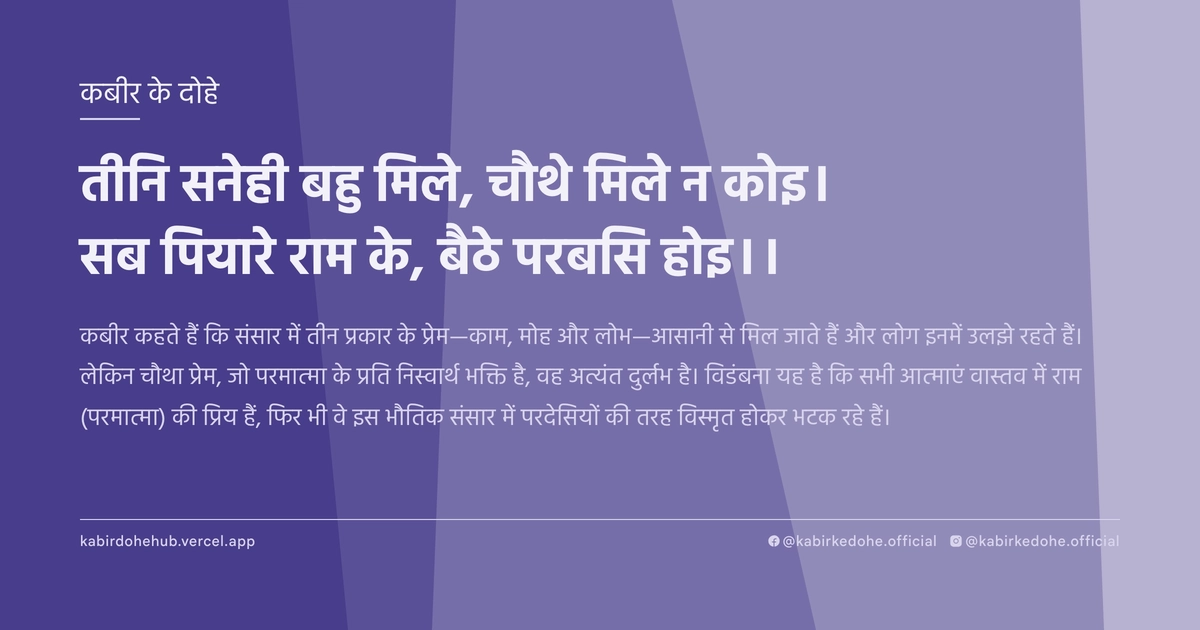
तीनि सनेही बहु मिले, चौथे मिले न कोइ।
सब पियारे राम के, बैठे परबसि होइ।।
Teeni sanehi bahu mile, chauthe mile na koi. Sab piyare Ram ke, baithe parbasi hoye.
इस पृष्ठ पर इस कबीर दोहे का अर्थ (meaning), हिंदी व्याख्या और अंग्रेज़ी अनुवाद, दार्शनिक विश्लेषण और व्यावहारिक जीवन सीख दी गई है। यह दोहा भक्ति (Bhakti) विषय से जुड़ा है — Kabir doha meaning and explanation in Hindi and English.
अर्थ (Meaning):
कबीर कहते हैं कि संसार में तीन प्रकार के प्रेम—काम, मोह और लोभ—आसानी से मिल जाते हैं और लोग इनमें उलझे रहते हैं। लेकिन चौथा प्रेम, जो परमात्मा के प्रति निस्वार्थ भक्ति है, वह अत्यंत दुर्लभ है। विडंबना यह है कि सभी आत्माएं वास्तव में राम (परमात्मा) की प्रिय हैं, फिर भी वे इस भौतिक संसार में परदेसियों की तरह विस्मृत होकर भटक रहे हैं।
Kabir observes that three forms of affection—lust, attachment, and greed—are abundant and easily found, trapping the soul in worldly cycles. However, the fourth love, the selfless devotion to the Divine, remains elusive. The tragedy lies in the fact that while every soul is inherently beloved by the Eternal Ram, they exist in this material realm as estranged exiles, forgetting their true home.
व्याख्या (Interpretation):
इस दोहे का शाब्दिक अर्थ सांसारिक संबंधों और ईश्वरीय प्रेम के बीच के अंतर को स्पष्ट करता है। यहाँ 'तीनि सनेही' काम, क्रोध और मोह जैसे सांसारिक आकर्षणों का प्रतीक हैं जो अहंकार को पुष्ट करते हैं। 'चौथा' वह प्रेम है जो द्वैत को समाप्त कर अद्वैत की स्थिति में ले जाता है, जिसे निर्गुण भक्ति कहा जाता है। कबीर यहाँ माया के प्रभाव को दर्शाते हैं, जहाँ आत्मा स्वयं को शरीर और सामाजिक पहचान के साथ जोड़ लेती है। 'परबसि' या परदेसी शब्द यह संकेत देता है कि मनुष्य का वर्तमान अस्तित्व एक भ्रम है; वह वास्तव में ब्रह्म का अंश है जो अपनी मूल पहचान भूलकर विस्मृति के अंधेरे में खो गया है। यह विरोधाभास है कि जो ईश्वर के सबसे करीब है, वही खुद को सबसे दूर महसूस करता है।
The literal meaning distinguishes between mundane attachments and divine love. The 'three affections' symbolize lust, greed, and emotional attachment, which reinforce the ego and bind the soul to Samsara. The 'fourth' represents the love of the Formless (Nirgun), which transcends duality and leads to the realization of Advaita (non-duality). Kabir highlights the veil of Maya, where the Atman mistakenly identifies with the physical body and social masks. The term 'parbasi' (exile/foreigner) suggests that the human condition is one of spiritual amnesia; we are essentially fragments of the Divine living in a state of alienation. The central paradox is that while the soul is eternally beloved by the Absolute, it wanders the earth as a stranger to itself, trapped in the illusion of separation.
दार्शनिक विश्लेषण (Philosophical Analysis):
कबीर का यह दर्शन उनके युग के सामाजिक और धार्मिक संघर्षों की उपज है, जहाँ कर्मकांड और बाहरी दिखावे ने वास्तविक आध्यात्मिकता को ढक लिया था। वे यहाँ स्पष्ट करते हैं कि केवल मंदिर या मस्जिद जाने से 'चौथा प्रेम' प्राप्त नहीं होता, क्योंकि वह प्रेम अहंकार के विसर्जन से आता है। यह विचार अद्वैत वेदांत के करीब है, जहाँ जीव और ब्रह्म की एकता पर जोर दिया गया है, लेकिन कबीर इसे एक सूफी रंग में ढालते हैं जहाँ विरह (separation) और मिलन (union) की तड़प मुख्य है।
वे ritualism का विरोध करते हुए कहते हैं कि यदि प्रेम में स्वार्थ है, तो वह बंधन है। काम, मोह और लोभ—ये तीनों 'सनेही' वास्तव में आत्मा की ऊर्जा को बाहर की ओर खींचते हैं, जिससे व्यक्ति अपनी आंतरिक शून्यता को कभी नहीं भर पाता। यह मनोवैज्ञानिक विस्थापन ही है जो मनुष्य को 'परदेसी' बनाता है।
सूफी मत के 'फना' (अहंकार का विनाश) और भक्ति मार्ग के 'शरणागति' का संगम यहाँ दिखता है। जब तक 'मैं' जीवित है, तब तक 'चौथा प्रेम' असंभव है। कबीर का तर्क है कि परमात्मा कहीं बाहर नहीं, बल्कि हमारे भीतर ही है, परंतु माया की परतों ने हमें अपनी ही वास्तविकता से दूर कर दिया है।
ऐतिहासिक संदर्भ में, कबीर ने जाति और धर्म की दीवारों को तोड़कर एक ऐसे सार्वभौमिक प्रेम की बात की जो किसी विशेष संप्रदाय का नहीं, बल्कि संपूर्ण अस्तित्व का है। वे चेतावनी देते हैं कि सांसारिक प्रेम हमें सुरक्षा का भ्रम देता है, जबकि ईश्वरीय प्रेम हमें उस सुरक्षा के भ्रम से मुक्त करता है।
अंततः, यह विश्लेषण हमें बताता है कि आध्यात्मिक जागृति का अर्थ नई जानकारी प्राप्त करना नहीं, बल्कि उस सत्य को याद करना है जिसे हम भूल चुके हैं। 'परबसि' होना एक मानसिक अवस्था है, और इस अवस्था से मुक्ति केवल आत्म-साक्षात्कार और निस्वार्थ समर्पण के माध्यम से ही संभव है।
Kabir's philosophy emerges from the socio-religious turbulence of his era, where ritualism and outward displays of piety had overshadowed genuine spiritual experience. He asserts that the 'fourth love' cannot be attained through mere temple or mosque visits, as it requires the complete dissolution of the ego. This aligns with Advaita Vedanta's emphasis on the oneness of Atman and Brahman, yet Kabir infuses it with a Sufi essence, emphasizing the agony of separation and the ecstasy of union.
He rejects ritualism, arguing that any love tainted by selfishness is merely a golden chain. Lust, attachment, and greed—the 'three affections'—divert the soul's energy outward, leaving the inner void perpetually unfilled. This psychological displacement is precisely what renders the human being a 'parbasi' or an exile in their own existence.
There is a profound synthesis here between the Sufi concept of 'Fana' (annihilation of the self) and the Bhakti path of 'Prapatti' (total surrender). As long as the 'I' persists, the fourth love remains unattainable. Kabir argues that the Divine is not a distant entity but the very core of our being, hidden beneath layers of Maya.
Historically, Kabir sought to dismantle the walls of caste and creed, proposing a universal love that transcends sectarian boundaries. He warns that worldly love provides a deceptive sense of security, whereas divine love liberates us from the very illusion of security.
Ultimately, this analysis reveals that spiritual awakening is not about acquiring new knowledge, but about remembering a forgotten truth. Being an 'exile' is a state of consciousness, and liberation from this state is possible only through self-realization and the annihilation of the ego-driven identity.
मूल संदेश (Core Message):
- सांसारिक प्रेम अक्सर एक सूक्ष्म बंधन होता है।
- परमात्मा के प्रति प्रेम ही एकमात्र वास्तविक मुक्ति है।
- अहंकार की उपस्थिति में ईश्वरीय प्रेम असंभव है।
- हम सब दिव्य हैं, लेकिन माया ने हमें परदेसी बना दिया है।
- करुणा ही वह सेतु है जो हमें घर वापस ले जाता है।
- Worldly love is often a subtle form of bondage.
- Devotion to the Divine is the only true liberation.
- Divine love is impossible in the presence of the ego.
- We are all divine, yet Maya has rendered us exiles.
- Compassion is the bridge that leads us back home.
व्यावहारिक उदाहरण (Practical Example):
वाराणसी के एक पुराने घाट पर रहने वाले एक वृद्ध विधवा, जानकी, का जीवन केवल अपनी मृत यादों और धार्मिक अनुष्ठानों के इर्द-गिर्द सिमटा था। वह दिन भर माला जपती और दूसरों को उनके पापों के बारे में बताती, यह मानकर कि वह आध्यात्मिक रूप से श्रेष्ठ है। उसके लिए प्रेम का अर्थ था अपने मृत पति की यादों से चिपके रहना और समाज में अपनी 'पवित्र' छवि बनाए रखना।
जानकी का जीवन उन 'तीन सनेहियों' से घिरा था: अपने अतीत के प्रति मोह, अपनी छवि के प्रति लोभ और एक अनकही मानसिक आसक्ति। वह खुद को ईश्वर के करीब मानती थी, लेकिन वास्तव में वह अपने अहंकार के पिंजरे में कैद थी।
एक दिन, घाट की सीढ़ियों पर एक छोटा बच्चा, जो किसी का नहीं था, भूख से तड़प रहा था। जानकी ने उसे देखा और पहले अपनी 'शुद्धता' के विचार के कारण उसे अनदेखा किया। लेकिन बच्चे की आँखों में जो बेबसी थी, उसने जानकी के भीतर कुछ तोड़ दिया।
उसने पहली बार अपनी माला छोड़ी और उस बच्चे को भोजन कराया। उस क्षण, उसे महसूस हुआ कि जिस ईश्वर को वह पत्थरों और मंत्रों में खोज रही थी, वह उस भूखे बच्चे की पुकार में था।
यह एक छोटा सा बदलाव था, लेकिन जानकी के भीतर एक विस्फोट हुआ। उसे समझ आया कि उसका अब तक का 'प्रेम' केवल एक मानसिक निवेश था, एक मोह था जो उसे खुद से ही दूर रख रहा था।
उसने महसूस किया कि वह अब तक एक 'परदेसी' की तरह जी रही थी—अपने ही घर (आत्मा) में रहते हुए भी अजनबी थी। उसने अपनी धार्मिक श्रेष्ठता का मुखौटा उतार फेंका।
अब वह केवल पूजा नहीं करती थी, बल्कि हर उस व्यक्ति की सेवा करने लगी जिसे समाज ने ठुकरा दिया था। उसकी भक्ति अब कर्मकांड से हटकर करुणा में बदल गई।
वह अब मंदिर की दीवारों में नहीं, बल्कि मानवता के खुले आंगन में राम को खोजने लगी। उसकी आँखों में अब वह कठोरता नहीं, बल्कि एक असीम शांति थी।
जानकी ने पाया कि जब उसने 'स्वयं' के प्रति मोह छोड़ा, तब उसे वह 'चौथा प्रेम' मिला जिसने उसे वास्तव में घर पहुँचा दिया।
यह 'कबीर ट्विस्ट' था: जब उसने अपनी पवित्रता की परिभाषा बदली, तभी वह वास्तव में पवित्र हुई।
Janaki, an elderly widow living on the ancient ghats of Varanasi, had spent her life confined to the memories of her dead husband and rigid religious rituals. She spent her days chanting beads and reminding others of their sins, believing herself to be spiritually superior. For her, love meant clinging to the past and maintaining a 'pure' image in society.
Janaki's life was surrounded by the 'three affections': attachment to her past, greed for social validation, and a subtle emotional clinging. She believed she was close to God, but in reality, she was imprisoned by her own ego.
One day, a small, orphaned child, shivering from hunger, sat on the steps of the ghat. Janaki saw him, but initially ignored him, fearing that interacting with a street child would compromise her ritual purity.
However, the raw desperation in the child's eyes cracked something inside her. For the first time, she dropped her prayer beads and fed the child with her own meager meal.
In that fleeting moment, she realized that the God she had been seeking in stones and mantras was present in the cry of that hungry child. This was a small act, but it triggered a spiritual explosion within her.
She understood that her previous 'love' was merely a mental investment—a form of attachment that had kept her estranged from her true self.
She felt that she had been living as a 'parbasi' (exile)—a stranger in her own home, the soul, despite her outward piety.
She cast off the mask of religious superiority. She no longer just prayed; she began serving every discarded soul in the city. Her devotion shifted from ritual to compassion.
She stopped searching for Ram within the walls of the temple and began finding Him in the open courtyards of humanity.
The hardness in her eyes was replaced by an infinite, quiet peace. Janaki discovered that by letting go of the attachment to her 'self', she finally found the 'fourth love' that led her home.
This was the 'Kabir Twist': only when she redefined her purity did she actually become pure.
अभ्यास मार्गदर्शन (Practice Guidance):
- दैनिक आत्म-निरीक्षण: प्रतिदिन 20 मिनट मौन बैठें और विश्लेषण करें कि आपके आज के कार्यों के पीछे कौन सा 'सनेही' (मोह, लोभ या अहंकार) था।
- निस्वार्थ सेवा का अभ्यास: सप्ताह में एक बार किसी ऐसे व्यक्ति की मदद करें जिससे आपको कोई लाभ न मिले और न ही सामाजिक प्रशंसा।
- साक्षी भाव: जब भी आप किसी के प्रति तीव्र आसक्ति महसूस करें, तो स्वयं से पूछें, 'क्या यह प्रेम है या केवल मेरी अपनी इच्छाओं का विस्तार?'
- डायग्नोस्टिक चेकलिस्ट: यदि आप दूसरों की आलोचना कर रहे हैं या अपनी धार्मिक पहचान पर गर्व महसूस कर रहे हैं, तो समझ लें कि आप अभी भी 'परबसि' (परदेसी) अवस्था में हैं।
- Daily Self-Inquiry: Spend 20 minutes in silence daily, analyzing which 'affection' (attachment, greed, or ego) drove your actions throughout the day.
- Practice of Selfless Service: Once a week, help someone from whom you can gain neither material benefit nor social recognition.
- The Witness State: Whenever you feel an intense attachment to someone, ask yourself, 'Is this true love, or merely an extension of my own desires?'
- Diagnostic Checklist: If you find yourself judging others or feeling pride in your spiritual/religious identity, recognize that you are still in the state of 'parbasi' (exile).
चिंतन प्रश्न (Reflection Questions):
- मेरी कौन सी सामाजिक पहचान (जाति, पद, धर्म) मुझे यह विश्वास दिलाती है कि मैं दूसरों से श्रेष्ठ हूँ?
- क्या मेरा 'प्रेम' वास्तव में दूसरे के लिए है, या वह मेरी अपनी जरूरतों को पूरा करने का एक तरीका है?
- यदि मेरी सारी बाहरी उपलब्धियाँ और रिश्ते छीन लिए जाएँ, तो मेरे भीतर क्या बचेगा?
- मैं अपने जीवन के किन हिस्सों में 'परदेसी' की तरह महसूस करता हूँ, जहाँ मैं खुद को अजनबी पाता हूँ?
- क्या मैं वास्तव में ईश्वर को खोज रहा हूँ, या मैं केवल अपनी इच्छाओं की पूर्ति के लिए एक दैवीय माध्यम चाहता हूँ?
- Which social identity (caste, rank, religion) convinces me that I am superior to others?
- Is my 'love' truly for the other, or is it a mechanism to fulfill my own emotional needs?
- If all my external achievements and relationships were stripped away, what would remain within me?
- In which parts of my life do I feel like a 'parbasi' (exile), feeling like a stranger to my own soul?
- Am I truly seeking the Divine, or am I merely looking for a celestial means to satisfy my desires?