
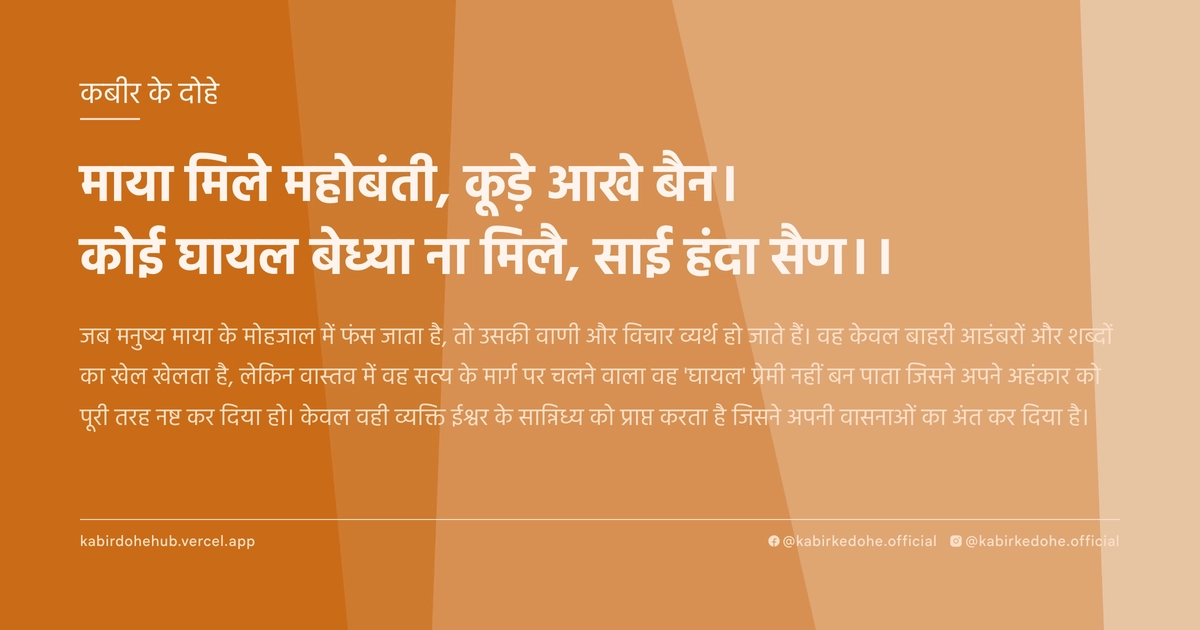
माया मिले महोबंती, कूड़े आखे बैन।
कोई घायल बेध्या ना मिलै, साई हंदा सैण।।
Maya mile mahobanti, koode aakhe bain. Koi ghayal bedhya na milai, sai handa sain.
इस पृष्ठ पर इस कबीर दोहे का अर्थ (meaning), हिंदी व्याख्या और अंग्रेज़ी अनुवाद, दार्शनिक विश्लेषण और व्यावहारिक जीवन सीख दी गई है। यह दोहा माया (Maya) विषय से जुड़ा है — Kabir doha meaning and explanation in Hindi and English.
अर्थ (Meaning):
जब मनुष्य माया के मोहजाल में फंस जाता है, तो उसकी वाणी और विचार व्यर्थ हो जाते हैं। वह केवल बाहरी आडंबरों और शब्दों का खेल खेलता है, लेकिन वास्तव में वह सत्य के मार्ग पर चलने वाला वह 'घायल' प्रेमी नहीं बन पाता जिसने अपने अहंकार को पूरी तरह नष्ट कर दिया हो। केवल वही व्यक्ति ईश्वर के सान्निध्य को प्राप्त करता है जिसने अपनी वासनाओं का अंत कर दिया है।
When a human becomes entangled in the illusions of Maya, their words and discourse become meaningless chatter. They engage in superficial rituals and intellectual gymnastics, yet they fail to become that 'wounded' seeker—one whose ego has been pierced and destroyed. Only those who have transcended worldly attachments and annihilated the self can truly dwell in the presence of the Divine.
व्याख्या (Interpretation):
कबीर यहाँ 'माया' को एक ऐसी शक्ति के रूप में चित्रित करते हैं जो चेतना को भ्रमित करती है। 'कूड़े आखे बैन' का अर्थ है कि जब तक हृदय में वासना है, तब तक ज्ञान की बातें केवल शोर हैं। 'घायल' शब्द यहाँ एक गहरे आध्यात्मिक विरोधाभास को दर्शाता है; यह वह व्यक्ति है जिसका अहंकार सत्य की तलवार से छिन्न-भिन्न हो गया है। निर्गुण भक्ति में, ईश्वर की प्राप्ति के लिए पहले 'स्व' का विसर्जन आवश्यक है। यह अद्वैत वेदांत के उस सिद्धांत से मिलता है जहाँ ज्ञाता और ज्ञेय का भेद समाप्त हो जाता है। माया वह पर्दा है जो आत्मा को ब्रह्म से अलग दिखाता है, और इस पर्दे को केवल पूर्ण समर्पण और अहंकार की मृत्यु से ही हटाया जा सकता है।
Kabir portrays 'Maya' as a deceptive force that clouds consciousness. The phrase 'koode aakhe bain' suggests that as long as desire persists, intellectual discourse remains mere noise. The term 'wounded' (ghayal) presents a profound spiritual paradox; it refers to the seeker whose ego has been pierced and shattered by the sword of Truth. In Nirgun Bhakti, the realization of the Formless requires the prior dissolution of the 'I'. This aligns with Advaita Vedanta, where the duality between the knower and the known vanishes. Maya is the veil obscuring the non-duality of Atman and Brahman, and this veil can only be lifted through total surrender and the annihilation of the false self.
दार्शनिक विश्लेषण (Philosophical Analysis):
कबीर का यह दोहा उनके युग के धार्मिक पाखंड और कर्मकांडों पर एक तीखा प्रहार है। उस समय समाज बाहरी प्रतीकों, जैसे माला, तिलक और कठिन उपवासों को ही भक्ति का प्रमाण मानता था। कबीर तर्क देते हैं कि ये सब 'माया' के ही सूक्ष्म रूप हैं, जो मनुष्य को यह भ्रम देते हैं कि वे आध्यात्मिक प्रगति कर रहे हैं, जबकि उनका अहंकार और अधिक पुष्ट हो जाता है।
दार्शनिक स्तर पर, यह सूफी मत के 'फना' (अस्तित्व का विनाश) और वेदांत के 'अहं ब्रह्मास्मि' के बीच का सेतु है। जब तक 'मैं' मौजूद है, तब तक 'वह' (ईश्वर) नहीं मिल सकता। कबीर के अनुसार, वास्तविक भक्ति बौद्धिक विमर्श में नहीं, बल्कि हृदय के उस विदारण में है जहाँ मनुष्य अपनी सारी सामाजिक और व्यक्तिगत पहचान को त्याग देता है।
माया केवल धन या संपत्ति नहीं है, बल्कि यह वह मानसिक स्थिति है जहाँ हम सत्य को अपनी इच्छाओं के चश्मे से देखते हैं। कबीर चेतावनी देते हैं कि जो लोग केवल शास्त्रों की व्याख्या करते हैं, वे वास्तव में माया के जाल में और गहरे फंस रहे हैं क्योंकि वे सत्य को 'जानने' की कोशिश कर रहे हैं, उसे 'होने' की नहीं।
यह विश्लेषण हमें बताता है कि आध्यात्मिक यात्रा 'जोड़ने' की नहीं, बल्कि 'छोड़ने' की प्रक्रिया है। यह एक विखंडन है—पुराने संस्कारों का, पूर्वग्रहों का और उस झूठी पहचान का जिसे हमने समाज के सामने खड़ा किया है। बिना इस आंतरिक मृत्यु के, पुनर्जन्म संभव नहीं है।
अंततः, कबीर यह स्थापित करते हैं कि ईश्वर (साईं) केवल उनके साथ होते हैं जो 'शून्य' हो चुके हैं। जो व्यक्ति स्वयं को पूर्ण मानता है, उसके लिए ईश्वर के लिए कोई स्थान नहीं बचता। केवल वह जो 'घायल' है, यानी जिसने अपनी सीमाओं को स्वीकार कर लिया है और अहंकार को त्याग दिया है, वही उस अनंत शांति का अनुभव कर सकता है।
This couplet is a sharp critique of the religious hypocrisy and ritualism prevalent during Kabir's era. Society then viewed external symbols—beads, tilaks, and rigorous fasting—as the sole evidence of devotion. Kabir argues that these are subtle forms of 'Maya,' creating a delusion of spiritual progress while actually reinforcing the ego.
Philosophically, this serves as a bridge between the Sufi concept of 'Fana' (annihilation of the self) and the Vedantic realization of 'Aham Brahmasmi'. As long as the 'I' exists, the 'Divine' cannot be realized. For Kabir, true devotion lies not in intellectual discourse but in the 'wounding' of the heart, where one discards all social and personal identities.
Maya is not merely wealth or possessions; it is the psychological state of perceiving Truth through the lens of personal desire. Kabir warns that those who merely interpret scriptures are sinking deeper into Maya because they seek to 'know' the Truth rather than 'become' it.
This analysis reveals that the spiritual journey is not a process of accumulation, but of subtraction. It is a dismantling—of old conditioning, prejudices, and the false persona constructed for societal approval. Without this internal death, spiritual rebirth is impossible.
Ultimately, Kabir establishes that the Divine (Sai) dwells only with those who have become 'zero'. For the one who believes themselves to be complete or superior, there is no room for the Divine. Only the 'wounded'—the one who has accepted their limitations and surrendered the ego—can experience that infinite peace.
मूल संदेश (Core Message):
- शब्दों का ज्ञान सत्य नहीं है, अनुभव ही एकमात्र प्रमाण है।
- माया वह सूक्ष्म अहंकार है जो हमें ईश्वर से दूर रखता है।
- अहंकार का टूटना ही आध्यात्मिक जागृति की पहली शर्त है।
- बाहरी आडंबर केवल आत्मा के ऊपर चढ़ी धूल की परतें हैं।
- शून्यता में ही पूर्णता का वास होता है, स्वयं को मिटाओ।
- सत्य को जानने की कोशिश छोड़कर, सत्य बन जाने का प्रयास करें।
- Intellectual knowledge is not truth; only direct experience is proof.
- Maya is the subtle ego that keeps us alienated from the Divine.
- The shattering of the ego is the primary condition for awakening.
- External rituals are merely layers of dust upon the soul.
- Completeness resides in emptiness; erase the self to find the All.
- Stop trying to 'know' the truth and start striving to 'be' the truth.
व्यावहारिक उदाहरण (Practical Example):
वाराणसी के घाटों पर रहने वाले एक वृद्ध बुनकर, माधव, की कहानी है। माधव अपने काम में निपुण थे, लेकिन उन्हें अपनी कला का बहुत अहंकार था। वे मानते थे कि उनके द्वारा बुने गए वस्त्र सबसे श्रेष्ठ हैं और वे अक्सर अन्य बुनकरों को नीचा दिखाते थे। वे मंदिर जाते थे, दान देते थे और शास्त्रों की चर्चा करते थे, जिससे उन्हें लगता था कि वे बहुत धार्मिक हैं।
एक दिन उनके जीवन में एक फकीर आया, जिसने माधव के सबसे महंगे वस्त्र को देखा और मुस्कुराते हुए कहा, "धागे तो सुंदर हैं, लेकिन बुनने वाले का अहंकार इस कपड़े को भारी बना रहा है।"
माधव को यह बात चुभी। उन्होंने फकीर से बहस की और अपनी श्रेष्ठता के प्रमाण दिए। फकीर ने शांत भाव से कहा, "तुम शब्दों के जाल बुन रहे हो, लेकिन क्या तुमने कभी अपने भीतर के उस पर्दे को फाड़ा है जो तुम्हें तुम्हारी असलियत से अलग करता है?"
अगले कुछ हफ्तों तक माधव ने देखा कि फकीर बिना किसी पहचान के, बिना किसी नाम के, बस लोगों की सेवा कर रहे थे। माधव ने महसूस किया कि उनकी सारी धार्मिकता केवल एक मुखौटा थी ताकि वे समाज में 'ज्ञानी' दिख सकें।
एक रात, एक भीषण बाढ़ आई जिसने माधव की पूरी कार्यशाला और उनके कीमती कपड़ों को बहा दिया। जिस संपत्ति और कला पर उन्हें गर्व था, वह पल भर में नष्ट हो गई।
उस विनाश के क्षण में, माधव का अहंकार टूट गया। वे सड़क पर अकेले खड़े थे, उनके पास न तो कपड़े थे और न ही कोई पहचान। पहली बार, उन्होंने महसूस किया कि वे 'घायल' हो चुके हैं—उनकी झूठी पहचान छिन गई थी।
उस शून्य में, उन्हें वह शांति मिली जो उन्हें वर्षों के शास्त्र-पाठ और पूजा से नहीं मिली थी। उन्होंने महसूस किया कि जब तक वे 'महान बुनकर' थे, वे वास्तव में अंधे थे।
अब माधव फिर से बुनने लगे, लेकिन अब वे अपनी कला को अपना अहंकार नहीं, बल्कि ईश्वर की सेवा मानते थे। वे अब दूसरों को नीचा नहीं दिखाते थे, बल्कि हर धागे में उस निराकार ईश्वर को देखते थे।
उनका जीवन अब 'कूड़े बैन' (व्यर्थ शब्दों) से मुक्त होकर एक मौन साधना बन गया था। उन्होंने जान लिया था कि जब तक 'मैं' मरता नहीं, तब तक 'साईं' प्रकट नहीं होते।
माधव की यह यात्रा दिखाती है कि कैसे बाहरी नुकसान कभी-कभी आंतरिक जागृति का द्वार बन जाता है, बशर्ते हम उस 'घाव' को स्वीकार करें।
Consider the story of Madhav, an elderly weaver living on the ghats of Varanasi. Madhav was a master of his craft, but he harbored a deep pride in his skill. He believed his fabrics were the finest and often belittled other weavers. He visited temples, gave charity, and discussed scriptures, believing himself to be deeply spiritual.
One day, a wandering dervish arrived and looked at Madhav's most expensive cloth, smilingly saying, "The threads are beautiful, but the weaver's ego makes this fabric too heavy to wear."
Madhav felt insulted. He argued with the dervish, citing his accolades. The dervish calmly replied, "You are weaving a web of words, but have you ever torn the veil within that separates you from your true nature?"
Over the next few weeks, Madhav observed the dervish serving people without any identity or name. Madhav realized that his own religiosity was merely a mask to appear 'learned' in society.
One night, a devastating flood swept away Madhav's entire workshop and all his precious fabrics. The wealth and art he took pride in vanished in an instant.
In that moment of destruction, Madhav's ego shattered. He stood alone on the street, stripped of his possessions and his identity. For the first time, he felt 'wounded'—his false persona had been ripped away.
In that void, he found a peace that years of scriptural study and prayer had never provided. He realized that as long as he was the 'Great Weaver,' he had been spiritually blind.
Madhav began to weave again, but now he viewed his art not as a source of pride, but as a service to the Divine. He no longer belittled others; instead, he saw the Formless God in every thread.
His life, once filled with 'koode bain' (meaningless words), became a silent meditation. He understood that until the 'I' dies, the 'Divine' cannot manifest.
Madhav's journey illustrates how external loss can become a gateway to internal awakening, provided we accept the 'wound' of ego-death.
अभ्यास मार्गदर्शन (Practice Guidance):
- दैनिक आत्म-निरीक्षण: प्रतिदिन 20 मिनट मौन बैठें और उन क्षणों को याद करें जब आपने अपनी श्रेष्ठता सिद्ध करने के लिए शब्दों का सहारा लिया।
- अहंकार का विसर्जन: दिन में एक बार ऐसा कार्य करें जिसमें आपको कोई श्रेय न मिले और जिसे आप गुप्त रखें, ताकि 'पहचान' की भूख कम हो।
- साक्षी भाव का अभ्यास: जब भी क्रोध या गर्व महसूस हो, तो स्वयं से पूछें, "यह कौन है जो गर्व महसूस कर रहा है?"
- डायग्नोस्टिक चेकलिस्ट: क्या मैं दूसरों की सलाह को अपनी बौद्धिक श्रेष्ठता के कारण खारिज करता हूँ? क्या मेरी प्रार्थनाएँ केवल बाहरी दिखावा हैं? यदि हाँ, तो आप अभी भी माया के प्रभाव में हैं।
- Daily Self-Inquiry: Sit in silence for 20 minutes daily and recall moments where you used words merely to establish your superiority.
- Dissolution of Ego: Once a day, perform an act of service that brings you no credit and keep it secret to starve the hunger for recognition.
- Practice of Witnessing: Whenever pride or anger arises, ask yourself, "Who is this 'I' that is feeling superior?"
- Diagnostic Checklist: Do I dismiss others' advice because of my perceived intellectual superiority? Are my prayers merely external performances? If yes, you are still under the influence of Maya.
चिंतन प्रश्न (Reflection Questions):
- मेरे जीवन का वह कौन सा 'मुखौटा' है जिसे मैं सबसे अधिक सहेज कर रखता हूँ?
- क्या मेरी धार्मिकता वास्तव में मुझे विनम्र बना रही है, या यह मेरे अहंकार को एक नया आधार दे रही है?
- यदि मेरी सारी उपलब्धियाँ और पदियाँ आज छीन ली जाएँ, तो मेरे भीतर क्या बचेगा?
- मैं किन शब्दों का उपयोग सत्य को छिपाने के लिए करता हूँ?
- क्या मैं वास्तव में 'घायल' होने (अहंकार खोने) के लिए तैयार हूँ, या मैं केवल सुरक्षित आध्यात्मिक यात्रा चाहता हूँ?
- मेरे डिजिटल व्यक्तित्व (Social Media Ego) और मेरे वास्तविक आंतरिक शून्य के बीच कितना अंतर है?
- Which 'mask' in my life do I cherish and protect the most?
- Is my spirituality actually making me humble, or is it providing a new foundation for my ego?
- If all my achievements and titles were stripped away today, what would remain within me?
- Which words do I use as a shield to hide the truth from myself?
- Am I truly ready to be 'wounded' (to lose my ego), or do I only desire a safe, comfortable spiritual journey?
- What is the gap between my digital persona (social media ego) and my actual internal void?