
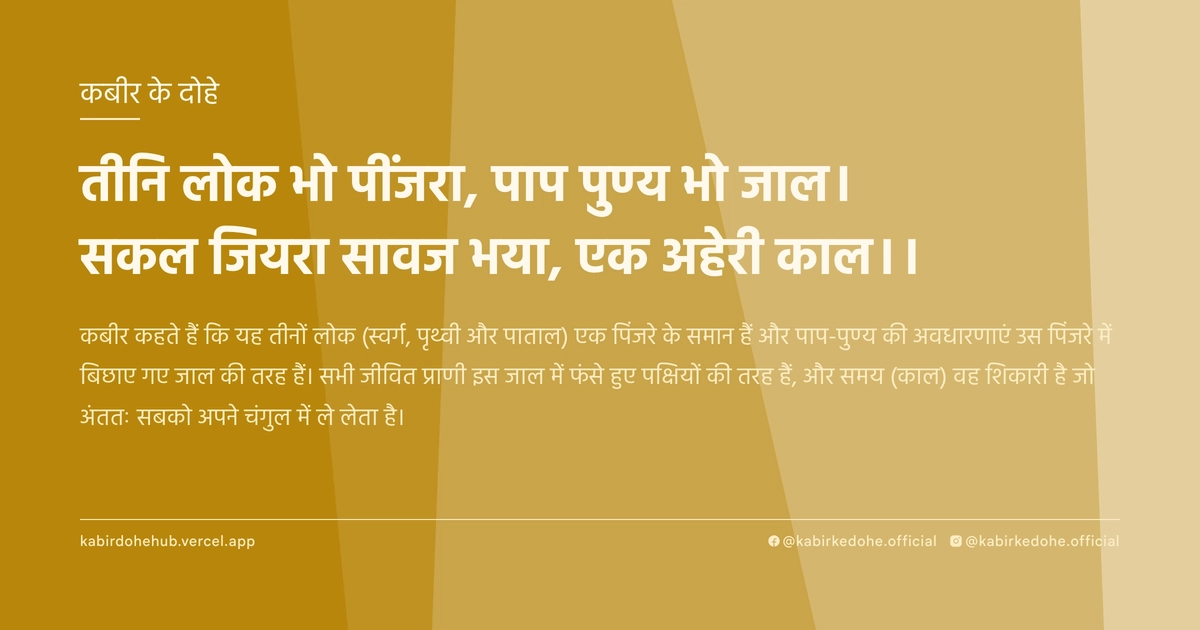
तीनि लोक भो पींजरा, पाप पुण्य भो जाल।
सकल जियरा सावज भया, एक अहेरी काल।।
Teeni lok bho pinjara, paap punya bho jaal. Sakal jiyara savaj bhaya, ek aheri kaal.
इस पृष्ठ पर इस कबीर दोहे का अर्थ (meaning), हिंदी व्याख्या और अंग्रेज़ी अनुवाद, दार्शनिक विश्लेषण और व्यावहारिक जीवन सीख दी गई है। यह दोहा मृतुक्यता (Mortality) विषय से जुड़ा है — Kabir doha meaning and explanation in Hindi and English.
अर्थ (Meaning):
कबीर कहते हैं कि यह तीनों लोक (स्वर्ग, पृथ्वी और पाताल) एक पिंजरे के समान हैं और पाप-पुण्य की अवधारणाएं उस पिंजरे में बिछाए गए जाल की तरह हैं। सभी जीवित प्राणी इस जाल में फंसे हुए पक्षियों की तरह हैं, और समय (काल) वह शिकारी है जो अंततः सबको अपने चंगुल में ले लेता है।
Kabir asserts that the three realms of existence—heaven, earth, and the underworld—are nothing but a cage. The concepts of sin (paap) and merit (punya) are the deceptive nets spread within this cage. All living souls are like trapped birds, while Time (Kaal) acts as the relentless hunter who eventually captures every soul.
व्याख्या (Interpretation):
यहाँ 'पिंजरा' भौतिक शरीर और सांसारिक मोह का प्रतीक है। कबीर एक गहरा विरोधाभास प्रस्तुत करते हैं: हम जिसे 'पुण्य' मानकर संचित करते हैं, वह वास्तव में हमें इस संसार के चक्र में और अधिक मजबूती से बांधता है। यह निर्गुण भक्ति का सार है, जहाँ मुक्ति केवल कर्मकांडों से नहीं, बल्कि द्वैत के पूर्ण त्याग से मिलती है। माया ने हमें पाप और पुण्य के खेल में उलझा दिया है ताकि हम अपनी वास्तविक स्वरूप (ब्रह्म) को भूल जाएं। जब तक जीव स्वयं को 'कर्ता' मानता है, वह काल के शिकारी के लिए एक आसान लक्ष्य बना रहता है। अंततः, यह दोहा आत्मा और परमात्मा के अद्वैत संबंध की ओर इशारा करता है, जहाँ शिकारी और शिकार दोनों एक ही चेतना के हिस्से हैं।
The 'cage' symbolizes the physical body and the psychological attachments of worldly existence. Kabir presents a profound paradox: the very 'merit' we strive to accumulate acts as a golden chain, binding us more tightly to the cycle of rebirth. This is the essence of Nirgun Bhakti, where liberation is found not through rituals, but through the total transcendence of duality. Maya employs the dichotomy of sin and virtue as a deceptive net to obscure the soul's true nature as Brahman. As long as the soul identifies as the 'doer' (ego), it remains a vulnerable prey for Time (Kaal). Ultimately, the verse points toward the non-duality of the hunter and the hunted, suggesting that only by dissolving the ego can one escape the cycle.
दार्शनिक विश्लेषण (Philosophical Analysis):
कबीर का यह दोहा मध्यकालीन भारत के धार्मिक पाखंड और कर्मकांडीय कठोरता पर एक तीखा प्रहार है। उस समय समाज जाति और बाहरी अनुष्ठानों के आधार पर 'पुण्य' अर्जित करने की होड़ में था। कबीर ने इस धारणा को चुनौती दी कि केवल अच्छे कर्मों से मोक्ष मिलता है; उन्होंने तर्क दिया कि जब तक 'मैं' (अहंकार) मौजूद है, पुण्य भी एक बंधन है।
यह विचार अद्वैत वेदांत के करीब है, जहाँ संसार को 'माया' कहा गया है। माया केवल बुराई नहीं है, बल्कि वह 'भ्रम' है जो हमें सत्य से दूर रखता है। यहाँ पुण्य को जाल कहना एक क्रांतिकारी विचार है, क्योंकि यह बताता है कि स्वर्ग की लालसा भी एक प्रकार की आसक्ति है जो आत्मा को मुक्त नहीं होने देती।
सूफीवाद के प्रभाव में, कबीर 'इश्क-ए-हकीकी' (ईश्वर के प्रति प्रेम) की बात करते हैं, जहाँ प्रेमी को अपने अस्तित्व को मिटाना पड़ता है। जिस प्रकार एक पक्षी पिंजरे की सुंदरता को भूलकर केवल उड़ने की इच्छा रखता है, उसी प्रकार साधक को सांसारिक सुखों और आध्यात्मिक उपलब्धियों के अहंकार से ऊपर उठना चाहिए।
मनोवैज्ञानिक स्तर पर, यह दोहा हमारी कंडीशनिंग की बात करता है। हम समाज द्वारा निर्धारित 'सही' और 'गलत' के मापदंडों में इतने उलझ जाते हैं कि हम अपनी सहज चेतना को खो देते हैं। काल (समय) यहाँ केवल मृत्यु नहीं, बल्कि वह निरंतर परिवर्तन है जो हर अहंकार को नष्ट कर देता है।
अंततः, कबीर का संदेश यह है कि मुक्ति पाप या पुण्य के संतुलन से नहीं, बल्कि इन दोनों के पार जाने से मिलती है। जब जीव यह जान लेता है कि वह न तो पापी है और न ही पुण्यात्मा, बल्कि वह शुद्ध चैतन्य है, तब शिकारी का जाल स्वतः ही टूट जाता है।
This couplet is a searing critique of the religious hypocrisy and ritualistic rigidity prevalent in medieval India. During Kabir's era, society was obsessed with accumulating 'merit' through caste-based rituals and external displays of piety. Kabir challenged the notion that mere good deeds lead to liberation, arguing that as long as the 'I' (ego) exists, even virtue is a shackle.
This perspective aligns closely with Advaita Vedanta, where the world is described as 'Maya'. Maya is not merely evil, but the 'illusion' that veils the ultimate truth. To describe merit as a 'net' is a revolutionary philosophical move; it suggests that the desire for heaven is itself a form of attachment that prevents the soul from achieving absolute liberation.
Influenced by Sufism, Kabir emphasizes the annihilation of the self (Fana). Just as a bird ignores the gilded bars of a cage to yearn for the open sky, the seeker must transcend both worldly pleasures and the spiritual pride associated with 'righteousness'.
Psychologically, the verse addresses human conditioning. We become so entangled in socially constructed definitions of 'right' and 'wrong' that we lose touch with our innate consciousness. Time (Kaal) here represents not just biological death, but the relentless force of entropy that eventually dissolves every ego-construct.
Ultimately, Kabir's message is that liberation is not found in the balance of sin and virtue, but in transcending the duality altogether. When the soul realizes it is neither a sinner nor a saint, but pure consciousness, the hunter's net ceases to exist.
मूल संदेश (Core Message):
- संसार एक मोहक पिंजरा है, जिसे हम अपना घर समझते हैं।
- पाप और पुण्य केवल मन के द्वंद्व हैं, जो आत्मा को बांधते हैं।
- वास्तविक मुक्ति कर्मों के संचय में नहीं, बल्कि उनके त्याग में है।
- अहंकार का विसर्जन ही शिकारी (काल) से बचने का एकमात्र मार्ग है।
- जब 'मैं' मिटता है, तब पिंजरा और शिकारी दोनों लुप्त हो जाते हैं।
- The world is a seductive cage that we mistakenly call our home.
- Sin and merit are merely mental dualities that bind the soul.
- True liberation lies not in the accumulation of deeds, but in their transcendence.
- The dissolution of the ego is the only way to escape the hunter (Time).
- When the 'I' vanishes, both the cage and the hunter disappear.
व्यावहारिक उदाहरण (Practical Example):
वाराणसी के घाटों पर रहने वाला एक वृद्ध विधवा, जिसे लोग 'माई' कहते थे, अपना पूरा जीवन धर्म के कठोर नियमों का पालन करने में बिता चुकी थी। वह हर दिन घंटों जप करती, केवल सात्विक भोजन करती और दूसरों को पाप-पुण्य की चेतावनी देती। उसे विश्वास था कि उसके इन 'पुण्यों' से उसे मृत्यु के बाद मोक्ष मिलेगा।
एक दिन उसकी मुलाकात एक घुमंतू साधु से हुई जो घाट की सीढ़ियों पर चुपचाप बैठा था। माई ने उसे उपदेश देना शुरू किया कि कैसे वह अपने जीवन को पापों में बर्बाद कर रहा है और उसे पुण्य कमाने के लिए अनुष्ठान करने चाहिए।
साधु ने मुस्कुराते हुए एक छोटा सा पिंजरा दिखाया जिसमें एक चिड़िया फड़फड़ा रही थी। उसने पूछा, 'माई, यदि मैं इस चिड़िया को सोने के दानों से खिलाऊं और इसके पिंजरे को रेशम से सजाऊं, तो क्या यह मुक्त हो जाएगी?'
माई ने तुरंत उत्तर दिया, 'नहीं, वह अभी भी कैद है।'
साधु ने धीरे से कहा, 'ठीक वैसे ही, आपके पुण्य उस सोने के दाने और रेशम की सजावट हैं। वे आपके जीवन को सुंदर बना सकते हैं, लेकिन वे आपको इस शरीर और मोह के पिंजरे से मुक्त नहीं करेंगे। आप पुण्य के जाल में इतनी उलझी हैं कि आपने उड़ना ही भुला दिया है।'
यह सुनकर माई के भीतर कुछ टूट गया। उसे अहसास हुआ कि उसकी पूरी धार्मिकता वास्तव में उसके अहंकार को पालने का एक तरीका थी। वह 'पुण्य की संचयकर्ता' बनकर खुद को दूसरों से श्रेष्ठ मानती रही थी।
अगले कुछ महीनों में, माई का व्यवहार बदल गया। उसने दिखावे के जप और कठोर नियमों को छोड़ दिया। अब वह केवल निस्वार्थ भाव से बीमारों की सेवा करने लगी, बिना यह सोचे कि इससे उसे कोई फल मिलेगा या नहीं।
उसने पाया कि जब उसने 'पुण्य' कमाने की इच्छा छोड़ी, तो उसके मन का बोझ हल्का हो गया। वह अब धर्म की रक्षक नहीं, बल्कि प्रेम की वाहक बन गई थी।
मृत्यु के समय, उसके चेहरे पर कोई भय नहीं था, क्योंकि उसने जान लिया था कि शिकारी (काल) केवल उस 'अहंकार' को पकड़ता है जो खुद को कुछ मानता है। वह अब एक मुक्त पक्षी की तरह थी।
In the ghats of Varanasi lived an elderly widow known as 'Mai', who had spent her entire life adhering to the strictest religious codes. She spent hours in chanting, ate only the purest satvic food, and constantly warned others about the perils of sin and the necessity of merit. She was convinced that her accumulated 'punya' would guarantee her moksha after death.
One day, she encountered a wandering ascetic sitting silently on the stone steps. Mai began lecturing him, explaining how he was wasting his life in sin and urging him to perform rituals to earn merit.
The ascetic smiled and produced a small cage containing a fluttering bird. He asked, 'Mai, if I feed this bird golden grains and decorate its cage with the finest silk, will it be free?'
Mai replied instantly, 'No, it is still imprisoned.'
The ascetic softly said, 'Exactly. Your merits are those golden grains and silk decorations. They may make your imprisonment comfortable, but they will not free you from the cage of the body and attachment. You are so entangled in the net of merit that you have forgotten how to fly.'
These words shattered Mai's internal construct. She realized that her lifelong piety was merely a sophisticated way of nourishing her ego. By becoming a 'collector of merit,' she had secretly viewed herself as superior to others.
Over the following months, Mai's behavior transformed. She abandoned the performative chants and rigid rules. She began serving the sick and the dying with pure selflessness, without any thought of spiritual reward.
She discovered that once she let go of the desire to 'earn' merit, the heavy burden on her mind vanished. She was no longer a guardian of religion, but a vessel of love.
When her time finally came, there was no fear on her face. She understood that the hunter (Time) only captures the 'ego' that believes it is something separate. She had become like a bird that had already flown.
अभ्यास मार्गदर्शन (Practice Guidance):
- प्रतिदिन 20 मिनट मौन बैठें और विचार करें कि आपकी कौन सी 'अच्छाइयाँ' वास्तव में आपके अहंकार को संतुष्ट कर रही हैं।
- एक 'अहंकार पत्रिका' (Ego Journal) बनाएँ। जब भी आप किसी की मदद करें, तो लिखें कि क्या आप बदले में प्रशंसा या आध्यात्मिक श्रेष्ठता की अपेक्षा कर रहे थे।
- अभ्यास करें: दिन में कम से कम एक ऐसा कार्य करें जिसका कोई बाहरी फल न हो और जिसे आप किसी को न बताएँ।
- निदान चेकलिस्ट: क्या आप दूसरों के 'पाप' देखकर खुद को श्रेष्ठ महसूस करते हैं? क्या आप अपनी धार्मिक पहचान से बहुत अधिक जुड़े हुए हैं? यदि हाँ, तो आप अभी भी 'जाल' में हैं।
- Sit in silence for 20 minutes daily and contemplate which of your 'good deeds' are actually serving to nourish your ego.
- Maintain an 'Ego Journal'. Whenever you help someone, record whether you were subconsciously expecting praise or a feeling of spiritual superiority.
- Practice: Perform at least one act of kindness daily that has no external reward and keep it a complete secret from everyone.
- Diagnostic Checklist: Do you feel superior when observing others' 'sins'? Are you overly attached to your religious identity? If yes, you are still entangled in the 'net'.
चिंतन प्रश्न (Reflection Questions):
- क्या मेरी नैतिकता वास्तव में करुणा से प्रेरित है, या यह केवल समाज में मेरी छवि को बेहतर बनाने का एक उपकरण है?
- यदि मुझसे मेरे सभी 'पुण्य' और धार्मिक उपलब्धियां छीन ली जाएं, तो मेरी पहचान का क्या बचेगा?
- मैं किन 'स्वर्ग' की कल्पनाओं के कारण वर्तमान क्षण की वास्तविकता से भाग रहा हूँ?
- क्या मैं वास्तव में स्वतंत्र होना चाहता हूँ, या मैं केवल एक अधिक आरामदायक और 'पुण्यमय' पिंजरे की तलाश में हूँ?
- मेरे जीवन का वह कौन सा हिस्सा है जहाँ मैं अभी भी 'पाप और पुण्य' के पुराने खेल खेल रहा हूँ?
- Is my morality truly driven by compassion, or is it merely a tool to enhance my social image?
- If all my 'merits' and religious achievements were stripped away, what would remain of my identity?
- What fantasies of 'heaven' am I using to escape the raw reality of the present moment?
- Do I truly desire liberation, or am I simply searching for a more comfortable and 'virtuous' cage?
- In which areas of my life am I still playing the outdated game of 'sin and merit'?