
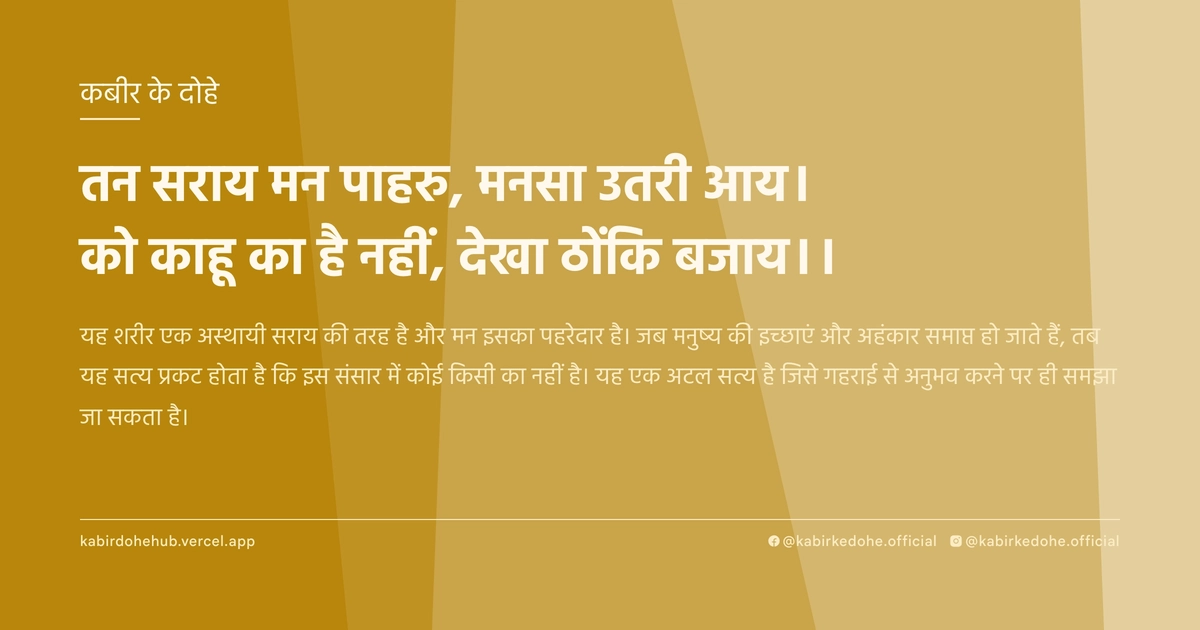
तन सराय मन पाहरु, मनसा उतरी आय।
को काहू का है नहीं, देखा ठोंकि बजाय।।
Tan saray man pahru, mansa utari aay. Ko kahu ka hai nahi, dekha thonki bajay.
इस पृष्ठ पर इस कबीर दोहे का अर्थ (meaning), हिंदी व्याख्या और अंग्रेज़ी अनुवाद, दार्शनिक विश्लेषण और व्यावहारिक जीवन सीख दी गई है। यह दोहा आत्मा और शरीर (Soul and Body) विषय से जुड़ा है — Kabir doha meaning and explanation in Hindi and English.
अर्थ (Meaning):
यह शरीर एक अस्थायी सराय की तरह है और मन इसका पहरेदार है। जब मनुष्य की इच्छाएं और अहंकार समाप्त हो जाते हैं, तब यह सत्य प्रकट होता है कि इस संसार में कोई किसी का नहीं है। यह एक अटल सत्य है जिसे गहराई से अनुभव करने पर ही समझा जा सकता है।
The physical body is merely a temporary inn, and the mind acts as its vigilant guard. Once the delusions of desire and the ego are dismantled, the stark reality emerges: no one truly belongs to anyone else. This is an absolute truth, realized only through profound spiritual awakening and direct experience.
व्याख्या (Interpretation):
कबीर यहाँ शरीर की तुलना एक 'सराय' से करते हैं, जहाँ यात्री केवल कुछ समय के लिए रुकते हैं। मन को 'पाहरु' या पहरेदार कहा गया है, जो हमें इस भ्रम में रखता है कि यह अस्थायी निवास हमारा स्थायी घर है। जब 'मनसा' यानी मानसिक कामनाएं शांत होती हैं, तब साधक को यह बोध होता है कि सभी सांसारिक संबंध मायावी हैं। यह निर्गुण भक्ति का सार है, जहाँ आत्मा का संबंध केवल उस निराकार ब्रह्म से है। यहाँ द्वैत का अंत होता है और यह समझ आता है कि 'मैं' और 'मेरा' केवल मानसिक कल्पनाएं हैं। अंततः, यह दोहा हमें मोह के बंधन तोड़कर आत्म-साक्षात्कार की ओर ले जाता है।
Kabir employs the metaphor of a 'sarai' (inn) to describe the human body, emphasizing its transient nature. The mind is cast as the 'pahru' (guard), a sentinel of illusion that convinces us this temporary lodging is a permanent home. When 'mansaa'—the driving force of desire—is subdued, the seeker awakens to the truth that all worldly attachments are ephemeral. This aligns with Nirgun Bhakti, where the soul's only enduring bond is with the Formless Absolute. The paradox lies in the fact that we guard a house that does not belong to us. By dismantling the ego, the non-duality of Atman and Brahman is revealed, proving that the perceived separation between individuals is a veil of Maya.
दार्शनिक विश्लेषण (Philosophical Analysis):
कबीर का यह दृष्टिकोण अद्वैत वेदांत और सूफी मत के 'फना' (अहंकार का विनाश) के सिद्धांतों का संगम है। उनके समय में, समाज कर्मकांडों और जातिगत श्रेष्ठता में उलझा था, जहाँ लोग बाहरी पहचान को ही सत्य मानते थे। कबीर ने इस सामाजिक ढांचे पर प्रहार करते हुए कहा कि जब मृत्यु आती है, तो न जाति काम आती है न धन; केवल आत्मा की शुद्धता शेष रहती है।
दार्शनिक स्तर पर, 'सराय' का विचार यह दर्शाता है कि भौतिक शरीर केवल एक वाहन है। हम अक्सर शरीर की पहचान को अपनी आत्मा की पहचान मान लेते हैं, जो कि अज्ञानता की पराकाष्ठा है। यह भ्रम ही दुख का मूल कारण है। जब हम यह स्वीकार करते हैं कि हम यहाँ केवल मेहमान हैं, तो हमारा मोह स्वतः कम होने लगता है।
सूफीवाद में भी इसी तरह की विरक्ति की बात की गई है, जहाँ ईश्वर के प्रति प्रेम पाने के लिए दुनिया से मोह का त्याग आवश्यक है। कबीर यहाँ 'ठोंकि बजाय' शब्द का प्रयोग कर रहे हैं, जिसका अर्थ है किसी बात को जोर देकर या प्रमाण के साथ सिद्ध करना। वे कहते हैं कि यह सत्य केवल किताबी नहीं है, बल्कि अनुभवजन्य है।
मनोवैज्ञानिक रूप से, मन का पहरेदार बनना हमारी रक्षा प्रणाली (defense mechanism) है जो हमें मृत्यु के भय से बचाने के लिए झूठे सुरक्षा कवच बनाता है। यह कवच हमें रिश्तों और संपत्तियों से बांधता है। जब यह कवच टूटता है, तब वास्तविक स्वतंत्रता का अनुभव होता है।
अंततः, कबीर का संदेश यह है कि मुक्ति बाहरी दुनिया में नहीं, बल्कि आंतरिक विरक्ति में है। जब हम यह जान लेते हैं कि कोई किसी का नहीं है, तब हम वास्तव में सबके हो जाते हैं क्योंकि तब हमारे भीतर से 'मेरा' और 'तेरा' का भेद समाप्त हो जाता है और केवल करुणा शेष रहती है।
Kabir’s perspective is a synthesis of Advaita Vedanta’s non-duality and the Sufi concept of 'Fana' (the annihilation of the self). During his era, society was deeply entrenched in ritualism and caste hierarchies, where external identities were mistaken for ultimate truths. Kabir challenged this by asserting that at the moment of death, neither caste nor wealth remains; only the purity of the soul persists.
Philosophically, the 'inn' metaphor illustrates that the physical body is merely a vehicle. The fundamental human error is equating the identity of the body with the identity of the soul. This misidentification is the root of all suffering (Samsara). By accepting our status as temporary guests, the grip of attachment naturally loosens.
This mirrors Sufi teachings, where detachment from the world is a prerequisite for achieving union with the Divine. Kabir uses the phrase 'thonki bajay,' suggesting a truth that is not merely theoretical but empirically proven through direct spiritual experience. He is not preaching a philosophy but reporting a discovery.
Psychologically, the mind acting as a 'guard' represents the ego's defense mechanism. To avoid the existential dread of mortality, the mind constructs a facade of permanence through relationships and possessions. This facade creates a false sense of security and ownership.
Ultimately, Kabir suggests that liberation is found not in the external world, but in internal detachment. When one realizes that 'no one belongs to anyone,' the boundaries of the ego dissolve. Paradoxically, by letting go of the claim of ownership over others, one becomes universally connected through pure, selfless compassion.
मूल संदेश (Core Message):
- शरीर नश्वर है, इसे स्थायी घर मानना सबसे बड़ी भूल है।
- मन का अहंकार हमें सत्य देखने से रोकता है, यह एक भ्रम पैदा करता है।
- सच्ची स्वतंत्रता तब मिलती है जब हम 'मेरा' और 'तेरा' के बंधन तोड़ते हैं।
- सांसारिक रिश्ते अस्थायी हैं; केवल आत्मा का परमात्मा से संबंध शाश्वत है।
- अनासक्ति का अर्थ प्रेम का त्याग नहीं, बल्कि स्वामित्व के भ्रम का त्याग है।
- The body is transient; mistaking it for a permanent home is the ultimate delusion.
- The ego of the mind acts as a veil, preventing the realization of absolute truth.
- True liberation occurs only when the chains of 'mine' and 'thine' are broken.
- Worldly relationships are ephemeral; only the bond between Soul and Absolute is eternal.
- Detachment is not the absence of love, but the absence of the illusion of ownership.
व्यावहारिक उदाहरण (Practical Example):
वाराणसी के एक पुराने घाट पर रहने वाले एक वृद्ध विधवा, जानकी, का जीवन इसी सत्य का प्रतिबिंब था। उन्होंने अपना पूरा जीवन अपने पति और बच्चों की सेवा में समर्पित कर दिया था। उनके लिए उनका परिवार ही उनका संपूर्ण संसार था।
जब उनके बेटे विदेश चले गए और उनकी यादें धुंधली होने लगीं, तो जानकी गहरे अवसाद में डूब गईं। उन्हें लगता था कि उनके जीवन का आधार छीन लिया गया है। वे हर दिन गंगा किनारे बैठकर अपने अतीत को याद करतीं और रोतीं।
एक दिन उनकी मुलाकात एक घुमंतू साधु से हुई, जिन्होंने उन्हें कबीर का यह दोहा सुनाया। साधु ने उनसे पूछा, 'माता, क्या आप इस घाट पर आने वाले यात्रियों को देखती हैं? वे आते हैं, कुछ देर रुकते हैं और फिर चले जाते हैं। क्या आप उन यात्रियों के जाने पर रोती हैं?'
जानकी ने कहा, 'नहीं, क्योंकि मैं जानती हूँ कि वे यहाँ केवल कुछ समय के लिए आए थे।' साधु ने मुस्कुराते हुए कहा, 'तो फिर अपने जीवन और रिश्तों को भी इसी घाट की तरह क्यों नहीं देखतीं? यह शरीर भी एक सराय है और आपके प्रियजन भी केवल कुछ समय के यात्री थे।'
इस बात ने जानकी के भीतर एक बिजली की तरह काम किया। उन्होंने महसूस किया कि उन्होंने अपने मन को एक पहरेदार बना लिया था, जो केवल उन यादों की रक्षा कर रहा था जो अब अस्तित्व में ही नहीं थीं।
धीरे-धीरे, जानकी ने अपनी उदासी को स्वीकार किया और उसे विसर्जित करना शुरू किया। उन्होंने महसूस किया कि जिस प्रेम को वे 'मेरा' कह रही थीं, वह वास्तव में एक सार्वभौमिक ऊर्जा थी जो केवल उनके माध्यम से प्रवाहित हो रही थी।
उन्होंने अपना समय अन्य बेसहारा वृद्धों की मदद करने में लगाना शुरू किया। अब वे किसी एक व्यक्ति से चिपकी नहीं थीं, बल्कि हर अजनबी में अपने परिवार को देखने लगीं।
उनकी आंतरिक शांति देखकर लोग हैरान थे। उन्होंने जान लिया था कि जब हम यह मान लेते हैं कि कोई हमारा नहीं है, तो पूरी दुनिया हमारी अपनी हो जाती है।
जानकी का जीवन अब एक बोझ नहीं, बल्कि एक उत्सव बन गया था। उन्होंने शरीर की सराय में रहते हुए भी अपनी आत्मा को मुक्त कर लिया था।
अंत में, जब उनकी मृत्यु आई, तो उनके चेहरे पर एक असीम शांति थी, क्योंकि उन्होंने पहरेदार (मन) को हटा दिया था और सत्य को गले लगा लिया था।
Janaki, an elderly widow living on an ancient ghat in Varanasi, embodied the struggle with this truth. She had spent her entire life devoted to her husband and children, viewing her family as the absolute center of her existence.
When her sons moved abroad and their visits became rare, Janaki sank into a deep depression. She felt as though the very foundation of her life had been ripped away. Every day, she sat by the Ganges, weeping over the ghosts of her past.
One day, she encountered a wandering monk who recited this specific Doha by Kabir. The monk asked her, 'Mother, do you watch the travelers who visit this ghat? They arrive, stay for a while, and then depart. Do you weep when they leave?'
Janaki replied, 'No, for I know they were only here for a short time.' The monk smiled and said, 'Then why not view your life and relationships as this ghat? This body is but an inn, and your loved ones were merely fellow travelers.'
These words struck Janaki like a bolt of lightning. She realized she had turned her mind into a guard, vigilantly protecting memories that no longer existed in reality.
Slowly, Janaki began to acknowledge her grief and then consciously release it. She understood that the love she called 'mine' was actually a universal energy flowing through her, not a possession to be owned.
She began spending her time caring for other homeless elderly people. She was no longer clinging to a specific person; instead, she started seeing her family in every stranger she met.
People were amazed by her newfound inner peace. She had discovered that when we stop claiming ownership over others, the entire world becomes our own.
Janaki's life was no longer a burden of longing, but a celebration of presence. While still inhabiting the 'inn' of the body, she had liberated her soul.
When her time finally came to depart, there was an infinite peace on her face, for she had dismissed the guard of the mind and embraced the ultimate truth.
अभ्यास मार्गदर्शन (Practice Guidance):
- प्रतिदिन 20 मिनट मौन ध्यान करें, जहाँ आप अपने शरीर को केवल एक 'किराये के घर' के रूप में देखें, न कि अपनी स्थायी पहचान के रूप में।
- एक जर्नल लिखें जिसमें उन चीजों की सूची हो जिन्हें आप 'मेरा' कहते हैं, और फिर विश्लेषण करें कि इनमें से वास्तव में आपका क्या है जो मृत्यु के बाद भी रहेगा।
- व्यवहार परिवर्तन: जब भी किसी व्यक्ति या वस्तु के प्रति अत्यधिक मोह या ईर्ष्या महसूस हो, तो स्वयं से कहें, 'यह सराय है, मैं यहाँ केवल मेहमान हूँ' और गहरी सांस लें।
- नैदानिक चेकलिस्ट: क्या आप किसी के जाने पर अत्यधिक विचलित होते हैं? क्या आप अपनी भौतिक उपलब्धियों को अपनी पहचान मानते हैं? यदि हाँ, तो आपका 'मन-पहरेदार' अभी भी सक्रिय है।
- Practice 20 minutes of silent meditation daily, visualizing your body not as your identity, but as a 'rented room' or a temporary shelter.
- Maintain a journal listing everything you claim as 'mine,' then critically analyze which of these possessions will remain with you after death.
- Behavioral Shift: Whenever you feel intense attachment or jealousy toward a person or object, whisper to yourself, 'This is an inn; I am but a guest,' and take a deep breath.
- Diagnostic Checklist: Do you feel devastated by the departure of others? Do you equate your net worth or status with your soul's value? If yes, your 'mind-guard' is still dominating your consciousness.
चिंतन प्रश्न (Reflection Questions):
- यदि आज आपका शरीर यह 'सराय' छोड़ दे, तो आपके पीछे ऐसी कौन सी पहचान बचेगी जिसे आप वास्तव में 'अपना' कह सकें?
- आपका 'मन-पहरेदार' किन यादों और डर की रक्षा कर रहा है, और क्या वह सुरक्षा वास्तव में आपको मुक्त कर रही है या कैद?
- आप जिन लोगों को अपना मानते हैं, क्या आप उन्हें वैसे ही प्यार करते हैं जैसे वे हैं, या आप उन्हें अपनी इच्छाओं के अनुसार ढालकर 'अपना' बनाना चाहते हैं?
- डिजिटल युग में, आपकी सोशल मीडिया प्रोफाइल आपकी 'सराय' का कौन सा हिस्सा है और आप उसे स्थायी बनाने की कितनी कोशिश कर रहे हैं?
- क्या आपकी करुणा केवल अपनों के लिए है, या वह उस स्तर पर पहुँच गई है जहाँ कोई पराया नहीं रहा?
- If your body were to leave this 'inn' today, what identity would remain that you could truthfully call your own?
- What specific memories and fears is your 'mind-guard' protecting, and is this protection liberating you or imprisoning you?
- Do you love the people you claim as 'yours' for who they truly are, or are you trying to mold them into a version that serves your ego?
- In the digital age, what part of your social media persona is a facade of this 'inn,' and how much effort do you spend making it seem permanent?
- Is your compassion reserved only for those you call 'mine,' or has it expanded to a state where no one is a stranger?