
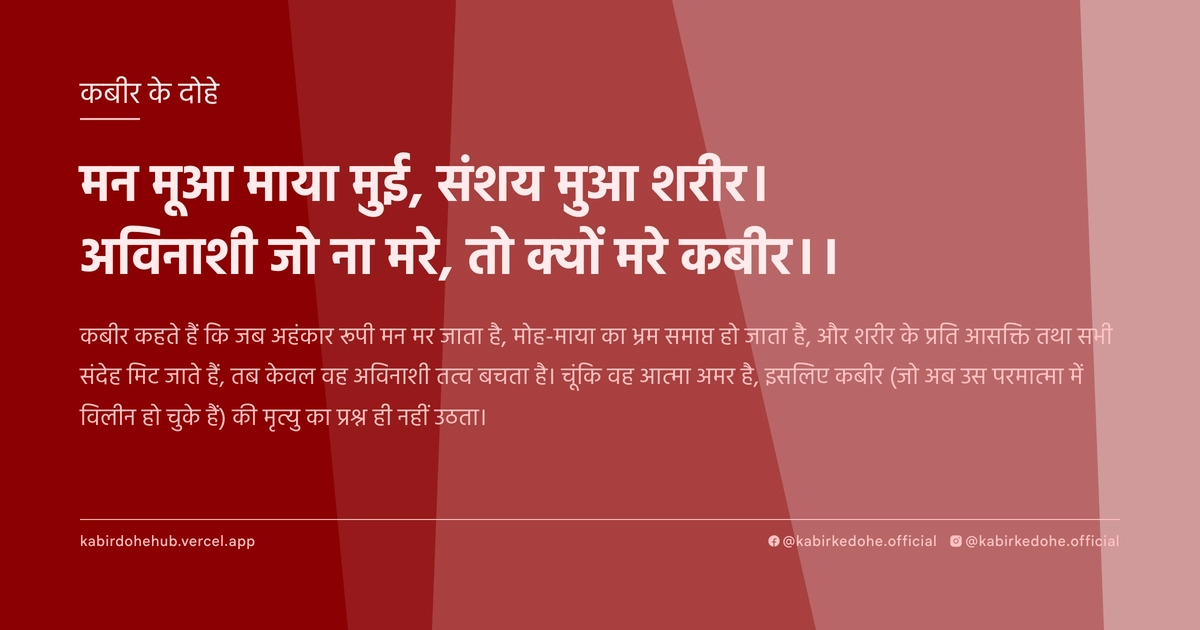
मन मूआ माया मुई, संशय मुआ शरीर।
अविनाशी जो ना मरे, तो क्यों मरे कबीर।।
Man mua maya mui, sanshay mua shareer. Avinashi jo na mare, to kyon mare Kabir.
इस पृष्ठ पर इस कबीर दोहे का अर्थ (meaning), हिंदी व्याख्या और अंग्रेज़ी अनुवाद, दार्शनिक विश्लेषण और व्यावहारिक जीवन सीख दी गई है। यह दोहा निर्गुण ब्रह्म (Nirguna Brahman) विषय से जुड़ा है — Kabir doha meaning and explanation in Hindi and English.
अर्थ (Meaning):
कबीर कहते हैं कि जब अहंकार रूपी मन मर जाता है, मोह-माया का भ्रम समाप्त हो जाता है, और शरीर के प्रति आसक्ति तथा सभी संदेह मिट जाते हैं, तब केवल वह अविनाशी तत्व बचता है। चूंकि वह आत्मा अमर है, इसलिए कबीर (जो अब उस परमात्मा में विलीन हो चुके हैं) की मृत्यु का प्रश्न ही नहीं उठता।
Kabir declares that when the ego-driven mind perishes, the illusion of Maya dissolves, and all doubts regarding the physical body vanish, only the Imperishable remains. Since the true essence of being is immortal and beyond decay, the death of Kabir—who has merged with the Infinite—is an impossibility.
व्याख्या (Interpretation):
यह दोहा मृत्यु के भौतिक स्वरूप के बजाय आध्यात्मिक मृत्यु की बात करता है। 'मन' यहाँ व्यक्तिगत अहंकार का प्रतीक है, 'माया' संसार के प्रति झूने लगाव को दर्शाती है, और 'संशय' अज्ञानता की वह परत है जो हमें सत्य से दूर रखती है। जब ये तीनों नष्ट होते हैं, तो साधक द्वैत (duality) से मुक्त होकर अद्वैत (non-duality) की स्थिति में पहुँचता है। यहाँ 'कबीर' केवल एक व्यक्ति नहीं, बल्कि उस जागृत चेतना का प्रतीक हैं जो शरीर के बंधन से मुक्त है। यह निर्गुण भक्ति का चरम है जहाँ आत्मा और परमात्मा का मिलन होता है। यह विरोधाभास कि 'कबीर नहीं मरते' यह स्पष्ट करता है कि शरीर नश्वर है, परंतु वह तत्व जो शरीर को संचालित करता है, वह शाश्वत है।
This couplet addresses spiritual death rather than biological cessation. The 'mind' symbolizes the individual ego, 'Maya' represents the illusory attachment to the material world, and 'doubt' is the veil of ignorance obscuring the Truth. When these three are annihilated, the seeker transcends duality and enters the state of Advaita (non-duality). Here, 'Kabir' does not refer to a mere person, but to the awakened consciousness that has liberated itself from bodily constraints. This is the pinnacle of Nirgun Bhakti, where the Atman merges with the Brahman. The paradox—that Kabir does not die—clarifies that while the physical vessel is perishable, the animating essence is eternal and immutable.
दार्शनिक विश्लेषण (Philosophical Analysis):
कबीर का यह दर्शन अद्वैत वेदांत और सूफी मत के 'फना' (annihilation) के सिद्धांत का संगम है। उनके समय में कर्मकांड और बाहरी दिखावे का बोलबाला था, जिसे कबीर ने सिरे से नकार दिया। उन्होंने तर्क दिया कि मोक्ष किसी तीर्थ या मंदिर में नहीं, बल्कि स्वयं के भीतर के अहंकार को मारने में है।
यहाँ 'मन' का मरना मनोवैज्ञानिक मृत्यु है, न कि शारीरिक। जब तक 'मैं' का भाव जीवित है, तब तक माया का जाल सक्रिय रहता है। माया वह शक्ति है जो सत्य को छिपाकर असत्य को सत्य दिखाती है। जब साधक इस भ्रम को पहचान लेता है, तो वह माया से मुक्त हो जाता है।
सूफीवाद में इसे 'नफ्स' (lower self) का दमन कहा जाता है। कबीर का दृष्टिकोण यह है कि जब तक व्यक्ति अपनी पहचान शरीर से जोड़कर रखता है, वह भय और शोक के चक्र में फंसा रहता है। शरीर की मृत्यु केवल एक वस्त्र बदलने जैसी है, यदि आत्मा जागृत है।
यह दोहा जाति और धर्म के भेदों को मिटाने का आह्वान करता है क्योंकि मृत्यु के समय न कोई ब्राह्मण रहता है और न कोई मुसलमान; केवल वह शुद्ध चेतना बचती है। कबीर का विद्रोह इसी सार्वभौमिक सत्य पर आधारित था।
अंततः, यह विश्लेषण हमें बताता है कि वास्तविक जीवन वही है जो अहंकार की मृत्यु के बाद शुरू होता है। जो जीवित रहकर भी मर चुका है (अहंकार शून्य), वही वास्तव में अविनाशी है। यह भौतिकता से परे एक ऐसी यात्रा है जहाँ शून्य ही पूर्णता बन जाता है।
Kabir's philosophy here is a confluence of Advaita Vedanta and the Sufi concept of 'Fana' (annihilation of the self). During his era, ritualism and external piety dominated the spiritual landscape, both of which Kabir vehemently rejected. He argued that liberation is not found in pilgrimages or temples, but in the systematic dismantling of the internal ego.
The 'death of the mind' described is a psychological and spiritual transition, not a biological one. As long as the sense of 'I' persists, the web of Maya remains active. Maya is the cosmic illusion that veils the Absolute Truth and presents the transient as permanent.
In Sufism, this mirrors the struggle against the 'Nafs' (the lower self). Kabir posits that as long as an individual identifies solely with the physical body, they remain trapped in the cycle of fear and grief. The death of the body is merely a change of raiment if the soul has already awakened.
This teaching serves as a radical critique of caste and religious divisions. In the face of ultimate dissolution, neither the Brahmin nor the Muslim exists; only the pure, undifferentiated consciousness remains. Kabir's rebellion was rooted in this universal equality.
Ultimately, this analysis reveals that true life begins only after the death of the ego. He who is 'dead' while still living—meaning, devoid of self-importance—is the only one who is truly immortal. It is a journey from the fragmented self to the wholeness of the Void, where emptiness becomes the ultimate fullness.
मूल संदेश (Core Message):
- अहंकार की मृत्यु ही वास्तविक जीवन का प्रारंभ है।
- माया का पर्दा हटने पर केवल सत्य शेष रहता है।
- शरीर नश्वर है, परंतु चेतना शाश्वत और अविनाशी है।
- संदेह का अंत ही आध्यात्मिक पूर्णता की पहली सीढ़ी है।
- स्वयं को मिटा देना ही परमात्मा में विलीन होना है।
- The death of the ego is the birth of true existence.
- Only Truth remains once the veil of Maya is lifted.
- The body is transient, but consciousness is eternal.
- The end of doubt is the first step toward spiritual wholeness.
- To annihilate the self is to merge with the Divine.
व्यावहारिक उदाहरण (Practical Example):
वाराणसी के एक पुराने घाट पर रहने वाली एक वृद्ध विधवा, जानकी, का जीवन अत्यंत कठिन था। वह दूसरों के घरों में बर्तन मांजती और बचे हुए भोजन से अपना गुजारा करती थी। समाज उसे 'अशुभ' मानता था और वह स्वयं भी अपने दुखों को अपनी नियति मानकर शोक में डूबी रहती थी।
उसका मन हमेशा इस बात से भरा रहता था कि उसका बेटा उसे छोड़ गया और उसका पति बहुत पहले गुजर गया। यह 'मन' का वह बोझ था जिसने उसे जीवित मृत बना दिया था। वह हर समय अपनी पहचान एक 'बेचारी विधवा' के रूप में देखती थी।
एक दिन उसने एक फकीर को सुना जो कह रहा था कि 'जो मर गया, वही जी उठा'। जानकी को पहले तो यह बात समझ नहीं आई, लेकिन उसने विचार किया कि क्या वह वास्तव में जीवित है? उसने महसूस किया कि उसकी पहचान केवल उसके दुखों और उसकी सामाजिक स्थिति से जुड़ी है।
उसने तय किया कि वह अपनी उस 'पहचान' को मारेगी। उसने अपने भीतर के उस शोक को, जो उसे एक पीड़ित के रूप में परिभाषित करता था, धीरे-धीरे विसर्जित करना शुरू किया। उसने यह स्वीकार किया कि उसका शरीर और उसकी सामाजिक स्थिति केवल एक बाहरी आवरण हैं।
जैसे-जैसे उसका अहंकार (कि मैं पीड़ित हूँ) मरने लगा, उसकी माया (कि दुनिया उसके प्रति क्रूर है) भी कम होने लगी। उसने पाया कि जब वह दूसरों की सेवा बिना किसी उम्मीद के करती है, तो उसका दुख गायब हो जाता है।
एक समय ऐसा आया जब जानकी को अब इस बात का डर नहीं था कि लोग उसे क्या कहते हैं या वह कल क्या खाएगी। उसके भीतर का 'संशय' समाप्त हो गया कि वह ईश्वर की संतान है या नहीं।
उसने महसूस किया कि वह अब केवल एक शरीर नहीं, बल्कि उस शांति का हिस्सा है जो पूरे शहर को घेरे हुए है। वह अब अपनी मृत्यु से नहीं डरती थी क्योंकि उसने जीवन जीते-जी अपनी छोटी पहचान को मार दिया था।
जब वह अंततः शांत भाव से इस दुनिया से विदा हुई, तो उसके चेहरे पर एक ऐसी मुस्कान थी जिसे देखकर लोग हैरान थे। वह मरकर भी नहीं मरी थी, क्योंकि उसने अपनी आत्मा के अविनाशी स्वरूप को पा लिया था।
Janaki, an elderly widow living on an ancient ghat in Varanasi, led a life of profound hardship. She scrubbed pots in other people's homes and survived on leftover scraps. Society branded her as 'inauspicious,' and she, too, lived submerged in grief, viewing her suffering as an inescapable destiny.
Her mind was perpetually occupied by the void left by her son who had abandoned her and a husband long gone. This was the 'burden of the mind' that had made her a living corpse. She identified herself solely as a 'pitiful widow.'
One day, she overheard a wandering dervish proclaiming, 'He who has died is the only one who has truly awakened.' Initially, Janaki found this paradoxical, but she began to question: Was she truly alive, or was she merely a collection of memories and sorrows?
She decided to 'kill' that identity. She began the arduous process of dissolving the grief that defined her as a victim. She realized that her physical form and social status were merely external garments, irrelevant to her true essence.
As her ego—the identity of the 'sufferer'—began to perish, the Maya—the illusion that the world was inherently cruel—also faded. She discovered that when she served others without expectation, her personal agony vanished.
Eventually, Janaki reached a state where she no longer feared the judgment of others or the uncertainty of her next meal. The 'doubt' regarding her divine connection evaporated.
She felt that she was no longer just a body, but a part of the pervasive silence that enveloped the city. She ceased to fear death because she had already executed the death of her limited self while still breathing.
When she finally departed this world in serene silence, a smile lingered on her face that baffled the onlookers. She had not truly died, for she had realized the immortal nature of her being.
अभ्यास मार्गदर्शन (Practice Guidance):
- प्रतिदिन 20 मिनट मौन साधना करें, जहाँ आप अपने विचारों को केवल एक दर्शक की तरह देखें, उनमें शामिल न हों।
- एक डायरी लिखें जिसमें आप अपनी उन पहचानों (जैसे पद, रिश्ता, जाति) की सूची बनाएं जिन्हें आप 'मैं' कहते हैं, और फिर विचार करें कि यदि ये सब छीन लिए जाएं, तो आप कौन होंगे?
- जब भी क्रोध या मोह उत्पन्न हो, स्वयं से पूछें: 'यह कौन है जो दुखी है? क्या यह अविनाशी आत्मा है या यह क्षणभंगुर मन?'
- निदान चेकलिस्ट: यदि आप अभी भी दूसरों की प्रशंसा या आलोचना से विचलित होते हैं, तो आपका 'मन' अभी जीवित है। यदि आप मृत्यु के विचार से भयभीत हैं, तो 'माया' अभी प्रभावी है।
- Engage in 20 minutes of silent observation daily, watching your thoughts as a detached witness without becoming entangled in them.
- Maintain a journal listing all the identities (titles, relationships, caste) you call 'I', then contemplate: 'If all these were stripped away, what remains?'
- Whenever anger or attachment arises, ask yourself: 'Who is the one suffering? Is it the immortal essence, or this transient mind?'
- Diagnostic Checklist: If you are still swayed by the praise or criticism of others, your 'ego-mind' is still alive. If the thought of death evokes fear, 'Maya' still holds dominion.
चिंतन प्रश्न (Reflection Questions):
- आपकी वह कौन सी सामाजिक पहचान है जिसे खोने का विचार आपको सबसे अधिक डराता है?
- क्या आप वास्तव में स्वतंत्र हैं, या आपकी इच्छाएं केवल दूसरों की अपेक्षाओं का प्रतिबिंब हैं?
- यदि आज आपका शरीर समाप्त हो जाए, तो आपके पीछे ऐसा क्या बचेगा जिसे 'आप' कहा जा सके?
- आपकी डिजिटल पहचान (सोशल मीडिया) आपके वास्तविक आंतरिक स्वरूप को कितना छिपाती या बढ़ा-चढ़ाकर दिखाती है?
- क्या आप अपनी मान्यताओं को सत्य मानते हैं, या केवल इसलिए मानते हैं क्योंकि वे आपके परिवेश में प्रचलित हैं?
- Which social identity do you cling to so tightly that the thought of losing it terrifies you?
- Are you truly autonomous, or are your desires merely reflections of others' expectations?
- If your body ceased to exist today, what would remain that could be called 'You'?
- To what extent does your digital persona mask or distort your authentic internal reality?
- Do you hold your beliefs because they are True, or simply because they are prevalent in your environment?