
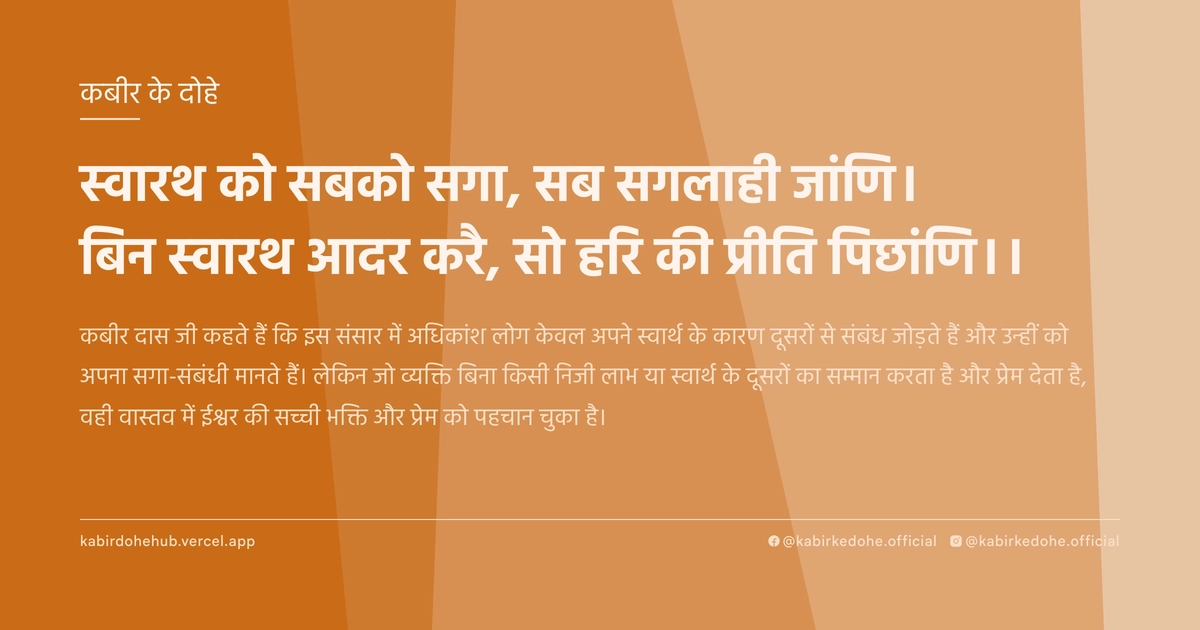
स्वारथ को सबको सगा, सब सगलाही जांणि।
बिन स्वारथ आदर करै, सो हरि की प्रीति पिछांणि।।
Swarth ko sabko saga, sab saglahi jaani. Bin swarth aadar karai, so Hari ki preeti pichhani.
इस पृष्ठ पर इस कबीर दोहे का अर्थ (meaning), हिंदी व्याख्या और अंग्रेज़ी अनुवाद, दार्शनिक विश्लेषण और व्यावहारिक जीवन सीख दी गई है। यह दोहा निष्ठा (Integrity) विषय से जुड़ा है — Kabir doha meaning and explanation in Hindi and English.
अर्थ (Meaning):
कबीर दास जी कहते हैं कि इस संसार में अधिकांश लोग केवल अपने स्वार्थ के कारण दूसरों से संबंध जोड़ते हैं और उन्हीं को अपना सगा-संबंधी मानते हैं। लेकिन जो व्यक्ति बिना किसी निजी लाभ या स्वार्थ के दूसरों का सम्मान करता है और प्रेम देता है, वही वास्तव में ईश्वर की सच्ची भक्ति और प्रेम को पहचान चुका है।
Kabir explains that in this world, most people form bonds and recognize kinship only based on mutual selfishness or personal gain. However, the individual who offers respect and kindness to others without any expectation of reward or ulterior motive is the one who has truly realized and embodied the divine love of Hari.
व्याख्या (Interpretation):
इस दोहे का शाब्दिक अर्थ है कि स्वार्थ ही दुनिया के रिश्तों की बुनियाद है। रूपकात्मक स्तर पर, कबीर 'स्वार्थ' को 'माया' के एक सूक्ष्म रूप के रूप में देखते हैं, जो आत्मा को पृथकता और अहंकार के बंधन में जकड़े रखता है। जब कोई बिना स्वार्थ के आदर करता है, तो वह अपने भीतर के 'अहं' (Ego) को मिटा देता है, जिससे वह अद्वैत अवस्था में पहुँच जाता है जहाँ 'मैं' और 'तू' का भेद समाप्त हो जाता है। यह निर्गुण भक्ति का सार है, जहाँ ईश्वर किसी मूर्ति में नहीं, बल्कि निस्वार्थ सेवा और करुणा में निवास करता है। यहाँ 'हरि की प्रीति' का अर्थ केवल धार्मिक पूजा नहीं, बल्कि उस सार्वभौमिक चेतना का अनुभव है जो समस्त मानवता को एक सूत्र में पिरोती है। यह विरोधाभास है कि जिसे हम बाहरी दुनिया में खोजते हैं, वह वास्तव में निस्वार्थता के क्षणों में हमारे भीतर प्रकट होता है।
Literally, the verse asserts that selfishness is the bedrock of worldly relationships. Metaphorically, Kabir views 'selfishness' as a subtle manifestation of 'Maya' (illusion), which binds the soul in the shackles of separation and ego. When one offers respect without motive, they dissolve the 'Ahankar' (ego), transitioning into a state of Advaita (non-duality) where the distinction between 'self' and 'other' vanishes. This is the essence of Nirgun Bhakti, where the Divine resides not in idols, but in selfless service and compassion. 'Hari ki Preeti' here refers not to ritualistic worship, but to the experience of a universal consciousness that weaves all humanity into one thread. It is the central paradox that the Divine, sought in distant heavens, manifests internally the moment the ego is surrendered through selfless love.
दार्शनिक विश्लेषण (Philosophical Analysis):
कबीर का यह दोहा उनके युग के सामाजिक और धार्मिक पाखंड पर एक गहरा प्रहार है। 15वीं शताब्दी में, धर्म अक्सर जातिगत श्रेष्ठता और कर्मकांडीय शुद्धता के इर्द-गिर्द घूमता था, जहाँ 'आदर' केवल उच्च वर्णों या शक्तिशाली लोगों के लिए आरक्षित था। कबीर ने इस व्यवस्था को चुनौती देते हुए यह प्रतिपादित किया कि वास्तविक आध्यात्मिकता बाहरी दिखावे में नहीं, बल्कि आंतरिक शुद्धि और निस्वार्थता में है।
दार्शनिक रूप से, यह विचार अद्वैत वेदांत के करीब है, जहाँ यह माना जाता है कि आत्मा और ब्रह्म एक ही हैं। यदि हम सभी एक ही चेतना का हिस्सा हैं, तो दूसरे की सेवा करना वास्तव में अपनी ही सेवा करना है। जब हम स्वार्थ त्यागते हैं, तो हम उस भ्रम को तोड़ते हैं कि हम अलग-अलग इकाइयाँ हैं। यह सूफी मत के 'इश्क-ए-हकीकी' (ईश्वरीय प्रेम) से भी मेल खाता है, जहाँ प्रेमी अपने अस्तित्व को मिटाकर परमात्मा में विलीन हो जाता है।
कबीर यहाँ मनोवैज्ञानिक रूपांतरण की बात कर रहे हैं। स्वार्थ एक मानसिक कारागार है जो हमें भय और असुरक्षा में रखता है। जब कोई व्यक्ति 'बिन स्वार्थ' आदर करना सीखता है, तो वह भय से मुक्त होकर प्रेम की स्थिति में आता है। यह केवल एक नैतिक उपदेश नहीं है, बल्कि चेतना के स्तर को ऊपर उठाने का एक मार्ग है।
अक्सर लोग इस दोहे को केवल 'परोपकार' के रूप में देखते हैं, लेकिन कबीर का संकेत 'अहंकार के विसर्जन' की ओर है। परोपकार में भी कभी-कभी 'दाता' का अहंकार छिपा होता है ('मैं मदद कर रहा हूँ')। कबीर जिस आदर की बात कर रहे हैं, वह पूर्णतः शून्य भाव से आता है, जहाँ कर्ता का बोध समाप्त हो जाता है।
अंततः, यह दोहा कर्मकांडीय धर्म और वास्तविक धर्म के बीच के अंतर को स्पष्ट करता है। मंदिर-मस्जिद जाना या माला जपना तब तक व्यर्थ है जब तक हृदय में स्वार्थ का वास है। वास्तविक इबादत वह है जो मनुष्य को मनुष्य से बिना किसी शर्त के जोड़ती है, क्योंकि वही मार्ग ईश्वर तक ले जाता है।
This couplet is a profound critique of the social and religious hypocrisy of Kabir's era. In the 15th century, religion often revolved around caste superiority and ritualistic purity, where 'respect' was reserved only for the high-born or the powerful. Kabir challenged this structure, asserting that true spirituality lies not in external displays but in internal purification and selflessness.
Philosophically, this aligns with Advaita Vedanta, which posits that the Atman (individual soul) and Brahman (universal soul) are one. If we are all fragments of the same consciousness, serving another is fundamentally serving oneself. By relinquishing selfishness, we shatter the illusion of separation. This also resonates with the Sufi concept of 'Ishq-e-Haqiqi' (Divine Love), where the lover annihilates their existence to merge with the Beloved.
Kabir is addressing a psychological transformation. Selfishness is a mental prison that keeps us trapped in fear and insecurity. When a person learns to respect others without motive, they transition from a state of fear to a state of love. This is not merely a moral exhortation but a method for elevating one's level of consciousness.
Common literalist interpretations often mistake this for simple 'philanthropy.' However, Kabir points toward the 'dissolution of the ego.' Even in charity, the ego of the 'giver' often persists ('I am helping'). The respect Kabir advocates stems from a state of 'Shunya' (void), where the sense of being the 'doer' completely disappears.
Ultimately, the verse clarifies the distinction between ritualistic religion and authentic spirituality. Visiting temples or mosques is futile if the heart remains occupied by selfishness. True worship is that which connects human to human unconditionally, for that is the only path leading to the Divine.
मूल संदेश (Core Message):
- स्वार्थ रिश्तों का भ्रम पैदा करता है, प्रेम उन्हें जीवंत करता है।
- सच्ची भक्ति मंदिर में नहीं, निस्वार्थ आदर में निहित है।
- अहंकार का विसर्जन ही ईश्वर से मिलन का एकमात्र मार्ग है।
- जब 'मैं' समाप्त होता है, तब 'हरि' प्रकट होते हैं।
- बिना शर्त सम्मान ही आत्मा की उच्चतम अभिव्यक्ति है।
- Selfishness creates the illusion of kinship; love makes it real.
- True devotion resides not in temples, but in selfless respect.
- The dissolution of ego is the only path to Divine union.
- When the 'I' vanishes, the 'Divine' manifests.
- Unconditional respect is the highest expression of the soul.
व्यावहारिक उदाहरण (Practical Example):
एक समय की बात है, वाराणसी के घाटों पर रामदीन नाम का एक वृद्ध नाविक रहता था। वह जीवन भर नाव चलाकर लोगों को नदी पार कराता था, लेकिन उसका स्वभाव बहुत कठोर था। वह केवल उन्हीं यात्रियों से अधिक सम्मान और प्रेम लेता था जो उसे ज्यादा पैसे देते थे या ऊंचे पदों पर होते थे। उसके लिए हर रिश्ता एक सौदेबाजी था।
एक दिन, एक अत्यंत वृद्ध और दुर्बल महिला उसके पास आई। उसके पास पैसे बहुत कम थे और वह चलने में असमर्थ थी। रामदीन ने उसे अनदेखा किया और एक अमीर व्यापारी को प्राथमिकता दी। लेकिन उस महिला ने बिना किसी शिकायत के, मुस्कुराते हुए रामदीन के पैर छुए और उसे एक छोटा सा, पुराना फल भेंट किया, यह कहते हुए कि "बेटा, तुम्हारी मेहनत के लिए यह छोटा सा उपहार।"
रामदीन चौंक गया। उसने जीवन में कभी ऐसा निस्वार्थ सम्मान नहीं देखा था। वह महिला वास्तव में एक संन्यासिनी थी जिसने अपना सब कुछ त्याग दिया था। उसने रामदीन से कहा, "जब हम कुछ पाने की इच्छा रखते हैं, तो हम केवल दर्पण देखते हैं। जब हम देने की इच्छा रखते हैं, तो हम ईश्वर को देखते हैं।"
यह बात रामदीन के हृदय में गहरे तक उतर गई। उसे महसूस हुआ कि वह अब तक केवल 'सगे' (स्वार्थी रिश्तों) को खोज रहा था, जबकि असली सुकून उस निस्वार्थ प्रेम में था जो उसने उस वृद्ध महिला की आँखों में देखा।
अगले कुछ महीनों में, रामदीन का व्यवहार पूरी तरह बदल गया। उसने उन लोगों की मदद करना शुरू किया जो उसे कुछ नहीं दे सकते थे। वह बीमारों को मुफ्त में नदी पार कराता और घाटों पर भूखों को भोजन खिलाने लगा।
शुरुआत में, उसके साथी नाविकों ने उसका मजाक उड़ाया और कहा कि वह मूर्ख हो गया है। लेकिन रामदीन ने महसूस किया कि अब वह पहले से कहीं अधिक शांत और खुश था। उसका मन अब पैसों की गिनती में नहीं, बल्कि दूसरों की मुस्कुराहट में रमता था।
एक दिन, एक बहुत बड़ा अधिकारी उसके पास आया और उसे शहर में एक बड़ी नाव चलाने का प्रस्ताव दिया, जिसमें बहुत पैसा था। लेकिन रामदीन ने विनम्रता से मना कर दिया। उसने कहा, "मैंने अब तक केवल लाभ खोजा था, अब मैं प्रेम खोज रहा हूँ।"
रामदीन की इस निस्वार्थता ने पूरे घाट का माहौल बदल दिया। अन्य नाविक भी धीरे-धीरे उसकी करुणा से प्रभावित हुए और आपसी प्रतिस्पर्धा छोड़कर एक-दूसरे की मदद करने लगे।
रामदीन ने यह जान लिया था कि जब वह बिना किसी स्वार्थ के दूसरों का आदर करता है, तो वह वास्तव में अपने भीतर के ईश्वर से मिल रहा होता है।
उसका जीवन अब एक बोझ नहीं, बल्कि एक उत्सव बन गया था, क्योंकि उसने 'हरि की प्रीति' को पहचान लिया था।
Once, on the ghats of Varanasi, lived an elderly boatman named Ramdeen. He spent his life ferrying people across the river, but his nature was harsh. He showed respect and affection only to those passengers who paid him more or held high positions. For him, every relationship was a transaction.
One day, an extremely frail and elderly woman approached him. She had very little money and struggled to walk. Ramdeen ignored her, prioritizing a wealthy merchant instead. However, the woman, without a single complaint, smiled and touched Ramdeen's feet, offering him a small, withered fruit, saying, "Son, a tiny gift for your hard work."
Ramdeen was stunned. He had never experienced such selfless respect in his life. The woman was actually a sanyasini who had renounced everything. She told him, "When we wish to gain, we see only a mirror. When we wish to give, we see the Divine."
These words pierced Ramdeen's heart. He realized that he had spent his life seeking 'kinship' based on utility, while true peace lay in the selfless love he saw in the old woman's eyes.
Over the next few months, Ramdeen's behavior transformed completely. He began helping those who could offer him nothing in return. He ferried the sick for free and started feeding the hungry on the ghats.
Initially, fellow boatmen mocked him, calling him a fool. But Ramdeen felt a serenity and happiness he had never known. His mind no longer obsessed over counting coins but found joy in the smiles of others.
One day, a high-ranking official approached him with an offer to run a large commercial fleet in the city, promising immense wealth. Ramdeen politely declined. He said, "Until now, I sought only profit; now, I seek love."
Ramdeen's selflessness transformed the atmosphere of the entire ghat. Other boatmen, moved by his compassion, stopped their fierce competition and began supporting one another.
Ramdeen had realized that when he respected others without motive, he was actually encountering the Divine within himself.
His life was no longer a burden but a celebration, for he had finally recognized 'Hari ki Preeti'.
अभ्यास मार्गदर्शन (Practice Guidance):
- प्रतिदिन कम से कम एक ऐसा कार्य करें जिसमें आपका कोई व्यक्तिगत लाभ न हो और जिसे आप गुप्त रखें।
- स्व-पूछताछ (Self-Inquiry): जब भी आप किसी की मदद करें, रुककर पूछें, "क्या मैं इस कार्य से प्रशंसा या भविष्य में किसी लाभ की अपेक्षा कर रहा हूँ?"
- अभ्यास: दिन में तीन बार ऐसे लोगों को सम्मान दें जिन्हें समाज आमतौर पर अनदेखा करता है (जैसे सफाई कर्मचारी या सड़क किनारे बैठने वाले)।
- डायग्नोस्टिक चेकलिस्ट: यदि आप किसी व्यक्ति के व्यवहार में बदलाव आने पर अपनी मदद या सम्मान वापस ले लेते हैं, तो समझें कि आपका प्रेम अभी भी स्वार्थ से प्रेरित है।
- Perform at least one act of kindness daily that offers no personal gain and keep it strictly secret.
- Self-Inquiry: Whenever you help someone, pause and ask, "Am I expecting praise or a future favor from this action?"
- Practice: Three times a day, consciously offer genuine respect to those whom society typically overlooks (e.g., sanitation workers or street dwellers).
- Diagnostic Checklist: If you withdraw your help or respect the moment a person's behavior changes or they cease to be useful to you, recognize that your love is still driven by selfishness.
चिंतन प्रश्न (Reflection Questions):
- मेरे जीवन में ऐसे कितने लोग हैं जिनसे मेरा संबंध केवल मेरी जरूरतों के कारण है?
- क्या मैं वास्तव में दूसरों का सम्मान करता हूँ, या मैं केवल उस 'पद' का सम्मान करता हूँ जिसे वे धारण करते हैं?
- यदि मेरी सामाजिक प्रतिष्ठा और संसाधन छीन लिए जाएँ, तो क्या मेरे पास कोई ऐसा रिश्ता बचेगा जो निस्वार्थ हो?
- मेरे भीतर का 'डिजिटल अहंकार' मुझे दूसरों की मदद केवल दिखावे के लिए तो नहीं प्रेरित करता?
- क्या मैं उस व्यक्ति को सम्मान दे सकता हूँ जो मेरे विचारों के बिल्कुल विपरीत है और जिससे मुझे कोई लाभ नहीं?
- How many relationships in my life exist solely because they serve my current needs?
- Do I truly respect the human being, or do I merely respect the 'status' they hold?
- If my social prestige and resources were stripped away, would any selfless relationship remain in my life?
- Does my 'digital ego' drive me to help others merely for the sake of visibility and validation?
- Can I offer genuine respect to someone whose views are diametrically opposed to mine and from whom I gain nothing?