
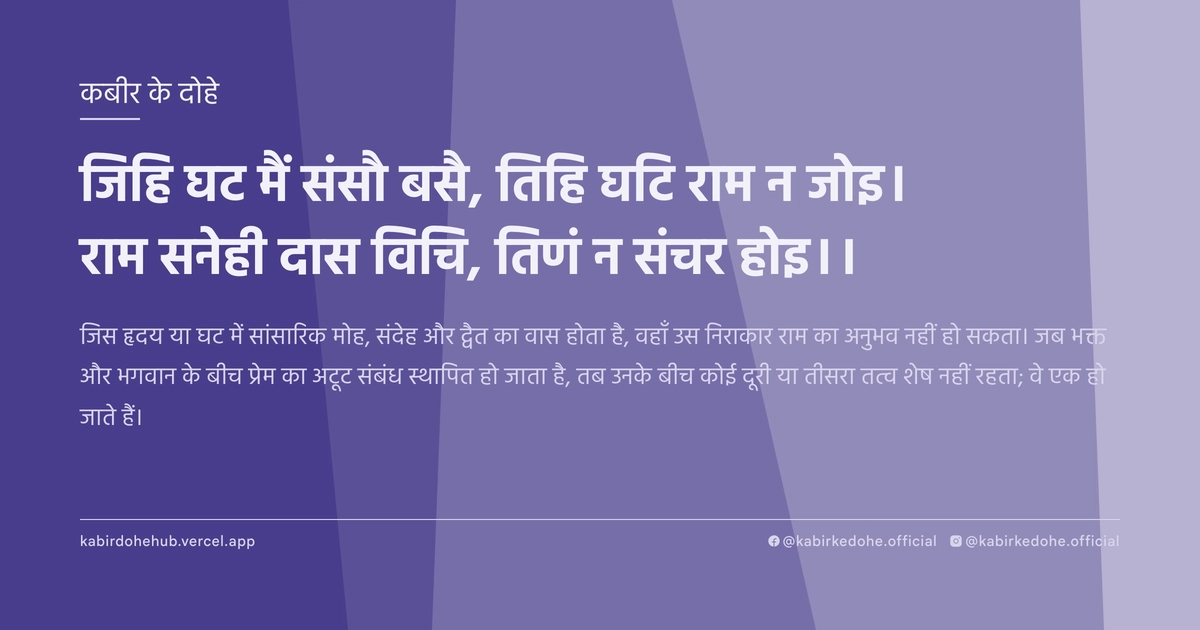
जिहि घट मैं संसौ बसै, तिहि घटि राम न जोइ।
राम सनेही दास विचि, तिणं न संचर होइ।।
Jih ghat main sansau basai, tih ghat Ram na joi. Ram sanehi das vichi, tin na sanchar hoye.
इस पृष्ठ पर इस कबीर दोहे का अर्थ (meaning), हिंदी व्याख्या और अंग्रेज़ी अनुवाद, दार्शनिक विश्लेषण और व्यावहारिक जीवन सीख दी गई है। यह दोहा अंतर ज्योति (The Inner Light) विषय से जुड़ा है — Kabir doha meaning and explanation in Hindi and English.
अर्थ (Meaning):
जिस हृदय या घट में सांसारिक मोह, संदेह और द्वैत का वास होता है, वहाँ उस निराकार राम का अनुभव नहीं हो सकता। जब भक्त और भगवान के बीच प्रेम का अटूट संबंध स्थापित हो जाता है, तब उनके बीच कोई दूरी या तीसरा तत्व शेष नहीं रहता; वे एक हो जाते हैं।
In the heart where worldly attachment, doubt, and duality reside, the formless Divine (Ram) cannot be found. When a true devotee and the Divine are united in selfless love, all separation vanishes, and no third entity can exist between them, achieving a state of absolute oneness.
व्याख्या (Interpretation):
यह दोहा आत्मा और परमात्मा के मिलन की अनिवार्य शर्त पर प्रकाश डालता है। 'घट' यहाँ मानव शरीर और चेतना का प्रतीक है। 'संसौ' या संशय का अर्थ केवल संदेह नहीं, बल्कि वह माया है जो हमें यह विश्वास दिलाती है कि हम ईश्वर से अलग हैं। जब तक अहंकार और सांसारिक आसक्ति मौजूद है, तब तक राम (परम तत्व) की उपस्थिति महसूस नहीं की जा सकती क्योंकि अहंकार और परमात्मा एक साथ नहीं रह सकते। जैसे प्रकाश के आते ही अंधकार मिट जाता है, वैसे ही प्रेम के उदय होते ही द्वैत समाप्त हो जाता है। यह निर्गुण भक्ति का सार है जहाँ ईश्वर किसी बाहरी मूर्ति में नहीं, बल्कि आंतरिक शुद्धता में मिलता है। यहाँ 'राम' दशरथ पुत्र नहीं, बल्कि वह सर्वव्यापी चेतना है जो हर कण में व्याप्त है।
This couplet illuminates the essential condition for the union of the Atman (soul) and Brahman (Universal Consciousness). The 'ghat' or vessel symbolizes the human body and consciousness. 'Sansau' refers not merely to doubt, but to the veil of Maya that creates the illusion of separation between the self and the Divine. As long as ego and worldly attachments persist, the experience of the formless Ram is impossible, for the ego and the Divine cannot coexist in the same space. Just as darkness vanishes upon the arrival of light, duality dissolves in the presence of divine love. This is the essence of Nirgun Bhakti, where God is not found in external idols but in internal purity. Here, 'Ram' does not refer to the historical king, but to the omnipresent consciousness pervading every atom of existence.
दार्शनिक विश्लेषण (Philosophical Analysis):
कबीर का यह दर्शन अद्वैत वेदांत और सूफी मत के 'फना' (अहंकार का विनाश) के सिद्धांत का एक सुंदर संगम है। कबीर उस समय के धार्मिक पाखंडों और कर्मकांडों पर प्रहार कर रहे थे, जहाँ लोग ईश्वर को मंदिरों और मस्जिदों में खोजते थे, जबकि वे अपने भीतर के अहंकार को नहीं त्यागते थे। उनके अनुसार, ईश्वर की प्राप्ति के लिए किसी बाहरी यात्रा की आवश्यकता नहीं है, बल्कि आंतरिक शुद्धि अनिवार्य है।
यह दोहा 'द्वैत' (Duality) के विनाश की बात करता है। जब तक 'मैं' और 'तू' का भाव है, तब तक विरह है। लेकिन जब प्रेम इतना गहरा हो जाए कि प्रेमी और प्रियतम एक हो जाएं, तो वह अवस्था 'अद्वैत' कहलाती है। यह सूफीवाद के 'इश्क-ए-हकीकी' (ईश्वरीय प्रेम) के समान है, जहाँ साधक अपनी पहचान को ईश्वर में विलीन कर देता है।
मनोवैज्ञानिक स्तर पर, यह अहंकार के विसर्जन की प्रक्रिया है। अहंकार वह पर्दा है जो हमें सत्य देखने से रोकता है। कबीर तर्क देते हैं कि जब तक हम अपनी पहचान को सामाजिक स्थिति, जाति या धार्मिक लेबल से जोड़ते हैं, हम उस सार्वभौमिक सत्य से दूर रहते हैं।
निर्गुण भक्ति का मार्ग यह सिखाता है कि ईश्वर का कोई आकार नहीं है; वह केवल प्रेम और जागरूकता के माध्यम से अनुभव किया जा सकता है। यहाँ 'राम' एक प्रतीक है उस परम शांति और सत्य का, जो केवल तब प्रकट होता है जब मन के सारे शोर (संसौ) शांत हो जाते हैं।
अंततः, कबीर यह स्पष्ट करते हैं कि भक्ति केवल प्रार्थना नहीं है, बल्कि एक रूपांतरण है। यह स्वयं को मिटाकर उस अनंत में समा जाने की कला है। जब 'दास' (भक्त) पूरी तरह समर्पित हो जाता है, तो वह स्वयं राम बन जाता है, क्योंकि आत्मा और परमात्मा वास्तव में एक ही हैं।
Kabir's philosophy here is a sublime synthesis of Advaita Vedanta and the Sufi concept of 'Fana' (the annihilation of the ego). He critiques the religious hypocrisy of his era, where seekers searched for God in temples and mosques while clinging to their internal egos. He asserts that the realization of the Divine requires no external pilgrimage, only internal purification.
The couplet addresses the destruction of 'Dvaita' or duality. As long as the notion of 'I' and 'Thou' persists, there is separation. However, when love becomes so profound that the lover and the Beloved merge, the state of 'Advaita' (non-duality) is achieved. This mirrors the Sufi path of 'Ishq-e-Haqiqi' (Divine Love), where the seeker dissolves their identity into the Absolute.
On a psychological level, this is the process of ego-transcendence. The ego is the veil that obstructs the vision of Truth. Kabir argues that as long as we identify ourselves through social status, caste, or religious labels, we remain distanced from the universal truth.
Nirgun Bhakti teaches that the Divine has no form; it can only be experienced through love and pure awareness. Here, 'Ram' is a symbol for that supreme peace and truth that manifests only when the mental noise (sansau) is silenced.
Ultimately, Kabir clarifies that devotion is not merely prayer, but a transformation. It is the art of erasing the self to merge with the Infinite. When the 'Das' (devotee) surrenders completely, they realize they are one with Ram, for the Atman and Brahman are fundamentally identical.
मूल संदेश (Core Message):
- अहंकार वह पर्दा है जो ईश्वर और आत्मा के बीच खड़ा है।
- सच्ची भक्ति बाहरी अनुष्ठानों में नहीं, बल्कि आंतरिक विसर्जन में है।
- जब 'मैं' मिटता है, तभी 'वह' प्रकट होता है।
- प्रेम ही वह एकमात्र सेतु है जो द्वैत को अद्वैत में बदलता है।
- परमात्मा को खोजना नहीं, बल्कि स्वयं को मिटाना ही वास्तविक प्राप्ति है।
- The ego is the only veil standing between the soul and the Divine.
- True devotion lies not in external rituals, but in internal dissolution.
- Only when the 'I' vanishes does the 'He' manifest.
- Love is the only bridge that transforms duality into non-duality.
- Realization is not about finding God, but about erasing the self.
व्यावहारिक उदाहरण (Practical Example):
एक समय की बात है, वाराणसी के घाटों पर माधव नाम का एक वृद्ध बुनकर रहता था। माधव अपनी कला में निपुण था, लेकिन उसका मन हमेशा इस बात से अशांत रहता था कि समाज उसे एक मामूली बुनकर समझता है। वह घंटों ईश्वर की प्रार्थना करता, लेकिन उसके मन में हमेशा यह शिकायत रहती कि उसे वह आध्यात्मिक शांति क्यों नहीं मिलती जो बड़े संतों को मिलती है।
वह अक्सर मंदिर जाता और पंडितों से पूछता कि मोक्ष का मार्ग क्या है। उसे बताया गया कि उसे और अधिक कठिन व्रत करने होंगे और अधिक दान देना होगा। माधव ने ऐसा ही किया, लेकिन उसका अहंकार और बढ़ गया क्योंकि अब वह खुद को दूसरों से अधिक 'धार्मिक' समझने लगा था।
एक दिन उसकी मुलाकात एक घुमंतू फकीर से हुई। फकीर ने माधव के चेहरे पर तनाव देखा और पूछा, "तुम क्या खोज रहे हो?"
माधव ने कहा, "मैं राम को खोज रहा हूँ, लेकिन वे मुझे नहीं मिलते।"
फकीर मुस्कुराया और उसने माधव के हाथ से रेशम का धागा लिया और उसे जोर से खींचकर तोड़ दिया। फकीर ने कहा, "जैसे यह धागा टूटा, वैसे ही अपने भीतर के 'मैं' को तोड़ो। तुम राम को खोज रहे हो, जबकि तुम खुद राम के रास्ते में खड़े हो। जब तक तुम 'बुनकर माधव' बनकर राम को खोजोगे, वह नहीं मिलेंगे। जब माधव मिट जाएगा, तब केवल राम बचेंगे।"
माधव को यह बात तुरंत समझ नहीं आई, लेकिन वह फकीर के शब्दों को मनन करने लगा। उसने महसूस किया कि उसकी सारी समस्या उसकी 'पहचान' से जुड़ी थी—उसका गर्व, उसकी शिकायतें और उसकी धार्मिक श्रेष्ठता का भाव।
अगले कुछ महीनों तक, माधव ने प्रार्थना करना छोड़ दिया और केवल अपने काम को प्रेम में बदलना शुरू किया। जब वह कपड़ा बुनता, तो वह यह नहीं सोचता था कि वह कपड़ा बेचकर पैसे कमाएगा, बल्कि वह हर धागे को ईश्वर की उपस्थिति मानकर बुनने लगा।
धीरे-धीरे, उसके मन से यह विचार निकल गया कि वह एक 'बुनकर' है। वह केवल एक माध्यम बन गया। एक दिन, जब वह एक सुंदर चादर बुन रहा था, उसे अचानक एक ऐसी शांति का अनुभव हुआ जिसे उसने कभी नहीं जाना था। उसे महसूस हुआ कि वह और उसका काम, और वह जिसे वह राम कह रहा था, सब एक ही हैं।
अब माधव के जीवन में कोई शिकायत नहीं थी। वह अब भी वही पुराना बुनकर था, लेकिन उसके भीतर का 'संसौ' (संदेह और अहंकार) समाप्त हो चुका था। वह अब राम को खोजता नहीं था, बल्कि वह स्वयं राम की उपस्थिति बन गया था।
Once, in the ghats of Varanasi, lived an elderly weaver named Madhav. Madhav was skilled in his craft, but his mind was perpetually restless, burdened by the feeling that society viewed him as a mere commoner. He spent hours in prayer, yet he constantly lamented why he did not possess the spiritual peace attributed to the great saints.
He frequently visited temples, asking priests for the path to liberation. He was told to perform harsher fasts and give more charity. Madhav complied, but his ego grew even larger, as he began to perceive himself as more 'religious' than others.
One day, he encountered a wandering fakir. Noticing the tension on Madhav's face, the fakir asked, "What is it that you seek?"
Madhav replied, "I seek Ram, but He remains elusive."
The fakir smiled, took a silk thread from Madhav's hand, and snapped it with a sharp tug. He said, "Just as this thread broke, break the 'I' within you. You seek Ram, yet you are the one standing in Ram's way. As long as you seek Him as 'Madhav the Weaver,' He will not be found. When Madhav vanishes, only Ram will remain."
Madhav did not grasp this immediately, but he began to contemplate the words. He realized that all his suffering was tied to his 'identity'—his pride, his grievances, and his sense of religious superiority.
For the next few months, Madhav stopped formal prayers and began transforming his work into an act of love. As he wove, he stopped thinking about the money he would earn; instead, he treated every thread as a manifestation of the Divine.
Gradually, the notion of being a 'weaver' faded. He became a mere instrument. One day, while weaving a beautiful shawl, he was suddenly overcome by a peace he had never known. He felt that he, his work, and the entity he called Ram were all one.
There were no more complaints in Madhav's life. He was still the same old weaver, but the 'sansau' (doubt and ego) within him had perished. He no longer sought Ram; he had become the very presence of Ram.
अभ्यास मार्गदर्शन (Practice Guidance):
- प्रतिदिन 20 मिनट मौन ध्यान करें, जहाँ आप अपने विचारों को केवल देखें, उनमें शामिल न हों।
- स्व-पूछताछ जर्नल: हर रात लिखें कि आज दिन भर में किस क्षण मेरा 'अहंकार' (मैं) सबसे अधिक सक्रिय था और उसने सत्य को कैसे ढका।
- सेवा का अभ्यास: किसी ऐसे व्यक्ति की मदद करें जिससे आपका कोई संबंध न हो, और यह सुनिश्चित करें कि आपकी मदद का पता उस व्यक्ति को न चले (गुमनाम सेवा)।
- निदान चेकलिस्ट: क्या मैं अभी भी अपनी पहचान अपनी उपलब्धियों या पद से जोड़ रहा हूँ? क्या मैं दूसरों में कमियाँ देख रहा हूँ? यदि हाँ, तो समझें कि 'संसौ' अभी मौजूद है।
- Practice 20 minutes of silent meditation daily, observing your thoughts as a witness without becoming entangled in them.
- Self-Inquiry Journaling: Every night, record the moments during the day when your 'ego' (the 'I') was most active and how it obscured the truth.
- Practice of Seva: Help someone with whom you have no connection, ensuring that your act of kindness remains anonymous to avoid ego-inflation.
- Diagnostic Checklist: Am I still tying my identity to my achievements or titles? Am I noticing flaws in others? If yes, recognize that 'sansau' (duality/ego) is still present.
चिंतन प्रश्न (Reflection Questions):
- मेरी वह कौन सी सामाजिक या धार्मिक पहचान है जिसे मैं खोने से सबसे ज्यादा डरता हूँ?
- क्या मेरी भक्ति वास्तव में समर्पण है, या यह केवल मेरी अपनी आध्यात्मिक श्रेष्ठता की भूख है?
- यदि आज मेरी सारी उपलब्धियाँ और पद छीन लिए जाएँ, तो मेरे भीतर क्या बचेगा?
- मैं दूसरों में जो कमियाँ देखता हूँ, क्या वे वास्तव में मेरे अपने आंतरिक अंधकारों का प्रतिबिंब हैं?
- क्या मैं ईश्वर को एक बाहरी सत्ता मानता हूँ या अपनी ही चेतना का शुद्धतम रूप?
- Which social or religious identity am I most afraid of losing?
- Is my devotion truly surrender, or is it merely a hunger for my own spiritual superiority?
- If all my achievements and titles were stripped away today, what would remain within me?
- Are the flaws I perceive in others actually reflections of my own internal shadows?
- Do I perceive the Divine as an external entity or as the purest form of my own consciousness?