
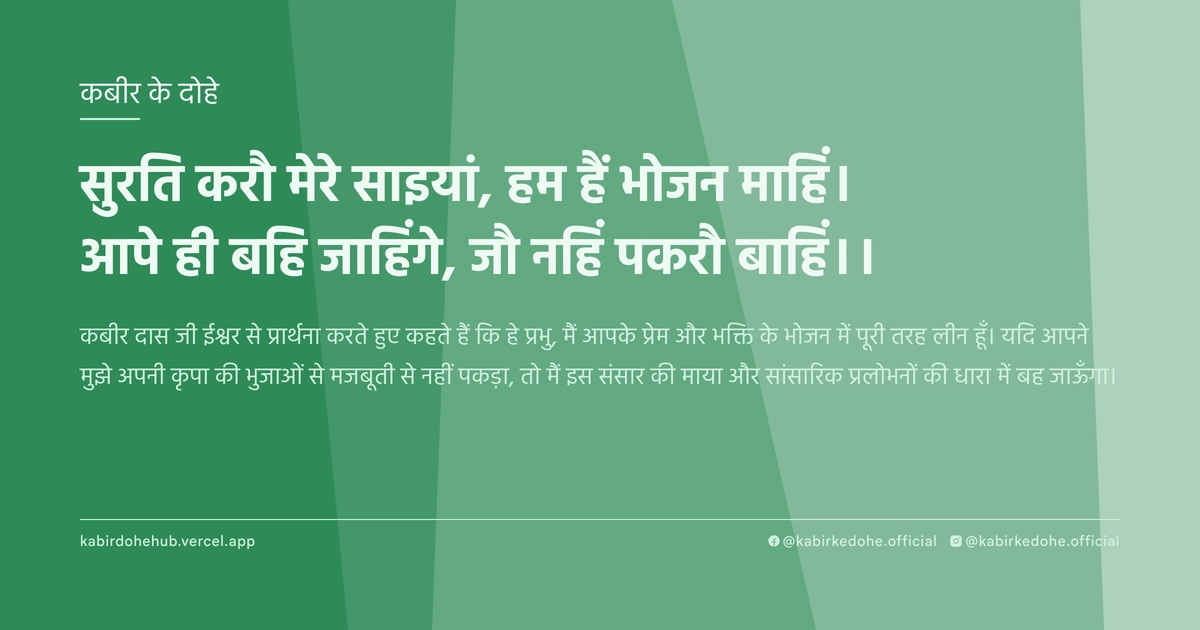
सुरति करौ मेरे साइयां, हम हैं भोजन माहिं।
आपे ही बहि जाहिंगे, जौ नहिं पकरौ बाहिं।।
Surati karau mere saiyan, hum hain bhojan mahin. Aape hi bahi jahinge, jau nahin pakrau bahin.
इस पृष्ठ पर इस कबीर दोहे का अर्थ (meaning), हिंदी व्याख्या और अंग्रेज़ी अनुवाद, दार्शनिक विश्लेषण और व्यावहारिक जीवन सीख दी गई है। यह दोहा प्रपत्ति (Surrender) विषय से जुड़ा है — Kabir doha meaning and explanation in Hindi and English.
अर्थ (Meaning):
कबीर दास जी ईश्वर से प्रार्थना करते हुए कहते हैं कि हे प्रभु, मैं आपके प्रेम और भक्ति के भोजन में पूरी तरह लीन हूँ। यदि आपने मुझे अपनी कृपा की भुजाओं से मजबूती से नहीं पकड़ा, तो मैं इस संसार की माया और सांसारिक प्रलोभनों की धारा में बह जाऊँगा।
Kabir appeals to the Divine, stating that he is immersed in the spiritual nourishment of God's love. He warns that unless the Divine holds him firmly by the arm with grace, he will inevitably be swept away by the turbulent currents of worldly illusion and ego.
व्याख्या (Interpretation):
इस दोहे का शाब्दिक अर्थ एक भक्त की अपनी विवशता की स्वीकारोक्ति है। यहाँ 'भोजन' केवल अन्न नहीं, बल्कि ईश्वरीय ज्ञान और प्रेम का प्रतीक है। कबीर 'निर्गुण भक्ति' के माध्यम से यह समझाते हैं कि आत्मा जब परमात्मा के स्वाद में लीन होती है, तब वह अपनी व्यक्तिगत पहचान खो देती है। यह 'अद्वैत वेदांत' की उस स्थिति को दर्शाता है जहाँ जीव और ब्रह्म का भेद मिट जाता है। हालाँकि, यह स्थिति अत्यंत नाजुक है; माया का वेग इतना तीव्र है कि बिना दैवीय हस्तक्षेप के अहंकार पुनः जन्म ले लेता है। 'बाहि' या भुजा पकड़ना उस 'अनुग्रह' (Grace) का प्रतीक है जो साधक को भ्रम के जाल से बाहर निकालता है। यह मानवीय अस्तित्व के उस विरोधाभास को उजागर करता है जहाँ हम मुक्त होना चाहते हैं, लेकिन हमारी अपनी इच्छाएँ हमें पुनः बंधन में डाल देती हैं।
Literally, this verse is an admission of the devotee's vulnerability. 'Bhojan' (food) here symbolizes the spiritual nourishment of divine knowledge and love. Through the lens of Nirgun Bhakti, Kabir suggests that when the soul is immersed in the taste of the Divine, it transcends its individual identity. This mirrors the Advaita Vedanta concept where the distinction between Atman and Brahman dissolves. However, this state is precarious; the current of Maya is so fierce that without divine intervention, the ego inevitably resurfaces. The act of 'holding the arm' symbolizes 'Anugraha' or Grace, the only force capable of anchoring the seeker against the tide of illusion. It highlights the central paradox of the human condition: the yearning for liberation while being perpetually pulled back by the gravity of worldly attachments.
दार्शनिक विश्लेषण (Philosophical Analysis):
कबीर का यह दोहा उस कालखंड का प्रतिनिधित्व करता है जब धर्म कर्मकांडों और बाहरी आडंबरों में जकड़ा हुआ था। कबीर ने स्पष्ट रूप से मंदिर-मस्जिद के विवादों को नकारते हुए 'सहज' मार्ग की बात की। यहाँ 'भोजन' का रूपक यह दर्शाता है कि ईश्वर कोई बाहरी वस्तु नहीं, बल्कि एक आंतरिक अनुभव है जिसे आत्मसात करना पड़ता है। यह सूफी मत के 'फना' (अहंकार का विनाश) के सिद्धांत से गहराई से जुड़ा है, जहाँ प्रेमी अपने प्रिय में इस कदर खो जाता है कि उसका अपना अस्तित्व समाप्त हो जाता है।
दार्शनिक स्तर पर, यह दोहा 'माया' की शक्ति का विश्लेषण करता है। माया वह पर्दा है जो सत्य को ढकता है। कबीर जानते थे कि केवल ज्ञान (Gyan) पर्याप्त नहीं है; जब तक हृदय में समर्पण (Bhakti) और ईश्वर की कृपा नहीं होती, तब तक बुद्धि केवल तर्क करती रहती है और वास्तव में मुक्त नहीं होती। वे जाति और वर्ण व्यवस्था के कट्टर विरोधी थे, क्योंकि उनके अनुसार आत्मा का कोई धर्म या जाति नहीं होती।
यह विश्लेषण हमें बताता है कि अहंकार का विलोपन (Annihilation of Ego) एक कठिन प्रक्रिया है। मनुष्य अक्सर सोचता है कि वह अपनी मेहनत से मोक्ष प्राप्त कर लेगा, लेकिन कबीर यहाँ 'शरणागति' (Surrender) पर जोर देते हैं। यह अद्वैतवाद का वह पहलू है जहाँ साधक यह महसूस करता है कि वह स्वयं कुछ नहीं है, बल्कि सब कुछ वह परमात्मा ही है।
सांस्कृतिक रूप से, कबीर ने समाज को यह सिखाया कि ईश्वर को पाने के लिए किसी मध्यस्थ (पुजारी या मौलवी) की आवश्यकता नहीं है। सीधा संबंध 'साधु' और 'साहिब' के बीच होता है। यह क्रांतिकारी विचार था जिसने आम जनमानस को आध्यात्मिक सशक्तिकरण दिया।
अंततः, यह दोहा मनोवैज्ञानिक रूपांतरण की बात करता है। जब व्यक्ति अपनी सीमाओं को स्वीकार करता है और पूर्णतः समर्पित होता है, तभी वह वास्तव में स्वतंत्र होता है। यह 'अहं' से 'वयं' (हम) और फिर 'तत्व' (परमात्मा) की ओर यात्रा है।
This couplet reflects an era where religion was stifled by rigid rituals and outward displays of piety. Kabir explicitly rejected the temple-mosque dichotomy, advocating for the 'Sahaja' (natural) path. The metaphor of 'Bhojan' suggests that the Divine is not an external entity to be sought, but an internal experience to be assimilated and digested into one's being. This aligns deeply with the Sufi concept of 'Fana' (annihilation), where the lover is so consumed by the Beloved that the individual self ceases to exist.
Philosophically, the verse analyzes the potency of 'Maya'. Maya is the veil that obscures the ultimate truth. Kabir posits that intellectual knowledge (Gyan) alone is insufficient; without the infusion of Grace (Anugraha) and heartfelt devotion, the mind remains trapped in logic and fails to achieve true liberation. He was a fierce opponent of caste and class hierarchies, asserting that the soul possesses no religion or social rank.
This analysis reveals that the annihilation of the ego is an arduous process. Humans often believe they can achieve salvation through sheer effort, but Kabir emphasizes 'Sharanagati' or total surrender. This is the facet of Advaita where the seeker realizes they are nothing, and everything is the Divine.
Culturally, Kabir taught that no intermediary—neither priest nor cleric—is necessary to reach God. The relationship is direct, between the seeker and the Eternal. This was a revolutionary shift that democratized spirituality for the common masses.
Ultimately, the verse speaks to a psychological transformation. Only when an individual acknowledges their inherent fragility and surrenders completely do they find true strength. It is a journey from the 'I' (Aham) to the 'We' (Vayam) and finally to the 'Absolute' (Tattva).
मूल संदेश (Core Message):
- अहंकार वह दीवार है जो हमें परमात्मा से अलग करती है।
- ज्ञान केवल दिशा दिखाता है, लेकिन कृपा ही गंतव्य तक पहुँचाती है।
- पूर्ण समर्पण ही वास्तविक स्वतंत्रता का एकमात्र द्वार है।
- स्वयं को 'कर्ता' मानना ही सबसे बड़ा आध्यात्मिक भ्रम है।
- जब 'मैं' मिटता है, तभी 'वह' प्रकट होता है।
- Ego is the wall that separates the individual from the Divine.
- Knowledge shows the direction, but Grace alone reaches the destination.
- Total surrender is the only gateway to authentic liberation.
- Believing oneself to be the 'Doer' is the greatest spiritual illusion.
- Only when the 'I' vanishes does the 'Absolute' manifest.
व्यावहारिक उदाहरण (Practical Example):
वाराणसी के एक पुराने घाट पर रामदीन नाम का एक वृद्ध नाविक रहता था। वह जीवन भर नाव चलाकर लोगों को पार लगाता रहा, लेकिन उसका अपना मन हमेशा अशांत रहता था। वह खुद को बहुत योग्य समझता था और मानता था कि उसकी मेहनत ही उसकी पहचान है।
रामदीन अक्सर अन्य नाविकों को नीचा दिखाता था, यह सोचकर कि वह उनसे अधिक अनुभवी है। उसका अहंकार उसकी सबसे बड़ी बाधा बन गया था। वह धर्म-कर्म तो करता था, लेकिन उसमें केवल दिखावा था, समर्पण नहीं।
एक दिन एक फकीर उसकी नाव में बैठा। फकीर ने देखा कि रामदीन नाव तो चला रहा है, लेकिन उसकी नजरें किनारे की भीड़ और दूसरों की प्रशंसा पर टिकी हैं। फकीर ने मुस्कुराकर कहा, 'नाविक, तू लहरों को नियंत्रित करने की कोशिश कर रहा है, जबकि तू खुद लहरों के हवाले है।'
रामदीन को यह बात चुभी। उसने तर्क दिया कि वह सबसे कुशल नाविक है। तभी अचानक गंगा में एक तीव्र भंवर उठा। रामदीन ने अपनी पूरी ताकत लगा दी, लेकिन नाव अनियंत्रित होकर बहने लगी। वह घबरा गया और पहली बार उसे अपनी लाचारी का अहसास हुआ।
उस क्षण, उसका सारा गर्व चूर-चूर हो गया। उसने महसूस किया कि उसकी कुशलता केवल एक भ्रम थी; असली शक्ति तो उस धारा की थी जिसने उसे जकड़ा हुआ था। वह चिल्लाया, 'हे प्रभु, मुझे बचा लो!'
फकीर ने शांत स्वर में कहा, 'अब तूने अपनी भुजाएं छोड़कर उसकी भुजा पकड़ने की कोशिश की है। जब तक तू खुद को कर्ता मानता था, तू डूब रहा था। अब जब तूने स्वीकार किया कि तू कुछ नहीं है, तभी तू बचेगा।'
रामदीन ने अपनी आँखें बंद कीं और पूरी तरह समर्पित हो गया। उसे महसूस हुआ कि एक अदृश्य शक्ति उसे सहारा दे रही है। वह भंवर से बाहर तो निकल आया, लेकिन उसके भीतर कुछ बदल गया था।
अब रामदीन नाव तो चलाता था, लेकिन वह खुद को 'कर्ता' नहीं मानता था। वह हर सवारी को ईश्वर का रूप मानने लगा और अपनी कुशलता का श्रेय परमात्मा को देने लगा।
उसका जीवन अब शांतिपूर्ण था। उसने सीखा कि जब हम अपनी सीमित क्षमताओं के अहंकार को छोड़कर दैवीय कृपा पर भरोसा करते हैं, तभी हम जीवन के असली भंवरों से पार पा सकते हैं।
यह 'कबीर ट्विस्ट' था—अहंकार का पूर्ण विनाश और पूर्ण समर्पण, जिसने एक अभिमानी नाविक को एक शांत साधक में बदल दिया।
On an ancient ghat in Varanasi lived an elderly boatman named Ramdeen. For decades, he ferried people across the river, yet his own mind remained turbulent. He considered himself highly capable, believing his hard work was his sole identity.
Ramdeen often looked down upon other boatmen, believing his experience made him superior. This ego became his greatest obstacle. While he performed religious rituals, they were mere displays of piety, devoid of true surrender.
One day, a wandering Sufi ascetic boarded his boat. The ascetic noticed that while Ramdeen steered the boat, his attention was fixed on the crowds on the shore and the praise of others. The ascetic smiled and said, 'Boatman, you try to control the waves, while you yourself are at the mercy of the current.'
Ramdeen took offense and argued that he was the most skilled navigator. Suddenly, a violent whirlpool erupted in the Ganges. Ramdeen exerted all his strength, but the boat became uncontrollable. Panic seized him, and for the first time, he felt his own utter helplessness.
In that moment, his pride shattered. He realized his perceived skill was a mere illusion; the true power lay in the current that now held him captive. He cried out, 'O Lord, save me!'
The ascetic said calmly, 'Now you have stopped relying on your own arms and sought the arm of the Divine. As long as you saw yourself as the Doer, you were sinking. Now that you admit you are nothing, you shall be saved.'
Ramdeen closed his eyes and surrendered completely. He felt an invisible force supporting him. He eventually emerged from the whirlpool, but something within him had shifted fundamentally.
Ramdeen continued to row his boat, but he no longer viewed himself as the 'Doer'. He began to see every passenger as a manifestation of the Divine and attributed his skill to God's grace.
His life became peaceful. He learned that when we abandon the ego of our limited capabilities and trust in Divine Grace, we can navigate the true whirlpools of existence.
This was the 'Kabir Twist'—the total annihilation of ego and complete surrender, transforming an arrogant boatman into a serene seeker.
अभ्यास मार्गदर्शन (Practice Guidance):
- दैनिक समर्पण ध्यान: प्रतिदिन 20 मिनट शांत बैठें और यह विचार करें कि आपके जीवन की हर सफलता आपकी नहीं, बल्कि एक उच्च शक्ति की कृपा है।
- आत्म-पूछताछ जर्नल: हर रात लिखें कि आज आपने कहाँ 'मैं' (अहंकार) को प्रधानता दी और कहाँ आप केवल एक माध्यम (Instrument) बने रहे।
- व्यवहारिक परिवर्तन: जब भी आप किसी की मदद करें, तो इस भाव से करें कि आप केवल ईश्वर के हाथ का एक औजार हैं, न कि कोई उपकारी।
- निदान चेकलिस्ट: यदि आप छोटी विफलताओं पर अत्यधिक क्रोधित होते हैं या सफलताओं पर अत्यधिक गर्व करते हैं, तो समझें कि आप अभी भी 'अपनी भुजाओं' के भरोसे हैं, 'उसकी भुजा' के नहीं।
- Daily Surrender Meditation: Sit in silence for 20 minutes daily, contemplating that every success in your life is not your own achievement, but the grace of a Higher Power.
- Self-Inquiry Journaling: Every night, record instances where the 'I' (ego) took precedence and moments where you acted merely as a divine instrument.
- Behavioral Shift: When helping others, consciously maintain the feeling that you are simply a tool of the Divine, rather than the benefactor.
- Diagnostic Checklist: If you feel extreme anger at small failures or excessive pride in successes, recognize that you are still relying on 'your own arms' rather than 'His arm'.
चिंतन प्रश्न (Reflection Questions):
- आपकी वह कौन सी उपलब्धि है जिसे आप पूरी तरह अपना मानते हैं? क्या वह वास्तव में आपकी है?
- जब आप दूसरों की आलोचना करते हैं, तो क्या आप वास्तव में उनकी गलती देख रहे होते हैं या अपने अहंकार का प्रतिबिंब?
- यदि आज आपकी सारी सामाजिक पहचान (पद, प्रतिष्ठा, रिश्ता) छीन ली जाए, तो आपके भीतर क्या बचेगा?
- क्या आपका 'आध्यात्मिक अभ्यास' भी आपके अहंकार को पोषण दे रहा है कि आप दूसरों से अधिक 'जागृत' हैं?
- आप किस डर से पूर्ण समर्पण नहीं कर पा रहे हैं? वह डर क्या है—नियंत्रण खोने का या अस्तित्व मिटने का?
- Which achievement do you claim entirely as your own? Is it truly yours, or a confluence of countless unseen graces?
- When you criticize others, are you seeing their flaw or merely a reflection of your own hidden ego?
- If all your social identities—rank, prestige, relationships—were stripped away today, what would remain within you?
- Is your 'spiritual practice' inadvertently feeding your ego by making you feel more 'awakened' than others?
- What is the root of your fear regarding total surrender? Is it the fear of losing control or the fear of non-existence?